Thursday, December 25, 2008

Long tail?


http://news.cnet.com/8301-1023_3-10127413-93.html

Another illustration that Search is a winner-takes-all market. This distribution can be explained by users switching their priorities for search engines. Albert-László Barabási writes in Nature ( 435, 207-211 (12 May 2005))
... the main finding is that the observed fat-tailed activity distributions can be explained by a simple hypothesis: humans execute their tasks based on some perceived priority, setting up queues that generate very uneven waiting time distributions for different tasks.
One important question to consider: what does it take for people to re-think their priorities? For example, we can see how high energy prices forced consumers to abandon gas-guzzling trucks. Other examples of massive priority shifts?

Wednesday, December 10, 2008

CNet on Dec 5, 2008:
Apple announced ... 300 million applications have been downloaded from a catalog that now tops 10,000 different apps.
Most of those applications are just an interface with the "infocloud". I wonder how difficult it would be move them to a different mobile platform. Despite all the hoopla, Microsoft and Google might not that far behind. The long-term dominance in the enterprise software space is at stake here. Any company that figures out a way to tap into mission-critical business applications will come out the strongest out of the current industry downturn.

As a side note: this would be a good example to consider in the class with regard to the 10x diagram. Specifically, students need to appreciate how Apple drives increase in user interaction with the iPhone/iPod ( the Time axis).

Tuesday, December 09, 2008

Innovation in e-tailing

Over the last week ( 12/2 - 12/9) I've been tracking Amazon's bestsellers in the HDTV category. To my surprise, I discovered that prices for most popular TV sets sold and shipped by the e-tailer fluctuate over time. For example, the price of Samsung's LN46A650 HDTV varies from $1,499.99 to $1,614 ( see the graph below).


I wonder if they run some kind of a reverse auction to maximize revenue from the holiday traffic.

Tuesday, December 02, 2008

Why PhDs voted overwhelmingly for Barak Obama in this election cycle?

One explanation would be that so far the scientific community took the biggest employment hit during this recession, therefore people voted with their wallets. For example, Monster Employment Index for the San Francisco Bay Area shows that over the last 12 months job demand in Life, Physical, and Social Sciences category fell 50% ( Oct, 07 - 121; Oct, 08 - 61).
http://corporate.monster.com/Press_Room/MEI/Oct08/DMA/MonsterLEI_SF_Oct08.pdf

Military and Maintenance/Repair jobs were among the least affected.

Monday, December 01, 2008

Winner-takes-all holiday markets

Shopping news ( amazon.com 8:04pm PST, 12/1/08):
- 9 out 10 bestsellers in the mp3/audio category are iPods;
- LCD TVs: 5 Samsung, 2 Panasonic, 2 Toshiba, 1 Sony;
- Car GPS: 5 Garmin, 2 TomTom; 2 Magellan; 1 Other;
- Car audio and speekers: totally dominated by Pioneer (9 out 10);
- Shredders are split between Fellowes and Aurora;
- All-in-one (printer/fax/copier): 7 HP, 3 Canon;
- Home/Office phones: 10 out 10 Panasonic

If you are a #3, you are nobody.

Sunday, November 30, 2008

Cloud Computing and HD Television

The benefits of cloud computing to mobile devices and smart phones has been discussed at length in the industry press. What's been missing is a discussion about the impact of Cloud Computing on High Definition TV. Today, most of HDTV sets, even those with highest screen resolutions, act as dumb terminals incapable of providing users with multi-application multi-window experiences. Cloud Computing can address this "dumbness", provided TV makers figure out a way to accommodate multiple inputs on the screen and give users free-hand navigation devices, similar to vii remote or, to go further, enable touchscreen phones work as mousepads.
What's the incentive for TV manufacturers to do all this work? First of all, it will give them a relatively easy way to differentiate their devices. Secondly, getting a larger TV set would make a lot more sense for users who want to access multiple apps/feeds at the same time. TV and news shows are not as immersive as movies. Packing more information on that 60-inch screen would make TV experience much more tolerable.

Tuesday, November 25, 2008

A good paper by Ronald S. Burt on brokerage-based innovation model:
Brokerage across the structural holes between groups provides a vision of options otherwise unseen, which is the mechanism by which brokerage becomes social capital.
The organization is rife with structural holes, and brokerage has its expected correlates. Compensation, positive performance evaluations, promotions, and good ideas are disproportionately in the hands of people whose networks span structural holes. The between-group brokers are more likely to express ideas, less likely to have ideas dismissed, and more likely to have ideas evaluated as valuable.

People connected to groups beyond their own can expect to find themselves delivering valuable ideas, seeming to be gifted with creativity. This is not creativity born of genius; it is creativity as an import-export business. An idea
mundane in one group can be a valuable insight in another.

A positive side effect for an enterprise-wide social network could be a clear map of structural holes within the organization. By analyzing connections between groups and people we could identify most valuable avenues for internal and external innovation. Especially so, if the company's suppliers and customers can be viewed/represented as a part of the network.

Monday, November 24, 2008

Cnet, among others, reports on RPX,
a San Francisco-based start-up, calls itself a "defensive patent aggregator." The company plans to buy available patents to keep them out of the hands of "patent trolls," or firms that obtain patents for the purpose of suing other companies for royalties or licensing fees.

RPX will sell memberships to companies for a fixed annual fee that could range from $35,000 to $4.9 million, depending on the member company's operating income. For the price of the annual membership, companies will receive the patent licenses purchased by RPX. The Wall Street Journal reported that Cisco Systems and IBM have already signed up.

Several considerations seem to be important here:
1. Third-party management of patent risks is becoming a legitimate business model.
2. The market for patents is going to be more liquid, i.e. it will be easier to buy and sell patents.
3. Deverticalization of the innovation supply chain will accelerate.
4. In the long run, people will start looking for process improvements, i.e. better, more efficient ways to create inventions.
5. Patent evaluation methods will have to improve dramatically too.

Tuesday, November 04, 2008

Who is going to win this battle of technologies?

Battle of technologies:

Laser fruit "stickers" vs regular fruit labels.

The conventional ones are high resolution, wear-tear resistant, and easy to use.
Have you noticed the little "brand" stickers on your bananas, apples, peaches, pears, mangos, kiwi, and other seasonal fruits?
The number on that little sticker, not only is the price look number, it also tells how the product is grown or created. This has made news recently with the release of the new rules for "organic" labeling. For conventionally grown fruit, the PLU code on the sticker consists of four numbers. Organically grown fruit have a five-numeral PLU beginning with the number 9. Genetically engineered fruit has a five-numeral PLU beginning with the number 8.

But the laser "stickers" are coming:
A growing number of produce packers and distributors are experimenting with natural-light labeling, a new process that uses a laser to etch identifying information (country of origin, variety, etc.) into the skins of fruits and vegetables without bruising or causing other damage.

Sunday, November 02, 2008

Cnet on Microsoft's strategic move into cloud computing:
Microsoft also now understands that its platform must span every kind of device--PC, notebook, smartphone, car, home, etc.--and offline scenarios. Microsoft missed the Web search revolution, but it's not going to miss out on the much bigger revolution--the move to the cloud over the next two decades.

Google is building a competing ecosystem from the ground up with similar characteristics and a desire to attract millions of developers. Amazon is pushing its elastic computer cloud, and Rackspace, EMC, IBM, and many other companies are trying to get a piece of the action. Most the cloud companies are focused on hosting services, but the biggest piece will be platforms-as-a-service with developers creating and running their applications for on a cloud operating system.

Microsoft's best shot would be to go after the enterprise market. They can leverage MS Office installed base and enable access to shared documents and applications for smartphones, netbooks, laptops, etc. The enterprise market is a better business target because it allows Microsoft to move away from the ad-supported model where Google dominates.
As we discussed in the class last spring, the battle for the back-end, i.e. the cloud, is the next step in technology-business evolution of computing. Proliferation of smartphones, spurred by iPhone, is going to accelerate user adoption.

p.s. I wish blogger would allow me to draw diagrams!

Saturday, November 01, 2008

Americans becoming more obese. This paper by Harvard economists David M. Cutler, Edward L. Glaeser and Jesse M. Shapiro highlights the "control" aspects of the problem. As in the cases of information overload or personal asset management or company growth, the ability to orchestrate the flow of goods and services is absolutely critical to the overall success of the system. Its control function or the lack of thereof tends to become the most important limiting or even harmful factor.
While the medical profession deplores the increase in obesity, the standard economic view is the opposite. Lower prices for any good – either monetary or time costs – expand the budget set and make people better off. But self-control issues complicate this interpretation. If people have difficulty controlling how much they eat, lowering the time costs of food consumption may exacerbate these problems. Certainly, the $30-$50 billion spent annually on diets testifies to the
self-control problems that many people face. In the last part of the paper, we consider the welfare implication of lower food production costs in a model where individuals have self-control problems. Such a model helps explain why the increases in weight have been biggest at the upper end of the weight distribution, where self-control problems are the most severe.

A good exercise for the The Magicians and Reverse Brainstorm. A long-term trend/process frames behavior of the system.

Monday, October 20, 2008

A good post by Steve Waldman on financial innovation:
(e.g. good)
* Exchange-traded funds
* The growth of venture capital and angel investing
* The democratization of access to financial information (e.g. Yahoo! finance)
* The democratization of participation in financial markets (e.g. the growth of internet and discount brokerages that offer easy access to a wide variety of stocks, bonds, and exchange-traded derivatives, both domestic and international).

(and bad)
[*] CDOs, and etc.
* 401-K plans with limited investment menus
*
* The conventional wisdom that long-term savings ought by default be placed in passive stock funds
* The conflation of ordinary saving and financial return seeking
* The tolerance, advocacy, and subsidy of financial leverage throughout the economy
* The move towards large-scale, delegated, and professionalized of money management
* The growth of investment vehicles accessible primarily or solely to professional and institutional investors

I'll come back to discuss it in more detail.

Dilemma of the Day

As an inventor you want to create a snob effect, i.e. to find an exclusive path (solution) in a problem space.

As an innovator you want to create a bandwagon effect, i.e. to find a most common path in the problem space.

Sunday, October 19, 2008

on October 1, 1908, to be exact--that Ford Motor built the very first of the iconic gasoline-powered automobiles to be sold. By the time formal production halted in May 1927, more than 15 million had been built, and American lives and landscapes had been set on a very new road.

One of the few instances in the history of technology when product and process innovation went hand in hand. ( a shift to the left on the graph below).

Thursday, October 16, 2008

Cloud computing: emerging trade-off

Pew Research issued a research note on cloud computing.

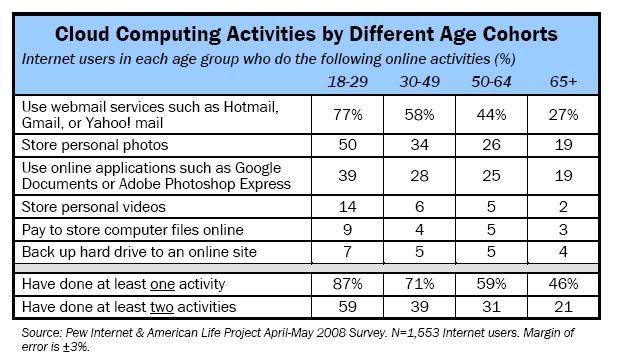
So far, web-based e-mail has emerged as a dominant application. 77% among 18-29 year-olds use it on a regular basis. Personal photos is a close second.


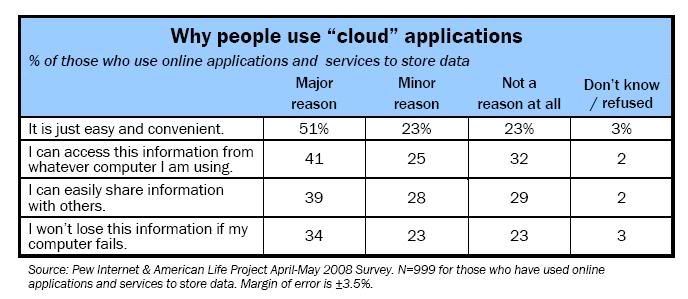
I am surprised, though, that gaming is not on the radar. It's not clear whether this is a gap in the study, or a sign of low demand. In general, my impression is that "cloud computing" is not about computing. Rather, the cloud plays the role of a convenient remote storage for "communicatable" information ( e-mail, photos, common files).
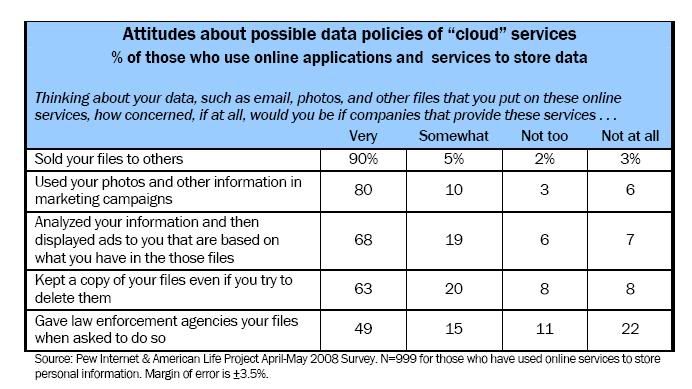
In addition to that, a clear trade trade-off between convenience and privacy shows up in the data.

vs


On the other hand, people do use online banking extensively, which means that privacy concerns are probably based on an unclear business model ( why there's free lunch in the cloud?), rather than a technology issue.

Monday, October 13, 2008


I find this optical illusion - young girl or old hag - a good metaphor for inventive thinking. As an inventor you've got to be able to see both, old and new, in the technology you are trying to improve, disrupt, or displace. You need to understand how a recipe for success in the old world picture became a recipe for disaster in the new world. What are the useful features that you need to preserve in your future solution? What are the harmful factors that have to be overcome? If you don't the both sides of the innovation equation, the path to creative destruction can rather quickly become a road to self-destruction.

Friday, October 10, 2008

CNet reports on the dire financial situation for startups and VCs:


High-tech innovation in the US will decrease dramatically during the next two years.

Sunday, September 28, 2008

Technology-Market revolution as it happens

bloomberg.com reports:
MidAmerican, a unit of Buffett's Berkshire Hathaway Inc., said on Sept. 27 it agreed to invest HK$1.8 billion ($232 million) to buy about 10 percent of BYD Co., citing the parent's focus on environmental products. The U.S. billionaire was attracted by the Shenzhen, south China-based company's ``strong position'' in the development of batteries used in electric vehicles, according to JPMorgan Chase & Co. analyst Charles Guo.
 Battery technology is key to breaking the old "efficiency vs road performance" trade-off for electric cars. Buffet's bet signifies a major upheaval in the automotive industry and around it: car design, infrastructure, oil consumption, services, electricity generation, and etc. This is also a very good indicator that global warming can and will be avoided.

Watermellon cubes

 
BBC News writes about Japanese cuboid watermelons.  The unusual shape was thought up by enterprising farmers to lower the storage and transportation costs. Well, they did not succeed in that department, but square watermelons found their way to upscale grocery shops:
Here in California you can buy a traditional green-black-red spheroid for no more than $10.  What a bargain!