Showing posts with label prediction. Show all posts

Wednesday, July 24, 2013

Sisyphus 2.0: predicting the future is easy.

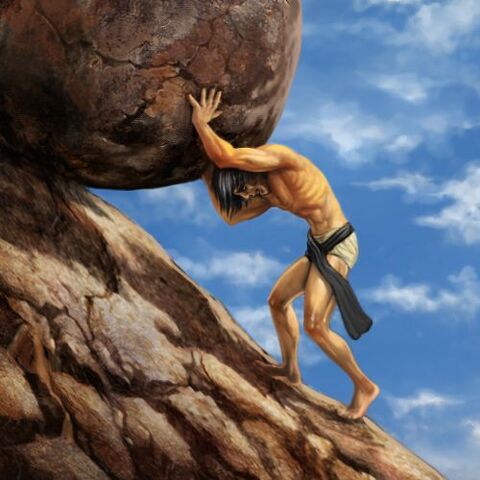
Despite all the technological change, our daily lives are quite similar to that of Sisyphus, a character from an ancient Greek myth. As a punishment, the gods condemned him to" roll an immense boulder up a hill, only to watch it roll back down, and to repeat this action forever."


A research paper from Microsoft shows that а modern person's future is highly predictable:
It turns out that no matter how spontaneous we think we are, humans are actually quite predictable in our movements, even over extended periods of time. Not only did Far Out predict with high accuracy the correct location of a wide variety of individuals, but it did so even years into the future.
The researchers note that frequently visited locations can be further linked to people's actions. One could reasonably guess that people who happen to be at the same location do similar things. As a result, knowing what one person does on a regular basis helps predict what other people do on a regular basis. Quite likely, companies like Google, with access to lots of user data, will soon be able to predict (among other things) a country's economic activity better than the government statistics.


tags:  process, creativity, prediction, mobile, aboutness


Sunday, July 15, 2012

Predicting 30-year tech cycles.

 MIT TR on, presumably, predicted death of PC:
An interesting post from tech commentator Robert X. Cringely reveals how he predicted the death of the personal computer back in 1992, in his book Accidental Empires. He called the death for right about... now.

His logic, based on history, was that transformative information technologies take 30 years to essentially be digested by society. It took three decades before moveable type led to books. It took three decades before telephones truly began to permeate and transform our lives. Similarly, film was born in the last years of the 19th century but only took off in the 1920s, and TV was invented in the 1920s but didn’t really take off until the 1950s.
 Here, I agree John Geanokoplos, a professor of economics at Yale, that unconditional predictions are shots in the dark. Because there are so many unknowns, esp. at the macro level, that it's much more prudent to work on developing and tracking alternative future scenarios.

tags: s-curve, technology, method, prediction

Sunday, June 06, 2010

Schools and Creativity

A 2006 TED talk by Ken Robinson. Sir Ken is a brilliant speaker and he raises an important issue of how children are taught to dull their creativity in school.

Friday, August 28, 2009

Dilemma of the Day: predicting the future.

I am reading Blue Ocean Strategy, by W.C. Kim and Renee Mauborgne. It's a good book, full of interesting business intuitions and anecdotes, but contradictory statements, like the two below, leave me sometimes puzzled:

We're not talking about predicting the future, something that is inherently impossible. p.76.

Visualizing strategy can also help managers responsible for corporate strategy predict and plan the company's future growth and profit. p.96.

On one hand, the future is inherently unpredictable; on the other, here's a visualization tool that helps you do exactly that. Huh?

I guess they mean that future is probabilistic. Some predictions can be made with a greater degree of confidence than others. For example, I can rather confidently predict that 50 years from now, unless humanity perishes in a cataclysmic event, we will use electricity to satisfy our basic energy needs. We will use money in commercial transactions. We will have developed genetic techniques to treat diseases that seem to be untreatable today. Etc, etc.

On the other hand, I can't predict with sufficient accuracy whether Apple as a company will survive these 50 years; who who will be its new CEO, and what the change in leadership is going bring. My hunch, though, is that he or she will still be human and make contradictory statements like the ones in the Blue Ocean book.

Wednesday, August 26, 2009

The imminent death of printing is a really good news for trees.

Monday, May 19, 2008

The Promise of Prediction Markets article in Science magazine makes a point that over time people get better at forecasting event outcomes ( see the graph below).


But we can turn this argument on its head and say that while crowds are generally good at predicting short-term events, they are not that great in predicting long-term outcomes. Furthermore, the farther the crowds are removed from an event, the worse their accuracy rate is. It is the job of inventors/innovators, not the crowds, to not only predict the future, but also make it happen. Truly great innovators, like Edison, Disney, Moore, Gates, and Jobs, have the ability to lead the crowds onto "predicting" the success of their innovations.