A small pilotless vehicle manufactured by Honeywell International, capable of hovering and "staring" using electro-optic or infrared sensors, is expected to be introduced soon in the skies over the Florida Everglades.
If use of the drone wins U.S. Federal Aviation Administration approval after tests, the Miami-Dade Police Department will start flying the 14 pound, or 6.35 kilogram, drone over urban areas with an eye toward full-fledged employment in crime fighting.
"Our intentions are to use it only in tactical situations as an extra set of eyes," said Detective Juan Villalba, a police department spokesman.
He acknowledged strong interest from law enforcement agencies in getting drones up and running, however, and said the smaller aircraft were particularly likely to have a "huge economic impact" over the next 10 years.
Friday, March 28, 2008
The march to add spy drones to local law enforcement arsenal continues:

Tuesday, March 25, 2008
Strategy as a set of trade-offs
Defining the objective, scope, and advantage requires trade-offs, which Porter identified as fundamental to strategy. If a firm chooses to pursue growth or size, it must accept that profitability will take a back seat. If it chooses to serve institutional clients, it may ignore retail customers. If the value proposition is lower prices, the company will not be able to compete on, for example, fashion or fit. Finally, if the advantage comes from scale economies, the firm will not be able to accommodate idiosyncratic customer needs. Such trade-offs are what distinguish individual companies strategically.Harvard Business Review, April 2008, p. 85.
Invention of a new business model usually breaks through an "unavoidable" trade-off. For example, Google and Amazon.com found ways to get around the scale vs. customization trade-off. Hotel chains solved institutional vs retail, and etc. Companies that define themselves as a trade-off maintainer are prone to disruptions from their more innovative peers.
Thursday, March 20, 2008
Scientific American proposes a grand scheme for solar power:
While British researchers see environmental dangers everywhere, except in massive installations of solar panels:
Solar energy’s potential is off the chart. The energy in sunlight striking the earth for 40 minutes is equivalent to global energy consumption for a year. The U.S. is lucky to be endowed with a vast resource; at least 250,000 square miles of land in the Southwest alone are suitable for constructing solar power plants, and that land receives more than 4,500 quadrillion British thermal units (Btu) of solar radiation a year. Converting only 2.5 percent of that radiation into electricity would match the nation’s total energy consumption in 2006.
To convert the country to solar power, huge tracts of land would have to be covered with photovoltaic panels and solar heating troughs. A direct-current (DC) transmission backbone would also have to be erected to send that energy efficiently across the nation.
The technology is ready. On the following pages we present a grand plan that could provide 69 percent of the U.S.’s electricity and 35 percent of its total energy (which includes transportation) with solar power by 2050. We project that this energy could be sold to consumers at rates equivalent to today’s rates for conventional power sources, about five cents per kilowatt-hour (kWh). If wind, biomass and geothermal sources were also developed, renewable energy could provide 100 percent of the nation’s electricity and 90 percent of its energy by 2100.
While British researchers see environmental dangers everywhere, except in massive installations of solar panels:
the great environmental concerns of the future should be nanomaterials, manmade viruses and biomimetic robots.
So say researchers, policymakers and environmental campaigners, who have identified 25 potential future threats to the environment in the UK, which they say researchers should focus on.
In addition to well-publicised risks such as toxic nanomaterials, the acidification of the ocean and increasingly frequent extreme weather events, the list includes some more outlandish possibilities. These include:
• Biomimetic robots that could become new invasive species.
• Experiments involving climate engineering, for instance ocean 'fertilisation' and deploying solar shields
• Increased demand for the biomass needed to make biofuel.
• Disruption to marine ecosystems caused by offshore power generation.
• Experiments to control invasive species using genetically engineered viruses.
Paul Lockhart writes:
This is a big problem with education in general. Students are not taught to look for cool open-ended problems. Inventiveness and creativity are presented as simple puzzle-solving exercise, where answers are known before hand and are really easy to test against.
The main problem with school mathematics is that there are no problems. Oh, I know what
passes for problems in math classes, these insipid “exercises.” “Here is a type of problem. Here is how to solve it. Yes it will be on the test. Do exercises 1-35 odd for homework.” What a sad way to learn mathematics: to be a trained chimpanzee.
This is a big problem with education in general. Students are not taught to look for cool open-ended problems. Inventiveness and creativity are presented as simple puzzle-solving exercise, where answers are known before hand and are really easy to test against.
Wednesday, March 12, 2008
Dilemma of the Day
Economist Paul Romer:
So with ideas, you have this tension: You want high prices to motivate discovery, but you want low prices to achieve efficient widespread use.
Wednesday, February 20, 2008
Trade-off of the Day
 These strategies reflect an underlying tension when the forces of innovation meet up with network externalities: is it better to wipe the slate clean and come up with the best product possible ( revolution) or to give up some performance to ensure compatibility and thus ease consumer adoption (evolution)?
 You can increase performance at the cost of increasing customer switching costs, or vice-versa. Ideally, you would like to have an improved product that is also compatible with the installed base, but technology is usually not so forgiving, and adapters and emulators are notoriously buggy. You will inevitably face the trade-off.
Shapiro, C. and Varian H.R. 1998. Information Rules. Boston: HBSP. p. 191
Monday, February 18, 2008
Trade-off of the Day

"When choosing terms and conditions, recognize the basic trade-off: more liberal terms and conditions will tend to raise the value of your product to consumers but may reduce the number of units sold."
Shapiro, C. and Varian H.R. 1998. Information Rules. Boston: HBSP. p. 103.
Saturday, February 09, 2008
A Bloomberg article about possible Microsoft Yahoo merger:
What a way for Google to get rid of all competition in the search technology! A very smart move because it could potentially deny Microsoft access to a high quality search engine. If that happens the Yahoo acquisition does not make sense for Microsoft at all.
The New York Times reported Feb. 4 that Google CEO Eric Schmidt contacted Yang to suggest a partnership between their companies. A partnership with Google may allow Yahoo to outsource its search service, shedding the costs of running its own search engine and sharing ad revenue with its larger rival.
What a way for Google to get rid of all competition in the search technology! A very smart move because it could potentially deny Microsoft access to a high quality search engine. If that happens the Yahoo acquisition does not make sense for Microsoft at all.
A CNN article about Osprey, a plane-helicopter hybrid:
Another indicator that helicopters are going to yield the scene to other flying apparatuses, like ospreys and drones.
The Osprey, which takes off and lands like a helicopter but flies like a plane, was designed to replace the Corps' aging and less-capable helicopter fleet.
The military, which has ordered 360 of the aircraft, said the 10 deployed to Iraq are doing what they are supposed to do -- carrying troops faster, farther and safer than the copters can.
In December, commanders gave the planes a more risky mission called "aero-scout" in which a group of V-22s flies into a relatively unsecured location and drops off Marines for a search mission.
The Osprey seems to have become a favorite of commanders who need to get to places quickly, including Gen. David Petraeus, the top U.S. military commander in Iraq. Petraeus used one to fly around the country on Christmas Day to visit troops.
"Gen. Petraeus flew in the jump seat and was very impressed by the aircraft's capabilities," according to Col. Steve Boylan, a spokesman for the general.
"The rate of climb is exceptional, and it can fly about twice as fast as a Black Hawk [helicopter], without needing to refuel as frequently," Boylan said. "Beyond that, its automatic-hover capability for use in landing in very dusty conditions, even at night, is tremendous."
Petraeus chose the Osprey for that mission because it was the only aircraft in the inventory that could fly around the country without refueling and not rely on runways, Boylan said.
Another indicator that helicopters are going to yield the scene to other flying apparatuses, like ospreys and drones.
Friday, January 25, 2008
The "Aha!" moment.
Scientific American:
People who are better aware of their problem-solving strategies are less likely to experience surprise at the moment of discovery. I've seen it over and over again in invention workshops. Clueless people have a lot of "wonderful discoveries" during brainstorming sessions, but the end result often is not that interesting.
At the end of each trial, subjects reported whether or not they had a strong "Aha!" moment. Interestingly, researchers found that subjects who were aware that they had found a new way to tackle the problem (and so, had consciously restructured their thinking) were less likely to feel as if they'd had eureka moment compared to more clueless candidates.
People who are better aware of their problem-solving strategies are less likely to experience surprise at the moment of discovery. I've seen it over and over again in invention workshops. Clueless people have a lot of "wonderful discoveries" during brainstorming sessions, but the end result often is not that interesting.
Sunday, December 30, 2007
12/29/07 many news agencies picked up analysis provided by research firm Basex, which chose "information overload" as its 2008 "Problem of the Year."
We should probably add to it calorie-, TV-, guns-, and other overloads that we've been suffering for years now. Though, I am yet to hear anything about vacation overload :)
Many Americans share this concern. In a 2007 Pew survey, 49 percent of Americans described themselves as having "few tech assets" and said that constant connectivity was an annoyance, not a liberation.
But young people don't seem to have (yet, anyway) developed the same sense of aggravation toward technology that forces them to multitask. Many choose to do so, in fact. The Kaiser Family Foundation found in a study this year that most junior high and high school students train themselves early in the dark arts of multitasking, with most listening to music or watching TV while they read books or surf the Internet. 30 percent of students even multitask while doing their homework.
Will these students feel the multitasking pinch when they grow up to become the new generation of "knowledge workers," or will constant exposure to interruptions make them more adept at handling the massive torrent of information that flows through modern computers and cell phones? Or is the "do more things at once philosophy" simply a dead end that produces only monstrosities, like the Internet-connected refrigerator we've heard so much about?
We should probably add to it calorie-, TV-, guns-, and other overloads that we've been suffering for years now. Though, I am yet to hear anything about vacation overload :)
Friday, December 28, 2007
12/27/07 News Agencies
Chinese cities are reaching growth limits.
Beijingers were warned to stay indoors on Thursday as pollution levels across the capital hit the top of the scale, despite repeated assurances by the government that air quality was improving.
"This is as bad as it can get," a spokeswoman for the Beijing Environmental Protection Bureau told AFP.
"Level five is the worst level of air pollution. This is as bad as it has been all year."
According to the bureau's website, 15 out of the 16 pollution monitoring stations in urban Beijing registered a "five" for air quality rating.
The main pollutant was suspended particulate matter, which is usually attributed to coal burning and automotive exhaust.
Chinese cities are reaching growth limits.
12/28/27 Reuters:
Buffet's risk profile fits the one of a risk-taker, while in reality his larger-than-life bets decrease risks because they enable him to shape the situation. He always buys control, not risk. He times his purchases so that his ability to control the developments in the industry is at a maximum. For example, now everybody is out of cash and he can come in and define his new rules for the game.
Warren Buffett's Berkshire Hathaway Inc (BRKa.N) (BRKb.N) is starting a bond insurer that would help state and local governments lower their borrowing costs, and is likely to lure business from established rivals struggling with credit market turmoil.
Buffett, often called the world's greatest investor, is known for taking large business and investment risks.
He has said, for example, that Berkshire is willing to suffer a $6 billion insurance loss on a single storm. The company was able to boost premiums following Hurricane Katrina after weaker rivals reduced underwriting risk.
Buffet's risk profile fits the one of a risk-taker, while in reality his larger-than-life bets decrease risks because they enable him to shape the situation. He always buys control, not risk. He times his purchases so that his ability to control the developments in the industry is at a maximum. For example, now everybody is out of cash and he can come in and define his new rules for the game.
Kinsey Steven G., Bailey Michael T., Sheridan John F., Padgett David A., The Inflammatory Response to Social Defeat is Increased in Older Mice, Physiology & Behavior (2007), doi: 10.1016/j.physbeh.2007.11.003
These findings relate to the problem we considered during the Summer 2006 Principles of Invention course: physical injures cause older people disproportionate amount of suffering, and often are a precursor to a downward health spiral.
As seen previously in young adult mice, social defeat caused an increase in anxiety-like behavior in the open field test, but had no effect on learned helplessness in the forced swim test. These data indicated that repeated social defeat results in a proinflammatory state that is exacerbated in older mice. The implications of these data are noteworthy, given the strong role of inflammation in many age-related diseases.
These findings relate to the problem we considered during the Summer 2006 Principles of Invention course: physical injures cause older people disproportionate amount of suffering, and often are a precursor to a downward health spiral.
12/28/07 By JEANNINE AVERSA, AP Economics writes:
A very interesting trend. People will be spending less money on housing and loan servicing, and probably more on staples, entertainment, and communications.
New-home sales tumbled 9 percent in November from October to a seasonally adjusted annual sales pace of 647,000, the Commerce Department reported Friday. That was the worst sales pace since April 1995.
"It was ugly," declared Richard Yamarone, economist at Argus Research. "It is the one sector of the economy that doesn't show any signs of life. It doesn't look like there is any resuscitation in store for housing over the next year," he said.
The housing picture turned out to be more grim than most anticipated. Many economists were predicting sales to decline by 1.8 percent to a pace of 715,000.
By region, sales fell in all parts of the country, except for the West.
In the Midwest, new-home sales plunged 27.6 percent in November from October. Sales dropped 19.3 percent in the Northeast and fell 6.4 percent in the South. In the West, however, sales rose 4 percent.
Over the last 12 months, new-home sales nationwide have tumbled by 34.4 percent, the biggest annual slide since early 1991, and stark evidence of the painful collapse in the once high-flying housing market.
"I think you can classify what we are seeing in the housing market as a crash," said Mark Zandi, chief economist at Moody's Economy.com. "Sales and home prices are in a free fall. The downturn is intensifying."
A very interesting trend. People will be spending less money on housing and loan servicing, and probably more on staples, entertainment, and communications.
Monday, December 10, 2007
Seth Godin talks about his newest book "All Marketers are Liars".
02:50 into the video he says: "Technology gives you a shot at marketing".
This is control point of the first kind: "remarkable product", i.e. something that gets you a foot in the market's door. Two more control points to go: ... still need to find good words to describe them.
Saturday, December 08, 2007
Why do some theaters innovate more than others?
An Empirical Study. Paul Dimaggio and Kristen Stenberg. Poetics, Volume 14, Issues 1-2, April 1985, Pages 107-122.
Market breeds conformity. Very similar to ideas expressed in Christensen's "Innovator's Dilemma": one one hand you have to listen to your customers, because they pay your money; on the other hand you don't want to listen to them, because they do not know what they are going to need tomorrow.
Abstract
The authors develop a measure of the ‘innovativeness’ of the repertoires of U.S. resident nonprofit theatres and test hypotheses about the relationship between environmental and organizational factors and innovation. Access to potential patrons rich in cultural capital appears to make theatre repertoires more innovate, while dependence upon the market (as opposed to grants and contributions) is associated with greater conformity of repertoire. Theatres with smaller budgets to maintain, fewer seats to fill, and less need for earned income are less conformist in their programming than are large theatres with capacious houses and high rates of earned income. Holding size and dependence on earned income constant, there is no evidence that age, structural differentiation, or the presence of subscription audiences—all associated with ‘institutionalization’ – have either a negative or a positive impact on innovation. New York theatres innovate more, and are less negatively affected by growth and the market, than theatres elsewhere in the U.S. It is suggested that artistic innovation has come to depend overwhelmingly on the behavior of formal organizations and that, consequently, we must understand the principles that govern the relationship of such organizations to their economic and social environments in order to understand artistic change.
Market breeds conformity. Very similar to ideas expressed in Christensen's "Innovator's Dilemma": one one hand you have to listen to your customers, because they pay your money; on the other hand you don't want to listen to them, because they do not know what they are going to need tomorrow.
The question of technology
Prof. Hubert L.Dreyfus writes
I think I am getting close to answering this question. The key is to consider various aspects of the innovation process and determine pathways through which we become devastated or enslaved by technology.
We start by thinking about technology as an evolving system of interacting elements. The devastation occurs when on a certain step of the system evolution we, without realizing the consequences, become objects of control rather its subjects.
Consider iPod.
When we buy one in a store on or on the internet, we acquire not just the device itself, but also cables, iTunes software, automatic connections to iTunes internet service, and, finally, a certain way to interface with media devices. We say we by an iPod, but in reality, we pay for one thing, specifically a piece of hardware, but acquire a whole system of elements and relationships that has products, services, and processes built into it.
The enslavement begins in this cognitive gap between "pay money for" and "acquire" which we tend to hide from ourselves by using just one word "buy".
In order to enjoy our purchase, we have to plug ourselves into a technology, which is being continuously developed by Apple corporation. In other words, we become a part of Apple technology - a living, breathing, consuming, paying part, capable of acquiring further products, services, processes, and, ultimately, led to the next Apple technology.
References.
1. Reinventing the Wheel: A Buddhist Response to the Information Age", by Peter D. Hershock.
2. H.L.Dreyfus (above)
3. Faïz Gallouj, 2002, Innovation in services and the attendant old and new myths. Journal of Socio-Economics, Volume 31, Issue 2, 2002, Pages 137-154.
4. Jeffrey A. Martin and Kathleen M. Eisenhardt, 2004, COPING WITH DECLINE IN DYNAMIC MARKETS: CORPORATE ENTREPRENEURSHIP AND THE RECOMBINATIVE ORGANIZATIONAL FORM. Advances in Strategic Management, Volume 21, 2004, Pages 357-382
5. Jonathan D. Lintona, and Steven T. Walsh, 2007, A theory of innovation for process-based innovations such as nanotechnology, Technological Forecasting and Social Change ( Article in press).
How can we relate ourselves to technology in a way that not only resists its devastation but also gives it a positive role in our lives? This is an extremely difficult question to which no one has yet given an adequate response, but it is perhaps the question for our generation.
I think I am getting close to answering this question. The key is to consider various aspects of the innovation process and determine pathways through which we become devastated or enslaved by technology.
We start by thinking about technology as an evolving system of interacting elements. The devastation occurs when on a certain step of the system evolution we, without realizing the consequences, become objects of control rather its subjects.
Consider iPod.
When we buy one in a store on or on the internet, we acquire not just the device itself, but also cables, iTunes software, automatic connections to iTunes internet service, and, finally, a certain way to interface with media devices. We say we by an iPod, but in reality, we pay for one thing, specifically a piece of hardware, but acquire a whole system of elements and relationships that has products, services, and processes built into it.
The enslavement begins in this cognitive gap between "pay money for" and "acquire" which we tend to hide from ourselves by using just one word "buy".
In order to enjoy our purchase, we have to plug ourselves into a technology, which is being continuously developed by Apple corporation. In other words, we become a part of Apple technology - a living, breathing, consuming, paying part, capable of acquiring further products, services, processes, and, ultimately, led to the next Apple technology.
References.
1. Reinventing the Wheel: A Buddhist Response to the Information Age", by Peter D. Hershock.
2. H.L.Dreyfus (above)
3. Faïz Gallouj, 2002, Innovation in services and the attendant old and new myths. Journal of Socio-Economics, Volume 31, Issue 2, 2002, Pages 137-154.
4. Jeffrey A. Martin and Kathleen M. Eisenhardt, 2004, COPING WITH DECLINE IN DYNAMIC MARKETS: CORPORATE ENTREPRENEURSHIP AND THE RECOMBINATIVE ORGANIZATIONAL FORM. Advances in Strategic Management, Volume 21, 2004, Pages 357-382
5. Jonathan D. Lintona, and Steven T. Walsh, 2007, A theory of innovation for process-based innovations such as nanotechnology, Technological Forecasting and Social Change ( Article in press).
Friday, December 07, 2007
Voter fraud detection in Russian elections
gaika on slashdot writes
A fraud detection problem has been solved. There's a strong indication that election laws were broken. The Systematic Innovation theory predicts that within an unconstrained system the next step would be activation of the "control" element, capable of addressing the abnormality. For example, in a country with independent press and/or judiciary an investigation and, possibly, a lawsuit would follow.
Now, I wonder what is going to happen with this discovery in Putin's Russia. In my opinion, there are several ways the situation can unfold:
1. Nothing happens. The government and the press ignores this information.
2. Strong negative reaction. The findings are suppressed and steps are taken to discredit the authors of the study.
3. A weak positive reaction. An independent investigation is initiated and it produces a credible explanation of the events.
4. A strong positive reaction. A government investigation is launched and it produces a credible explanation of the events.
4a. same as 4, but the government doesn't find anything suspicious.
Depending on the outcome, we'll be able to see which "control" mechanisms are the strongest, and which ones are entirely missing.
For comparison: Voting results in Canada.
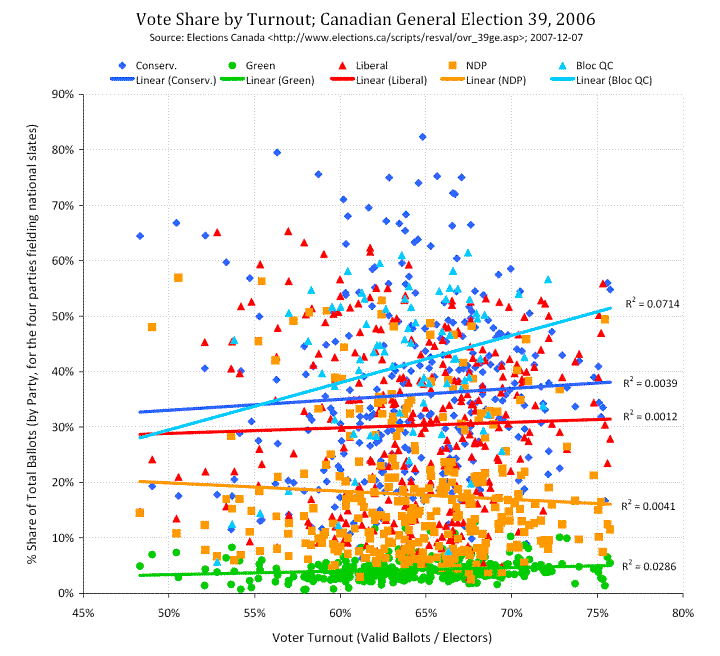
"A graph in the best traditions of Edward Tufte shows how the voting was rigged in Russian parliament elections. Initially some regions were showing higher than 100% attendance, but later on everything was corrected, or way too much corrected, as the correlation between winning party's vote and attendance now stands at 90%. I guess the people who have rigged the vote have never heard about Correlation Cofficient."

A fraud detection problem has been solved. There's a strong indication that election laws were broken. The Systematic Innovation theory predicts that within an unconstrained system the next step would be activation of the "control" element, capable of addressing the abnormality. For example, in a country with independent press and/or judiciary an investigation and, possibly, a lawsuit would follow.
Now, I wonder what is going to happen with this discovery in Putin's Russia. In my opinion, there are several ways the situation can unfold:
1. Nothing happens. The government and the press ignores this information.
2. Strong negative reaction. The findings are suppressed and steps are taken to discredit the authors of the study.
3. A weak positive reaction. An independent investigation is initiated and it produces a credible explanation of the events.
4. A strong positive reaction. A government investigation is launched and it produces a credible explanation of the events.
4a. same as 4, but the government doesn't find anything suspicious.
Depending on the outcome, we'll be able to see which "control" mechanisms are the strongest, and which ones are entirely missing.
For comparison: Voting results in Canada.
Subscribe to:
Posts (Atom)