Showing posts with label brain. Show all posts

Thursday, July 23, 2015

How marketing affects the brain

I'm taking Dr. Hunt's History of Wine course at Stanford University CSP - a great learning experience. Wine fascinates me not only because (in moderate amounts) it stimulates creative thinking. From an inventor perspective, wine is interesting because it defies the common wisdom "Necessity is the mother of invention." We, humans, invented and perfected an incredible variety of wines and spirits just to make our lives more enjoyable. Arguably, the invention of wine turned enjoyment into a necessity in the modern society. Since enjoyment is a highly subjective matter, wine can serve as our entry point into the world of studying how attitudes affect human perceptions and thinking.

In 2007, a group of scientists from CalTech used wine tasting to study the impact of marketing on people's brains.


It's been widely reported that when subjects know the price of wine they consistently give high ratings to expensive wines. It's also known that in blind trials subjects don't find much difference between expensive and cheap wines. The important questions are, "How does the price information skew our brainwork? Does expensive wine taste better because we anticipate a better tasting experience from an implicit marketing message that a higher price means a higher product quality?" Here's an excerpt from the published paper:
Because perceptions of quality are known to be positively correlated with price (9), the individual is likely to believe that a more expensive wine will probably taste better. Our hypothesis goes beyond this by stipulating that higher taste expectations would lead to higher activity in the medial orbitofrontal cortex (mOFC), an area of the brain that is widely thought to encode for actual experienced pleasantness (6, 10–16). The results described below are consistent with this hypothesis. We found that the reported price of wines markedly affected reported EP and, more importantly, also modulated the blood-oxygen-level-dependent (BOLD) signal in mOFC.


In short, a $90 price tag activated the brain's pleasure center more than a $10 one - an almost 10X impact! Since in both cases researchers used the same wine, areas of the brain responsible for the more basic perceptions, including smell and taste, did not make any difference. The findings of the study was consistent with the placebo effect. External marketing information dominates internal perceptions.

As an exercise in creative thinking, we can try to use these results beyond the realm of wine tasting. For example, how does a perceived value of a startup or its founders affect the valuation in the early stages of financing when no objective data can be found yet? Are hype cycles are endemic in the high-tech industry because there's an inevitable time gap between the real and imaginary results of proposed innovations? Is the Mathew Effect hardwired into human brains?

tags: effect, brain, entrepreneurship, biology, research, science, perception, hype

Sunday, July 19, 2015

Invention of the Day: Brain Cleanup

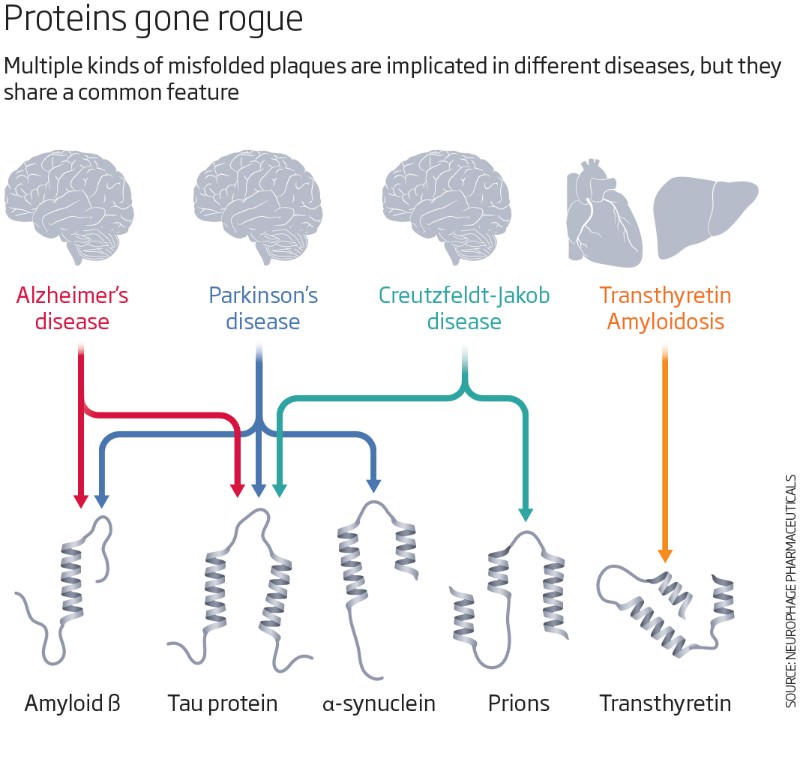
New Scientist reports that NeuroPhage Pharmaceuticals (Cambridge, MA) has found a way to cleanup rogue proteins that form in the brain, causing debilitating mental disorders, such as Alzheimer's and Parkinson's diseases:

The drug is the first that seems to target and destroy the multiple types of plaque implicated in human brain disease. Plaques are clumps of misfolded proteins that gradually accumulate into sticky, brain-clogging gunk that kills neurons and robs people of their memories and other mental faculties. Different kinds of misfolded proteins are implicated in different brain diseases, and some can be seen within the same condition.


The hope is that the novel drug will destroy the plaques but leave healthy brain cells alive.


NeuroPhage's US patent applications can be found here.

tags: medicine, brain, control, tool, entrepreneurship, biology

Friday, November 08, 2013

Lunch Talk: Changing your brain (TEDxToronto)


Barbara Arrowsmith-Young talks about brain plasticity and how mental exercises can help overcome problems with one's own thinking.

tags: aboutness, brain, lunchtalk, psychology, biology

Tuesday, April 23, 2013

A solution to the terrorism problem would be to make everybody wear Google Glass devices. If one sees or smells a bomb-making material, the device reports the incident to the authorities. With this setup everybody becomes a self-policing drone, with Google AI algorithms functioning as a giant external brain.

 Figure from: Intelligence: the eye, the brain, and the computer, by Fischler and Firschein. 1987. p. 18.


tags: problem, solution, detection, control, brain, mind

Tuesday, February 26, 2013

No Singularity in sight. Ever.

The debate between proponents and opponents of strong Artificial Intelligence (AI) continues. A biologist specializing in the field calls Kurzweil's bluff:

(MTR 2/18/13) “The brain is not computable and no engineering can reproduce it,” says Nicolelis, author of several pioneering papers on brain-machine interfaces.

[F]uturist Ray Kurzweil, recently hired on at Google as a director of engineering, has been predicting that not only will machine intelligence exceed our own, but people will be able to download their thoughts and memories into computers.

Nicolelis calls that idea sheer bunk. “Downloads will never happen,” he said during remarks made at the annual meeting of the American Association for the Advancement of Science in Boston on Sunday. “There are a lot of people selling the idea that you can mimic the brain with a computer.”

Nicolelis thinks in the future humans with brain implants might be able to sense x-rays, operate distant machines, or navigate in virtual space with their thoughts, since the brain will accommodate foreign objects including computers as part of itself.

Recently, Nicolelis’s Duke lab has been looking to put an exclamation point on these ideas. In one recent experiment, they used a brain implant so that a monkey could control a full-body computer avatar, explore a virtual world, and even physically sense it.
 tags: control, brain, interface, computing, intelligence

Better life through brain stimulation

Synchronizing brain cells appears to do wonders for at least one mental disorder. Although researchers still wander in the dark, they are at least in the right house.
(MTR 02/25/2013)A brain-pacemaker helped put out-of-sync brain circuits back on track in patients with extreme forms of obsessive-compulsive disorder (OCD), reported researchers in yesterday’s Nature Neuroscience. The work could help improve treatment of severe OCD and even lead to other, less invasive new forms of treatment.

The next step, says Figee [, will be to see if he and his colleagues can use the brain activity measures to determine if a patient’s deep-brain stimulator is working properly. An implant has several electrodes, and it can take a lot of trial and error to learn which should be active and at which pulse settings for each patient. “We still don’t really know what we do; sometimes people respond, sometimes they don’t, sometimes it takes weeks or a year trying all kinds of settings,” he says. Using the brain scanning tools in the clinic may be years away, but it is possible, says Figee. “This may help us focus on the brain synchronization that we should aim for,” he says.

tags: control, brain, science, biology, health

Monday, July 23, 2012

Lunch Talk: BBC - The Human Mind (part 3).

How the brain works to relate to other people.


link

tags: lunchtalk, brain, social, networking 

Sunday, July 22, 2012

Lunch Talk: BBC - The Human Mind (Part 2).

The second part of The Human Mind, a BBC documentary about the brain. The focus of this part is human personality.


link

tags: lunchtalk, emotion, biology, brain

Saturday, July 21, 2012

Lunch Talk: BBC - The Human Mind (Part 1)

Part 1 of a BBC documentary about "restructuring" one's brain, i.e. learning.


Link

tags: brain, lunchtalk, education

Wednesday, July 11, 2012

Lunch Talk: Internet and the brain.

(7/9/12. Newsweek.) The brains of Internet addicts, it turns out, look like the brains of drug and alcohol addicts. In a study published in January, Chinese researchers found “abnormal white matter”—essentially extra nerve cells built for speed—in the areas charged with attention, control, and executive function. A parallel study found similar changes in the brains of videogame addicts. And both studies come on the heels of other Chinese results that link Internet addiction to “structural abnormalities in gray matter,” namely shrinkage of 10 to 20 percent in the area of the brain responsible for processing of speech, memory, motor control, emotion, sensory, and other information. And worse, the shrinkage never stopped: the more time online, the more the brain showed signs of “atrophy.”


tags: 10x, internet, payload, niche construction, psychology, brain, social

Friday, February 17, 2012

Lunchtalk: (@Google/Stanford) Neuroscience of meditation.

Philippe Goldin is a research scientist and heads the Clinically Applied Affective Neuroscience group in
the Department of Psychology at Stanford University.

He spent 6 years in India and Nepal studying various languages, Buddhist philosophy and debate at Namgyal Monastery and the Dialectic Monastic Institute, and serving as an interpreter for various Tibetan Buddhist lamas. He then returned to the U.S. to complete a Ph.D. in Clinical Psychology at Rutgers University.


link


tags: lunchtalk, biology, brain, psychology, health

Thursday, February 09, 2012

LunchTalk: (TED) How your brain knows where you are.

How do you remember where you parked your car? How do you know if you're moving in the right direction? Neuroscientist Neil Burgess studies the neural mechanisms that map the space around us, and how they link to memory and imagination.


link

Now, I understand how the Method of Loci works for content memorization. The brain creates content-related neuron firing patterns that are co-located with spacial neuron firing patterns. When you activate location-based neurons you also activate content-related memory neurons.

tags: lunchtalk, brain, memory, psychology

Saturday, February 04, 2012

Seeing without recognition.

A paper in Cognition describes a series of experiments where participants had to search through a heap of overlapping items. To locate the target, they had to 'unpack' the heap by moving objects aside. It turns out, a purely mechanical task of moving things aside interferes with the process of recognition, as if the motor system dictates the pace of mental work to the rest of the brain.
We report that during this task participants often fail to recognize the target despite moving it, and despite having looked at the item. The rate of this ‘unpacking error’ was minimally affected by set size and dual task manipulations, but was strongly influenced by perceptual difficulty and perceptual load. We suggest that the error occurs because of a dissociation between perception for action and perception for identification, providing further evidence that these processes may operate relatively independently even in naturalistic contexts, and even in settings like search where they should be expected to act in close coordination.
Grayden J.F. Solman, et. al. 2011. Found and missed: Failing to recognize a search target despite moving it. http://dx.doi.org/10.1016/j.bbr.2011.03.031
From a practical perspective, having large working surfaces, e.g. desks or screens, can improve recognition (or intuitive judgement) because there's no need to move things around in order to find what you are looking for. (The Whiteboard Effect?) In clutter situations machine-based search should be more effective than human-based one.

tags: detection, psychology, brain, information, control

Tuesday, January 24, 2012

Remotely controlled brain.

Switching technology from lasers to LEDs lets an MIT startup plant a  light-weight controller right into a lab animal brain.
Jan 23, 2012. MTR -- Optogenetics relies on genetically altering certain cells to make them responsive to light, and then selectively stimulating them with a laser to either turn the cells on or off. Instead of a laser light source, Kendall Research uses creatively packaged LEDs and laser diodes, which are incorporated into a small head-borne device that plugs into an implant in the animal's brain. The device, which weighs only three grams, is powered wirelessly by supercapacitors stationed below the animal's cage or testing area.

The wireless capabilities allow researchers to control the optogenetics equipment remotely, or even schedule experiments in advance. 
Data collection is also seems to be one of their key applications. Maybe when people agree to genetically modify their brains to emit lights, this technology will be invaluable for a new kind of communications.

tags: control, energy, storage, communications, biology, brain, startup

Friday, January 13, 2012

The random walk of a killer's mind.

M. V. Simkin and V. P. Roychowdhury analyzed behavior pattern of a serial killer who murdered 53 people over a period of 12 years.
We propose a model according to which the serial killer commits murders when neuronal excitation in his brain exceeds certain threshold. We model this neural activity as a branching process, which in turn is approximated by a random walk.


Neat. I wonder if you can model the mind of a serial inventor within the same model. Maybe Edison's diary can be a good data source.

tags: mind, brain, information, social, forecast

Sunday, January 01, 2012

How Anesthesia Changes Mind.

Studying human brain under anesthesia presents not only ethical, scientific, and philosophical problems, but also involves some down-to-earth technological challenges. For example, it's difficult to collect and correlate people's different types of vital signs, both from brain imaging and more traditional collection techniques. Here's how engineers and scientists managed to solve the problem.
January 1, 2012. MTR -- Brain imaging in human subjects undergoing anesthesia is tricky because it requires anesthetizing people within a scanner and outside a normal operating room. Brown and his colleagues found a way to solve the technical and safety problems: they recruited volunteers who had already received tracheostomies, or surgical holes in the throat. That meant a tube could readily be used to restore their breathing in an emergency. In 2009, the researchers demonstrated that they could safely record both EEG and fMRI data on people under anesthesia; now they are working to correlate the imaging and EEG data with the observable changes seen as patients enter an anesthetized state.
Rather than "modifying" people to make their key vital signs exposed, they found those who's already been "modified" for other purposes. (This approach is generally outlined in Principles 9 through 11 in classical TRIZ problem-solving recommendations. These are instances of Separation in Time from the dilemma resolution techniques.)
Anesthesia studies have already cast doubt on one popular theory, which links consciousness to a particular type of brain wave with a frequency around 40 hertz. Mashour points out that research in anesthesia shows these waves can exist even when patients are unconscious. But the patterns that anesthesiologists see do support another theory: that consciousness emerges from the integration of information across large networks in the brain. 
 I wonder how much of our "everything is a network" thinking is determined by everyday exposure to the Internet. Brain is much more than a network, but we don't have the right words to describe it yet.


tags: mind, brain, biology, philosophy, problem, solution, triz

Friday, December 02, 2011

Why Zynga is like milk chocolate.

Zynga's product strategy is almost indistinguishable from the way chocolate producers are working to seduce consumers into buying sweets.
(Nov 30, 2011. WSJ) - "We want to get more Godiva into people's mouths more often," said Lauri Kien Kotcher, chief marketing officer for Godiva and senior vice president of global brand development. "It's all about chocolate snacks, little chocolate treats. …When those things come, you just keep eating."

LaTanya Tinsley, a Raleigh, N.C., master's student, usually has a few squares of milk chocolate for her afternoon snack.
Ms. Tinsley used to buy a chocolate bar about once a month when visiting the Godiva store a half-hour from her home. "Now I can go to the grocery store that's five minutes away and it's in the candy aisle," she said. "I bought two bars day before yesterday."
If over-consumption of sugar and fat creates an obese body, then over-consumption of Zynga-style gamelets should lead to a porky brain. 


tags: gaming, 10x, control, time, business, model, brain

Friday, November 18, 2011

Lunch Talk: Divided Brain.


"In this new RSAnimate, renowned psychiatrist and writer Iain McGilchrist explains how our 'divided brain' has profoundly altered human behaviour, culture and society."

tags:psychology, brain, biology

Sunday, November 13, 2011

Lunch Talk: A map of the brain.


From TED website: "As CEO of the Allen Institute for Brain Science, Allan Jones leads an ambitious project to build an open, online, interactive atlas of the human brain."

"How can we begin to understand the way the brain works? The same way we begin to understand a city: by making a map."

Wednesday, September 28, 2011

Problem-solving through insightful learning

An amazing chimp uses water as a tool to get food.


A systematic study of creativity in animals was pioneered by Dr. Wolfgang Kohler. His most famous experiment involved a chimpanzee who figured out how to make a telescoping stick to reach for a banana lying far away from the cage.


In 1917, Kohler published The Mentality of Apes (1917), where he described his experiments and proposed the concept of Insightful Learning, a process of problem solving by manipulating information about objects in one's mind. His work lead to the Gestalt theory of creativity.

tags: psychology, creativity