MidAmerican, a unit of Buffett's Berkshire Hathaway Inc., said on Sept. 27 it agreed to invest HK$1.8 billion ($232 million) to buy about 10 percent of BYD Co., citing the parent's focus on environmental products. The U.S. billionaire was attracted by the Shenzhen, south China-based company's ``strong position'' in the development of batteries used in electric vehicles, according to JPMorgan Chase & Co. analyst Charles Guo.Battery technology is key to breaking the old "efficiency vs road performance" trade-off for electric cars. Buffet's bet signifies a major upheaval in the automotive industry and around it: car design, infrastructure, oil consumption, services, electricity generation, and etc. This is also a very good indicator that global warming can and will be avoided.
Sunday, September 28, 2008
Technology-Market revolution as it happens
bloomberg.com reports:

Watermellon cubes

BBC News writes about Japanese cuboid watermelons. The unusual shape was thought up by enterprising farmers to lower the storage and transportation costs. Well, they did not succeed in that department, but square watermelons found their way to upscale grocery shops:
Here in California you can buy a traditional green-black-red spheroid for no more than $10. What a bargain!
Sunday, September 07, 2008
Just wanted to add another consideration to my previous message about the new Google browser. The move into the browser space can be a defensive strategy against Microsoft Explorer 8. Here's a description of a feature that could help destroy Google's advertisement-based business model:
A good example for the Technology Battle tool
Why it is so important? Because in InPrivate mode Explorer 8 will be able to block all Google Ads and Analytics tools. No ads, no analytics, no money for Google. Finita la comedia.InPrivate Blocking
Today websites increasingly pull content in from multiple sources, providing tremendous value to consumer and sites alike. Users are often not aware that some content, images, ads and analytics are being provided from third party websites or that these websites have the ability to potentially track their behavior across multiple websites. InPrivate Blocking provides users an added level of control and choice about the information that third party websites can potentially use to track browsing activity.To use this feature, open a new tab and select InPrivate Browsing, or select "InPrivate Browsing" from the Safety menu. To end your InPrivate Browsing session, simply close the browser window.
A good example for the Technology Battle tool
The Independent writes:
A note from a system evolution perspective: the ultimate goal is a control point of the 3rd type ( pace of innovation). In this particular system, browser is a Tool; cloud services - Source; Internet - Distribution; application logic - Control; data + scripts - Payload. Google has a chance to tightly couple Tool, Source, Control, and Payload. That'll give them full control over the evolution of the system.
Bill Stewart, the internet historian and founder of livinginternet.com, said Google's image took a nosedive last week. "There has been a tremendous amount of goodwill for Google but the announcement of the browser is a tipping point.Google lacks a mass market device-based distribution platform. Android OS and the browser are designed to address this strategic hole. If Google succeed, they will be capable of tying people to Google's own "cloud" services. We are running a risk of one day waking up inside a walled garden, where all information is packaged and presented to us by an advertisement giant, which Google has become. And it'll be as free, as free television.
"It indicates that they are out to dominate and are mimicking their worst enemy: Microsoft. There has been a change in sentiment. The goodwill has evaporated and turned to concern."
A note from a system evolution perspective: the ultimate goal is a control point of the 3rd type ( pace of innovation). In this particular system, browser is a Tool; cloud services - Source; Internet - Distribution; application logic - Control; data + scripts - Payload. Google has a chance to tightly couple Tool, Source, Control, and Payload. That'll give them full control over the evolution of the system.
Wednesday, July 23, 2008
cnet reports that The Lightning GT, a new electric car, boasts not only four seconds 0 to 60mph acceleration, but also a super-fast charging time:
The Lightning GT has a technological advantage over the Roadster, or so it seems, depending on whether recharge time is an issue for owners. The company says the car takes 10 minutes to recharge, if charged from a three-phase power supply (those found in industrial buildings, compared to the residential single phase). The Tesla Roadster has an estimated 3.5-hour charge time from a residential outlet.This approach to charging electric batteries might solve a critical problem for the industry. A 10-minute wait is not that much different from the time people usually spend today filling up their cars.
Tuesday, July 15, 2008
12:32 15 July 2008 New Scientist and Reuters report
I should develop a technology battle case study to analyze and forecast possible implications of the announcement.
Intel, the world's biggest PC chip maker, has launched the next-generation of its Centrino wireless chips for use in laptop computers and other non-PC devices.This is an interesting development in the battle between WiMax and 3G. If we do a system, element-by-element, analysis, we discover that 3G has significant advantage because it has service providers, distribution network, and cool client devices, such as iPhone, compared to just PCs on the WiMax side. Will WiMax follow the WiFi citywide deployment pattern, when services chains, e.g. Starbucks, install access points to attract customers? Unlikely. Coffee shops are local, and so are WiFi configurations. WiMax are WAN-bound, therefore only a citywide business entity would benefit from it.
The chips combine Wi-Fi capability with a newer wireless technology called WiMax, which allows for high-speed data transmission over much bigger distances, such as across entire cities. The WiMax-enabled version of the chips should be available later this year.
I should develop a technology battle case study to analyze and forecast possible implications of the announcement.
Saturday, July 12, 2008
As we discussed in class a couple of months ago, iPhone is not a phone. Rather, it is a sophisticated software application platform. Apple is extremely smart in helping its customers to jump over the abyss between mobile voice and mobile computing in two easy steps: (1) iPhone -> (2) iPhone 3G. Neither Windows Mobile, nor Android demonstrate the ability to move seamlessly between the two worlds.
Speaking of the App Store, it's easily the best thing about the iPhone 3G—although it also happens to be available on the old iPhone via the firmware 2.0 update. I've already posted my impressions of the App Store, plus a handful of the more than 500 available applications (Gina has also posted some reviews), but I'll say it again—if you're looking for something new to get excited about in iPhoneland, this is it. The 3-D, accelerometer-enabled games like Super Monkey Ball look amazing on the iPhone, the TypePad blogging app lets you post thoughts and photos on the fly, Pandora delivers free, streaming music channels, and Loopt lets you keep track of your pals in real time—and that's just the tip of the iceberg.
Friday, June 27, 2008
Analysts use US customs data to detect indicators for an impending iPhone 3G product launch.
“They have never before reported this product on their customs declarations,” says Ryan Petersen of ImportGenius.com. “The fact that they are importing millions of units, combined with dwindling stocks of the first generation of iPhones, clearly supports the Citi analysts predictions.”
Two of Apple’s long-time manufacturing partners for desktop computers —Hon Hai Precision Corp. and Quanta Computer—have been rumored to be working on the newest generation of the popular cell phone.
On March 19 Quanta delivered 20 ocean containers of merchandise, described on the Bills of Lading as “electric computers,” to Apple, Inc. Neither Apple, Quanta, nor any other company has ever used this product description for any shipments to the U.S.
The advanced features of the iPhone make it perfectly legitimate for Apple to declare the products as computers, rather than telephones. By doing this, the company may hope to avoid the attention that a massive influx of phones may bring about, while simultaneously maintaining secrecy as to the true identify of the phone’s manufacturers.
People are finally acknowledging that iPhone is a computer, not a phone.
Monday, June 23, 2008
Dilemma of the Day
Gallup Management Journal writes:
And here lies the dilemma. The factors that have typically had the greatest impact on customer engagement -- and that have offered service marketers (including banks) the greatest opportunities to exceed customer expectations and differentiate the customer experience -- are the "people" factors. (See "People Who Need People" in the "See Also" area on this page.) But these human interaction opportunities are the ones that are being reduced or, in some cases, eliminated.
Thursday, June 19, 2008
Facebook. A social networking study from 2005-06
http://video.google.com/videoplay?docid=3910777240176719644
Friday, June 13, 2008
mobile browser interface
Firefox Mobile Concept Video from Aza Raskin on Vimeo.
A number of interesting solutions here. May use it for the class this summer
Thursday, June 05, 2008
Challenges that we face today ( in no particular order):
- high energy costs
- global warming
- rising food prices
- lots of hungry people in developing countries
- lack of business models for social networking
- international terrorism
- war in Iraq
- shifts in global economic and political power ( from US and Europe to Asia Pacific)
- low us dollar
- financial crisis
- budget deficits in the US
- growing number of people with no medical insurance in the US
- slowdown/recession in the US
- etc.
Wonderful times. All these crisis, problems, and challenges mean that for a while there will be sustained demand for new technology developments and problem solving. Most likely, innovations will come from individuals and small companies, rather than large corporations. A great time to be an entrepreneur or tech investor in the US. The country still has the best research universities, VC infrastructure, and good demographics. Full steam ahead!
Thursday, May 29, 2008
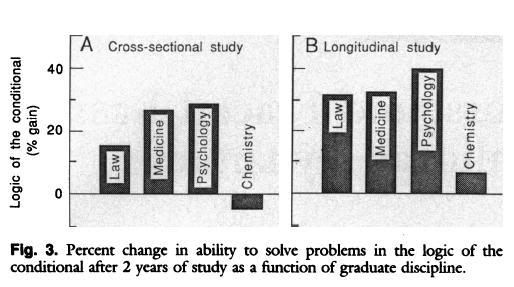
Twentieth-century psychologists have been pessimistic about teaching reasoning, prevailing opinion suggesting that people may possess only domain-specific rules, rather than abstract rules; this would mean that training a rule in one domain would not produce generalization to other
domains. Altematively, it was thought that people might possess abstract rules (such as logical ones) but that these are induced developmentally through self-discovery methods and cannot be trained. Research suggests a much more optimistic view: even briefformal training in inferential
rules may enhance their use for reasoning about everyday life events. Previous theorists may have been mistaken about trainability, in part because they misidentified the kind of rules that people use naturally.
Teaching Reasoning. RICHARD E. NISBETT, GEOFFREY T. FONG, DARRIN R. LEHMAN, PATRICIA W. CHENG.
Science Magazine, 30 October 1987.
Another confirmation that model-based approach to teaching invention skills can be extremely useful when abstract rules are illustrated with examples from different domains. Just teaching-by-example or abstract reasoning logic may not be enough to get the knowledge transfer effect.
Wednesday, May 28, 2008
As we've discovered during the last session of the Principles of Invention class at Stanford, server technology is going to be a strong control point in the emerging mobile applications space. Google continues to build a leadership position in technology and mind share among software developers and corporations. They (Google) become embedded into the fabric of the new generation of web applications.
For example, CNET writes:
We'll probably explore further invention/innovation opportunities in this space during our next class, BUS75
For example, CNET writes:
MySpace's announcement that it has integrated Gears into its messaging system to create a backup of messages (email) to a user's computer and thereby enable faster searching and sorting of the messages. With 170 million messages sent each day on MySpace, this adds up to cost-savings as it needn't process all of the email searching and sorting server-side.Or look at Google's App Engine, which is one area in which Google keeps trying to "mak[e] clouds of computing power more accessible to all developers." Google is now opening up App Engine to everyone, not an elect few, at pricing that is very compelling.
We'll probably explore further invention/innovation opportunities in this space during our next class, BUS75
Tuesday, May 27, 2008
History of DHL:
This is an example of a system evolution pattern where control information "finds" a fast channel to improve the overall system performance. In this case, DHL found a way to increase productivity in the global shipping industry by delivering customs documents to foreign ports while freight ships were still en route. Officials were able to review the documents before the goods arrived, thus cutting the time that ships had to spend in port.
In 1969, Adrian Dalsey, Larry Hillblom and Robert Lynn (D, H, and L) founded DHL as a service shuttling bills of lading between San Francisco and Honolulu. The company grew rapidly and in a few years initiated service to the Philippines, Japan, Hong Kong, Singapore and Australia, creating an entirely new industry of international door-to-door express service in the Pacific Basin. Steady expansion continued in the 1970's as DHL initiated service to Europe (1974), Latin America (1977), the Middle East (1978) and Africa (1978).
This is an example of a system evolution pattern where control information "finds" a fast channel to improve the overall system performance. In this case, DHL found a way to increase productivity in the global shipping industry by delivering customs documents to foreign ports while freight ships were still en route. Officials were able to review the documents before the goods arrived, thus cutting the time that ships had to spend in port.
From the history of Fedex Corp:
A good example how an alternative distribution system emerges by capturing large volumes of new types of payloads. Also of interest is coupling of distribution with storage ( parts warehousing ). A pattern familiar from the early banking systems.
FedEx was founded as Federal Express Corporation in 1971, by 28-year-old Memphis, Tennessee, native Frederick W. Smith. Smith, a former Marine pilot, originally outlined his idea for an overnight delivery service in a term paper he wrote for a Yale University economics class. He felt that air freight had different requirements than air passenger service and that a company specializing in air freight rather than making it an add-on to passenger service would find a lucrative business niche. Speed was more important than cost, in Smith's view, and access to smaller cities was essential. His strategies included shipping all packages through a single hub and building a private fleet of aircraft. Company-owned planes would free the service from commercial-airline schedules and shipping regulations, while a single hub would permit the tight control that got packages to their destinations overnight. In making his dream a reality, Smith selected Memphis as his hub: it was centrally located and despite inclement weather its modern airport rarely closed.
A good example how an alternative distribution system emerges by capturing large volumes of new types of payloads. Also of interest is coupling of distribution with storage ( parts warehousing ). A pattern familiar from the early banking systems.
Tuesday, May 20, 2008
May 20, 2008. An update on the mobile application space
Google continues to position itself as a premier, if not dominant, player in the emerging mobile software space.
Google could soon find itself as the iPhone’s largest independent software vendor, while at the same time becoming its biggest competitor through the launch of the company’s own mobile platform. While browser-based versions of Google’s Web applications will run via both Android and the iPhone’s Web browser with little or no modifications (since both use WebKit), native apps for either platform aren’t compatible. In many instances Google may pick and choose which of its services to build native iPhone clients for, and which should remain browser-based or exclusively native for Android devices. As an example, the pre-release version of Google Maps for Android already has features missing from the iPhone version.
Google continues to position itself as a premier, if not dominant, player in the emerging mobile software space.
Monday, May 19, 2008
The Promise of Prediction Markets article in Science magazine makes a point that over time people get better at forecasting event outcomes ( see the graph below).

But we can turn this argument on its head and say that while crowds are generally good at predicting short-term events, they are not that great in predicting long-term outcomes. Furthermore, the farther the crowds are removed from an event, the worse their accuracy rate is. It is the job of inventors/innovators, not the crowds, to not only predict the future, but also make it happen. Truly great innovators, like Edison, Disney, Moore, Gates, and Jobs, have the ability to lead the crowds onto "predicting" the success of their innovations.
But we can turn this argument on its head and say that while crowds are generally good at predicting short-term events, they are not that great in predicting long-term outcomes. Furthermore, the farther the crowds are removed from an event, the worse their accuracy rate is. It is the job of inventors/innovators, not the crowds, to not only predict the future, but also make it happen. Truly great innovators, like Edison, Disney, Moore, Gates, and Jobs, have the ability to lead the crowds onto "predicting" the success of their innovations.
Sunday, May 18, 2008
herding cats
However, Peterson found a negative relationship between creative cities and strength that connects people to one another - such as modesty, gratitude, spirituality, teamwork, kindness, and fairness. ... This jibes with my research teams findings which show that regional creativity and innovation are related to diversity and openness, but not to social capital of the sort Robert Putnam has written about. Putnam's most recent research has also found that diversity hinders social capital. This is all very troubling news for our sense of community and social cohesion. The very strengths that make places diverse and creative seem to damage our social capital and community commitment. ( Florida, R. Who's your city. Basic Books, 2008 p. 210-211 )
A interesting trade-off: more creative people - fewer/shallower social connections. Makes perfect sense in terms of system analysis, because connection creation and maintenance require time and resources that can be better spent on developing new ideas. Online social networking, with its "low-touch" relationships, serves this environment much better than more traditional forms of social interaction, like family, clubs, churches, and etc. May also relate to the Tipping Point phenomenon described by Malcolm Gladwell and Andrew Hargadon's concept of technology brokering ( How Breakthroughs Happen).
I will use this problem as an example in my next Principles of Invention class.
Personality Maps
 The maps show distribution of the Big Five Personality Traits in the United States.
Extroverted, Agreeable, Neurotic, Conscientious, Open-to-Experience
I wonder what kind of processes sustain these distributions. For example, a person with new ideas can be easily accommodated in Silicon Valley, but rejected in the South ( Georgia, Missouri, etc.) The network-centric view that Richard Florida proposes in Who's Your City is limited to the "Distribution" system component and does not explain a self-perpetuating cycle. Various institutions have to work together to convert ideas into cool products and high-paying jobs.
click on the picture to enlarge
(Source: Jason Rentfrow, Cambridge University; Kevin Stolarick, University of Toronto. Original maps by Ryan Morris. )
Subscribe to:
Posts (Atom)