Showing posts with label ideality. Show all posts

Wednesday, July 08, 2015

Wires are dead?

Gizmodo reviews the new line of IKEA's wireless chargers:
IKEA’s wireless charging technology is exactly what it sounds like. It’s a feature being built into a small number of furniture items—namely, lamps and nightstands—but also sold independently as charging pads that you can set on top of a surface or install in any piece of furniture. Once the charging pad is plugged in, you just set your phone on top of a rubber “+” sign. And it charges!
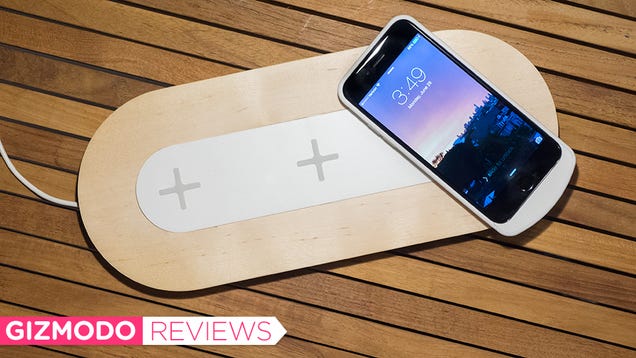

100 years from now you will have your electronic brain implants recharged with a wireless electric pillow while you are sleeping! :)

Speaking of the brain, a group of computer scientists from UCSD and Politechnico di Torino published a paper that describes an implementation of a memory cell-based computing architecture. From the abstract:
Memcomputing is a novel non-Turing paradigm of computation that uses interacting memory cells (memprocessors for short) to store and process information on the same physical platform. It was recently proven mathematically that memcomputing machines have the same computational power of nondeterministic Turing machines. Therefore, they can solve NP-complete problems in polynomial time and, using the appropriate architecture, with resources that only grow polynomially with the input size. The reason for this computational power stems from properties inspired by the brain and shared by any universal memcomputing machine, in particular intrinsic parallelism and information overhead, namely, the capability of compressing information in the collective state of the memprocessor network. We show an experimental demonstration of an actual memcomputing architecture that solves the NP-complete version of the subset sum problem in only one step and is composed of a number of memprocessors that scales linearly with the size of the problem. We have fabricated this architecture using standard microelectronic technology so that it can be easily realized in any laboratory setting.

It's too early to call, but an alternative to the Universal Turing Machine can lead to the creation of novel brain-like applications.

Saturday, June 27, 2015

Principles of Invention and Innovation (BUS 74). Session 1, Quiz 2

Research shows* that college students who use their laptops and mobile phones in class get easily distracted and miss important information. They also distract their professors and other students.


Question: How would IDEAL education and personal communications systems would change the situation?

* Michael J. Berry , Aubrey Westfall. Dial D for Distraction: The Making and Breaking of Cell Phone Policies in the College Classroom . College Teaching. Vol. 63, Iss. 2, 2015. DOI:10.1080/87567555.2015.1005040 http://www.tandfonline.com/doi/abs/10.1080/87567555.2015.1005040

Friday, June 26, 2015

Principles of Invention and Innovation (BUS 74). Session 1, Quiz 1.

According to the LA Times,

More than 1.2 million Americans are living with HIV – including about 156,300 who don’t realize it, according to a new report from the Centers for Disease Control and Prevention.

That means 13% of those who are infected with the virus that causes AIDS aren’t in a position to protect their health, or the health of others.


Question: In your opinion, how would an IDEAL healthcare system would change the situation? Briefly describe at least one hypothetical solution that would lead to a breakthrough.

Tuesday, September 06, 2011

Invention of the Day: Virtual guest of a real event.

Bill Gates and a dozen of other people from Microsoft invented a virtual guest:

From the US Patent 8,012,023 issued today:

... a virtual reality generation component that emulates real-life activities of a guest that is remotely viewing a spectator event that takes place outside of a virtual environment into corresponding virtual activities of a virtual guest representation in the virtual environment;
....
The idea is to let virtual and real guest mingle during a spectator event. The figures from the patent (below) show a bunch of bio sensors, but the physical can also be a brain reader too.


The best part of the patent is that it references our ( Mike Schmitt and I) 2002 patent application, where we claim a system that allows external spectators watch and participate in online games.

tags: games, virtual, social, information, biology, patent, example, ideality

Thursday, July 28, 2011

Invention of the Day: Mobile Accessories

I picked out these inventions from the New Scientist 1% section( the name of the section is probably a reference to Edison's famous 1% inspiration vs 99% perspiration quote.)

IBM filed a patent application for an adjustable virtual keyboard, which can be calibrated to user's typing habits. Note that on the picture below keys are of different sizes and not necessarily aligned. Would be a good idea for tablet devices.


Apple filed a patent application on a phone/audio headset that doesn't get tangled as much as conventional wired headsets. Why? Because the cable has sections with variable stiffness. The flexible sections allow the cable to bend, while the stiff ones prevent it from tangling. Kind of neat, but we all know that, according to the ideality principle, an ideal cable would conduct the signal while not existing at all. That's right, wireless cables don't get tangled.


tags: invention, problem, solution, ideality, apple, mobile, distribution, patents, example, interface

Tuesday, February 01, 2011

Turning bad ideas into great solutions

Scott Adams, the virtual father–and-mother of Dilbert, writes about an interesting creativity technique:

I spent some time working in the television industry, and I learned a technique that writers use. It's called "the bad version." When you feel that a plot solution exists, but you can't yet imagine it, you describe instead a bad version that has no purpose other than stimulating the other writers to imagine a better version.

For example, if your character is stuck on an island, the bad version of his escape might involve monkeys crafting a helicopter out of palm fronds and coconuts. That story idea is obviously bad, but it might stimulate you to think in terms of other engineering solutions, or other monkey-related solutions. The first step in thinking of an idea that will work is to stop fixating on ideas that won't. The bad version of an idea moves your mind to a new vantage point.

Essentially, the goal is to shift your thinking from a real-world implementation to the outcome you want to achieve by whatever means possible: flying monkeys, gnomes, magic wands, and etc. Maxwell's demons would also be great candidates for implementing a "bad version" that eventually leads to great solutions.

TRIZ has at least two tools to accomplish a similar goal: The Ideal Solution technique and The Gnomes method (often called the Smart Little People method - argh! what an ugly translation from the original Russian Метод Маленьких Человечков).


tags: ideality, creativity, imagination, psychology, triz, method,

Sunday, August 08, 2010

10 thousand monkeys with 10 thousand VCRs

A good example for explaining the 4Q diagram: a new technology was created to address a totally new market. Even people who had no clue how devices worked bought and used VCRs.

In the early 1980s, an apocryphal story made the rounds among video storeowners concerning a hapless customer who brought his VCR back to the store where he’d purchased it a year earlier, complaining that it had stopped working. The storeowner looked it over, wondering if there had been some mechanical failure, but found none. Upon ejecting the videocassette currently in the deck, the storeowner found that it had been played and recorded over so many times that the magnetic tape had worn to the point of snapping. Handing the customer the tape, the storeowner asked if all of his tapes were this worn, to which the customer responded, “I didn’t even know that piece came out!”

Greenberg, Joshua. From Betamax to Blockbuster : Video Stores and the Invention of Movies on Video. Cambridge, MA, USA: MIT Press, 2008. p 41.

Another story from the same book shows the deep roots of IP TV:

Friday, June 11, 2010

More virtual goods for your real money

June 7, 2010. VentureBeat:

Zynga is the biggest success story to come out of the new wave of social game companies, buт it has been curiously absent from one of the hottest new game platforms — the iPhone. That’s changing today with chief executive Mark Pincus' announcement that Zynga is releasing FarmVille for iPhone.

One question is whether virtual goods purchases on FarmVille for iPhone will be as lucrative as they have been on Facebook.

Buying and trading virtual goods using a mobile device is becoming easier, which means the frequency of transactions is going to increase dramatically. Furthermore, beginning with this generation of users, purchasing with digital money will become routine and start the process of gradual disappearance of physical bills, credit cards, and wallets. They will follow hand watches to the museum of extinct human artifacts.

tags: money, ideality, 10x, payload, system, social, market, commerce

Tuesday, May 18, 2010

Money as a mobile application.

Credit cards are becoming extinct:

just wave your iPhone at any Visa payWave terminal, which can already be found at some 32,000 retailers, and voila, you've made your transaction.

Visa has the market power to make interface devices ubiquitous, while the banks can be made responsible for distributing mobile applications. As the result, we've got the credit card business model, but without the credit card.

tags: money, ideality, distribution, packaging, tool, digital, information, commerce

Saturday, November 14, 2009

Is Facebook a status function?

Philosopher John Searle describes a certain type of invention, he calls it status function, instances of which exist only because people collectively believe in their functions:

Think of the difference between a knife and a 20 dollar bill. The knife will cut just in virtue of its physical structure. But the 20 dollar bill will not buy just in virtue of its physical structure. It can only function as money if it is recognized, accepted, and acknowledged as valid currency. The knife function can exist for anybody capable of exploiting the physics, but the status function can only exist if there is collective representation of the object as having the status that carries the function.

He claims that humans create their civilizations by inventing various status functions:

I regard the invention of the limited liability corporation, like the invention of double-entry bookkeeping, universities, museums, and money, as one of the truly great advances in human civilization. But the greatest advance of all is the invention of status functions, of which these are but instances. ... without them, human civilization, as we think of it, would be impossible.

Status functions seem to be essential for scalability. From a system point of view, they are instances of the Control component.

Source: John Searle. 2005. What is an institution? doi:10.1017/S1744137405000020

tags: invention, ideality, theory, function

Wednesday, August 19, 2009

Magic as a Service

The cloud computing is coming. It will be the next step in the evolution of technology and, most likely, will fuel the next stock market bubble. In the meantime, to prepare for the inevitable we need to learn the new terminology: IaaS, PaaS, Saas. Here's an excerpt from a post that untangles the acronyms:

IaaS (Infrastructure as a Service) in a general sense, provides the ability to ’summon’ resources in specific configurations at will and delivers value similar to what one might find in a traditional datacenter. IaaS’ power lies in its massive on-the-fly flexibility and configurability. It can be equated to owning a magic wand that could conjure up a variety of network and server resources in zero time and occupying zero space.

This description is so close to the TRIZ definition of Ideality! The infrastructure does not exist, but its functionality is fulfilled.

Thursday, August 13, 2009

Dilemma of the Day: gel condoms

New Scientist, 11 August 2009.
Patrick Kiser, whose team developed the gel at the University of Utah in Salt Lake City, says that the objective is to give women in countries where HIV is rife a cheap way to protect themselves from viruses and pregnancy even if their partner is unwilling to wear a condom.

Dilemma:
A. The gel has to be penetrable to enable unobstructed sexual intercourse.
B. The gel has to be impenetrable to prevent infiltration of sperm, HIV, and other sexually transmitted viruses.

Solution: Separation in Time (upon condition)

The gel is liquid as long as it is in contact with the acidity that is normal in a vagina, but will turn solid when it encounters semen, which is slightly alkaline. Any particles wider than 50 nanometres – including sperm, HIV and other viruses such as the herpes virus and the papilloma virus, which causes cervical cancer – are trapped.

Thursday, July 30, 2009

On Sept 10, 2007 I wrote, "My prediction is that they [drones] will replace helicopters as high resolution air vehicles: from traffic monitoring to neighborhood policing to forest fire detection to geological research."

Today, this prediction is getting closer to reality:

Your local police may soon be packing flying surveillance bots. At the AlwaysOn Stanford Summit, Aeryon Labs President Dave Kroetsch gave a compelling pitch on his company, which makes a two-pound robot helicopter that has enough on-board intelligence and stability control to allow it to be flown by people who just point to locations on a Google Map-based interface.

Just in time for chapter 5 rewrite on the 10X Diagram.

Saturday, May 23, 2009

Decision Making and Problem Solving

From a 1987 paper by a group of then present and future Nobel Laureates:

Because the possibilities in realistic problem situations are generally multitudinous, trial-and-error search would simply not work; the search must be highly selective.

The more difficult the problem, the smaller are the chances that a simple brainstorming session would lead to a solution it.

One of the procedures often used to guide search is "hill climbing," using some measure of approach to the goal to determine where it is most profitable to look next.

This is relevant to the Three Magicians technique (3x3). A combination of the "Climb on the Roof" and "Fall back - Spring ahead" usually works the best.

Another, and more powerful, common procedure is means-ends analysis. In means-ends analysis, the problem solver compares the present situation with the goal, detects a difference between them, and then searches memory for actions that are likely to reduce the difference.

In open-ended (inventive) problems setting the goal is often the most difficult task. That's why formulating the Ideal Result and stating dilemmas helps identify the gap between the present and the future. The 10X diagram also comes very handy in this type of discussions.

The third thing that has been learned about problem solving, especially when the solver is an expert, is that it relies on large amounts of information that are stored in memory and that are retrievable whenever the solver recognizes cues signaling its relevance.

During this stage, participation of the subject matter experts is essential. In earlier stages though, they should be kept in check, because they carry "the curse of knowledge". That is, the experts' psychological inertia often prevents them from finding a creative solution.


References:
Decision Making and Problem Solving
Author(s): Herbert A. Simon, George B. Dantzig, Robin Hogarth, Charles R. Plott, Howard Raiffa, Thomas C. Schelling, Kenneth A. Shepsle, Richard Thaler, Amos Tversky, Sidney Winter.
Source: Interfaces, Vol. 17, No. 5 (Sep. - Oct., 1987), pp. 11-31
Stable URL: http://www.jstor.org/stable/25061004

Tuesday, May 19, 2009

A brief history of Paris Metro maps at Creative Review.

You can see how the designer tries to create a highly informative map that would work for most of the people. Now, that we have moved into a digital world, we need map that work for every one. Individually. With the right information at the right time.

Wednesday, March 18, 2009

Recently, I wrote about voice communications and books becoming virtual, i.e. an application on a mobile computer. Here's how remote control follows the same path (NYT):
And so now we have a bounty of applications and accessories that let us use the technology we already have to control the technology we already have. This is not only frugal, but upgradeable and flexible. Whether you want to control your music, your television or your PowerPoint presentation, there’s probably a solution using your phone.

Thursday, March 12, 2009

Sorry, Mr. Graham Bell.

Finally, VOIP has found its place in the world by way of GoogleVoice:
Google Voice, the new version of the GrandCentral technology Google acquired in July 2007, has the potential to make the search giant a middleman in an important part of people's lives, telephone communications. With the service, people can pick a new phone number from Google Voice; when others call it, Google can ring all the actual phones a person uses and handle voice mail.
If this promise materilizes - and I believe it will - home phones as we know them are dead. Today, they are already half-dead because the younger generation clearly prefers mobiles. But now, the good old land line will have no excuse for existence whatsoever. Over time, conferences, virtual audio/video conferences, and other means of media-based communications will be come a part of everyday business and leisure activities. GoogleVoice in combination with Android is going to be a very strong contender for #1 position in telecom applications space.

Monday, March 09, 2009

A major step in the evolution of the book:
Now you can go to the iTunes Store to buy the Kindle app from Amazon that lets you read ebooks made for the Kindle device on the iPhone. Yes, it's that confusing! Maybe they shouldn't have called the app the same name as the device...I thought "Kindle" was the device?

                               via  marginal revolution
No wonder people are confused. The book technology, as invented by Guttenberg, is going to be transformed from a physical thing into a digital media format with a variety of readers.The physical paper book will go the way clocks, maps, and calculators went: virtual ("ideal") application on a device of convenience.

Thursday, February 26, 2009

The President of the Authors Guild doesn't like the new text2speech technology: when it cuts into authors' income:
[Amazon's] Kindle 2 can read books aloud....
I.B.M. has patented a computerized voice that is said to be almost indistinguishable from human ones. This voice is programmed to include “ums,” “ers” and sighs, to cough for attention, even to “shhh” when interrupted. According to Andy Aaron, of I.B.M.’s Thomas J. Watson research group speech team: “These sounds can be incredibly subtle, even unnoticeable, but have a profound psychological effect. It can be extremely reassuring to have a more attentive-sounding voice.”

We've gotten to a point where every type of communication is just an application on the computer: audio, video, text. With a little bit more time and technology we'll have books with embedded movie or voice scripts. Maybe this way writers will be able to charge more for content presented with "real" emotions, rather than the ones generated by computerized voices.

Tuesday, February 24, 2009

A brief history of mobile phones:

It has been more than 35 years since Martin Cooper placed the first call on a mobile phone to his rival at Bell Labs while working at Motorola. Heck, it's been nearly 20 years since Saved by the Bell’s Zack Morris placed a phone call to Kelly Kapowski from his locker. In that time, phones have come a long way.
We now live in a golden age of mobile phones. Or, perhaps more accurately, the end of the age of mobile phones. The iPhone, the G2, the N95, the Bold: These are exceptionally small mobile computers with built-in telephony features.
Phone has become a function on a portable device.