Wednesday, February 15, 2012

(BN) Google as Benevolent Dictator Yanks Apps With Kill Switch: Tech

Bloomberg News, sent from my iPhone.

Google as Benevolent Dictator Yanks Apps With Kill Switch: Tech

Feb. 15 (Bloomberg) -- Finnish developer Janne Kytomaki said he knew something was amiss last year when he noticed dozens of best-selling applications on Google Inc.'s Android Market listing the same incorrect author.

Kytomaki ran tests, identified the mislabeled software as a fast-moving attack and published the findings online.

Google responded swiftly. It yanked the apps from the marketplace and, using a little-known tactic to keep the malware from spreading, flipped a kill switch that reached into more than 250,000 infected Android smartphones and removed all vestiges of the software.

"I was positively surprised by how fast Google got the apps removed from the market and how fast they were able to roll out a tool for removing the malware," Kytomaki said.

Google, Apple Inc. and Microsoft Corp. have with little fanfare embraced technology that lets technicians instantly and remotely purge unauthorized content from users' machines. So- called kill switches are standard on Android handsets and iPhones, the smartphone leaders. The capability will soon become more widespread with the release of Microsoft's Windows 8 software for tablets and computers.

While their stated use is for the removal of harmful content, there's no standard definition of what that means, and companies aren't required to disclose when and how the tools are employed. The technology could be harnessed by a hacker to unleash a virus, a company to pry into a user's private information or a government body to repress free speech, said Eric Goldman, director of the High Tech Law Institute at Santa Clara University's law school.

'Dictator-Philosopher-King'

"We have the benevolent dictator, philosopher-king type of model," Goldman said. "You have someone who has absolute control over my hard drive in ways I may have never anticipated or consented to. If they use that power wisely, they actually make my life better. We don't know if they use the power wisely. In fact, we may never know when they use their power at all."

Kill switches are technologically unsophisticated administrative programs that run silently in the background. They have long existed in controlled networks, like at work, where technical staff has power over every machine. They haven't been widely used on personal computers, whose users are online sporadically and inconsistently update security patches -- a failure that has fostered the spread of malware such as the Conficker worm, which has infected millions of Windows machines.

Smartphone users, on the other hand, are online all the time and must download applications from tightly controlled stores. By design, mobile software gives computer companies a second chance on security, said Kevin Mahaffey, co-founder of Lookout Inc., a San Francisco security firm for smartphones.

'Overcorrection'

"The remote-removal tools are very much a response to the mistakes of the PC era," Mahaffey said. "Whether or not it's an overcorrection, I think history will tell us. It can be done right, but we as an industry need to tread carefully. It's easy to imagine several dystopian futures that can arise from this."

One concern is that Google, Microsoft and others could face external pressure to engage kill switches.

Governments are getting increasingly aggressive in demanding help from technology companies in censoring e-mail and the Internet, as BlackBerry maker Research In Motion Ltd. learned in 2010 when India, Saudi Arabia and the United Arab Emirates pressured it to open customer communications to inspection.

"If you build a control into a device that the manufacturer and carrier can control, it will be used by governments," said Chris Wysopal, co-founder of Veracode Inc., a security firm in Burlington, Massachusetts.

Benefits, Drawbacks

Hackers are also getting more sophisticated at infiltrating protected networks, and privacy breaches are more common as personal data becomes the coin of the Internet realm. A kill switch feature carries clear benefits, and potentially dangerous drawbacks, Wysopal said.

"It can really be used to add security, but it can also be used to deny people their rights to communicate," he said. "This is a place where there's no clear doctrine. We haven't heard anything clearly come out from an Apple or a Google saying, 'Here's when we'll use our kill switch and when we won't.'"

Representatives of Mountain View, California-based Google and Microsoft, based in Redmond, Washington, said they have used kill switches a handful of times, though they declined to provide specifics.

Tricking 'Twilight' Fans

The kill switch is reserved for "really egregious, really obvious cases" of harmful content, said Hiroshi Lockheimer, Google's vice president of Android engineering.

"We've always viewed remote removal as the final option," he said. "It's not something we want to use."

One instance came after Jon Oberheide, a 28-year-old security researcher from Ann Arbor, Michigan, duped fans of the "Twilight" teen vampire movies. Oberheide uploaded a fake app on the Android Market and billed it as a preview of the latest film in the series. The software was empty, except for a single screen shot.

Still, the app, which had been downloaded 200 times, provided an entrée that might have let Oberheide introduce malware onto devices. It also helped Oberheide goad Google into using its kill-switch option.

"It finally happened," Oberheide said.

Google, taking a lesson from PC industry bouts with malware, has built in more aggressive protections since the first versions of Android, which began appearing in phones in 2008. Google's partners have sold more than 250 million Android devices, while Apple has sold more than 180 million iPhones.

Hacking Risk

Security experts said users would be at risk if hackers were able to hijack the mechanism Google uses to push software to the devices. Lockheimer said Google takes security of the mechanism seriously and has built-in protections.

Microsoft, which enabled the feature in Windows smartphones several years ago, said its takedowns have not involved malware. The violations concerned "technical issues and content issues," said Todd Biggs, a director of product management at Microsoft.

"Revocation is a last resort, and it's uncommon," Biggs said. "We take that as a signpost that we're on target toward our goal, which is safe, reliable apps for consumers."

Microsoft disclosed last year that it was adding a kill switch to desktop and laptop software. It did so by posting the terms of use for an application store, a new feature for Windows 8.

Amazon's '1984' Moment

RIM's licensing documents for vendors say that RIM reserves the right to remove applications from users' devices "for any reason whatsoever." Marisa Conway, a spokeswoman for Waterloo, Ontario-based RIM, declined to comment.

Tom Neumayr, a spokesman for Cupertino, California-based Apple, also declined to comment. Steve Jobs, Apple's deceased co-founder, confirmed the existence of a kill switch in a 2008 interview with the Wall Street Journal. Jobs said it would be "irresponsible" for Apple not to have a way to protect users from malicious applications. The comment appeared at the bottom of a story about iPhone app sales, in response to research that uncovered clues that such a feature existed on Apple devices.

The incident that encapsulates the danger of using a kill switch is Amazon.com Inc.'s use of the feature to delete some copies of George Orwell's "1984" and "Animal Farm" novels from Kindle devices in 2009 after discovering a publisher had sold them without the necessary rights.

'Stupid, Thoughtless, Out of Line'

Customers were infuriated, and CEO Jeff Bezos called it "stupid, thoughtless and painfully out of line with our principles." The company vowed it would never delete books from Kindles again.

Amazon representatives didn't respond to requests for comment.

While the emergence of kill switches shows the growing control that technology companies have assumed over users' devices, it also exposes the shortcomings of other methods of keeping users' computers clean.

Stephanie Stambaugh, a 47-year-old freelance writer from Denver, has been battling a so-called botnet infection on her home PCs since December. Her Internet provider, Comcast Corp., alerted her to the infection, a type of program where a machine is controlled without the user's consent that is becoming more common. She said that while she has run a dozen different antivirus and other cleanup programs, she is still getting alerts that her machine is infected.

Giving Up Privacy

Stambaugh said she can't afford the $130 virus cleanup service that Comcast offers, and is considering reinstalling her operating software, the nuclear option of virus cleanups.

Cable-network operators such as Comcast have insight into which computers are compromised, since they can see when machines are silently reaching out to malicious sites. Yet they don't have the same capabilities as companies such as Google, Microsoft and Apple. Aside from alerting customers, they are limited to quarantining poisoned computers, or restricting the amount of bandwidth they consume.

Cathy Avgiris, a senior vice president for Philadelphia- based Comcast, said fully cleaning an infection is tedious, imprecise work, since the most harmful programs are good at hiding themselves. She said Comcast would be leery of adopting a kill-switch function for that reason.

Even some security experts who see the value of a kill switch say its advantages don't outweigh the potential risks.

"For most users, the ability to remotely remove apps is a good thing," said Charlie Miller, a hacker of Apple products and a researcher at the security firm Accuvant Inc. However, "I don't really like Google or anybody else with the ability to tell me what apps I can run or can't run and to remotely manage my devices. For me, the added payoff of security doesn't make up for the control and privacy you give up."

To contact the reporter on this story: Jordan Robertson in San Francisco at jrobertson40@bloomberg.net

To contact the editor responsible for this story: Tom Giles at tgiles5@bloomberg.net

Find out more about Bloomberg for iPhone: http://m.bloomberg.com/iphone/


Eugene.

Tuesday, February 14, 2012

Your social privacy is dead too.

Mobile apps freely access user contact information. Even if you personally take care of your private data, there's still a way to pierce you privacy veil through your friends, colleagues, and acquaintances.
Feb 14, 2012. VBeat -- Facebook, Twitter, Instagram, Foursquare, Foodspotting, Yelp, and Gowalla are among a smattering of iOS applications that have been sending the actual names, email addresses and/or phone numbers from your device’s internal address book to their servers, VentureBeat has learned. Several do so without first asking permission, and Instagram and Foursquare only added permissions prompts after the Path flare-up.
tags: privacy, information, control, social, networking

(BN) Cisco Says Mobile Data Traffic More Than Doubled as IPads Gain Popularity

Bloomberg News, sent from my iPhone.

Cisco Says Mobile Data Traffic More Than Doubled as IPads Spread

Feb. 14 (Bloomberg) -- Cisco Systems Inc., the biggest maker of networking equipment, saw the strain on global wireless networks more than double last year, fueled by more people watching mobile video and using tablets.

In an annual report released today, Cisco said that wireless data traffic -- videos, audio and e-mails sent via laptops, smartphones and tablets -- rose 133 percent in 2011, a bit more than the 131 percent it anticipated.

Cisco's Visual Networking Index is a key benchmark for the industry, used by wireless carriers, equipment suppliers and software developers to predict sales of their products. Faster data growth could force carriers to spend more money on new gear, following delays in upgrades that have crimped sales at Juniper Networks Inc. and other networking companies.

"Mobile data traffic will continue to explode," Suraj Shetty, a vice president in charge of service-provider marketing at San Jose, California-based Cisco, said in an interview. "This is a trend we don't see slowing down."

Mobile data growth will climb 110 percent this year, Cisco predicted. And the traffic will increase 18-fold by 2016, reaching 10.8 exabytes per month, the company said. That's equivalent to streaming 33 billion DVDs annually.

The surge resembles what happened with wired Internet networks between 1997 and 2001, when their average annual growth was 150 percent, Cisco said.

"A lot of service providers are increasing their spending on wireless," Shetty said.

YouTube Clips

Video is a big source of the traffic. More people are watching YouTube clips or streamed movies on their laptops and phones -- activities that take up a lot of bandwidth. By 2016, video will account for more than 70 percent of all mobile traffic, up from about 52 percent in 2011, Cisco said.

The popularity of smartphones and tablets is another contributor. While laptops hooked up to wireless networks are the biggest single source of network congestion today, that's changing. By 2016, smartphones will account for 48 percent of global mobile traffic, up from 18 percent now, Cisco said. Tablets will contribute 10 percent of the total, up from 1 percent in 2011.

Wireless consumption also is becoming more evenly distributed among customers. At the beginning of 2010, the heaviest 1 percent of users accounted for 52 percent of traffic. That percentage has come down since carriers such as AT&T Inc. curbed browsing speeds of the top users. In 2011, the top customers contributed 24 percent, Cisco said.

Gigabyte Club

Meanwhile, the average consumer's data appetite is growing. By 2016, 60 percent of mobile users -- some 3 billion people worldwide -- will belong to the Gigabyte Club, according to Cisco. That means they consume more than a gigabyte of mobile data a month. In 2011, only half of 1 percent of users fit that description.

That's put a further strain on wireless carriers, which already have struggled to meet demand in recent years, especially in cities like New York and San Francisco. One remedy is to rely more on Wi-Fi networks at homes, coffee shops and airports.

By 2015, Wi-Fi networks will overtake wired Internet connections, such as digital subscriber lines, as the technology handling more global traffic than any other -- reaching 46.7 percent, according to Cisco. Wi-Fi networks handled 38 percent of the total last year, while wired connections accounted for 60 percent. Cellular networks made up just 2 percent, Cisco found.

To contact the reporter on this story: Olga Kharif in Portland, Oregon, at okharif@bloomberg.net

To contact the editor responsible for this story: Tom Giles at tgiles5@bloomberg.net

Find out more about Bloomberg for iPhone: http://m.bloomberg.com/iphone/


Eugene.

(BN) Cybersecurity Bill in U.S. Senate Seeks Industry Rules to Thwart Hackers

Bloomberg News, sent from my iPhone.

Cybersecurity Bill in U.S. Senate Calls for Industry Rules

Feb. 14 (Bloomberg) -- Companies running computer networks essential to U.S. economic and national security would be required to better defend their systems from spies, hackers and terrorists under bipartisan Senate legislation unveiled today.

The bill calls for identifying vital information networks and setting security requirements for companies and government agencies. Lawmakers and regulators say rules are needed to fight increasingly sophisticated cyber attacks capable of disrupting power grids, banks and communications networks.

"We are on the brink of what could be a calamity," Senator Jay Rockefeller, a West Virginia Democrat, said in announcing the bill on the Senate floor. "A widespread cyber attack could potentially be as devastating to this country as the terror attacks that tore apart this country 10 years ago."

The push for comprehensive cybersecurity legislation has intensified following attacks last year on companies including New York-based Citigroup Inc., the third-largest U.S. bank by assets, and Bethesda, Maryland-based Lockheed Martin Corp., the world's largest defense company.

Senate Majority Leader Harry Reid, a Nevada Democrat, has said he wants to bring the bill to the chamber's floor for a vote as soon as possible. The Senate Homeland Security and Governmental Affairs Committee scheduled a Feb. 16 hearing on the measure backed by Senators Joe Lieberman, a Connecticut Independent, and Susan Collins, a Maine Republican.

Cost Concerns

The Senate bill introduced today may affect computer security spending at businesses including Southern Co., the largest U.S. utility owner by market value, and AT&T Inc., the nation's biggest telephone company.

The legislation combines elements of cybersecurity bills introduced in the past three years into one measure. Industry groups have criticized its broad approach, saying it may raise costs for companies and be too prescriptive.

"We settled on a plan that creates no new bureaucracy or heavy-handed regulations," Rockefeller said. "It's premised on companies taking responsibility for securing their own networks."

A Bloomberg Government study released Jan. 31 found that utilities, banks and other operators of critical networks would have to spend almost nine times more on computer defenses to achieve security capable of preventing 95 percent of attacks, an increase to $46.6 billion a year from about $5.3 billion.

The study, conducted by the Ponemon Institute LLC, a Traverse City, Michigan-based security-research firm, was based on interviews with technology managers at 124 companies and 48 government agencies.

Homeland Security

Under the legislation, the Homeland Security Department would have the power to identify systems that may cause mass casualties or catastrophic economic damage when attacked. The agency would set regulations requiring operators of critical networks to improve security. Companies would have to show that their networks are secure or face penalties.

The U.S. Chamber of Commerce, the nation's largest business-lobbying group, urged lawmakers last week to delay consideration of the bill and called for hearings before any floor vote, citing concerns about added expenses for companies.

"Rushing forward with legislation that has not been fully vetted would be a major mistake," Bruce Josten, the Chamber's executive vice president of government affairs, wrote in a Jan. 30 letter to Reid and Senate Minority Leader Mitch McConnell, a Kentucky Republican.

Stolen Cards

Government rules typically can't keep pace with fast- changing technology and evolving cyberthreats, Kevin Richards, senior vice president of federal government affairs for TechAmerica, a trade association, said in an interview.

"There are two cardinal rules when it comes to the tech community," said Richards, whose Washington-based group's members include Apple Inc., International Business Machines Corp. and Dell Inc. "First is the rule of do no harm. Second is beware of unintended consequences."

Seven Senate Republicans sent a letter to Reid today expressing reservations about his plans for swift action on the measure by the full chamber. The letter was signed by Kay Bailey Hutchison of Texas, John McCain of Arizona, Charles Grassley of Iowa, Saxby Chambliss of Georgia, Lisa Murkowski of Alaska, Jeff Sessions of Alabama and Mike Enzi of Wyoming.

Hacker Attacks

The debate over cybersecurity legislation is unfolding amid increased concerns that U.S. networks are vulnerable to theft and sabotage. Hackers from China and Russia are pursuing American industrial secrets, jeopardizing an estimated $398 billion in U.S. research, according to a Nov. 3 report from the National Counterintelligence Executive, an advisory panel of senior U.S. security officials.

Companies with payroll and other corporate accounts lose about $1 billion a year because of hackers based mostly in Eastern Europe, according to security specialist Don Jackson of Dell SecureWorks. Hackers sell stolen credit-card data for as little as $3.50 per card on underground bazaars, an investigation by Bloomberg News showed last year.

More than 80 U.S. law firms have been targeted by China- based hackers intent on acquiring their clients' deal data to give Chinese companies an edge in investments and negotiations, according to Mandiant Corp., an Alexandria, Virginia-based cybersecurity firm.

House Approach

"There is disagreement about when hackers will disrupt critical infrastructure in the United States but most experts put it within the next couple of years," James Lewis, director of the technology and public policy program at the Center for Strategic and International Studies in Washington, told the House Energy and Commerce Communications and Technology Subcommittee during a Feb. 8 hearing.

The Chamber and TechAmerica say they favor legislation that relies on incentives, rather than rules, to improve security. Republicans in the U.S. House of Representatives are pursuing smaller, targeted bills rather than the comprehensive approach taken in the Senate.

"I don't want to get bogged down with a giant bill," Representative Greg Walden, an Oregon Republican, said in an interview Feb. 8.

An 11-page bill from Representative Mike Rogers, a Michigan Republican, would let the government disclose classified cyberthreat data to companies in sensitive industries and shield businesses from lawsuits when they act in good faith to protect their networks.

Incentives Considered

A separate 45-page measure from Representative Dan Lungren, a California Republican, would create a federal organization to promote information-sharing on cyberthreats. It would let the Homeland Security Department identify risks to networks and develop security measures, without giving the agency new regulatory powers.

Walden, who leads the House Energy and Commerce Communications and Technology Subcommittee, said he will consider taking up a bill offering companies incentives that may also include tax breaks.

"If we do this in an incorrect way we actually hurt the ability of the private sector," he said.

The government and companies should work together to map out computer security deficiencies rather than impose a broad regulatory framework, Robert Dix, vice president of government affairs for Sunnyvale, California-based Juniper Networks Inc., said in an interview Feb. 8.

"Let's take the chewable bites," said Dix, whose company makes computer hardware and software. "Let's pass it, get traction and then build on it."

The Senate bill is S. 2105. The Rogers bill is H.R. 3523, and the Lungren bill is H.R. 3674.

To contact the reporter on this story: Chris Strohm in Washington at cstrohm1@bloomberg.net

To contact the editor responsible for this story: Michael Shepard at mshepard7@bloomberg.net

Find out more about Bloomberg for iPhone: http://m.bloomberg.com/iphone/


Eugene.

Quote of the Day: Patent as a Slingshot.

The David Co. v. Goliath, Inc. kind of competition is dependent on investment in David Co. — the small new competitor. And few men will invest in such a competitor unless they think it has a potential patent monopoly as a slingshot.
Picard v. United Aircraft. 128 F.2d 632 (1942). Court of Appeals, Second Circuit. May 28, 1942.

Lunchtalk: (@ TED) Creating new architecture.

In a wildly entertaining discussion with Richard Saul Wurman, architect Frank Gehry gives TEDsters his take on the power of failure, his recent buildings, and the all-important Then what? factor.


link

tags: lunchtalk, creativity, architecture, infrastructure

Monday, February 13, 2012

(BN) MIT to Begin Sign-Ups for Free Online Course With Certificate

Bloomberg News, sent from my iPhone.

MIT to Begin Sign-Ups for Free Online Course With Certificate

Feb. 13 (Bloomberg) -- Massachusetts Institute of Technology will begin enrollment today for the first course in its enhanced online platform, where students around the world can take classes and get a certificate upon completion.

The first class -- 6.002x: Circuits and Electronics -- will be free, though subsequent courses will come with a small fee, MIT Provost L. Rafael Reif said in a phone interview. The three- month course will begin March 5.

For the past 10 years, MIT has provided documents and lecture notes online for more than 2,000 courses through its OpenCourseWare program to more than 100 million people. Through its new MITx initiative, non-MIT students will, for the first time, have their performance assessed and receive certificates if they show mastery in the subject, the Cambridge, Massachusetts-based school said in a statement.

"Anybody anywhere that has the time, motivation, drive to learn this kind of material should be given the opportunity to do so," Reif said. The new program will have more interactive features than MIT's current OpenCourseWare offerings, he said.

Students will have video lectures, midterm and final exams, weekly deadlines to complete homework and labs and access to discussion forums. They can expect to spend about 10 hours a week on the course, MIT said.

While enrollment in the first course is unlimited, the college isn't making predictions on how many students may sign on. The introductory course calls for an advanced mathematics and physics background.

"Our estimate could be off by orders of magnitude on the lower or higher end," Anant Agarwal, the lead instructor of the class, said on a conference call. More courses will begin later this year.

The circuits and electronics class will focus on the inner- workings of smartphones and other "cool gadgets," Agarwal said.

To contact the reporter on this story: Andrew Theen in New York at atheen@bloomberg.net

To contact the editor responsible for this story: Lisa Wolfson at lwolfson@bloomberg.net

Find out more about Bloomberg for iPhone: http://m.bloomberg.com/iphone/


Eugene.

(BN) Alcatel-Lucent Seen as Leader in Wireless Capacity Fight: Tech

Bloomberg News, sent from my iPhone.

Alcatel-Lucent Seen as Leader in Wireless Capacity Fight: Tech

Feb. 14 (Bloomberg) -- Sprint Nextel Corp. is in talks to use new Alcatel-Lucent telecommunications gear designed to help wireless networks handle more calls. The discussions reflect the industry's race to avert a capacity crunch for mobile service.

Alcatel-Lucent's lightRadio, introduced a year ago, is a Rubik's Cube-sized device that contains radios and antennae and can be mounted on rooftops, phone poles and bus shelters to expand a network's capacity in a given spot. LightRadio is one of several new technologies created to help the mobile-phone industry cope with the rising tide of calling and data that's putting a strain on mobile networks just as the wireless airwaves -- or spectrum -- used to carry traffic grow scarce.

As consumers do more Web surfing and application downloading on devices such as Apple Inc.'s iPhone and tablets using Google Inc. Android software, mobile-data traffic will surge 26-fold in the five years through 2015, Cisco Systems Inc. estimates. And with limited spectrum available, mobile-service providers are looking for ways to squeeze more from existing capacity. That has Alcatel-Lucent and other gear makers racing for part of the $36 billion that Ovum predicts U.S. phone companies will devote to capital spending in 2012.

"We use technologies to mine spectrum as much as possible," Bob Azzi, senior vice president of network at Overland Park, Kansas-based Sprint, said in an interview. "That can give us some wiggle room along the way."

'Spectrum Crunch'

Multiple U.S. carriers are testing lightRadio and may begin deploying it this year, Marcus Weldon, chief technology officer at Paris-based Alcatel-Lucent, said in an interview. He declined to identify the carriers. Representatives of Dallas-based AT&T Inc. and Verizon Communications Inc., based in New York, declined to comment.

"We are in a spectrum crunch," Weldon said.

For the past two decades, the U.S. government has helped carriers meet increased demand by auctioning off large blocks of airwaves, used to carry calls and data. Freeing new spectrum has emerged as a "crucial challenge," Federal Communications Commission Chairman Julius Genachowski said in a speech last year. Even after new auctions happen, it would take several more years for the buyers to deploy the spectrum.

As a result, U.S. carriers may grow more dependent on new technologies to keep up with escalating user demand.

'Waiting' for the FCC

"The No. 1 issue for us as we move forward, and for the industry, I believe, continues to be spectrum," AT&T Chief Executive Officer Randall Stephenson said during a January earnings call. "This growth cannot continue without more spectrum being cleared and brought to market. And despite all the speeches from the FCC, we're all still waiting."

Qualcomm Inc., the biggest maker of mobile-phone chips, has developed its own software and chips for small cells -- these the size of a cigarette pack -- designed to boost network capacity.

New capacity-boosting cells augur an overhaul of the design of wireless networks, which now rely on placement of large, expensive cell towers that transmit signals between handsets and the vast underground fiber-optic cable networks that send calls instantly across the globe.

"It's going to change the way that networks get deployed, and we're going to get the data rates through the devices up pretty dramatically by using that," Paul Jacobs, CEO of San Diego-based Qualcomm, said during a November conference call with investors.

Revamp Costs

A recent survey by Informa Telecoms & Media showed that 60 percent of carriers say small cells of various types will be more important than traditional cells in advanced wireless networks.

Revamping networks won't come cheap. Each cell has to be attached to existing equipment. The market for outdoor cells like those from Alcatel-Lucent could rise to as high as $8 billion by 2016, according to ABI Research. U.S. wireless carriers will increase capital spending 10 percent to $36 billion this year, according to London-based Ovum. That's double the rate of last year.

"There's a real concern: Can we keep up with demand?" Alcatel's Weldon said. "There's only one solution, and it's a difficult solution to afford. Carriers can't afford to increase spending much. All this means, they'll take longer to do it. Network congestion is always going to be a factor."

Capacity constraints already interfere with call quality and download speeds in highly populated areas. According to J.D. Power & Associates, 13 percent of all calls made with smartphones experience some degradation.

Congestion

"There are already isolated, but regularly occurring congestion issues in major cities," Peter Rysavy, president of consulting firm Rysavy Research, said in an interview. "Over time, usage will increase, and it will constrain usefulness of the service."

Carriers such as Sprint are coping in other ways, including shifting more traffic to local Wi-Fi networks, and using software to adjust mobile video so it takes less bandwidth during peak hours.

Sprint is also buying capacity from other network owners, such as Bellevue, Washington-based Clearwire Corp. As a result of the Clearwire arrangement, Sprint won't face a spectrum crunch until 2016, Azzi said.

Clearwire is in discussions to provide airwaves to other carriers, Clearwire CEO Erik Prusch said in a recent interview.

"Spectrum deficiency really gets large in 2013-2014," Prusch said. "We are talking to a lot of players, anybody who's in need of it." He declined to identify other carriers.

Rising Prices

Another option is for carriers to raise consumer prices, discouraging network use. Tim Horan, an analyst at Oppenheimer & Co., expects U.S. service providers to raise prices on wireless contracts at a faster pace in the coming years.

"They are going to either charge for usage more or increase the minimum amount" paid for a data plan, Horan said in an interview. AT&T in January increased the cost of its cheapest smartphone data plan for new customers to $20 a month, from $15. Several carriers moved away from unlimited data plans to limited plans last year.

For some carriers, technological innovation may do most to avert the capacity crunch, said Reed Hundt, a former chairman of the Federal Communications Commission.

"God only made a certain amount of spectrum," Hundt said in an interview. "To go beyond that you have to have a different architectural solution, and that's where micro cells come in."

To contact the reporter on this story: Olga Kharif in Portland at okharif@bloomberg.net

To contact the editor responsible for this story: Tom Giles at tgiles5@bloomberg.net

Find out more about Bloomberg for iPhone: http://m.bloomberg.com/iphone/


Eugene.

(BN) Apple Apps Remain Developers’ Favorite Even as Android Spreads

Bloomberg News, sent from my iPhone.

Apple Apps Remain Developers' Favorite Even as Android Spreads

Feb. 14 (Bloomberg) -- Google Inc. has turned Android into the most popular operating system for smartphones. And yet the platform may be losing ground to Apple Inc.'s iOS in a major area: new applications.

Relative to Apple, fewer apps were created for Android in January than a year earlier, according to Flurry, a company that analyzes mobile-software data. Developers made roughly one new Android app for every three Apple apps, Flurry found. A year ago, they created two Android app for every three Apple apps.

While the study only tracked developers who design apps using Flurry's tools, the shift suggests that Google's bid to overtake Apple's industry-leading App Store may be losing some steam. Apple has more than 550,000 apps in its store, compared with over 400,000 for Google's Android Market. Both companies count on the array of apps to make their phones more enticing and lock in consumers who are already using the devices.

"We saw a greater migration to iOS," said Peter Farago, vice president of marketing at San Francisco-based Flurry.

Google has made quick gains on Apple since the first Android phones went on sale in 2008. In 2011, though, the growth in new apps for Android was about half the level of Apple, according to the firm, which tracks more than 55,000 developers. The study measured more than 65,000 new software projects over the course of the year.

Less Interested?

Other research firms are seeing a similar slowdown in Android. A survey of about 2,000 developers conducted by Appcelerator and IDC found that fewer programmers were "very interested" in developing for Android phones and tablets in November than in June, while their interest in iOS devices remained unchanged.

Christopher Katsaros, a spokesman at Google in Mountain View, California, declined to comment. Christine Monaghan at Cupertino, California-based Apple didn't return a request for comment.

The reasons for the smaller interest in Android involve time and money. Apple apps can be quicker to develop and it's easier to generate revenue from them, thanks in part to Apple's iTunes system.

"Developers can make more money on iOS," Farago said.

Take GameHouse, a maker of games such as "Doodle Jump" and "NCIS the Game." It makes three to four times more revenue on an iOS title than on an Android game, said Ken Murphy, a vice president at the company, which is part of RealNetworks Inc. GameHouse also has to spend an extra two months working on an Android game versus an iOS title. That lengthens the time it takes to get it to market by about 30 percent, he said.

"It's nowhere near as simple as iOS," Murphy said.

'Tough Spot'

The sheer variety of Android devices is one complication. GameHouse has to tweak its games to account for variations in accelerometers and responsiveness in more than 550 different Android gadgets, Murphy said. Apple, by contrast, has just a few models.

Bill O'Donnell, general manager of mobile products at the travel site Kayak.com, says his company isn't able to test its software on every variety of Android phone. There are just too many of them.

"It puts developers in a tough spot," he said.

Sometimes individual models require many extra changes. With Amazon.com Inc.'s Kindle Fire tablet, two Kayak engineers had to spend a month and a half changing all of the company's apps to work with Bing Maps rather than Google Maps, O'Donnell said. Despite being an Android device, Kindle Fire didn't come with Google apps preloaded.

"That was a huge pain," he said.

App Stores

Distributing Android software to multiple application stores takes more work as well, whereas developers only have to submit iOS programs to Apple's site.

"For Android, there are 90 app stores," said Alex Caccia, president of Marmalade, whose software lets developers adapt apps to different devices. "And if you are serious about this market, you've got to do it."

It's also not as easy to charge Android users for apps as it is on Apple devices. With iPhones and iPads, owners' credit- card accounts are already stored on iTunes, which makes app purchases simple. Android doesn't have the same mechanism for all its users, Farago said.

"Consumers are more trained to get free things on Android," he said.

Long-Term Opportunity

While Android developers can make money off sales of in- game merchandise, such as virtual weapons and other digital items, many are still working out how to do that, Caccia said.

Even so, the slowdown in app development hasn't stopped the spread of Android devices. In the fourth quarter, Android was running on 47.3 percent of U.S. smartphones, up from 44.8 percent in the previous three months, according to research firm ComScore Inc. And while Google's Android Market has fewer apps than Apple's store, the number of programs has almost tripled from a year ago.

Developers still see Android as a valuable source of revenue in the longer term, as Google irons out the wrinkles. GameHouse is planning to hire more staff to work on the software.

"In the short term, there's a lot of money in iOS," Murphy said. "In the long term, we are very bullish on Android."

To contact the reporter on this story: Olga Kharif in Portland, Oregon, at okharif@bloomberg.net

To contact the editor responsible for this story: Tom Giles at tgiles5@bloomberg.net

Find out more about Bloomberg for iPhone: http://m.bloomberg.com/iphone/


Eugene.

Lunchtalk: Open Science.

In Reinventing Discovery, Michael Nielsen argues that we are living at the dawn of the most dramatic change in science in more than 300 years. This change is being driven by powerful new cognitive tools, enabled by the internet, which are greatly accelerating scientific discovery. There are many books about how the internet is changing business or the workplace or government. But this is the first book about something much more fundamental: how the internet is transforming the nature of our collective intelligence and how we understand the world. Reinventing Discovery tells the exciting story of an unprecedented new era of networked science.


link

tags: science, source, lunchtalk

Zynga vs Personalized Media Communications.

Feb 14, 2012. WebProNews -- Personalized Media Communications filed a patent suit in the U.S. District Court for the Eastern District of Texas against Zynga. They claim that the social games maker has infringed on four of their patents.

The four patents in the suit ( US7,797,717; US7,908,638; US7,734,251; US7,860,131) are continuations of an application filed in 1981, now US4,694,490.


tags:patents, information, deontic, gaming, business


Quote of the Day: Turing Machine.

It was also disappointing that when in January 1937 Computable Numbers at last appeared in print, there was so little reaction. Church reviewed it for the Journal of Symbolic Logic and thereby put the words "Turing machine" into published form. But only two people asked for offprints.   -- Alan Turing: The Enigma, by Andrew Hodges.
As we can see, one of the major discoveries of the 20th century that set up the computing revolution went largely unnoticed not only for the general public, but for professional mathematicians as well.

tags: detection, creativity, computing, quote

Sunday, February 12, 2012

Ripping off, the Down Under edition.

Quickflix, a company that copied Netflix business model lock, stock and barrel is getting a $10M investment from HBO.
Feb 7, 2012. VBeat -- Quickflix is one of the largest streaming and physical (DVD and Blu-ray) video rental services in Australia. The company’s streaming video-on-demand subscription service is integrated into a variety of devices, such as Smart TVs, Playstation 3, Blu-ray players, and select Android-based mobile devices. Quickflix customers have access movie and television content from Sony Pictures, Warner Brothers, NBCUniversal, HBO, and others. The company reported having over 94,000 paying subscribers and $4.3 million in revenue for Q4 2011.
Quickflix envelope

 Netflix envelope


Ripping off somebody else's idea seems to be a perfectly good way to succeed in business.

tags: innovation, payload, distribution

Lunchtalk: (@Stanford) Evaluating a business idea.

CES Alumni Entrepreneurship Bootcamp.

This lecture covers the general areas that an entrepreneur should evaluate when considering a new business idea.


link

Saturday, February 11, 2012

Puzzle of the Day: The Odd One Out.


Which one is out?

To do list for this blog.


1. need to figure out why Microsoft Passport failed, while Facebook and Twitter single sign-ins are becoming widely successful despite gaping privacy holes. Most likely, Microsoft has a strong patent portfolio that covers this technology area.

2. write up Invention of the Day: Creativity. How technological creativity was re-invented by J.P. Gulford in the 1950s.

3. write up Invention of the Day: dynamite. How Alfred Nobel's invention played out in the US.

4. write up Invention of the Day: genetically modified animals.

5. why and how the US patent system is inefficient by design (which makes it biased toward inventors vs innovators.)

Running shoes: Science vs Experience.

Research shows that running without shoes reduces long-term stress on bones and joints.
Those are the findings of a pair of studies by Daniel Lieberman, a professor of human evolutionary biology at Harvard University. He found runners who use a forefoot strike face a significantly lower risk of repetitive stress injuries, and barely there running shoes produce more efficient movement than conventional kicks.
The two studies, published this month in the journal Medicine & Science in Sports & Exercise, come less than two years after Lieberman’s earlier work found runners wearing minimalist shoes put less force into the ground, therefore less force on their bodies, when striking the ground with their forefoot versus their rearfoot.

It would be logical then for runners to switch to a new, minimalist style of shoes that enable running closest  to barefoot. Unfortunately, such shoes produce short-term injuries on uneven surfaces. Here's what one runner had to say about them:
But as I left paved road for dirt trail, I got my first lesson in the limits of minimal running. I landed on an angular rock concealed in the dirt, which felt as if a needle had been thrust into my heel. The pain had just begun wearing off a few minutes later when I landed on a stone hidden beneath fallen leaves – same foot, same spot. To say that I wanted to cry would understate how much it hurt.

The ideal running shoe would have the best of both worlds: encourage natural style of running and prevent short-term injuries. In the absence of such shoe, the short-term injuries are going to dominate runner's experience. Therefore, we can predict that the minimal shoe innovation will fail to become a dominant design in the shoe industry.

On the other hand, it may produce better results for professional runners and gain acceptance through high-profile endorsements as a backup pair for running on smooth surfaces.

tags: innovation, invention, science, technology, psychology, biology

LunchTalk: (@Berkeley) Demystifying the Chinese Economy.

Speaker: Justin Yifu Lin, Senior Economist and Senior Vice President, World Bank.

Building on a distinguished career as one of China’s leading economists, Mr. Lin is undertaking an ambitious research program that examines the industrialization of rapidly developing countries and sheds new light on the causes of lagging growth in poor regions.


link

tags: lunchtalk, economy, 4q diagram, mousetrap

Clever is less than or equal to 140.

I'm reading The Evolution of Logic, by W.D. Hart. The book covers the last two centuries of philosophical and mathematical developments that enabled creation of the modern computer science, including principles built into software and hardware.
Out of curiosity, I decided to twit few quotes from the book. Here's what I got:


Since the sentence ( a quote from Burge describing Descartes understanding of self-evident truths) turned out to be longer than 140 characters, Twitter told me to be more clever.

It's self-evident that to justify an arbitrary limitation, Twitter has to associate this stupid limitation with a psychologically positive attribute "clever."


Friday, February 10, 2012

The killer device.

For the first time, web traffic from Apple's mobile devices exceeded that of Macs. One revolution Steve Jobs started thirty years ago is coming to an end. The other one is just getting under way.


Feb 10, 2012. VBeat -- In the first quarter of 2012, for instance, Apple sold 37.04 million iPhones, 15.43 million iPads, and just 5.2 million Macs.

It’s not quite the death of the desktop, but mobile devices are gaining ground on their traditional brethren, at least within the Apple-centric world.
“There is cannibalization, clearly, of the Mac by the iPad, but we continue to believe that there’s much more cannibalization of Windows PCs by the iPad,” Cook said

tags: mobile, s-curve, web, tool, information, synthesis

Invention of the Day: Nerve Repair.

The New Scientist reports on a new, potentially breakthrough technique, to repair nerve damage in injuries.


10 February 2012. NS -- When a nerve is severed through injury, surgeons must suture the two stumps together as quickly as possible. Yet even under controlled lab conditions, Bittner's tests in rats suggest that these conventional sutures restore little more than 30 per cent of previous mobility, even three months after surgery.


Put bluntly, the body botches nerve repair. It forms seals over the two severed stumps of a broken nerve within an hour, says Bittner, but it doesn't reconnect them first. Even if surgeons then suture the two ends, the seals will prevent nerve signals from passing easily across the join.

Bittner realised that we need a system that blocks the body's repair process. The way to do that, he discovered, is to immediately flush the injury site with a calcium-free salty solution that also contains methylene blue, a chemical that blocks oxidation reactions. Calcium and oxidation drive the formation of tiny spheres called vesicles, which in turn seal the nerve stumps.


tags: health, distribution, information, control, invention, biology, science

Why the content industry has to innovate to survive.

Because of its reputation of being "infamous for stealing money from artists", the content industry is going to lose jury verdicts in the majority of copyright violation trials.  Psychologically, jurors will have a hard time punishing individual users for "robbing the robbers."

SOPA  (the Stop Online Piracy Act) was designed, at least in part, to preempt copyright violations and as a result avoid court cases involving copyright infringement. SOPA's failure shows that to survive the industry hast to find a way to provide digital content conveniently and economically to the general public. Therefore, it is relatively easy to predict that within the next 5 years a new business model is going to emerge in content distribution.

RFS 9: Kill Hollywood

How do you kill the movie and TV industries? Or more precisely (since at this level, technological progress is probably predetermined) what is going to kill them? Mostly not what they like to believe is killing them, filesharing. What's going to kill movies and TV is what's already killing them: better ways to entertain people. So the best way to approach this problem is to ask yourself: what are people going to do for fun in 20 years instead of what they do now?
Hat tip to Max Shtein for the Y Incubator link.

tags: information, control, business, model, innovation, problem, information, media

LunchTalk: (@Google) Tools for Collective Intelligence.

Douglas Engelbart is the inventor of the computer mouse and led research teams at Stanford Research Institute that developed hypertext, networking computing and early graphical user interfaces. He has been honored with the MIT-Lemelson Prize, the Turing Award, the 2000 National Medal of Technology, and the Ben Franklin Award. For 57 years, Doug has worked on increasing human capability using Social Networks. The question topmost on his mind: What tools are needed to harness the collective intelligence of many people to apply to common problems and reach collective goals?


link

Thursday, February 09, 2012

Social Media explained

Source of the picture.

tags: social, networking, payload, detection

LunchTalk: (TED) How your brain knows where you are.

How do you remember where you parked your car? How do you know if you're moving in the right direction? Neuroscientist Neil Burgess studies the neural mechanisms that map the space around us, and how they link to memory and imagination.


link

Now, I understand how the Method of Loci works for content memorization. The brain creates content-related neuron firing patterns that are co-located with spacial neuron firing patterns. When you activate location-based neurons you also activate content-related memory neurons.

tags: lunchtalk, brain, memory, psychology

Wednesday, February 08, 2012

Who invented multi-media web?


Feb 8, 2012. Wired -- Michael Doyle, a low-profile Chicago biologist, claims that it was actually he and two co-inventors who invented — and patented — the “interactive web” before anyone else, while they were employed by the University of California back in 1993. Doyle argues that a program he created at the UC’s San Francisco campus, which allowed doctors to view embryos over the nascent World Wide Web, was the first program that allowed users to interact with images inside of a web browser window. The defendants hotly contest that, saying that it was programs like Pei-Yuan Wei’s pioneering Viola that first offered this functionality.


Several billion of dollars in royalties are at stake in the patent trial that starts this week in Tyler, Texas. The most important defendants are Google, Yahoo, Amazon and other internet giants. Remarkably, Microsoft, which got sued first in 1999, settled several years ago for the estimated $100M.

Of course, this patent trial doesn't threaten the future of the web, as some people would like us to believe. First, it's not about controlling the web or e-commerce. Rather, it's about getting a share of the profits companies make using the technology.

Second, as Wired wrote a year and a half ago, the web is dead anyway. The sooner we move past it, the better.

tags: patent, internet, business, model, innovation, invention, control point, web

Startup incubator instead of business school.

MIT Tech Review runs an interview with Naval Ravikant, an investor who set up a social network for fundrasing. The interview covers various topics, including the value of early entrepreneurial experience:
What about business school?
I think incubators are just replacing it wholesale. The theory was you go to business school to learn entrepreneurship. But the reality is they're going to spend two years and $200,000 learning from some guy who's never started a company in his life. Things move very, very quickly today. At an incubator, you're going to learn fast in a community of your peers in an environment where there's pressure on deliverables and shipping schedules.

tags: startup, innovation, social, network

LunchTalk: (TED) The myths about "third-world"

You've never seen data presented like this. With the drama and urgency of a sportscaster, statistics guru Hans Rosling debunks myths about the so-called "developing world."

link

tags: lunchtalk, education, trend

Tuesday, February 07, 2012

Smartphones reincarnated.

Mass production of smartphone components creates opportunities for new embedded applications based on smartphone software and hardware. For example, Romo the robot.
Feb 4, 2012. CNet -- They wanted to build a robot that, like any software-based product, could be tweaked and changed over time. Their robot needed to evolve.
The problem was cost. Nguyen, who is 25, came up with the idea of tying it all to a smartphone in order to take advantage of the powerful processor already built into the phone. This way, the most expensive part of building a robot from scratch would, in effect, be taken care of by Apple or other smartphone makers

Now we know that in the future old phones will be reincarnated as robots or some other type of computing interface for various appliances.
The PC revolution created huge opportunities for embedded computing: from dental office equipment to PC-based supermarket checkout stands to blade servers that run on Intel processors. In a similar fashion, the smartphone revolution will power new connected appliances.

tags: computing, mobile, innovation, s-curve, 4q diagram


Lunchtalk: (TED) Back to the Future

From deep in the TED archive, Danny Hillis outlines an intriguing theory of how and why technological change seems to be accelerating, by linking it to the very evolution of life itself. The presentation techniques he uses may look dated, but the ideas are as relevant as ever.

link

tags: lunchtalk, forecast, 10X, s-curve

Monday, February 06, 2012

The Patent Paradox. BUS 111. Session 5 Announcement.

The topic for the session is Patent Litigation in the United States. This Thursday, February 9, we'll have four distinguished guest speakers:

1. The Honorable Ronald M. Whyte, Senior District Judge, United States District Court, Northern District of California.

Judge Whyte was appointed to the federal bench by President George H.W. Bush and took his oath of office in 1992. Prior to that, he served as Judge of the Superior Court of the State of California for Santa Clara County, appointed by Governor George Deukmejian in 1989.

Judge Whyte received his bachelor of arts degree in mathematics from Wesleyan University, and earned his J.D. from the University of Southern California School of Law.

In 2011, Judge Whyte has been selected to receive the 2011 American Inns of Court Professionalism Award for the Ninth Circuit.

2. Mark Chandler, Senior Vice President, General Counsel and Secretary of Cisco.

At Cisco, Mark Chandler manages a team of 250 professionals. Previously, he was Managing Attorney for the Europe, Middle East and Africa region, based in Paris.

Mr. Chandler is also a member of the Dean’s Advisory Council of Stanford Law School, the Board of Trustees of Belmont Hill School in Belmont, Massachusetts, and the Advisory Council of the Woodrow Wilson International Center for Scholars in Washington. He has previously served as member and chairman of the City of Palo Alto Planning Commission.

Mr. Chandler holds a bachelor’s degree in Economics from Harvard College and a juris doctor degree from Stanford Law School.

3. Joe Chernesky, Vice President and General Manager of Global Licensing at Intellectual Ventures.

Founded in 2000 and with about US$5 billion in capital under management, Intellectual Ventures stimulates the creation of new inventions by supplying capital, expertise and new business models to the global IP market.

Mr. Chernesky was also co-founder, president and chief operating officer of IPotential, a leading provider of intellectual property strategy and patent monetization services. Prior to starting IPotential, Mr. Chernesky served as vice president of Boeing Management Company, a subsidiary of The Boeing Company, where he was responsible for its IP policy, strategies and initiatives. Prior to joining Boeing, Mr. Chernesky held several management positions at Intel in intellectual property licensing and business development, new product development and corporate treasury.
Mr Chernesky holds a BS and MBA from the University of Arizona, and served for 10 years as a US naval officer in various active and reserve assignments throughout the world.

4. Joe Greco of Beck, Ross, Bismonte & Finley, LLP.

Joe Greco has practiced intellectual property and business law in Silicon Valley since graduating from Stanford Law School in 1982. Joe specializes in litigating and advising clients in patent, trade secrets, copyright, trademark and complex business matters. He has represented large and small companies in diverse industries, including semiconductors, software, radiology, magnetic media, and medical products. On multiple occasions Law & Politics has named him a Northern California Super Lawyer in Intellectual Property Litigation.

Mr. Greco received his Bachelor of Arts degree from Dartmouth College (A.B. 1979; magna cum laude, Phi Beta Kappa), and J.D. from Stanford Law School (J.D. 1982; Order of the Coif).

The market side of breakthrough technology and business model.

The latest numbers from Asymco show that Apple, with 9% global share of physical mobile phones, has 75% of industry profits. All other manufacturers are fighting each other, supplying the market with commodity devices and services.

For more detail, see CNET.

Simply put, the iPhone ecosystem has no substitutes.

tags: mobile, innovation, apple, breakthrough, niche construction

Internet cloud is becoming a utility.

Nocira, a startup founded by Martin Casado and Nick McKeown from Stanford University and Scott Shenker from University of California at Berkeley, is pushing for complete virtualization of network services.
Feb 5, 2012. VBeat -- It’s a new version of virtualization, but one for the whole network. With virtualizaiton software like VMware, a single computer can use translation software to behave as if it were dozens of different computers at once. Each “virtual machine” is a compartment within the computer that serves a particular user. But since that user isn’t using the computer, the computer can be rededicated to serve other users. It’s a more efficient way to use computers and serve users. The virtual machines can be created as needed to serve the demands of users within minutes.

Nocira's patent application Method and Apparatus for Implementing and Managing Virtual Switches  shows a translation layer sitting between user-level services and cloud hardware. When implemented, this should increase demand for computing power and memory inside the switching fabric. 

tags: cloud, networking, distribution, security

More 3D implants on the way.

Printing bones and joints seems to be an important application  for 3D printing. A woman in Belgium got her jawbone printed and replaced with a titanium implant.
Feb 6, 2012. NS -- By using an MRI scan of their patient's ailing jawbone to get the shape right, they fed it to a laser sintering 3D printer which fused tiny titanium particles layer by layer until the shape of her jawbone was recreated. It was then coated in a biocompatible ceramic layer. No detail was spared: it even had dimples and cavities that promoted muscle attachment, and sleeves that allowed mandibular nerves to pass through - plus support structures for dental implants the patient might need in future.
I wonder how long will it take to figure out how to print neurons or their equivalent, so that motor and sensory functions can be restored in, e.g. paraplegics.

 tags: health, detection, information, control, biology

Lunchtalk: (@Google) Business Model Generation.

"Alexander Osterwalder is an entrepreneur, speaker and business model innovator. Together with Professor Yves Pigneur he co-authored Business Model Generation, a global bestseller on the topic of business model innovation. His Business Model Canvas, a tool to visualize, challenge and (re-) invent business models is used by leading organizations around the world, like 3M, Ericsson, PwC, and many more. Alexander is a frequent keynote speaker and has held guest lectures in top universities around the world, including Stanford, Berkeley and HEC.


tags: business, model, innovation

Sunday, February 05, 2012

Facebook's key vulnerabilities.

Facebook's IPO registration statement lists (among others) two important failure conditions:

- [if] we are unable to successfully balance our efforts to provide a compelling user experience with the decisions we make with respect to the frequency, prominence, and size of ads and other commercial content that we display;

- [if] we are unable to continue to develop products for mobile devices that users find engaging, that work with a variety of mobile operating systems and networks, and that achieve a high level of market acceptance.

Both of them are based on trade-offs. The first one is a trade-off between the ads and content. That is, on one hand, the more ads Facebook places, the more revenue it gets, but on the other hand, the more ads it places, the more it annoys its users. 10 years ago Yahoo failed to solve this trade-off and entered a long period of decline.

The second trade-off is between the need to be active in the mobile market, and the lack of a successful ad placement strategy there. That is, the more users access Facebook on mobile, the less revenue the company gets.
We do not currently directly generate any meaningful revenue from the use of Facebook mobile products, and our ability to do so successfully is unproven. Accordingly, if users continue to increasingly access Facebook mobile products as a substitute for access through personal computers, and if we are unable to successfully implement monetization strategies for our mobile users, our revenue and financial results may be negatively affected.

tags: trade-off, problem, social, network

LunchTalk: Henry Ford and the auto industry.


In the 1920s, Ford Motor Co. was considered the leader in manufacturing technology and practices. Elements of Taylor's scientific management were combined with what economists now call "efficiency wages" (wages well above the general market - the famous $5 day). In this video, workers and others of that era reflect on working at Ford.

The whole series as a playlist.

tags: lunchtalk, industry, business, model

Saturday, February 04, 2012

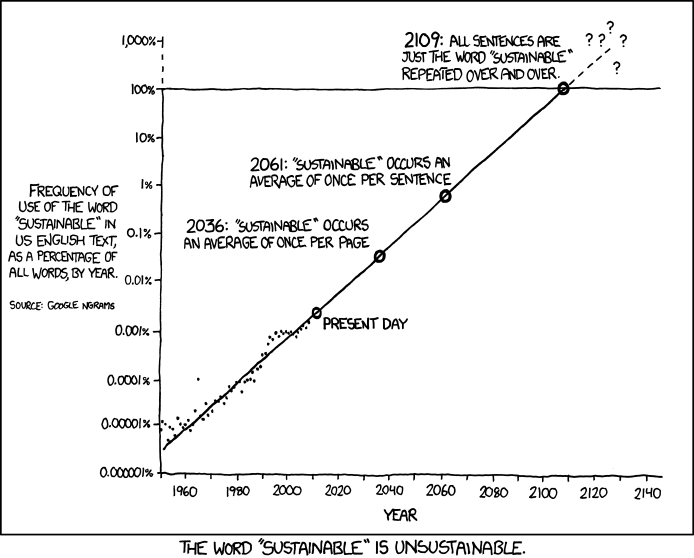
XKCD: Unsustanable!


Quote of the Day: Light in the Brain.

On September 8 Edison saw the light. This was only the first in a chain of stimulations, however. Inside Edison’s head the pulse of light was converted into a neurological flash, and this internal illumination, in the marvelous mental reconfiguring we call inspiration, became a vision of what would later become the electrical grid.
He would invent not merely a better lamp, he would invent a system. The lamps would be mass produced and would come in many forms. The system of energy and lamp and fixture would be served by a centralized power source and a branching distribution grid. The same wires would bring energy to other machines.

Schewe, Phillip F. (Contribution by). Grid : A Journey Through the Heart of Our Electrified World. Washington, DC, USA: Joseph Henry Press, 2007. p 35.

Post hoc ergo propter hoc. There's no evidence that Edison invented the whole system in one flash of inspiration. Further, years of his documented experiments show a concept in development, not a mere implementation of a pre-determined concept.

Seeing without recognition.

A paper in Cognition describes a series of experiments where participants had to search through a heap of overlapping items. To locate the target, they had to 'unpack' the heap by moving objects aside. It turns out, a purely mechanical task of moving things aside interferes with the process of recognition, as if the motor system dictates the pace of mental work to the rest of the brain.
We report that during this task participants often fail to recognize the target despite moving it, and despite having looked at the item. The rate of this ‘unpacking error’ was minimally affected by set size and dual task manipulations, but was strongly influenced by perceptual difficulty and perceptual load. We suggest that the error occurs because of a dissociation between perception for action and perception for identification, providing further evidence that these processes may operate relatively independently even in naturalistic contexts, and even in settings like search where they should be expected to act in close coordination.
Grayden J.F. Solman, et. al. 2011. Found and missed: Failing to recognize a search target despite moving it. http://dx.doi.org/10.1016/j.bbr.2011.03.031
From a practical perspective, having large working surfaces, e.g. desks or screens, can improve recognition (or intuitive judgement) because there's no need to move things around in order to find what you are looking for. (The Whiteboard Effect?) In clutter situations machine-based search should be more effective than human-based one.

tags: detection, psychology, brain, information, control

Twitter bots as community organizers.

Human copycat behavior can be exploited to increase social interaction online. When social bots start following and retwitting members of a group of real people, the rate of following among the group increases as well.
January 23, 2012. MTR -- a group of freelance Web researchers has created more sophisticated Twitter bots, dubbed "socialbots," that can not only fool people into thinking they are real people, but also serve as virtual social connectors, speeding up the natural rate of human-to-human communication.

...the group tracked 2,700 Twitter users, divided into randomly assigned "target groups" of 300, over 54 days.

On average, each bot attracted 62 new followers and received 33 incoming tweets (mentions and retweets). But Hwang and his colleagues also found that the human-to-human activity changed within the target groups when the socialbots were introduced. They noted a 43 percent increase in follows, compared to the control period averaged over all the groups. However, one group exhibited a 355 percent increase in this connection rate. 
Could it be that twitter is as contagious as laughing?

 tags: social, networking, psychology, 10X, biology, information

Friday, February 03, 2012

Finally, some good news for solar energy.

Because the electric grid in India is unreliable and solar panels keep getting cheaper,  renewable energy becomes economically competitive with local diesel generators.

Feb 2, 2012. The New Scientist -- A quarter of people in India do not have access to electricity, according to the International Energy Agency's 2011 World Energy Outlook report. Those who are connected to the national grid experience frequent blackouts. To cope, many homes and factories install diesel generators.

Now the generators could be on their way out. In India, electricity from solar supplied to the grid has fallen to just 8.78 rupees per kilowatt-hour compared with 17 rupees for diesel.

The one thing stopping households buying a solar panel is the initial cost, says Amit Kumar, director of energy-environment technology development at The Energy and Resources Institute in New Delhi, India. Buying a solar panel is more expensive than buying a diesel generator, but according to Chase's calculations solar becomes cheaper than diesel after seven years.

tags: system, evolution, mousetrap, energy, source, distribution

Invention of the Day: AC Electricity Distribution.


Today's system for delivering AC electricity to lights and devices was invented over one hundred years ago by Charles Proteus Steinmetz. By the early 20th century, his inventions, in combination with Tesla's AC motor and long-distance power lines, had displaced Edison's original DC designs.

In addition to that, Steinmetz pioneered corporate research as a model for systematically producing innovations. In the early 1900s, he convinced General Electric to open up its first research facility, which was built literally in Steinmetz backyard. Eventually, both his AC system and corporate lab had become exemplars for others to follow.

tags: invention, innovation, research, business, model

I thank Paul Grant for telling me the story of C.P. Steinmetz.

LunchTalk: (@Google) Best and worst bosses.

Stanford Professor Robert Sutton weaves together the best psychological and management research with compelling stories and cases to reveal the mindset and moves of the best (and worst) bosses. This book was inspired by the deluge of emails, research, phone calls, and conversations that Dr. Sutton experienced after publishing his blockbuster bestseller "The No Asshole Rule."


link

tags: lunchtalk, business, management

Russian Revolution: Angry Birds vs The Kremlin

Public protest in Russia over rigged parliamentary elections draws on a popular game as a metaphor for action. The vote-stealing pigs in the Kremlin must go!

Thursday, February 02, 2012

Lunchtalk: (TED) Swarms of robots.

Mick Mountz revolutionized the way warehouses pack and ship their inventory by using robots, mobile shelving, and algorithms based on complexity theory. What used to take hours of tedious tasks is transformed into fun, 15-minute, click-to-ship order processing.


link

tags: lunchtalk, distribution, control, source, payload,

Wednesday, February 01, 2012

The impossible task of being a lonely teenager

The Snob, a Russian online magazine, has a story about impact of social/digital loneliness on teenagers (in Russian). Katerina Murashova, MD, asked 68 teenagers, 31 boys and 37 girls aged between 12 and 18, to spend 8 hours without talking to their friends or using electronic devices, phones, PCs, TVs, etc. Instead, the participants were allowed to engage in various solitary activities: board games, writing, arts and crafts, playing a musical instrument, walking, etc. Each participant could drop out of the experiment, should his or her experience become psychologically difficult.

Out of 68 participants, only 3 (2 boys and 1 girl) managed to last the required 8 hours. Another 7 survived 5 hours of loneliness, while the rest dropped out of the experiment within the first 1-3 hours. Every participant reported high levels of stress, including anxiety attacks.

This study reminds me of the famous Marshmallow Experiment conducted at Stanford in 1972. It looks like today's teenagers have the same problem as American 4-year-olds forty years ago - they have trouble distracting themselves from a highly desired object or experience.

tags: psychology, interaction


Pop culture and the great American divide.


In a NYT column David Brooks reviews Charles Murray’s book “Coming Apart.” He talks about the great social divide between two tribes of Americans:
... there are vast behavioral gaps between the educated upper tribe (20 percent of the country) and the lower tribe (30 percent of the country). This is where Murray is at his best, and he’s mostly using data on white Americans, so the effects of race and other complicating factors don’t come into play.
Roughly 7 percent of the white kids in the upper tribe are born out of wedlock, compared with roughly 45 percent of the kids in the lower tribe. In the upper tribe, nearly every man aged 30 to 49 is in the labor force. In the lower tribe, men in their prime working ages have been steadily dropping out of the labor force, in good times and bad.
I've started reading Murray's book and the data he presents looks both impressive and disturbing. It's also disturbing to see how popular media exploits the upper/lower tribe stereotypes to sell its product. See for example, how the new Britney Spears music video presents a conflict over a girl between an abusive upper tribe hipster and a lower tribe waiter.


tags: culture, social, media, information

Why Thomas Edison? It's the light bulb, stupid.

Jan 26, 2012. CNet -- Edison, the creator of the light bulb and phonograph, among many other inventions, earned the top title among 52 percent of those polled by Lemelson-MIT, a program that tries to honor inventors who have improved our lives and gauge peoples' perceptions about innovation.

Since Edison did not create the light bulb and his phonograph failed miserably as a practical innovation, it's hard to understand why young people chose him as the greatest innovator of all time. Further, I'm really surprised that Henry Ford, the creator of the mass production system, didn't make the list at all.

It would be interesting to see whether the results of the poll would be different, if people thought about important inventions/innovations first, and then matched them to the names of their creators. For example, today's energy system is based largely on Nikola Tesla's inventions and entrepreneurial efforts of George Westinghouse. When we consider the world of information and IT, the integrated circuit should win the invention race hands down. Robert Noyce would be the primary inventor, while Andy Grove the innovator. In communications, wireless and optical transmission of information is absolutely essential to the modern civilization (Tesla, Marconi, Gould, Chambers, and others.) In medicine, invention of the vaccine saved billions of lives (Jenner), etc...

Would Edison top the list if we used an outcome-based logic for selecting great inventors and innovators? I doubt it very much.

tags: invention, innovation, detection
 

LunchTalk: (TED) Global Crime Networks

Journalist Misha Glenny spent several years in a courageous investigation of organized crime networks worldwide, which have grown to an estimated 15% of the global economy. From the Russian mafia, to giant drug cartels, his sources include not just intelligence and law enforcement officials but criminal insiders.

link

tags: lunchtalk, security, control, networking