tags: interface, computers, interaction, lunchtalk,
Showing posts with label computers. Show all posts
Showing posts with label computers. Show all posts
Friday, February 01, 2013
Lunch Talk: Human Computer Interaction (UC Berkeley)
This is lecture 13 from UC Berkeley Computer Science 10 (CS 10) course.
tags: interface, computers, interaction, lunchtalk,
tags: interface, computers, interaction, lunchtalk,

Tuesday, July 24, 2012
Lunch Talk: (@TED) The Greatest Machine That Never Was.
The computer was invented in the 30s: not the 1930s, but the 1830s. British mathematician Charles Babbage designed and prototyped a fully functional mechanical computer he called the Analytical Engine, but it was never completed. Now a team in Britain plans to build the machine for display at London's Science Museum before the 2030s come around.
Link
P.S. You can find a working model of the Babage Engine, along with other fascinating computer-related innovations, at the Computer History Museum in Mountain View, CA.
tags: computers, history, lunchtalk
Sunday, July 31, 2011
Evolution of personal computing in one simple picture.
An interesting picture (borrowed somewhere on the web) showing Apple form factor evolution from 1976 to 2007 (click to enlarge).

Since I'm interested in functional, rather than form factor transitions, I can see two major shifts.
The first one, from a command-line general purpose calculator in approximately 1980 (Apple III) to a document- or file-processing machine in 1983 (Apple IIe). Note that the two-dimensional nature of the document required a mouse.
The second one, from a two-dimensional document processor/manager to a content stream device in 2007 with iPhone. Of course, it's impossible to show a mouse replacement - the new zoom-pan interface suitable for interacting with streams.
What's not visible on this picture? Wireless network! A key element in the transition between phase 1 and 2.
tags: system, evolution, payload, tool, interface, 10x, mobile, distribution, apple, information, computers, function

Since I'm interested in functional, rather than form factor transitions, I can see two major shifts.
The first one, from a command-line general purpose calculator in approximately 1980 (Apple III) to a document- or file-processing machine in 1983 (Apple IIe). Note that the two-dimensional nature of the document required a mouse.
The second one, from a two-dimensional document processor/manager to a content stream device in 2007 with iPhone. Of course, it's impossible to show a mouse replacement - the new zoom-pan interface suitable for interacting with streams.
What's not visible on this picture? Wireless network! A key element in the transition between phase 1 and 2.
tags: system, evolution, payload, tool, interface, 10x, mobile, distribution, apple, information, computers, function
Tuesday, July 19, 2011
Ripping off for fun and profit.
"Jobs was angry because he felt that Android was ripping off the key features of the iPhone."
Nowadays, Mark Zuckerberg probably feels the same. With Wave and Buzz, Google's home-grown attempts at social networking, Google tried to use gmail to get people into their user base. It didn't work because Wave and Buzz had interfaces and functionality very different from Facebook, a dominant design in the social networking space at the time. People decided not to move into an unfamiliar territory.
Now, with some tweaks, the new Google+ service is an obvious ripoff of Facebook, with a little bit of LiveJournal functionality - circles instead of friendlists - thrown in. It feels familiar, it looks familiar, it acts familiar. People seem to be moving in in millions.
Innovation by ripoff appears to be a winning business strategy for Google. They've done it with other major commercially successful products: Overture (text ads model - AdWords), Yahoo Maps (Google Maps), Youtube (acquisition after Google Video failed), iPhone (Android), and now Facebook (Google+). In many ways, this is similar to what Microsoft did in the 1980s and 90s - use their dominant operating system as leverage and a cash cow to rip off successful technologies: integrated software development tools, Windows PC interface, video gaming machine, office suite software, web browser, database/SQL solutions, and others.
No wonder Steve Jobs was angry about Android. It probably felt like a déjà vu, though this time it was Google, not Microsoft, ripping off Steve's ideas.
By the way, if you are into vintage bumper stickers, there's one for you on eBay right now:

tags: innovation, technology, business, model, platform, computers, history, microsoft, apple, google, facebook, social, networking, information
Friday, July 08, 2011
Business model innovation: scutage.
At around 1100, English king Henry II conducted a number of financial and administrative reforms, which allowed him to create a well-trained professional army and conquer territories far beyond the British Isles. Here's how it was implemented:
What are the advantages of the new vs the old military service model?
The first advantage would be a greater degree of specialization, which is a common attribute of almost any successful business model innovation. With the introduction of scutage, the barons could specialize in making money, e.g. by improving agriculture, crafts, and trade within their domains, while the king could specialize in soldier selection, training, and military strategy.
Another one, would be a greater control over resources. The barons could now control the timing and scope of labor use, which in the old model could've been taken away from them at arbitrary times, e.g. during harvest gathering or seasonal forest clearing for agricultural needs. At the same time, the king gained direct control over army mobilization time, which in the old model depended on the willingness and ability of barons to provide requested manpower according to the kings needs.
Finally, scoutage led to growth of a new class of professionals - mercenaries whose only purpose in life was warfare.
The structure of this business innovation is similar to the transition undergone by the computer industry in the 1970-80s: from IBM enterprise model, where software and hardware were provided as one package with a series of periodic custom updates, to PC-based shrink-wrap software sales, a model Microsoft eventually rode to world dominance in 1980-90s. In both cases we saw a replacement of obligation-specific (in kind) transactions with obligation-generic (money) ones. As a consequence, a new class of specialists developed, mercenaries in the beginning 12th century, pure software firms in the end of the 20th century.
tags: business, model, innovation, history, software, industry, information, technology, computers
Rather than relying on the customary military services of forty days owed him annually by his tenants-in-chief with their retainers, he began insisting that these feudal services should be commuted into a cash payment or ‘scutage’ (from the Latin, ‘scutum’, a shield), a process as welcome to the barons as to Henry’s finances. With the proceeds Henry was thus able to build up a more reliable and more mobile, permanent professional army of mercenaries, or ‘soldiers’ as they became known thereafter, from the ‘solidus’ or king’s shilling that they earned.
History of Money, by Glyn Davies. p. 142.
History of Money, by Glyn Davies. p. 142.
What are the advantages of the new vs the old military service model?
The first advantage would be a greater degree of specialization, which is a common attribute of almost any successful business model innovation. With the introduction of scutage, the barons could specialize in making money, e.g. by improving agriculture, crafts, and trade within their domains, while the king could specialize in soldier selection, training, and military strategy.
Another one, would be a greater control over resources. The barons could now control the timing and scope of labor use, which in the old model could've been taken away from them at arbitrary times, e.g. during harvest gathering or seasonal forest clearing for agricultural needs. At the same time, the king gained direct control over army mobilization time, which in the old model depended on the willingness and ability of barons to provide requested manpower according to the kings needs.
Finally, scoutage led to growth of a new class of professionals - mercenaries whose only purpose in life was warfare.
The structure of this business innovation is similar to the transition undergone by the computer industry in the 1970-80s: from IBM enterprise model, where software and hardware were provided as one package with a series of periodic custom updates, to PC-based shrink-wrap software sales, a model Microsoft eventually rode to world dominance in 1980-90s. In both cases we saw a replacement of obligation-specific (in kind) transactions with obligation-generic (money) ones. As a consequence, a new class of specialists developed, mercenaries in the beginning 12th century, pure software firms in the end of the 20th century.
tags: business, model, innovation, history, software, industry, information, technology, computers
Monday, June 20, 2011
Invention of the day: Retail Shop.
Money is arguably the oldest technology that gets reinvented all the time. The invention of coinage by the Lydians in the 6th century BC helped create the ancient Greek civilization, the progenitor of today's Western world. Being great traders, the Lydians also invented a major modern business model - permanent retail shop. Before that, retail trade was conducted either in temporary markets or door-to-door. Only recently, some two and a halve thousand years later, the "brick-and-mortar" retail model invented by the Lydians was successfully challenged by the likes of amazon.com and Apple's app store.
Compared to temporary market stalls, Lydian shops were the equivalent of today's high-frequency trading brokerage houses, and were greatly helped by another invention, a sophisticated sexagecimal computation system:

The system allowed bankers and traders perform computational operations with large numbers of coins, by converting them from a large number of small-value units to much smaller number of large-value ones. For example, if you earned your money in obols and didn't know much math, which was quite common at the time, you could still figure out how much you made in your newly invented brick-and-mortar retail operation, by converting obols into drachmas, staters, minas, and talents. This new computational ability is somewhat similar to the invention, in the 17th century, of the logarithm, a mathematical concept that helped simplify complex multiplication operations in military and engineering applications during the Renaissance, Industrial Revolution, and beyond.
Back to the ancient Greeks, people who made lots of money were "talented". I'm not joking. The etymology of the modern word "talent" goes back to the money-related ancient Greek term talanton. A copper sheet of about 60 lb in weight, something an average man could comfortably carry, was equivalent in value to a talent. A stronger man could carry more talents, thus the connection with the contemporary notion of a natural advantage, which, in turn, found its another incarnation in a common saying, If you are so smart, why aren't you rich.
* Coin conversion table from the book "A History of Money: From Ancient Times to the Present Day", by Glyn Davies.
tags: commerce, invention, business, model, system, computers, information, money, history, scale, 10x
Compared to temporary market stalls, Lydian shops were the equivalent of today's high-frequency trading brokerage houses, and were greatly helped by another invention, a sophisticated sexagecimal computation system:
The system allowed bankers and traders perform computational operations with large numbers of coins, by converting them from a large number of small-value units to much smaller number of large-value ones. For example, if you earned your money in obols and didn't know much math, which was quite common at the time, you could still figure out how much you made in your newly invented brick-and-mortar retail operation, by converting obols into drachmas, staters, minas, and talents. This new computational ability is somewhat similar to the invention, in the 17th century, of the logarithm, a mathematical concept that helped simplify complex multiplication operations in military and engineering applications during the Renaissance, Industrial Revolution, and beyond.
Back to the ancient Greeks, people who made lots of money were "talented". I'm not joking. The etymology of the modern word "talent" goes back to the money-related ancient Greek term talanton. A copper sheet of about 60 lb in weight, something an average man could comfortably carry, was equivalent in value to a talent. A stronger man could carry more talents, thus the connection with the contemporary notion of a natural advantage, which, in turn, found its another incarnation in a common saying, If you are so smart, why aren't you rich.
* Coin conversion table from the book "A History of Money: From Ancient Times to the Present Day", by Glyn Davies.
tags: commerce, invention, business, model, system, computers, information, money, history, scale, 10x
Friday, February 25, 2011
Will we see a similar ad for computer scientists?
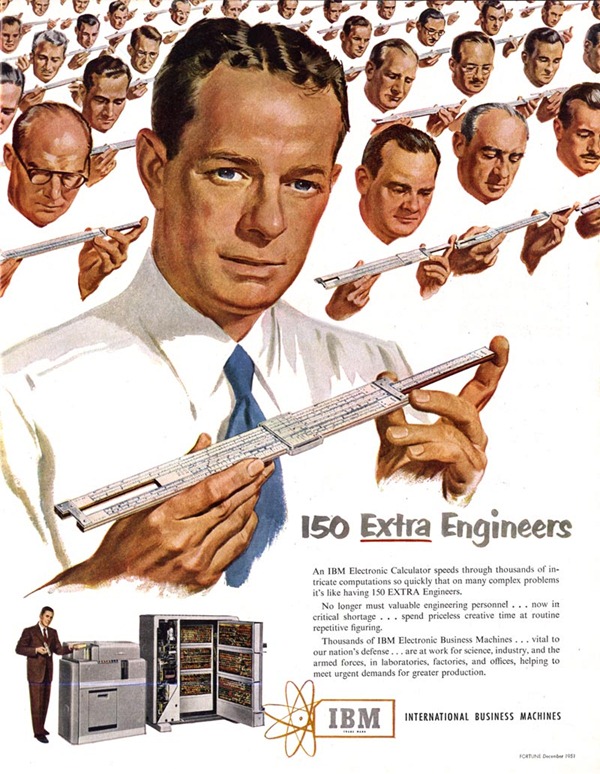
The ad's text says:
150 Extra Engineers
An IBM Electronic Calculator speeds through thousands of intricate computations so quickly that on many complex problems it’s like having 150 EXTRA Engineers.
Source: http://www.globalnerdy.com/2009/08/10/old-ibm-ad-150-extra-engineers/
tags: technology, innovation, business, computers, evolution
Tuesday, January 25, 2011
Ultimate cloud computing
Wired writes about a new supercomputing intelligence device in the skies above Afghanistan:
Besides military and law enforcement applications, can we use this technology for improving wireless data communications for mobile devices, e.g. during large public events? Probably, yes. Unlike drones, a blimp in the sky would work better as a local network hub than a communications satellite, just hang a bunch of antennas and solar panels on it. Even better, make the whole thing out of a solar power-generating fabric.
tags: cloud, computers, communications, military, privacy, video, mobile, dynamic, system, control, drones, energy
It’ll be floating 20,000 feet above the warzone, aboard a giant spy blimp that watches and listens to everything for miles around.
 The idea behind the Blue Devil is to have up to a dozen different sensors, all flying on the same airship and talking to each other constantly. The supercomputer will crunch the data, and automatically slew the sensors in the right direction: pointing a camera at, say, the guy yapping about an upcoming ambush.
The goal is to get that coordinated information down to ground troops in less than 15 seconds.
===
 The idea behind the Blue Devil is to have up to a dozen different sensors, all flying on the same airship and talking to each other constantly. The supercomputer will crunch the data, and automatically slew the sensors in the right direction: pointing a camera at, say, the guy yapping about an upcoming ambush.
The goal is to get that coordinated information down to ground troops in less than 15 seconds.
===
Besides military and law enforcement applications, can we use this technology for improving wireless data communications for mobile devices, e.g. during large public events? Probably, yes. Unlike drones, a blimp in the sky would work better as a local network hub than a communications satellite, just hang a bunch of antennas and solar panels on it. Even better, make the whole thing out of a solar power-generating fabric.
tags: cloud, computers, communications, military, privacy, video, mobile, dynamic, system, control, drones, energy
Monday, January 17, 2011
Wikipedia 3.0.
Turing (1950) argued that we would certainly regard a machine as intelligent if it could pass the following test: An experimenter sits in a room with two teletypes by which she conducts a “conversation” with two systems. One is a human, the other is a machine, but the experimenter is not told which is which. If, after asking many questions, she is likely to have much doubt about which is human and which is machine, we should, says Turing, concede intelligence to the machine. The Handbook of Brain Theory and Neural Networks. 2nd ed. MIT Press. p13.
Given a recent demonstration of IBM's Watson on Jeopardy, the only thing that's missing from machine intelligence is speech synthesis. It's sounds especially funny when the machine selects a question from the "Chicks dig me" category :)
tags:information, control, intelligence, tool, science, computers
Monday, November 01, 2010
Второй раз на те же грабли
The latest numbers on mobile software are in:
For the second time in its history Apple created a computing platform, PC being the first one, and for the second time they could not hold the advantage. Unbelievable.
tags: mobile, evolution, business, apple, google, microsoft, computers, software, control point
Google's Android platform was running on 43.6 percent of all the smartphones purchased in the United States in the third quarter. It was followed by Apple's iOS, which captured 26.2 percent market share, and Research In Motion's OS, which tallied 24.2 percent share. Microsoft's mobile OS held 3 percent market share in the quarter.
For the second time in its history Apple created a computing platform, PC being the first one, and for the second time they could not hold the advantage. Unbelievable.
tags: mobile, evolution, business, apple, google, microsoft, computers, software, control point
Friday, June 18, 2010
1963. A demo of a Graphical User Interface with the computer. During the interview, the reporter asks, "Can the computer work with a three-dimensional object?"
Isn't it amazing how in 50 years breakthrough ideas become "obvious".
tags: interface, computers, information, history, example, technology, video
Isn't it amazing how in 50 years breakthrough ideas become "obvious".
tags: interface, computers, information, history, example, technology, video
Saturday, February 20, 2010
The state of the net: no privacy, no security.
The Wall Street Journal reports:
Note that Facebook has emerged as the number one risk to privacy and security. Our electronic immune system is way behind the new information-based lifestyle.
via CNet.
tags: control, security, problem, evolution, intellectual, property, integrity, information, computers, internet
Hackers in Europe and China successfully broke into computers at nearly 2,500 companies and government agencies over the last 18 months in a coordinated global attack that exposed vast amounts of personal and corporate secrets to theft, according to a computer-security company that discovered the breach.
...hackers gained access to a wide array of data at 2,411 companies, from credit-card transactions to intellectual property.

...hackers gained access to a wide array of data at 2,411 companies, from credit-card transactions to intellectual property.

Note that Facebook has emerged as the number one risk to privacy and security. Our electronic immune system is way behind the new information-based lifestyle.
via CNet.
tags: control, security, problem, evolution, intellectual, property, integrity, information, computers, internet
Saturday, February 13, 2010
The unstoppable cloud
According to Goldman Sachs, bad economic times are good for rethinking IT infrastructure:
tags: cloud, infrastructure, system, evolution, information, computers, business, distribution, tool
... the macroeconomic downturn has likely accelerated software-as-a-service, or cloud, adoption, as customers are forced to look for lower-cost solutions to mission-critical business problems. Forty percent of survey respondents indicated that they would be more likely to use SaaS solutions in a weaker economy, due to perceived cost benefits, while only 4 percent said they were less likely to use an SaaS solution.
tags: cloud, infrastructure, system, evolution, information, computers, business, distribution, tool
Monday, February 08, 2010
Saturday, February 06, 2010
The iPad paradox
Up until now, Steve Jobs had been incredibly successful at introducing the public to truly revolutionary devices disguising them as familiar products. For example, iPod was positioned as a better , much better, incarnation of a traditional audio player, either CD or MP3. In reality, it was a device that in combination with iTunes allowed for a completely new level of functionality in creation, transfer, and sharing of collections of music: intuitive custom playlists, podcasts, audio library navigation, and etc. Compared with competition, i.e. conventional audio players, iPod looked like a na'vi among humans. It was a revolutionary system, but it felt familiar enough for people to try and learn to love.
Then came iPod Touch and iPhone. Again, they were presented to the public as greatly improved versions of iPod and mobile phone, respectively. But in both cases audio content play-out and communications were just a couple of software applications on a great multi-functional mobile computer. The combination of iPhone and iTunes was a different animal altogether, but it was disguised as a better phone+web system. These new Apple gadgets got rapidly adopted by consumers because they felt very familiar with basic functionality and the form factor. It was easy for everybody to try Apple's new technology and then experience the difference. You'd buy an Apple product as a replacement for your old player or cell phone, and later discover a totally new mode of interaction with the world of information.
But iPad is different. Really different. It can't be bought as a replacement. It's not a PC, smartphone, netbook, e-book, picture frame, TV, or whatever. It's a new thing that, unlike Apple's other revolutionary products, feels completely unfamiliar. Bummer! No wonder, people are confused. They can't say, "iPad is just like my pre-school dream picture book, only much-much better."
tags: dilemma, problem, solution, apple, information, computers, psychology, diffusion
Wednesday, January 20, 2010
An improved deal for authors from Amazon:
Will authors make more money from now on? Maybe, initially. But over time, the most likely outcome will be a steep drop in price for electronic books. Trade "paperbacks" will probably go down to the $3-5 range. Even at this level authors will make more money than with traditional publishers. We should also expect new formats that allow embedded media: video, audio, animations, and etc. One obvious choice would be a portable $1 application that feeds content, e.g. one episode at a time. Apple is already doing it with iTunes, and publishers, like New York Times or cable networks, will follow the model.
In 5-element analysis terms, this is a change in payload packaging, which usually precedes an expansion and drastic changes in other system elements.
tags: system, five element analysis, content, apple, information, computers, payload, evolution
Starting on June 30, Amazon says that for each Kindle book sold, authors and publishers who select the new 70 percent royalty option will receive 70 percent of the list price, minus delivery costs. This new option will be in addition to and will not replace the existing DTP standard royalty option, which is set at a 65-35 split, with 65 percent going to Amazon.
Will authors make more money from now on? Maybe, initially. But over time, the most likely outcome will be a steep drop in price for electronic books. Trade "paperbacks" will probably go down to the $3-5 range. Even at this level authors will make more money than with traditional publishers. We should also expect new formats that allow embedded media: video, audio, animations, and etc. One obvious choice would be a portable $1 application that feeds content, e.g. one episode at a time. Apple is already doing it with iTunes, and publishers, like New York Times or cable networks, will follow the model.
In 5-element analysis terms, this is a change in payload packaging, which usually precedes an expansion and drastic changes in other system elements.
tags: system, five element analysis, content, apple, information, computers, payload, evolution
Tuesday, January 19, 2010
The recent episode of hacking against Google and other US companies highlights an emerging problem: supply chain security. Since US consumers, corporations, and the military import most of their electronic gadgets from overseas, it is highly advantageous for hackers to plant viruses and sleeper exploits into the gadgets themselves or their components sometime during the production/distribution cycle.
Products and components are now "intelligent". That is, by design their behavior changes over the lifetime of the system, e.g. by hosting or executing new software. The old supply chain security and quality control took care of material or structural defects. The new one should learn how to deal with threats that are much more intelligent and fluid.
* I remember an episode from my work at a Fortune 500 corporation when I had to re-image a new laptop. I did a clean install, but the first thorough virus scan of the system revealed a backdoor trojan that came "pre-packaged" on an official corporate OS distribution disc.
tags: security, information, control, system, evolution, computers, google
A year ago, Insignia digital picture frames were pulled from shelves and online sites after Best Buy learned they could be carrying a virus. Also reported to be infected then were digital frames from Advanced Design System, Digital Spectrum, and Castleton. But digital frames aren't the only electronic items found to carry a hidden payload. Other malware-infected devices have included MP3-playing sunglasses, a flip video camera, and Maxtor external hard drives, according to the SANS Internet Storm Center.*
Products and components are now "intelligent". That is, by design their behavior changes over the lifetime of the system, e.g. by hosting or executing new software. The old supply chain security and quality control took care of material or structural defects. The new one should learn how to deal with threats that are much more intelligent and fluid.
* I remember an episode from my work at a Fortune 500 corporation when I had to re-image a new laptop. I did a clean install, but the first thorough virus scan of the system revealed a backdoor trojan that came "pre-packaged" on an official corporate OS distribution disc.
tags: security, information, control, system, evolution, computers, google
Friday, January 08, 2010
With power supply being a major datacenter cost driver, Google steps in to become an electric power marketer:
Looking beyond data center applications, future smart grid power meters are going to generate lots of information. Access to and processing of this information would be consistent with the overall Google's mission to "organize the world's information". To speculate further, Google could become a catalyst for the next generation auction-based power market, similar to the one they run for their keyword search adds.
tags: energy, information, market, control, computers, google, efficiency, magicians, five element analysis,
The Internet search company, which consumes vast amounts of electricity to run the computers in its data centers, created a subsidiary last month called Google Energy. It then applied for approval from the Federal Energy Regulatory Commission to be allowed to buy and sell power much like utilities do.
Google said it did not have specific plans to become an energy trader and that its primary goal was to gain flexibility for buying more renewable energy for its power-hungry data centers.
Google said it did not have specific plans to become an energy trader and that its primary goal was to gain flexibility for buying more renewable energy for its power-hungry data centers.
Looking beyond data center applications, future smart grid power meters are going to generate lots of information. Access to and processing of this information would be consistent with the overall Google's mission to "organize the world's information". To speculate further, Google could become a catalyst for the next generation auction-based power market, similar to the one they run for their keyword search adds.
tags: energy, information, market, control, computers, google, efficiency, magicians, five element analysis,
Tuesday, January 05, 2010
Looking beyond the 3D hype
More news about 3D:
I predict that in three years BluRay+3D will be a standard feature on high- and even medium-end PCs. All it takes is a slightly better graphics card, some clever software, and availability of content. Also, I wouldn't be surprised if the porn industry jumps onto the 3D bandwagon.
Strategically, the entertainment industry has a chance to pull away from youtube amateurs and initiate the next round of video arms race. The price of equipment and skill required to produce 3D is still beyond what most of the people used to flip cameras can afford money and time-wise.
Nevertheless, fairly soon prosumers will be able to take still 3D pictures. After Avatar, the visual art is no longer about flat images. Rather its about the real or virtual world as we would it with our own eyes.
tags: content, entertainment, information, computers, evolution, system, payload, tool
ESPN and Discovery Communications announced plans Tuesday[1/5/10] to launch the industry's first 3D television networks.
The sports programmer will introduce a 3D network this summer, while Discovery is joining forces with Sony and Imax for a 3D network to launch in 2011.
The sports programmer will introduce a 3D network this summer, while Discovery is joining forces with Sony and Imax for a 3D network to launch in 2011.
I predict that in three years BluRay+3D will be a standard feature on high- and even medium-end PCs. All it takes is a slightly better graphics card, some clever software, and availability of content. Also, I wouldn't be surprised if the porn industry jumps onto the 3D bandwagon.
Strategically, the entertainment industry has a chance to pull away from youtube amateurs and initiate the next round of video arms race. The price of equipment and skill required to produce 3D is still beyond what most of the people used to flip cameras can afford money and time-wise.
Nevertheless, fairly soon prosumers will be able to take still 3D pictures. After Avatar, the visual art is no longer about flat images. Rather its about the real or virtual world as we would it with our own eyes.
tags: content, entertainment, information, computers, evolution, system, payload, tool
Monday, December 07, 2009
Wikipedia knows everything. It even remembers the list of unusual software bugs. My favorite one is Schroedinbug:
The funny thing is that the concept is completely in agreement with John Searle's theory of Social Reality. The theory says that we create the reality by collectively believing in it. For example, paper or any other kind of money has value only because we all believe that it has value. In football, a team gets 6 points for a touchdown because everybody, including the opposing team, agrees that the touchdown is worth exactly 6 points.
I think schroedingbug works somewhat differently, though. Once it's noticed, people try to fix it and, due to a multitude side effects, the whole system promptly falls apart.
tags: construction, philosophy, computers, network, background, artifact, problem
A schroedinbug is a bug that manifests only after someone reading source code or using the program in an unusual way notices that it never should have worked in the first place, at which point the program promptly stops working for everybody until fixed.
The funny thing is that the concept is completely in agreement with John Searle's theory of Social Reality. The theory says that we create the reality by collectively believing in it. For example, paper or any other kind of money has value only because we all believe that it has value. In football, a team gets 6 points for a touchdown because everybody, including the opposing team, agrees that the touchdown is worth exactly 6 points.
I think schroedingbug works somewhat differently, though. Once it's noticed, people try to fix it and, due to a multitude side effects, the whole system promptly falls apart.
tags: construction, philosophy, computers, network, background, artifact, problem
Subscribe to:
Comments (Atom)