Showing posts with label triz. Show all posts

Sunday, January 01, 2012

How Anesthesia Changes Mind.

Studying human brain under anesthesia presents not only ethical, scientific, and philosophical problems, but also involves some down-to-earth technological challenges. For example, it's difficult to collect and correlate people's different types of vital signs, both from brain imaging and more traditional collection techniques. Here's how engineers and scientists managed to solve the problem.
January 1, 2012. MTR -- Brain imaging in human subjects undergoing anesthesia is tricky because it requires anesthetizing people within a scanner and outside a normal operating room. Brown and his colleagues found a way to solve the technical and safety problems: they recruited volunteers who had already received tracheostomies, or surgical holes in the throat. That meant a tube could readily be used to restore their breathing in an emergency. In 2009, the researchers demonstrated that they could safely record both EEG and fMRI data on people under anesthesia; now they are working to correlate the imaging and EEG data with the observable changes seen as patients enter an anesthetized state.
Rather than "modifying" people to make their key vital signs exposed, they found those who's already been "modified" for other purposes. (This approach is generally outlined in Principles 9 through 11 in classical TRIZ problem-solving recommendations. These are instances of Separation in Time from the dilemma resolution techniques.)
Anesthesia studies have already cast doubt on one popular theory, which links consciousness to a particular type of brain wave with a frequency around 40 hertz. Mashour points out that research in anesthesia shows these waves can exist even when patients are unconscious. But the patterns that anesthesiologists see do support another theory: that consciousness emerges from the integration of information across large networks in the brain. 
 I wonder how much of our "everything is a network" thinking is determined by everyday exposure to the Internet. Brain is much more than a network, but we don't have the right words to describe it yet.


tags: mind, brain, biology, philosophy, problem, solution, triz

Saturday, December 17, 2011

3D bio-engineering with magnetic fields.

Problem: growing 3D biological tissues on 2D surfaces flattens the tissues and harms their natural properties.
Solution: float the growing tissues in a magnetic field.

Dec 14, 2011. MTR - Now a new technology, pioneered by Houston-based n3D Biosciences, promises to float cells in a 3-D matrix made of nothing but magnetism.


The secret ingredient is a proprietary mix of nanoparticles the company calls Nanoshuttle. The addition of these particles to a dish of living cells allows them to move in response to magnetic fields that can be varied in three dimensions and across time.


Injection of magnetic particles to improve control over a clump of matter was one of G.Altshuller's favorite problem-solving techniques. There's a whole set of recommended solutions based on this principle in Substance-Field "standards." (in Russian)

tags: triz, biology, problem, solution

Tuesday, November 22, 2011

Solving dilemmas: Odysseus and the Sirens. [Separation in Action]

In two previous posts (1, 2) about the separation principles we considered the dilemma Odysseus encounters when he approaches the island where the three Sirens live:
[Odysseus]... faces a dilemma. On one hand, he wants to listen to the Sirens' song because it is the most beautiful song in the world. On the other hand, he doesn't want to hear the song because it will cause him to forget himself and run his ship into deadly rocks.
In Homer's poem, Odysseus resolves the dilemma in space and I propose another, more modern solution, using separation in time.

The third key TRIZ principle for solving dilemmas is Separation in Action [Interaction]. In the Odysseus dilemma we have two important incompatible interactions: a) listening to the song of the Sirens (Action 1); b) steering the ship away from the rocks (Action 2).

To get the best of both worlds, i.e. experience the song and not crash the ship on the rocks, the actions have to happen in the same space and in the same time, but independently from one another. In other words, the crew, including Odysseus, should be listening to the song (Action 1), and the ship,
independently from the crew, should be steering away from the rocks (Action 2).

A natural implementation of this concept would be a ship that steers itself. For example, the ship can be on auto-pilot or steered by a robot. This solution was not available to Odysseus, but is available to us. Further, a combination of separation in Action and Space can give us steering by remote control ( or by the will of gods.) You can think up other solutions as well.

====


To summarize all three posts: When solving dilemmas it is important to be patient, i.e. deploy slow deliberate thinking, and explore multiple potential solutions using all three separation principles as well as their combinations. Some of the ideas will be ripe for immediate implementation, others for future development. Since patents last 20 years, it usually makes sense to write up all of the ideas, not only the ones that are going to work immediately.

tags: triz, separation, problem, solution, example, strategy

Sunday, November 13, 2011

Solving dilemmas: Odysseus and the Sirens. [Separation in Time]

Last time we considered the dilemma Odysseus encounters when he approaches the island where the three Sirens live:
[Odysseus]... faces a dilemma. On one hand, he wants to listen to the Sirens' song because it is the most beautiful song in the world. On the other hand, he doesn't want to hear the song because it will cause him to forget himself and run his ship into deadly rocks.
In Homer's poem, Odysseus resolves the dilemma in space (see my earlier post). The obvious downside of his solution is that his crew did not get to hear the Sirens' song. That is, only Odysseus tied to the mast experiences it.

Another important TRIZ principle for solving dilemmas is Separation in Time. To get the best of both worlds, i.e. experience the song and not crash the ship on the rocks, everybody on the ship sails safely during the time of the song (Time 1) AND listens to the song when the ship is out of danger (Time 2.)


In other words, while they sail near the Sirens' island, all crew including Odysseus have their ears plugged so that the beautiful song does not distract them from steering the ship safely. As the result, everybody survives the encounter. But how will they hear the beautiful song of the Sirens? By listening to it later, e.g. by having the song recorded during the encounter and playing it back at the crew's convenience.

Of course, audio/video recording was not available at the Odysseus time, but it doesn't mean we should discount the possibility of applying the Separation in Time principle. After all, TiVo and other time-shifting devices are all based on this idea.

tags: triz, separation, problem, solution, example

Friday, November 11, 2011

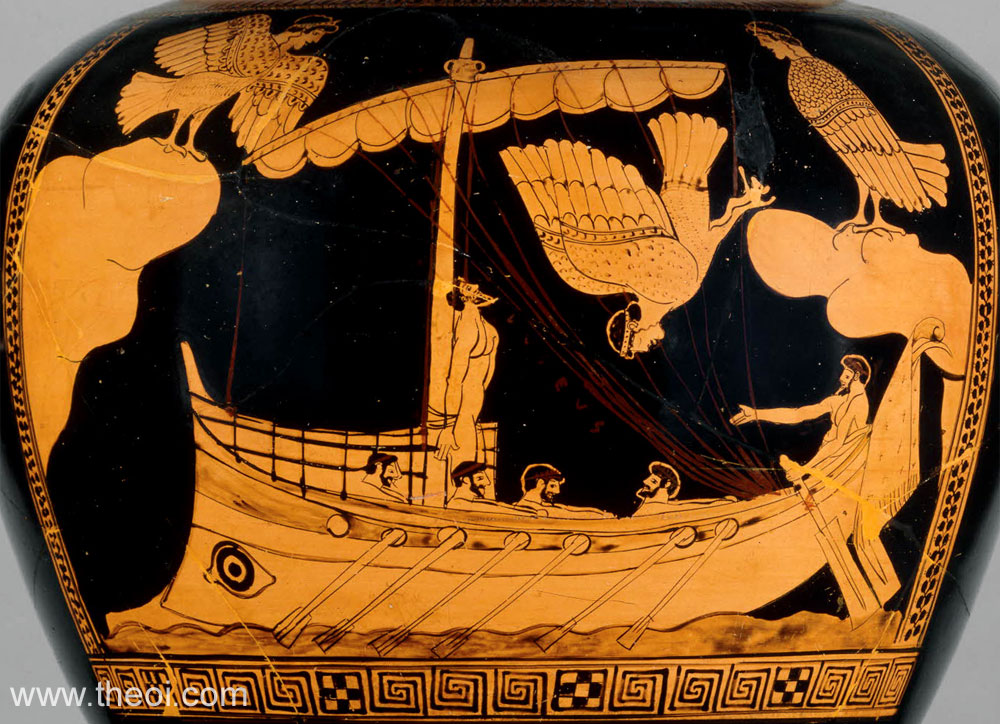
Solving dilemmas: Odysseus and the Sirens. [Separation in Space]

In ancient Greek mythology, the Sirens were sea nymphs who lured sailors to their death with a bewitching song. On his way home from Troy to Ithaca, Odysseus has to sail by the flowery island of Anthemoessa, where the Sirens lived.

The man faces a dilemma. On one hand, he wants to listen to the Sirens' song because it is ones in a lifetime opportunity to experience the most beautiful song in the world. On the other hand, he doesn't want to hear the song because it will cause him to forget himself and steer the ship toward deadly rocks.


Odysseus solves the dilemma by using the Separation in Space principle. To get the best of both worlds, i.e. to hear the song and avoid the deadly rocks, steering should not be mixed with listening. Odysseus, "that ingenious hero who traveled far and wide", tells his crew (Space 1) to plug their ears with wax and do the steering. The crew cannot hear the song and can't run the ship into the rocks. So far, so good.

He also tells the crew to tie him (Space 2) to the mast of the ship, so that when he hears the song he can't take over steering of the ship.

As a result, we've got a Space 1 element (the crew) that does the steering, and Space 2 (Odysseus) element that does the listening. Voilà, the dilemma is solved!

tags: dilemma, problem, solution, separation, triz
P.S. From a behavioral economics point of view, tying oneself to a mast is a commitment device that allows you to overcome the temptation of the present in favor of the future.
P.S.S. Separation in Space is a one of classical TRIZ principles for solving dilemmas. I needed a simple illustration of the principle for my book draft about problem solving methods. This one should probably work.

Tuesday, February 01, 2011

Turning bad ideas into great solutions

Scott Adams, the virtual father–and-mother of Dilbert, writes about an interesting creativity technique:

I spent some time working in the television industry, and I learned a technique that writers use. It's called "the bad version." When you feel that a plot solution exists, but you can't yet imagine it, you describe instead a bad version that has no purpose other than stimulating the other writers to imagine a better version.

For example, if your character is stuck on an island, the bad version of his escape might involve monkeys crafting a helicopter out of palm fronds and coconuts. That story idea is obviously bad, but it might stimulate you to think in terms of other engineering solutions, or other monkey-related solutions. The first step in thinking of an idea that will work is to stop fixating on ideas that won't. The bad version of an idea moves your mind to a new vantage point.

Essentially, the goal is to shift your thinking from a real-world implementation to the outcome you want to achieve by whatever means possible: flying monkeys, gnomes, magic wands, and etc. Maxwell's demons would also be great candidates for implementing a "bad version" that eventually leads to great solutions.

TRIZ has at least two tools to accomplish a similar goal: The Ideal Solution technique and The Gnomes method (often called the Smart Little People method - argh! what an ugly translation from the original Russian Метод Маленьких Человечков).


tags: ideality, creativity, imagination, psychology, triz, method,

Tuesday, May 18, 2010

The will to think.

I pulled the quote below from a 1976 paper by William Shockley, Nobel Laureate, inventor of the junction transistor.

A competent thinker will be reluctant to commit himself to the effort that tedious and precise thinking demands - he will lack “the will to think”- unless he has the conviction that something worthwhile will be done with the results of his efforts -- and, of course, there is always also the risk that his hard thinking may not produce any creative ideas.

A meaningful simplest case stimulates the will to think by reducing the threat of being forced to accomplish repugnant and tedious tasks.

Models often provide such meaningful simplest cases. For example, Copernicus' planetary system was a meaningful simple case that explained a lot of very complex astronomical data. The proverbial apple that fell on Newton's head was instrumental in making the gravitational theory simple and relevant despite all the calculus that had to be invented from scratch to prove the theory.
In my own experience, Altshuller's trade-off resolution technique is the easiest concept to explain in TRIZ. It's also the least powerful one. As a result we have a problem: people perceive something that is used to wake up their "will to think" as the real thing. Which is unfortunate because it prevents them from pursuing better invention methods.

References: W.Shockley. The Path to the Conception of the Junction Transistor. IEEE Transactions in Electronic Devices., Vol ED-23,   No 7,  July 1976.


tags: theory, problem, quote, education, triz, theory

Thursday, December 24, 2009

Chief Belief Officer

Devdutt Pattanaik talks at TED about the role of imagination in human's practice of world transformation. One particular technique, contrasting one-life vs infinite-lives styles of thinking, is similar to TRIZ Size-Time-Cost (STC) operator. The operator helps the imagineer to stretch various dimensions of the problem or object to discover qualitative transitions that otherwise are often missed in "normal" thinking.


Youtube video link here. Fast forward to the 10 minute point.

tags: control, operators, course, imagination, triz, psychology, exercise,10x

Tuesday, May 12, 2009

A good example of a solution to a detection problem: Swiss scientists found a common food sweetener, acesulfame potassium, that does not disintegrate in water treatment processes. Now they can use it to trace sources of the country's water supply.

"We can determine what fraction of waste water ends up groundwater," says Buerge. His study in the lower Glatt valley of Switzerland found that between 10 and 20 per cent of water that was pumped from ground-water aquifers had made its way there from domestic waste water.

Since the water (payload) itself cannot be detected, a stable intermediary (tag) is introduced to solve the problem. ( 28/37 -> principle 24).

Monday, March 16, 2009

In January, 2009, New Scientist published an article about the current debate in evolutionary biology on Darwin's "tree of life". The emerging view is that biological organisms do not form a neat genealogical tree, but rather a network that is ruled by Horizontal Gene Transfer (HGT).
Darwin assumed that descent was exclusively "vertical", with organisms passing traits down to their offspring. But what if species also routinely swapped genetic material with other species, or hybridised with them? Then that neat branching pattern would quickly degenerate into an impenetrable thicket of interrelatedness, with species being closely related in some respects but not others. ...
As more and more genes were sequenced, it became clear that the patterns of relatedness could only be explained if bacteria and archaea were routinely swapping genetic material with other species - often across huge taxonomic distances - in a process called horizontal gene transfer (HGT).
Technology, being closer in complexity to microbes rather than humans, seems to develop by transfer of ideas between different domains. The broker innovation model described in detail in "How Breakthroughs Happen" shows multiple example of solutions transfer from high-tech to low-tech industries. Furthermore, the Theory of Inventive Problem Solving (Russian acronym TRIZ) is built around the concept of repeating invention patterns that can be extracted from patented solutions. Also in this mold is template-based creativity approach proposed in Creativity In Product Innovation.

Though the mainstream innovation literature tends to focus on the personality of the inventor, real invention/innovation research work should be directed toward discovery of solution patterns and their proliferation throughout the technology noosphere.