Showing posts with label evolution. Show all posts

Wednesday, September 27, 2017

Invention of the Day: Hypodermic Syringe

I'm reading a wonderful book by Roger Bridman - 1,000 Inventions and Discoveries. It documents an incredible range of human ingenuity from thousands years ago to our days. For example, here's an invention that we take for granted today: hypodermic syringe.


Remarkably, it was invented by two people in different countries. As the book says, "[in 1853] In Scotland, physician Alexander Wood invented the hollow needle and adapted Pravaz’s device to go with it, forming the first hypodermic syringe." That is, the invention cannot be attributed to each of them separately because a new system — the syringe — provides functionality beyond the sum of its parts. A well-defined interface between the parts, the cylinder and the needle respectively, enabled rapid innovation in manufacturing technologies and use. For example, here's how hollow needles are produced today.


From an innovation timing perspective, we need to be aware that the business success of the new injection technology was determined by a major invention that came about much later.
By the late 1800s hypodermic syringes were widely available, though there were few injectable drugs (less than 2% of drugs in 1905). Insulin was discovered in 1921. This drug had to be injected into the bloodstream, so it created a new market for manufacturers of hypodermic needles and drugs.

Overall, the invention of the hypodermic syringe illustrates a number of important principles for pragmatic creativity:
- a new combination of parts has to produce a new system effect;
- no new science is necessary for making a technology breakthrough;
- a well-defined interface between parts enables rapid innovation on both sides, e.g. the cylinder and the needle;
- the success of the invention comes from a new use, which may require a new science, e.g. liquid penicillin;
- the combination of new parts (cylinder + needle) and use (liquid drug) form Dominant Design and Use patterns that remain stable for decades, if not centuries.

Friday, January 15, 2016

Lunch Talk: (Authors at Google) How New Ideas Emerge

Matt Ridley’s brilliant and ambitious new book in which he explores his considered belief that evolution—in biology, business, technology, and nearly every area of human culture—trumps deliberate and intelligent design.


tags: lunchtalk, creativity, innovation, evolution, scale

Tuesday, February 04, 2014

The Web is Dead - mobile edition.

The hyperlink (or URL) is one of the greatest inventions of the web era. It is excellent for linking pages, navigating between sites, downloading content, etc. Unfortunately, the URL is largely useless on mobile devices because it doesn't work outside the browser. To solve the problem, mobile technology companies develop alternatives that allow launching one app from another. MIT Tech Review reports that,

Today mobile apps increasingly rule our free time and require us to dive into separate, walled-off digital containers that don’t link up.

The new kind of hyperlink could make apps seem less walled off from one another. Deep linking, as the technology is called, is also seen as a way to open up new forms of advertising that will provide revenue to make mobile advertising more closely match its online counterpart (see “Why No One Likes Mobile Ads”).

Once a suitable replacement for the URL is found, the decline of the web will become inevitable. Here's a cheesy Facebook video that explains the concept:


tags: web, technology, evolution, aboutness, mobile, application

Thursday, November 14, 2013

Deontic Payload

My sticky notes on an extension to the system model introduced in BUS 74 and Scalable Innovation

tags: system, process, evolution

Thursday, October 10, 2013

Invention of the Day: DVR recording from a link on the Internet.

Yesterday, October 9, 2013, Twitter announced that it "will provide links that let pay–TV users record or view programs on Comcast's cable services." Bloomberg News reports about a Comcast executive explaining the new service,
“There are tons of conversation about live TV, but does that really lead to someone programming their DVR or picking up their remote?” Schwartz said. “This very clearly and in a measurable way links that conversation with consumption. If you’re a programmer, you monetize best if someone is watching that show live on a television set. It’s a win-win-win for Twitter, the programmers and the distributors.” 

More than 14 years ago when I worked at Philips Multimedia Center in Palo Alto, California, I invented (US Patent 6,611,654) a service that enabled users to accomplish scenarios now marketed by Twitter and Comcast. One of the scenarios covered by the patent involves a mobile user:
Alice got stuck in traffic on her way home. She is going to be late for the broadcast of a live piano concert. Fortunately, her palm-top Nino (or cell phone, or laptop) can access the TV programming network. With just a couple of clicks Alice sets her recording time-shifting device to cache the concert.
[Nino was a personal communications device developed and marketed — unsuccessfully— by Philips at the time. Tony Fadell, who later went to Apple to develop the original iPod and then created Nest, lead the effort.]

Even at that time, I could see that the Internet and mobile connectivity was going to bring new functionality to the users, including elements of social networking (because the nature of visual media is inherently social). Here's how it is described in the patent:
Alice loves talking about her favorite TV series. She watches the episodes frequently and enjoys every minute of it. In today's episode one of the characters behaves exactly as she predicted a couple of days ago. Alice needs to talk to her friend Jane about it. Jane is at work and cannot see the show. ...  One click and today's phone discussion (telecon) with Jane is going to be a real time experience.
The yesterday's announcement highlights the difference between Invention and Innovation that we emphasize in our book Scalable Innovation.
Source: Shteyn & Shtein, 2013. Figure P3.
Although we were able to make a first step toward innovation in 1999, e.g. by creating a prototype (first red dot on the chart), the innovation has become scalable when the connectivity infrastructure became ubiquitous. Today, phones, TVs, DVRs, thermostats, watches, and other devices are connected to the network and can be accessed by consumers in many contexts — personal, social, and business. As we show in the book, scalable innovation creates its own space. Right now, we enter a new phase (Chapters 15) when the entire system "flips" to accommodate connected devices; adding them to the network has become a "no-brainer."

Alan Kay once said, "The best way to predict the future is to invent it." I'm happy I was involved in inventing the right future.


Monday, July 23, 2012

The Creative (self-)Destruction of Nokia.

(WSJ. July 18, 2012). More than seven years before Apple Inc. AAPL -0.08% rolled out the iPhone, the Nokia team showed a phone with a color touch screen set above a single button. The device was shown locating a restaurant, playing a racing game and ordering lipstick. In the late 1990s, Nokia secretly developed another alluring product: a tablet computer with a wireless connection and touch screen—all features today of the hot-selling Apple iPad.
"Oh my God," Mr. Nuovo says as he clicks through his old slides. "We had it completely nailed."
Consumers never saw either device. The gadgets were casualties of a corporate culture that lavished funds on research but squandered opportunities to bring the innovations it produced to market.

People tend to forget that the iPhone, with its beautiful design, was just a part of a new system Steve Jobs and his team at Apple put together with help from Google, ATT, Hollywood, Samsung, and the app development community. Furthermore, to succeed in the early stages (Synthesis), an innovation doesn't have to be perfect,
Nokia engineers' "tear-down" reports, according to people who saw them, emphasized that the iPhone was expensive to manufacture and only worked on second-generation networks—primitive compared with Nokia's 3G technology. One report noted that the iPhone didn't come close to passing Nokia's rigorous "drop test," in which a phone is dropped five feet onto concrete from a variety of angles. 
Not surprisingly, Nokia's patent portfolio is worth more than its business operations.

tags: mobile, system, synthesis, s-curve, evolution

Sunday, July 22, 2012

Quote of the Day: Steve Wozniak on GUI.

In iWoz, Steve Wozniak writes about seeing for the first time the Graphical User Interface (GUI) at Xerox Park,
The minute I saw this interface, I knew it was the future. There wasn’t a doubt in my mind. It was like a one-way door to the future—and once you went through it, you could never turn back. It was such a huge improvement in using computers. The GUI meant you could get a computer to do the same things it could normally do, but with much less physical and mental effort. It meant that nontechnical people could do some pretty powerful things with computers without having to sit there and learn how to type in long commands. Also, it let several different programs run in separate windows at the same time. That was powerful!
tags: quote, interface, software, evolution

Saturday, July 14, 2012

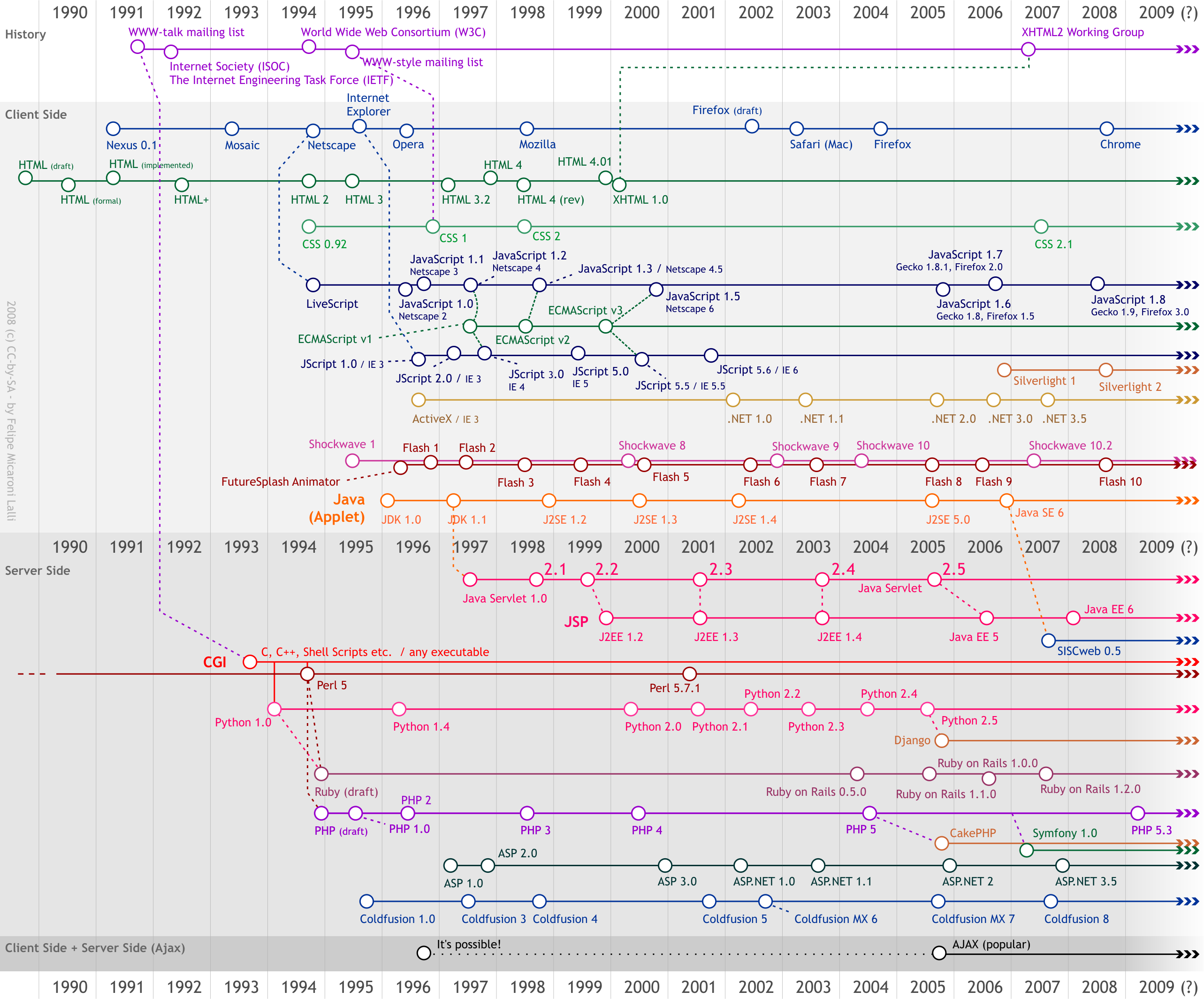
Web development timeline: Server and App side.

Web development timeline from Wikimedia:


Browser development timeline from Wikimedia


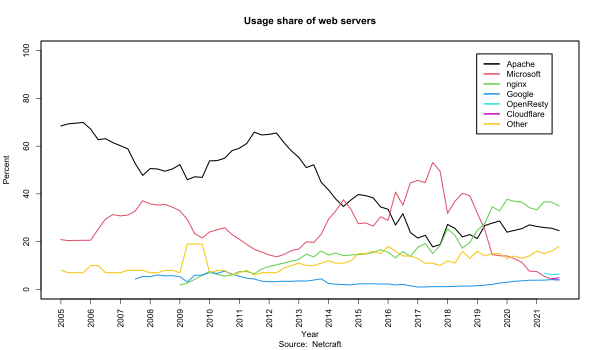
Market share of web servers
 

Monday, March 05, 2012

Lunch Talk: (@UC Berkeley) Printing Revolution


Paul Duguid explores the origins of the printing technology and popular myths about its impact on the society.


link

tags: lunchtalk, history, technology, evolution, tool

Sunday, February 19, 2012

323 Steve Jobs Patents

On Nov 23, 2011 NYT published a media presentation with links to all 323 Steve Jobs' US patents. It's a must have reference for anybody interested in evolution of computing and communication devices.


I wish they had a simple timeline without any grouping.

Thursday, February 16, 2012

Microsoft anti-trust timeline.


Time showed that the government's anti-trust actions didn't make much difference in the course of technology developments. Google, Apple, Facebook, and others overtook Microsoft without any help from the US and EU regulation bodies.
On the other hand, should the US order Microsoft breakup, smaller Microsoft entities had to be more innovative to succeed in the market place.


tags: control, background, evolution, microsoft, technology

Friday, February 03, 2012

Finally, some good news for solar energy.

Because the electric grid in India is unreliable and solar panels keep getting cheaper,  renewable energy becomes economically competitive with local diesel generators.

Feb 2, 2012. The New Scientist -- A quarter of people in India do not have access to electricity, according to the International Energy Agency's 2011 World Energy Outlook report. Those who are connected to the national grid experience frequent blackouts. To cope, many homes and factories install diesel generators.

Now the generators could be on their way out. In India, electricity from solar supplied to the grid has fallen to just 8.78 rupees per kilowatt-hour compared with 17 rupees for diesel.

The one thing stopping households buying a solar panel is the initial cost, says Amit Kumar, director of energy-environment technology development at The Energy and Resources Institute in New Delhi, India. Buying a solar panel is more expensive than buying a diesel generator, but according to Chase's calculations solar becomes cheaper than diesel after seven years.

tags: system, evolution, mousetrap, energy, source, distribution

Tuesday, January 31, 2012

LunchTalk: Modern Marvels - Stealth Technology

The Discovery Channel video narrates the cat-and-mouse game between radar and airplane making technologies.


link

Monday, January 30, 2012

Solera - another player in cloud security.

Solera Networks, a startup focused on real-time traffic analysis, got $20M from Intel Capital.
January 30, 2012. VBeat -- When hackers strike at company web sites, there is often no easy way to figure out what happened. Solera helps companies reconstruct exactly what transpired. The value of that data is often critical to figuring out who did it, much like the evidence found at a crime scene is often most critical in the first 48 hours. It’s important that network forensics be done instantaneously to give companies the best situational awareness possible.
In 2010, Intel acquired McAfee for $7.6B to beef up its offering of security software and services. Compared to that, the Solera investment looks like small potatoes, but it shows the general drive toward a more secure cloud. The web as we know it is dying, while mobile real-time networking proliferates. The demand for security in this new environment is going to be orders of magnitude greater than during the heydays of web.

tags: control, system, evolution, detection, security, internet, information, payload

Friday, January 27, 2012

Joyent vs Amazon

Joent is a cloud provider that intends to out-innovate Amazon.

Jan 23, 2012. VBeat -- San Francisco-based Joyent was founded in 2004 and has about 150 employees. It also has offices in Vancouver, Singapore and Geneva. The company plans to announce other “exciting” partnerships in the near future that will enable the company’s services in even more countries.
Here's how they see their  cloud orchestration services

Note that one of the pillars is Node.js - a JavaScript-based web server technology. It's hard to believe that Java Script, a scripting language designed by Netscape to execute simple logic within their browser, is now at the core of a cloud computing architecture. Who would've thunk!

tags: cloud, technology, evolution

Sunday, January 22, 2012

A database to store the cloud.

Amazon continues to push hard into cloud services with a database designed to handle disjoint information.
Jan 19, 2012. Wired -- NoSQL is a widespread effort to build a new kind of database for “unstructured” information — the sort of information that comes spilling off the internet with each passing second. Five years ago, Amazon introduced a NoSQL database service called SimpleDB, and now, it’s offering what you might think of as Amazon NoSQL Mark II. It’s called DynamoDB.

Like SimpleDB, DynamoDB is one of many Amazon Web Services (AWS), a set of tools offering online access to various computing resources, from virtual servers to virtual storage to databases and other software.
This is an important technology transition. Until fairly recently, internet applications were re-using (and are still using) database designs created for the previous generations of IT applications. Now, we see internet-specific architectures becoming available as a 24/7 service. Should be really good for mobile apps, games, ads, and connected devices.

tags: source, system, evolution, information, infrastructure

Monday, January 16, 2012

Invention of the Day: Barbed Wire.

Railroads opened up the American West to farmers and entrepreneurs.  To secure their large newly acquired properties, prevent crops from being trampled by cattle, and for many other purposes, they needed a way to build cheap fences. The old method of erecting wooden fences didn't scale because wood was either not available on the prairie or too expensive to transport in large quantities. Simple wire fences, though cheap to build, didn't work either because they were too easy on trespassers, both people and cattle.

In 1873, J.F. Glidden invented the barbed wire fence, as we know today. According to his invention, the barbs on the wire fence didn't rotate around the wire itself, providing two-sided rigid thorns.

Ten years later, Edenborn and Griesche invented a barbed wire machine that greatly improved the efficiency of making the wire.


In the 20th century, barbed wire was extensively used by the military to create defensive positions.


I thank Paul Henderson, whose father was a barbed wire collector, for alerting me to this remarkable invention.

tags: invention, efficiency, problem, evolution, productivity, history

Monday, December 12, 2011

Zynga Timeline

VBeat has a timeline of Zynga, from April 19, 2007 when Mark Pincus started PresidioMedia, till present. I pulled out a piece around the key social media platform acquisition on June 5, 2009.

July 31, 2009 — Surpassing Yahoo Games, Zynga becomes biggest online game operator in the U.S. with 44 million monthly unique users. Pincus says that Zynga will generate more than $100 million in revenues in 2009. Zynga has 330 employees and 110 open jobs.
June 30, 2009Zynga hires Brian Reynolds as chief game designer. He sets up Zynga East as a new game studio in Baltimore, Md.
June 22, 2009 — FarmVille launches. It will grow to become the biggest social game of its time.
June 13, 2009 — The company bans a number of players for hacking the system to get more poker chips.
June 12, 2009 — Mark Pincus says Zynga is not planning an IPO. The company has more than 250 employees. Top rivals include Playfish, Playdom and SGN.
June 5, 2009 — Zynga acquires social network and game maker MyMiniLife. The company’s game engine becomes the infrastructure for FarmVille.
March 24, 2009 — At the first annual GamesBeat conference, Mark Pincus declares that social gaming isn’t a fad.
Around that time, Zynga had become a game platform on top of Facebook application platform. 

tags:  social, games, networking, platform, 4q diagram, infrastructure, evolution

Sunday, December 11, 2011

Analog vs Digital: the sad story of Kodak.

An excellent article in MTR about the demise of Kodak, despite the company's pioneering efforts in digital photography.

In 1997, the stock market valued the company at over $30 billion. Today Kodak is worth only $265 million.
Kodak also invested extensively in research and development. In fact, the first electronic camera using a charge-coupled device was invented by a Kodak engineer named Steven Sasson in 1975, and Kodak in many ways led early development in digital photography. The company introduced the first megapixel sensor in 1986, and the QuickTake camera launched by Apple in 1994 had to a large extent been developed by Kodak. It looked like a pair of binoculars, stored 32 photos, and could be connected to a personal computer.

But the limited performance and the high price tag of such cameras (the QuickTake cost about $800 and a high-end digital news camera ran $15,000) meant that the market for digital photography was very small, almost insignificant for a multibillion-dollar company like Kodak.


It's easy to think that Kodak was disrupted by cheap digital cameras. This is less than a half-truth. If there were no web and Facebook (social networking), we would still be printing pictures using Kodak paper and Kodak chemical processes. And, because we'd be taking a lot more pictures, there would be more money for the company than ever before.

The real company that destroyed Kodak was Facebook, not Nikon, Canon, Olympus, and others.

tags: system, evolution, source, tool, battle, technology, magicians

Saturday, October 29, 2011

Invention of the Day: Credit Card system

Bloomberg recently published an article with a brief history of money, describing the transition from coins to credit cards. The credit card piece caught my attention because of its American roots:
The modern credit card is an American creation, devised in the credit boom following World War II. First came the Diners Club card, introduced in 1950. Then, in 1958, the BankAmericard, ancestor of Visa, and the first universal credit card issued by a bank and generally accepted by a large number of businesses. But only in the 1990s did credit cards become truly global, widespread beyond North America and the U.K.
Of course, a credit card isn’t itself money, but a way of spending it, moving it and promising it. With credit and debit cards, money has lost its materiality. It can be called up virtually anywhere in the world instantaneously.
After some digging, I found a US Patent issued in 1923 describing the concept of a credit card system, which is really close to the one we've got today. Here's how the inventor envisioned the credit card:

 
20 years later another patent mentions the connection between credit card and travel.
Many business institutions, of which commercial air lines and the retailers of gasoline, oil and like supplies for automotive vehicles to the motoring public are an example, have a large number of outlets or places of business, frequently scattered over a wide territory, from any one of which credit may be extended to customers. In order that this may be done, the customers are usually furnished with an identification, commonly referred to as a credit card, bearing, among other things, the name and address of the customer entitled to the use of the same.

Only with the proliferation of computers and cheap long-distant communications, the credit card business took off in the 1960-1970s.


tags: s-curve, infrastructure, business, money, system, evolution,