Showing posts with label 10x. Show all posts

Wednesday, July 13, 2016

Stanford CSP, BUS 74. Session 3, Quiz 1.

In a recent NYT article titled "Ads Evolve Into New Forms as Media Landscape Shifts", Sydney Ember mentioned an emerging trend in the advertisement industry:
Consumption habits have become increasingly fragmented, with more people watching programming, including television shows and live sports, on different online platforms. As a result, traditional television, with its 30-second commercials, is losing its commanding share of advertising dollars. Digital media is expected to pass TV as the biggest advertising category in the United States this year, with roughly $68 billion in ad sales compared with $66 billion for TV, according to the Interpublic Group’s Magna Global.

With online ad spending growing, finding ways to stand out among the onslaught of other online ads has become more important for advertisers. And therein lies a possible conundrum: Advertisers want their ads to look less like ads even as they are fighting harder for attention.

Question 1.
Based on our brief class discussion (see slide 33 Lecture Notes from July 11, 2016) and an earlier post on this blog, use the 10X Change diagram to map ad-related business models mentioned in class. Briefly explain parameters for each model.
(a ppt version of the 10X Change diagram is available for download here).

Question 2 (bonus).
What major technology developments enabled key ("disruptive") business model transitions?

Question 3 (bonus). Use the 10X Change diagram to map potential ad-related business models that are now available with augmented reality games like Nintendo Go. What technologies (existing or new) can further improve such models?

Friday, March 27, 2015

Finally, I have my magic formula for analyzing problems and inventing new stuff!

Actor(s) {A}
in Context(s) {E},
using Stuff {S} and incurring Cost(s) {C},
perform Action(s) {P}
produce Result(s) {R},
which counts as Outcome(s) {O}

Several immediate thoughts:
- Dilemma resolution techniques apply to Actor(s) and/or Context(s).
- 10X analysis applies to Cost(s) and/or Result(s).
- The Three Magicians, esp. the second one, move us between Results and Outcomes and provide different levels of Contexts.
- Elements quantize!

There's a lot more but I have to think about how to describe this 6-dimensional innovation space in detail.

Also, we live in a world abundant with high-tech startups, while Christinsen's "Innovator's Dilemma" was formulated for a world with sparse startups. Today's successful high-tech companies — Google, FB, Apple, etc — feast on this abundance.

tags: invention, innovation, system, model, dilemma, 10x

Saturday, February 14, 2015

Invention of the Day: Power Plug

Q: How many lawyers does it take to change a light bulb?
A: How many can you afford?

The screw-in electric socket invented by Edison in the late 19th century has become the gold standard for ease of use. You don't need to take a Design Thinking class to appreciate the technical beauty of the solution.

In Scalable Innovation (Chapter 4) we use the Edison's invention as an example of interface "stickiness". That is, light bulb technologies keep changing, but the socket is likely to stay with us for another hundred years.

Nevertheless, there's even a better 100-year-old electric interface invention that is still in use today. We can appreciate its value by just looking at the picture of an early 20th century GE toaster (below):


Notice that to connect the toaster to a power outlet you have to use Edison's screw-in plug. It works great for light bulbs that need to be changed once a year, but for everyday electric appliances screwing-in and screwing-out the plug multiple times a day could be a problem.

Enter Harvy Hubbell, a prolific American inventor and entrepreneur. In 1903, he invents the modern power plug. You can see below a picture from his patent that shows two major parts of his solution: an Edison-compatible screw-in body (1) and a two-prong plug (2) that goes into it (US Patent 774,250). With this invention, attaching electric appliances becomes even easier than changing a light bulb.


Originally, Hubbell wanted to use round prongs, but after several months of experimenting with the idea, he decided on the now familiar flat prongs (US Patent 774,251).


The Hubbell's interface solution turned out to be so good that eventually people got rid of the vast majority of Edison's screw-in sockets in favor of plug-in power outlets.

tags: 10x, invention, innovation, scalability, STM-operator

Sunday, October 12, 2014

Invention of the Day: the Integrated Circuit

During the Nobel Prize week it's only appropriate to remember Nobel-worthy inventions that changed the world. Today it's almost impossible to imagine our lives without some kind of use of the Integrated Circuit (IC) because the technology has become a fundamental building block in modern computing, communications, data storage, power supply, sensor, and many other applications. (see the Wiki article linked above).

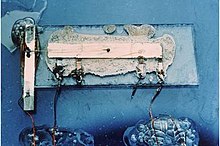
In 2000, Jack S. Kilby received 1/2 of the Nobel Prize in Physics for his 1958 invention of the IC. Here's a picture and diagram of his original invention:


When I read Kilby's Nobel Prize lecture, several of his passages strike me as remarkable because they show how difficult it is for contemporaries to recognize a great innovation:


Note that one of the core objections was that the new system doesn't use the best individual elements (resistors and transistors). Similarly, many years later — in the early 1990s — people doubted that video was ever going to be streamed over the Web because the Internet Protocol was poorly suited for synchronous data transmission. As innovators, we often have to remind people that the system is greater than a simple sum of its parts.

Kilby's speech also gives us a new perspective on the Moore's law. Here's what Kilby says:


Just one year later, Gordon Moore published his now famous article where he formulated his "law", stating that the density of elements in ICs would double every 18 months:

The chart from that article promised exponential performance riches to the "few adventurous companies" that were willing to bet on the new technology. Perhaps it is not a coincidence that tiny, unknown Silicon Valley startups, rather than large established companies, took full advantage of the opportunity and eventually created a new reality that we all live in today.

tags: invention, innovation, technology, market, 10X, cinderella

Friday, August 01, 2014

Invention of the Day: Wind-powered Sawmill

In the 17th century, the Dutch dominated sea trade and naval warfare. That time in European history is often referred to as the Dutch Golden Age. One Dutch inventor was particularly instrumental in giving his small independent nation a decisive advantage over Spain, the naval super-power of the 15th and 16th centuries.

In 1594-97, Cornelis Corneliszoon van Uitgeest (c. 1550 - c. 1600), a Dutch windmill owner, invented and perfected the first wind-powered sawmill. That is, before Cornelis two workers had to saw a log manually, using a specially designed pit. It was a long and ardious process.

Before:


After:

Source: Power from Wind: A History of Windmill Technology
By Richard Leslie Hills.


The new device allowed its operator to produce wooden planks 30 times faster than before.

Why this tech advance turned out to be strategically important for the Dutch nation?

Because wooden planks was the key material for building ships. In combination with ubiquitous windmills, the new technology enabled Dutch shipbuilders dramatically increase production of low-cost naval vessels, both military and commercial. As the result, the Dutch could not only swarm Spanish ships in sea battles, but also transport great amounts of commercial goods from newly discovered places in Africa and Asia, which gave them strong market advantages. The invention of the wind-powered sawmill brought about a 10X change in productivity that rippled through the entire world.

Eventually, the British overtook the Dutch, partly due to James Watt's improvements of the steam engine, which was much more powerful and reliable than the windmills.

tags: invention, innovation, 10X, source, tool, packaged payload, 


Thursday, July 31, 2014

Invention of the Day - Instant Messaging

It's hard to imagine today's life without instant messaging. The service has become one of the Dominant Designs in the Internet era. As we write in Scalable Innovation (Chapter 13):


Dominant Design is an implementation of a new functionality that the market adopts as the prototype for future implementations. Simply put, the dominant design is what everybody thinks all products or services in the new category should imitate.

US Patent 6,449,344

Today's IT giants — Google, Facebook, IBM,  Microsoft, Yahoo, Alibaba, and others provide instant messaging services as a "must have" feature. Recently, Facebook paid $19B for Whatsup, a company that built its mobile service using the instant messaging ideas. 

The original technology was developed in 1996 by an Israeli company Mirabilis and released during the same year as ICQ chat software. The service was extremely successful, even despite being characterized as the world's "ugliest website.


In 1998, AOL bought Mirabilis for $287M - a pitiful sum by today's Internet M&A standards. Eventually, AOL rebranded the service as the AOL Messenger. 

Instant Messaging had other important implications for the world of technology. First, ICQ influenced the development of other peer-to-peer (P2P) services, such as Napster, Gnutella, Skype, and others, which revolutionized content distribution and communications in the beginning of the 21st century.

Second, the business success of Mirabilis put Israel on the global map of Internet innovation and served as a catalyst for the creation of a thriving tech entrepreneurship culture in the country. 

Third, Instant Messaging helped initiate the Internet services era that exploded with the introduction of the iPhone and other smartphones.

Arguably, the invention of Instant Messaging is as important to the world as Graham Bell's invention of the phone in 1876. 

tags: invention, innovation, facebook, google, microsoft, dominant, design, 10x

Tuesday, May 27, 2014

Invention of the Day: Teleprompter

The teleprompter made live TV programs possible because it allowed news anchors and performers to deliver long speeches without spending days and weeks memorizing them.


According to a Smithsonian article:
“For those that had been either in theater or the movies, the transition to television was difficult, because there was a much greater need for memorizing lines,” says Christopher Sterling, a media historian at George Washington University. “At the time, there was a lot more live television, which many people today tend to forget.” Instead of memorizing the same batch of lines over the course of months, Barton was now expected to memorize new lines on a weekly or even daily basis. Cue cards were sometimes used, but relying on unsteady stagehands to flip between them could sometimes cause catastrophic delays.

Here, we can see how a new media technology — "the TV world" — lead to a 10X increase in demand for live content. During radio broadcasts, announcers could read long texts from a written or typed page. By contrast, live television required direct eye contact with the audience. In short, a successful TV program required the best of both worlds: lots of fresh content to compete with the radio, and direct contact with the audience like in the traditional theater. The invention of the teleprompter solved this problem.


As usually the case with major innovation, teleprompter was rejected by the convention professional thinking:
Although Schlafly, Barton and Kahn pitched the device to 20th Century Fox, the company was not interested. They promptly quit the company and started their own, founding the TelePrompTer Corporation.

A major refinement of the original invention came from Jess Oppenheimer, who invented an in-camera teleprompter.


Since then, the teleprompter's been a fixture in television, movies and political speeches. It'll be with us until, probably, somebody invents a brain-machine interface suitable for imitating direct human speech.

tags: invention, innovation, 10X, trade-off, dilemma, problem, solution

Sunday, January 26, 2014

Streamternet - a new term for describing our post-web world.

I've been struggling for a while to find a name for the new, post-web reality of the Internet. In Scalable Innovation (Section 3), we explain why we think that the web is dead, but we don't use any new word to mark the new reality. 

The core idea is that instead of sending files, we now deal with streams, e.g. video or update messages: Youtube, Twitter, Facebook, High-Frequency Trading, etc. In system terms, we see a dramatic change in the Packaged Payload and the intensity of its flow. 

Fundamentally, the iPhone and Google Glass are Streamternet devices. Their zoomable interfaces allow us to zoom in and out of the stream of information, and see it, e.g. in 2D, 3D, or 4D. The difference between the web and Streamternet is that time flows differently in them. That is, the intensity of data transactions is 100X higher on the Streamternet.

web, streamternet, system, packaged, payload, tool, 10X

Wednesday, January 22, 2014

BitCoin vs PayPal: a 100X+ difference

Both BitCoin and PayPal allow parties who don't trust each other's identity to exchange money electronically. The big difference is transaction costs. Because PayPal uses the existing system for electronic payments, it extracts high fees from the seller; the smaller the transaction, the larger the percentage of the fee. In short, PayPal doesn't scale down.


In contrast, BitCoin transactions are almost free. Moreover, they scale down as computing power (thanks to the Moore's law) becomes cheaper over time. The adoption of BitCoin or any similar monetary transaction system should stimulate development of businesses that involve high-volume payments. If posting on Twitter is free, BitCoin transactions should also be free.

Companies that will make Bitcoin payments reliable and secure are going to reap huge benefits in the mobile and financial markets.

tags: money, deontic, payload, control, machine1, machine2, finance, commerce, 10x, innovation

Sunday, January 19, 2014

Invention of the Day: Anaesthesia.

October 16, 1846 is the official birthday of anaesthesia, the art of preventing a surgery patient from feeling pain. On that day, surgeon Dr. Warren publicly demonstrated a painless tumor removal at the operating theater of the Massachusetts General Hospital. To anaesthetise the patient, Dr. Warren used the method invented by dentist William T.G. Morton. Under the invention, the patient was rendered unconscious by inhaling ether, an organic compound known to people since the 8th century, but never used in medicine before. The invention of practical anaesthesia (along with methods to prevent wound infection) created the world of modern surgery. The 1846 invention was a breakthrough that allowed people to control one of the basic biological experiences - pain.

Morton's US Patent 4,848 on the medical use of ether was never enforced due to public outcry.


Wednesday, January 15, 2014

Lab Notebook: A revolution in Human Resources.

Since the early days of Silicon Valley, venture capitalists (VCs) consider team quality to be a major factor predicting success of a startup. In the US, successful entrepreneurial teams typically emerge from universities and high-tech companies. In Israel, startup team formation often happens in the army, including, its high-tech units. Innovative, risk-tolerant, hard-working, highly-skilled people who can work together effectively are usually called "the A team." Startups succeed when the team discovers and takes advantage of a new, profitable business model, e.g. based on the latest and greatest technology. (Examples: Fairchild Semiconductors, Atari, Apple, Sun Microsystems, Netscape, PayPal, Yahoo, Google, Netflix, Facebook, Twitter, Wase, etc.)

Now, mature companies are trying to use the startup model to get employees to work as teams on specific projects, rather than functional departments in charge of internal processes. Netflix pioneered this approach and its former head of talent acquisition, Patty McCord, actively promotes it today. (See the HBR article for more detail). LinkedIn and Facebook use internal hackatons to identify new potential products and teams that can deliver them.

Another model is acqui-hiring, when an established company acquires a successful startup, so that they can work as an internal entrepreneurial team. Google and Facebook practice this model extensively. For example, many consider the recent acquisition of Nest GSV as an acqui-hire play by Google to get on board a team that can create a successful consumer device.

These approaches take into account that the startup-based innovation model created in Silicon Valley differs dramatically from the successful industrial innovation model pioneered by Henry Ford. He invented not only the mass-production logistics and manufacturing system, but also revolutionized labor hiring. Instead of an ethnically-based team of low-skilled workers hired to build a railroad or unload a ship, Ford wanted to see an English-speaking specialist who could fit into his production process. Similar to the quality control process in parts manufacturing, Ford tasked his newly-invented human resources (HR) department with selecting persons that fit a specific job criteria: work skills, education level, family history, ethnicity, etc. Elements of his approach were based on the popular at the time theory of eugenics, which advocated selecting people based on certain inherent traits. (Today, eugenics is broadly associated with racism and bigotry). Ford's HR system proved to be highly successful for the American industry because it allowed companies to plug individuals into well-defined work and social roles. (For example, when hiring engineers GE routinely interviewed wives of the candidates to make sure they possessed proper moral values.) 

After the World War II when educational and social roles started to shift, the new idea of the Human Capital eventually took hold. Large companies started treating their employees (often with an implied life-time job guarantee, e.g. a trade-union contract) as capital. As workplace requirements changed, the employees were provided with on-the-job educational and training opportunities to maintain or improve their skills. To manage the workforce and comply with labor laws, HR departments set up performance evaluation processes, with regular manager feedback, promotions, and incentives structures. Nevertheless, at the core of it was the old Henry Ford's idea that an individual had to fit into a pre-defined corporate production process. 

Of course, this model doesn't work in an environment where breakthrough innovations are required for company growth. Fist, startups simply can't afford the overhead. Second, large corporations, despite their incredible R&D capabilities, proved to be unable to accommodate innovations from within. Clayton Christensen described this problem in his seminal book "The Innovator's Dilemma." Unfortunately, the solutions that he offered don't seem to work despite people trying hard to implement them. Research in Motion, the maker of Blackberry phone, would be a great failure example (see the ft article). The company did everything by the book, but eventually could not compete with Apple's iPhone.

The current revolution in HR promises to solve the Innovator's Dilemma by giving internal entrepreneurs enough freedom inside the company to create innovations. It also lets companies get rid of employees that don't fit into their culture or have outdated skills. As a result, they get a mobile, active, motivated workforce that can move quickly and carry innovation risks/rewards, rather than offloading it to the parent company. Of course, traditional companies and their HR departments will lag behind in implementing the new model. Most likely, it will continue to spread through new successful startups capable of scaling their initial business into new technology markets.

tags: invention, innovation, control


Saturday, December 21, 2013

Lab Notebook: Silicon Valley and the Law of Diminishing Marginal Utility

Silicon Valley seems to defy one of the fundamental laws of economics: The Law of Diminishing Marginal Utility. The law, according to an investopedia article (need to find a textbook reference), says:

A law of economics stating that as a person increases consumption of a product - while keeping consumption of other products constant - there is a decline in the marginal utility that person derives from consuming each additional unit of that product.


They illustrate the law with a short video about a hungry girl with a pizza. The first slice of pizza tastes better than anything before.


The second slice of pizza still tastes good, but by the fifth piece, the girl is already full and she hates the fact that she has to eat the entire thing.


Let's try to apply this law to a major Silicon Valley innovation: web-based email. We skip the Hotmail vs Rocketmail controversy and go directly to the Yahoo vs Google email rivalry. In the early 2000s, Yahoo mail was an undisputed leader in this web services domain. The company was giving users 10 or 20 MB storage for free and charged for extra. Then came Google and offered at least 1GB of free storage with its brand new gMail. According to the law of diminishing marginal utility, this move would be "unlawful." That is, why offer people a lot more if we know from economics that usefulness declines with quantity of goods consumed?

Paradoxically, the more storage gmail offered, the more useful its service proved to be to the users, myself included. Millions flocked to gmail, abandoning their yahoo mailboxes.

In general, exponential growth in processing power, storage, and bandwidth (what I call "Machine 1") that Silicon Companies have been driving for the last 50 years makes users happier, defying the economics textbook wisdom taken at face value.

tags: machine1, economics, 10X, innovation, book, google, yahoo

Thursday, December 19, 2013

Lab Notebook: an example to illustrate Invention vs Innovation and 10X

This example can be added to the 2nd edition of Scalable Innovation or elsewhere:

So he [Steve Jobs] explains it, and he says, ‘You know, [the Xerox mouse] is a mouse that cost three hundred dollars to build and it breaks within two weeks. Here’s your design spec: Our mouse needs to be manufacturable for less than fifteen bucks. It needs to not fail for a couple of years, and I want to be able to use it on Formica and my bluejeans.’ (ref: Gladwell, M. Creation Myth. The New Yorker, May 16, 2011).

The Xerox mouse was an invention with an innovation potential. Steve Jobs was able to organize an effort to realize the potential, i.e. create the innovation. Xerox just couldn't do it at all (see the failed Alto attempt).

Source: Scalable Innovation. Fig P.4.

Also, note Jobs' exponential (10X) thinking: from two weeks to two years; from special pads to common surfaces.

tags: creativity, innovation, invention, 10X, example


Monday, November 05, 2012

Starbucks and McDonald's compete to deliver Diabetes 2

Recent medical research confirms my corollary that Starbucks is McDonald's for the affluent.

Researcher Marie-Soleil Beaudoin has discovered not only that a healthy person's blood sugar levels spike after eating a high-fat meal, but that the spike doubles after having both a fatty meal and caffeinated coffee – jumping to levels similar to those of people at risk for diabetes.
Since many Starbucks sell fatty sweets and lunches, adding coffee to the mix creates a recipe for sure-fire Diabetes 2: sugar (salt) + fat + caffeine. Similarly, when McDonald's sells coffee in addition to its traditional junk food they reproduce Starbucks' commercial success and the Diabetes 2 recipe.

tags: 10x, health, control, packaged payload, business, model

Thursday, September 06, 2012

Quote of the Day: Geoffrey Moore about the invention of the Integrated Circuit.

The Integrated Circuit (IC) invented in the late 1950s is one of the greatest inventions of all time. We'll be discussing the impact of ICs on the world in Lecture 2 of the Greatest Innovations of Silicon Valley course John Kelley and I will be teaching this quarter at Stanford University CSP.


Today, all computing devices — from tiny brain implants to giant data centers — use the technology for running a myriad of applications. Nevertheless, according to Gordon Moore, the author of the famous Moore's Law, at the time of the invention it was extremely difficult to envision the future importance of IC. Here's an excerpt from an interview Gordon Moore gave to Michael Wolff in 1976,

Wolff:
You didn't realize at the time how significant this would be?
Moore:
Absolutely not. Even after a family of integrated circuits was introduced, we didn't have the remotest idea that this was truly a major difference in the way electronics was going to be done in the future.

In my view, the moral of the story is, when you've made an invention use your imagination to see how the invention can scale up to revolutionize the world. Several tools would be particular applicable in this situation: the STM operator, 10X diagram, 4Q diagram, a system diagram in combination with the S-curve (to check for Synthesis).

tags: quote, invention, innovation, example, technology, 10X, imagination, creativity

Tuesday, August 07, 2012

Lunch Talk: (@TED) Medical diagnostics over the phone.

Parkinson’s disease affects 6.3 million people worldwide, causing weakness and tremors, but there's no objective way to detect it early on. Yet. Applied mathematician and TED Fellow Max Little is testing a simple, cheap tool that in trials is able to detect Parkinson's with 99 percent accuracy -- in a 30-second phone call.


tags: health, detection, lunchtalk

Thursday, August 02, 2012

Lunch Talk: History of Gaming

This is a university video-project made by "Game Design"-students from munich.

Games:
Tennis for Two, Oscilloscope, 1958
Pacman, Arcade, 1980
Donkey Kong, NES, 1986
Sonic the Hedgehog, Sega Mega Drive/Genesis, 1991
Street Fighter II. SNES, 1991
Super Mario 64, Nintendo 64, 1996
Final Fantasy VII, Sony Playstation, 1997
Need for Speed: Hot Pursiut 2, Sony Playstation 2, 2002
Ecco the Dolphin, Sega Dreamcast, 2000
Super Smash Bros. Melee, Nintendo Game Cube, 2001
Wii Sports Golf, Nintendo Wii, 2006
God of War III, Sony Playstation 3, 2010
Rock Band, XBox 360, 2008


On a related topic,  here's a good example of how a breakthroug technology delivers a better solution at 1/10 of the original price.
Cartridges are a very expensive medium, however, and many game developers resented Nintendo’s decision to continue using them. Sony’s licensing structure was built around a $10-per-game arrangement that included manufacturing disks, manuals, and packaging.
Compared to the cost of pressing CDs, manufacturing cartridges for Project Reality would be prohibitively expensive. At the time, it cost more than $20 to manufacture an 8-megabyte cartridge, compared to less than $2 to press a 640-megabyte CD. And the additional storage space on CDs could be used for video clips, animations, audio files, music, and larger games. -- The ultimate history of video games.

 tags: lunchtalk, gaming, 10X, trade-off, breakthrough, 

Wednesday, July 18, 2012

(ES) Creating business with 10X change.

Gordon Moore, of the Moore's Law fame, writes about his experience of creating a breakthrough technologies at Intel,

...at the time the first microprocessors were shipped, the total annual market for computers in the world was something like 10,000 units. The microprocessor would have been a commercial disaster if all we did was to replace those 10,000 units with cheaper processors.
I remember going to a conference and speaking before a group that was more involved in applications than devices and explaining to them that we had to ask big questions, like, ‘ How are we going to develop markets that can use 100,000 of these a month?’ (While one hundred thousand a month doesn’t seem like many now when compared to the tens of millions shipped currently, it sure did then.) Ted’s insight and the Fairchild experience with ICs helped us understand that this product had countless uses, but we also understood our efforts alone would build volume markets.
 To summarize, the goal was to create a market that could absorb 10 times more units shipped in a ten times shorter period of time. It's likely that Andy Grove's notion of a 10X change comes from the same early days at Intel.

Source: SIEPR Discussion Paper No. 00-45. Gordon Moore, Kevin Davis. Learning the Silicon Valley Way. Stanford University, 2001.

tags: 10X, 4q diagram, business, breakthrough

Wednesday, July 11, 2012

E-mail is dead.


CNet reports on the demographics of communications:
(July 11, 2012 12:03 PM PDT) The study shows that teens turn to text messaging for communication instead of writing e-mails. Six percent of teens use e-mail daily, while 39 percent say they never use e-mail. In contrast, 63 percent of teens text everyday, with some teens texting up to 100 messages a day.

tags: s-curve, payload, 10x, social, networking

Lunch Talk: Internet and the brain.

(7/9/12. Newsweek.) The brains of Internet addicts, it turns out, look like the brains of drug and alcohol addicts. In a study published in January, Chinese researchers found “abnormal white matter”—essentially extra nerve cells built for speed—in the areas charged with attention, control, and executive function. A parallel study found similar changes in the brains of videogame addicts. And both studies come on the heels of other Chinese results that link Internet addiction to “structural abnormalities in gray matter,” namely shrinkage of 10 to 20 percent in the area of the brain responsible for processing of speech, memory, motor control, emotion, sensory, and other information. And worse, the shrinkage never stopped: the more time online, the more the brain showed signs of “atrophy.”


tags: 10x, internet, payload, niche construction, psychology, brain, social