Renowned entrepreneur and Reddit cofounder Alexis Ohanian, will inspire you to think of unique ways to connect with your customers, and to build a community of users who want your business to succeed. In this class you'll learn some key branding, marketing, and user experience principles, plus specific tactics and strategies that you can use to create a company people love.
Note emotional vs cognitive appeal of a new product/service in a new market.
tags: lunchtalk, innovation, entrepreneurship, internet, web, creativity, emotion
Showing posts with label web. Show all posts
Showing posts with label web. Show all posts
Friday, January 16, 2015

Sunday, August 17, 2014
Invention of the Day: SGML (Standard Generalized Markup Language)
SGML is the second great invention (that I know of) by an American lawyer; the first one being the Cotton Gin, by Eli Whitney.
The Cotton Gin (1793) revolutionized the cotton industry in the US and, arguably, triggered the Industrial Revolution in England. Similarly, the SGML, co–invented by Charles F. Goldfarb, revolutionized the way we work with electronic documents. For example, the World Wide Web would be impossible without HTML, a simplified extension of SGML. Another extension of SGMIL is XML, a critically important document format used extensively in modern web and mobile applications.

In 1969, together with Ed Mosher and Ray Lorie, Goldfarb invented the SGML to make electronic documents compatible between different computing systems. Before SGML, a document would have instructions on how to handle it — procedural markup — embedded into the text. Since different IBM computer systems had different command sets, moving documents with procedural markup created a problem, because the same document would not "work" on a different computer. To solve the problem, the inventors came up with a language that could describe the contents of the document independently from the application or computer system that stored or processed it. Here's how Goldfarb wrote about the breakthrough in a 1971 paper:
tags: invention, innovation, separation, internet, web, packaged, payload,
The Cotton Gin (1793) revolutionized the cotton industry in the US and, arguably, triggered the Industrial Revolution in England. Similarly, the SGML, co–invented by Charles F. Goldfarb, revolutionized the way we work with electronic documents. For example, the World Wide Web would be impossible without HTML, a simplified extension of SGML. Another extension of SGMIL is XML, a critically important document format used extensively in modern web and mobile applications.
In 1969, together with Ed Mosher and Ray Lorie, Goldfarb invented the SGML to make electronic documents compatible between different computing systems. Before SGML, a document would have instructions on how to handle it — procedural markup — embedded into the text. Since different IBM computer systems had different command sets, moving documents with procedural markup created a problem, because the same document would not "work" on a different computer. To solve the problem, the inventors came up with a language that could describe the contents of the document independently from the application or computer system that stored or processed it. Here's how Goldfarb wrote about the breakthrough in a 1971 paper:
The principle of separating document description from application function makes it possible to describe the attributes common to all documents of the same type.20 years later, this feature of SGML turned out to be highly useful for the World Wide Web, a system designed for a seamless exchange of documents from networked computer systems around the world. HTML, a simplified version of SGML, allowed web enthusiasts to put together simple web pages that could be rendered in browsers on all kinds of machines. With the web, the invention turned into a great innovation.
tags: invention, innovation, separation, internet, web, packaged, payload,
Tuesday, February 04, 2014
The Web is Dead - mobile edition.
The hyperlink (or URL) is one of the greatest inventions of the web era. It is excellent for linking pages, navigating between sites, downloading content, etc. Unfortunately, the URL is largely useless on mobile devices because it doesn't work outside the browser. To solve the problem, mobile technology companies develop alternatives that allow launching one app from another. MIT Tech Review reports that,
Once a suitable replacement for the URL is found, the decline of the web will become inevitable. Here's a cheesy Facebook video that explains the concept:
tags: web, technology, evolution, aboutness, mobile, application
Today mobile apps increasingly rule our free time and require us to dive into separate, walled-off digital containers that don’t link up.
The new kind of hyperlink could make apps seem less walled off from one another. Deep linking, as the technology is called, is also seen as a way to open up new forms of advertising that will provide revenue to make mobile advertising more closely match its online counterpart (see “Why No One Likes Mobile Ads”).
Once a suitable replacement for the URL is found, the decline of the web will become inevitable. Here's a cheesy Facebook video that explains the concept:
tags: web, technology, evolution, aboutness, mobile, application
Sunday, January 26, 2014
Streamternet - a new term for describing our post-web world.
I've been struggling for a while to find a name for the new, post-web reality of the Internet. In Scalable Innovation (Section 3), we explain why we think that the web is dead, but we don't use any new word to mark the new reality.
The core idea is that instead of sending files, we now deal with streams, e.g. video or update messages: Youtube, Twitter, Facebook, High-Frequency Trading, etc. In system terms, we see a dramatic change in the Packaged Payload and the intensity of its flow.
Fundamentally, the iPhone and Google Glass are Streamternet devices. Their zoomable interfaces allow us to zoom in and out of the stream of information, and see it, e.g. in 2D, 3D, or 4D. The difference between the web and Streamternet is that time flows differently in them. That is, the intensity of data transactions is 100X higher on the Streamternet.
web, streamternet, system, packaged, payload, tool, 10X
Tuesday, January 14, 2014
Google + Nest GSV = the Web is Dead
Google announced that they are buying Nest GSV, the smart thermostat company, for $3.2B. The acquisition extends Google's push into the Internet of Things (IoT), including robotics, automatic cars, etc. Gartner's 2013 Hype Cycle report puts IoT firmly at the top of the hype chart.
 Recently, Cisco added to the hype with an estimate for the IoT market of $19T by 2020. Since Google missed badly on Social Networking, the company is eager not to miss on the next big thing. With the web going away (Scalable Innovation, Chapter 20), Google needs new massive sources of data streams to process; otherwise, all their data-crunching technology could become worthless. The Internet of Things seems to fit the requirements. Although the valuations are of hype-size proportions, today's web advertisement (search) produces enough cash to finance the future S-curve.
When I worked in research on IoT concepts in the early 2000s, it was too early. We did get a number of good patents, e.g. US7,620,703, US7,257,839, US7,092,861, US7,069,345, US6,838,986, out of that work, but the inventions didn't become mass-market innovations back then. Even today, it's still too early for the mass market. Interesting questions to consider would be, What does it mean to be too early? What problems do we need to solve, so that an innovation in this particular technology market becomes real?
tags: invention, innovation, hype, google, system, synthesis, web
Friday, October 11, 2013
Lunch Talk: TEDx, the battle for power on the Internet.
Bruce Schneier talks about the problem of control over data on the Internet.
In chapter 22 ("Seeing the Invisible: The System behind the New Internet") of our favorite book, we discuss the mechanism of Control that Internet users delegated to private companies in return for subsidized devices and services. Essentially, the users traded their long-term digital futures for short-term economic and status gains. In economics, it is called Future Discounting. Paradoxically, the original idea that on the web everything is free AND there are no strings attached to the content turned into a familiar trade-off: "free stuff with lots of strings attached." As usual, a recipe for success became a recipe for disaster.
In chapter 22 ("Seeing the Invisible: The System behind the New Internet") of our favorite book, we discuss the mechanism of Control that Internet users delegated to private companies in return for subsidized devices and services. Essentially, the users traded their long-term digital futures for short-term economic and status gains. In economics, it is called Future Discounting. Paradoxically, the original idea that on the web everything is free AND there are no strings attached to the content turned into a familiar trade-off: "free stuff with lots of strings attached." As usual, a recipe for success became a recipe for disaster.
Wednesday, January 30, 2013
The Web is Dead, a social media edition.
(San Francisco. Jan 30, 2012) Facebook Inc. said its mobile daily active users exceeded its desktop daily active users for the first time in the fourth quarter of 2012.The trend hasn't touched the enterprise world that much yet - a huge technology opportunity.
P.S. VentureBeat and Yahoo Mail web pages are the worst browser hogs ever. The pages contain sloppy scripts and flash widgets that pull data constantly, even when the the page is not visible in the tab view.
tags: s-curve, internet, web, mobile, social, networking
Sunday, September 09, 2012
A total war, the 21st century edition.
A white paper from Symantec (h/t CNet) details an ongoing large-scale e-spionage effort they call "The Elderwood Project." The company researchers believe that the same group, which (successfully) attacked Google through its China offices in 2009, is behind the current attacks,


The report describes a specific technique they call "watering hole," when the attacker infects a target site and waits, as if in an ambush, until target users access the site.
The scale of the attacks, in terms of the number of victims and the duration of the attacks, are another indication of the resources available to the attackers. Victims are attacked, not for petty crime or theft, but for the wholesale gathering of intelligence and intellectual property. The resources required to identify and acquire useful information—let alone analyze that information—could only be provided by a large criminal organization, attackers supported by a nation state, or a nation state itself.


The report describes a specific technique they call "watering hole," when the attacker infects a target site and waits, as if in an ambush, until target users access the site.
Monday, July 16, 2012
Saving Yahoo, act 6.
NYT adds another detail to the story of Yahoo's demise:
tag: s-curve, innovation, business, internet, web
[Marissa Mayer] said Yahoo was “one of the best brands on the Internet.”She recalled that when she first started at Google, the company would conduct user surveys and “people didn’t understand the difference between Yahoo and the Internet.”At the turn of the century, Yahoo owned the web, had unrestricted access to Google's search technology, and was one of the largest e-mail providers in the world. And they managed to blow the lead.
As she hashes out Yahoo’s strategy, Ms. Mayer said she was intent on leveraging the Internet company’s strong franchises including e-mail, finance and sports. She also hopes to do more with its video broadband and its mobile businesses.Let's do a reality check. Youtube dominates Internet video; GMail dominates e-mail (e-mail is dead anyway); Google and Apple share leadership in mobile; Apple gates access to Yahoo finance on the mobile. Facebook and Google are buying technology at the pace of a couple of startups a month. It will be a miracle if Ms Mayer pulls an upset using Yahoo's sports properties.
tag: s-curve, innovation, business, internet, web
Friday, February 24, 2012
Faking it, the government style.
The new "Consumer Privacy Bill of Rights" appears to be a successful attempt to lull consumers into believing that they can get privacy on the Web.
tags: internet, web, privacy, control, detection
Feb 23, 2012. CNET -- Do Not Track technology .... applies to targeted ads only and not to any other forms of tracking.It shows that with a clever name you can get 80% of people believe what they would like to believe.
Abine conducted a quick online survey of 500 Internet users starting on Wednesday and found that 80 percent of respondents believed that Do Not Track stops data collection or removed tracking technologies from their computers.
tags: internet, web, privacy, control, detection
Friday, February 10, 2012
The killer device.
For the first time, web traffic from Apple's mobile devices exceeded that of Macs. One revolution Steve Jobs started thirty years ago is coming to an end. The other one is just getting under way.

tags: mobile, s-curve, web, tool, information, synthesis

Feb 10, 2012. VBeat -- In the first quarter of 2012, for instance, Apple sold 37.04 million iPhones, 15.43 million iPads, and just 5.2 million Macs.
It’s not quite the death of the desktop, but mobile devices are gaining ground on their traditional brethren, at least within the Apple-centric world.
“There is cannibalization, clearly, of the Mac by the iPad, but we continue to believe that there’s much more cannibalization of Windows PCs by the iPad,” Cook said
tags: mobile, s-curve, web, tool, information, synthesis
Wednesday, February 08, 2012
Who invented multi-media web?
Feb 8, 2012. Wired -- Michael Doyle, a low-profile Chicago biologist, claims that it was actually he and two co-inventors who invented — and patented — the “interactive web” before anyone else, while they were employed by the University of California back in 1993. Doyle argues that a program he created at the UC’s San Francisco campus, which allowed doctors to view embryos over the nascent World Wide Web, was the first program that allowed users to interact with images inside of a web browser window. The defendants hotly contest that, saying that it was programs like Pei-Yuan Wei’s pioneering Viola that first offered this functionality.

Several billion of dollars in royalties are at stake in the patent trial that starts this week in Tyler, Texas. The most important defendants are Google, Yahoo, Amazon and other internet giants. Remarkably, Microsoft, which got sued first in 1999, settled several years ago for the estimated $100M.
Of course, this patent trial doesn't threaten the future of the web, as some people would like us to believe. First, it's not about controlling the web or e-commerce. Rather, it's about getting a share of the profits companies make using the technology.
Second, as Wired wrote a year and a half ago, the web is dead anyway. The sooner we move past it, the better.
tags: patent, internet, business, model, innovation, invention, control point, web
Monday, January 30, 2012
LunchTalk: (TED) How Wikipedia was created.
Jimmy Wales [the founder of Wikipedia] recalls how he assembled "a ragtag band of volunteers," gave them tools for collaborating and created Wikipedia, the self-organizing, self-correcting, never-finished online encyclopedia.
link
tags: web, internet, information, source, invention
Friday, December 09, 2011
Lunchtalk: Randal Munroe, of xkcd fame.
Here's my favorite comic of the social networking era

And here's a somewhat geeky talk by its creator.
tags: creativity, art, web, lunchtalk
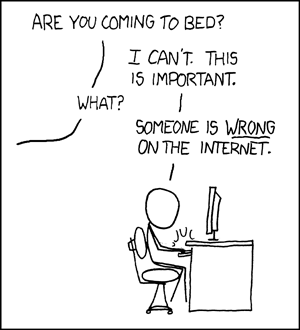
And here's a somewhat geeky talk by its creator.
Randall Munroe is the creator of xkcd, a webcomic of romance, sarcasm, math, and language. Munroe on Munroe: "I'm just this guy, you know? I'm a CNU graduate with a degree in physics. Before starting xkcd, I worked on robots at NASA's Langley Research Center in Virginia.
tags: creativity, art, web, lunchtalk
Sunday, November 20, 2011
Wednesday, November 09, 2011
No Flash, no problem.
As I predicted a year and a half ago, Adobe Flash for mobile devices is destined to die.
(Nov 8, 2011. CNet). In a momentous about-face, Adobe Systems is scrapping its high-profile effort to bring its Flash Player software to smartphones and tablets.This is another indication of a major shift in the development of the Internet. Technologies that created the web as we know it today are being swept aside by a new wave of innovation.
Subscribe to:
Posts (Atom)