Showing posts with label network. Show all posts

Monday, March 20, 2017

Lunch Talk: Jay Kaplan: Crowdsourcing Cybersecurity (at Stanford)

Entrepreneur Jay Kaplan, co-founder and CEO of Synack, describes how the idea of creating a cybersecurity service for enterprise businesses by crowdsourcing hackers went from sounding like a long shot to launching as a venture capital-backed startup. Kaplan, previously a senior analyst at the National Security Administration, talks about the virtues of government work and the nuances of “white hat” hacking.

Direct link to Youtube.


tags:network, security, enterprise, control

Thursday, December 05, 2013

Social Networking is the new TV, only much better

A study of new mothers shows that social networking has a strong positive effect on their well-being:
On average, mothers were 27 years old (SD = 5.15) and infants were 7.90 months old (SD = 5.21). All mothers had access to the Internet in their home. New mothers spent approximately 3 hours on the computer each day, with most of this time spent on the Internet. Findings suggested that frequency of blogging predicted feelings of connection to extended family and friends which then predicted perceptions of social support. This in turn predicted maternal well-being, as measured by marital satisfaction, couple conflict, parenting stress, and depression. In sum, blogging may improve new mothers’ well-being, as they feel more connected to the world outside their home through the Internet.
Source: Brandon T. McDaniel • Sarah M. Coyne • Erin K. Holmes. New Mothers and Media Use: Associations Between Blogging, Social Networking, and Maternal Well-Being. DOI 10.1007/s10995-011-0918-2
 
Another study of random 79 undegrads shows that:
In Experiment 2, those who focused on their Facebook page scored significantly higher in general self-esteem, but not narcissism, than a control group.
Across both experiments we found consistent evidence that narcissists reported having more ‘‘friends’’ on the SNSs. Partici- pants with higher NPI scores reported having more friends and more page views on MySpace and reported having more friends on Facebook.  

 The paper also notes that the new generation of students is quite different from the general population
 A recent Pew Research Center survey found that, com- pared to 20 other countries, rates of SNSs usage in America were among the highest (Pew Research Center, 2011). Among Americans, 80% of respondents aged 18–29 used SNSs (compared to 62% of those aged 30–49 and 26% of those 50 and older) and that 61% of users had college degrees, indicating that SNSs users are dis- proportionately young, educated adults. 

Looks like SNSs provide opportunities to improve social well-being by starring in one's own show.

tags: network, social, information, graph, research, science, book, facebook

Tuesday, February 26, 2013

Google Glass is the ultimate surveillance machine.

Google Glass has the potential to turn everybody into a surveillance camera. By capturing and analyzing video streams coming from multiple sources, Google would be able to cross-reference its image recognition algorithms with GPS data gathered by the target's Android or iOS device.

For example, when Bob's Google Glass device captures Alice on University Street in Palo Alto, Alice's mobile sends its location data to a Google Maps server. Although the two devices work independently, the information can be easily matched by timestamps and location data. Moreover, if Charlie sees Alice from a different angle, his Google Glass stream can be used to complement data received from Bob's and Alice's devices. If David — independently — tags Alice in his G+ post, the process of verification is complete. Unknowingly, Bob, Charlie, and David form a Google Glass spy network capable of tracking Alice's every move.

Although this scenario sounds a bit far fetched, Google has already implemented it in its web search engine. Because Google strives to download and index every available web page in the world, it knows which pages contain links to a particular page. Knowing the relationship helps Google assign high rank to pages that have a greater number of "incoming" links — the algorithm was Page's and Brin's research topic at Stanford. In short, if Alice, Bob, Charlie, and David are web pages, Google knows who sees whom. Similarly, Google has the ability to implement this logic for video streams, location data, and other bits and pieces of information collected from mobile devices.


tags: control, detection, social, network, packaged payload, google

Saturday, July 28, 2012

Lunch Talk: (@TED) All Your Devices Can Be Hacked.

Avi Rubin is Professor of Computer Science at Johns Hopkins University and Technical Director of the JHU Information Security Institute. Avi's primary research area is Computer Security, and his latest research focuses on security for electronic medical records. Avi is credited for bringing to light vulnerabilities in electronic voting machines. In 2006 he published a book on his experiences since this event.


tags: lunchtalk, control, security, network

Wednesday, February 08, 2012

Startup incubator instead of business school.

MIT Tech Review runs an interview with Naval Ravikant, an investor who set up a social network for fundrasing. The interview covers various topics, including the value of early entrepreneurial experience:
What about business school?
I think incubators are just replacing it wholesale. The theory was you go to business school to learn entrepreneurship. But the reality is they're going to spend two years and $200,000 learning from some guy who's never started a company in his life. Things move very, very quickly today. At an incubator, you're going to learn fast in a community of your peers in an environment where there's pressure on deliverables and shipping schedules.

tags: startup, innovation, social, network

Sunday, February 05, 2012

Facebook's key vulnerabilities.

Facebook's IPO registration statement lists (among others) two important failure conditions:

- [if] we are unable to successfully balance our efforts to provide a compelling user experience with the decisions we make with respect to the frequency, prominence, and size of ads and other commercial content that we display;

- [if] we are unable to continue to develop products for mobile devices that users find engaging, that work with a variety of mobile operating systems and networks, and that achieve a high level of market acceptance.

Both of them are based on trade-offs. The first one is a trade-off between the ads and content. That is, on one hand, the more ads Facebook places, the more revenue it gets, but on the other hand, the more ads it places, the more it annoys its users. 10 years ago Yahoo failed to solve this trade-off and entered a long period of decline.

The second trade-off is between the need to be active in the mobile market, and the lack of a successful ad placement strategy there. That is, the more users access Facebook on mobile, the less revenue the company gets.
We do not currently directly generate any meaningful revenue from the use of Facebook mobile products, and our ability to do so successfully is unproven. Accordingly, if users continue to increasingly access Facebook mobile products as a substitute for access through personal computers, and if we are unable to successfully implement monetization strategies for our mobile users, our revenue and financial results may be negatively affected.

tags: trade-off, problem, social, network

Sunday, January 22, 2012

Counting without numbers.

A paper in Nature Neuroscience shows that a neural network can learn how to count without any knowledge of numbers. Internally, it forms neuron firing patterns that are closer to the set theory than to arithmetic.  This research is a step toward an explanation for Approximate Number Sense (ANS), which is present in many animals, including humans (take a simple test to get a feeling for your own ANS).

08 January 2012. Nature Neuroscience (2012). doi:10.1038/nn.2996 ---
Here we show that visual numerosity emerges as a statistical property of images through unsupervised learning. We used deep networks, multilayer neural networks that contain top-down connections and learn to generate sensory data rather than to classify it8, 9. Stochastic hierarchical generative models are appealing because they develop increasingly more complex distributed nonlinear representations of the sensory input across layers9. These features make deep networks particularly attractive for the purpose of neuro-cognitive modeling.
The ability to approximate (estimate), rather than calculate, can be critical in complex situations. It might also explain why invention of number Zero was so controversial. We have a hard time "seeing", i.e. creating an internal neural network representation, a non-existing pattern.

tags: pattern, approximation, science, network, biology

Friday, January 13, 2012

The dilemma of happy marriage beyond sex and companionship.

The last figure from Thinking Fast and Slow, by David Kahneman, shows that life satisfaction peaks at the time of marriage and then goes precipitously down.
Kahneman writes that on one hand, marriage creates life satisfaction because it provides access to regular enjoyable sex. On the other hand, it requires "more time for doing housework, preparing food, and caring for children."

This is a typical trade-off that falls apart over time as family and household commitments grow. Solutions? I think they are somewhat straightforward: babysitters, house help, and a network of friends outside of home. Since $75K a year seems to be the threshold for happiness money can buy, any money made above it would be best invested in household services.


Tuesday, January 10, 2012

Mercedes+Facebook: socializing while driving.

Jan 9, 2011. Reuters -- Mercedes-Benz USA is bringing Facebook to its cars, with a special version of the service that is built-in to a new in-vehicle telematics system that will be unveiled at the Consumer Electronics Show in Las Vegas this week.
Drivers can also quickly access a list of friends that are nearby, or restaurants in the vicinity that their friends have "liked" on Facebook.
Welcome to Borg. By the way, cars should have a social network of their own. It's only fair to give them a chance to exchange status pics and messages.

tags: social, network, s-curve, transportation, information

Sunday, December 25, 2011

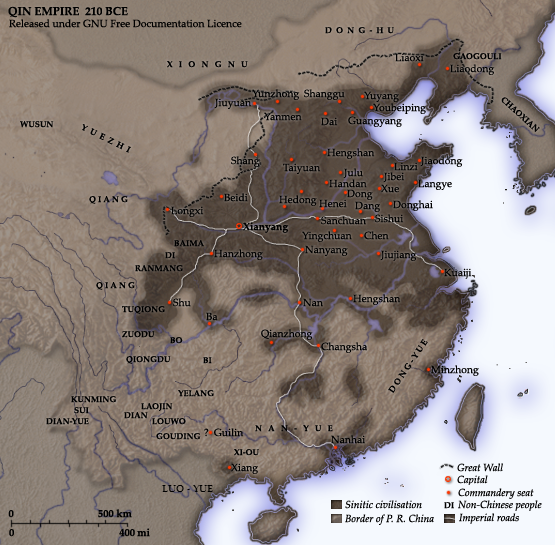
Enabling constraint: single width axle (China 3rd cent BCE).

Standardization of transportation was one of the long-lasting legacies of the Qin dynasty in ancient China. Ideology-wise, standardization had roots in legalism, a doctrine of universal application of clear laws; the doctrine developed in the 4th century BCE by Shang Yang, the prime minister of Qin. After Qin defeated the majority of other Chinese kingdoms and established a unified empire, they undertook enormous efforts to transform the state, including building advanced road infrastructure.
A 4,700 mile network of roads was developed to ease travel in the empire and to the frontiers. Regular staging posts allowed horses to be changed frequently and provided places to sleep at night. The single width of cart axles encouraged trade as there was no delay in moving goods through the provinces. All carts would travel in the same wheel ruts and there would be no need to change to a cart with a different axle width in different provinces.

Standard roads and single width axles were enabling constraints because the helped develop commerce. On the other hand, standardization of thought imposed by Qin turned ugly. They ordered and enforced destruction of all books that were in conflict with their ideology. Moreover, because at the time thought was largely transferred through oral teachings, Qin buried alive hundreds of Confucian scholars, who disagreed with Legalism.


Contrast this with Facebook, which established a standard way of communicating between people (social utility as Zuckeberg calls it) but allowed for free expression on top of the utility.

tags: constraint, payload, distribution, facebook, social, network, infrastructure

Thursday, December 22, 2011

What's good for the Internet is good for spies.

These days, keeping a secret is almost impossible; almost being the key word here. And some people are willing to spend good money on playing the spy game on the Internet.
Dec. 22 (Bloomberg) -- Business is booming, with annual revenue of $3 billion to $5 billion growing as much as 20 percent a year, ISS organizer Jerry Lucas estimates. 

Back at the hotel, the night is young and the paranoia is deep.

Unlike typical trade shows, this one has no social events. No corporate-sponsored cocktail parties. No hospitality suites. Clients and suppliers don’t want to be seen with each other in public, and some countries bar their agents from mingling at the event because it’s a recruiting ground for spies seeking sources, organizer Lucas says.
Quantum computing, if it ever comes to a reasonable implementation, is going to be a game changer in this market. Maybe it already is.

Thursday, December 08, 2011

Social network vs Wisdom of crowd

So far, since the mass adoption of the Internet (web) we had two major bubbles. One - the dot com bubble of the late 1990s; another - the housing and financials bubble of the late 2000s (the crash of 2008). The paradox is that the more information consumers and analysts have access to, the less they seem to be able to make reasonable conclusions from it. In other words, access to the broader wisdom of the crowds should help, not hurt decisions.

New research by Jan Lorenz, et. al. provides a possible explanation for the reduction in "wisdom" phenomenon,
The wisdom of crowd effect is a statistical phenomenon and not a social psychological effect, because it is based on a mathematical aggregation of individual estimates.
In contrast, we demonstrate by experimental evidence (N = 144) that even mild social influence can undermine the wisdom of crowd effect in simple estimation tasks.
Although groups are initially “wise,” knowledge about estimates of others narrows the diversity of opinions to such an extent that it undermines the wisdom of crowd effect in three different ways. 
- The “social influence effect” diminishes the diversity of the crowd without improvements of its collective error.
- The “range reduction effect” moves the position of the truth to peripheral regions of the range of estimates so that the crowd becomes less reliable in providing expertise for external observers.
- The “confidence effect” boosts individuals’ confidence after convergence of their estimates despite lack of improved accuracy.
 The increase in social interaction over the Internet probably leads to similar "wisdom" deterioration effects.

tags: reverse brainstorm, psychology, social, network,

Thursday, September 08, 2011

Organizing the world's users.


Google acquires Zagat, a service hosting user reviews of local businesses.

Having free content is essential to Google's search-related advertisement model. As people switch to social networks and apps on mobile devices, more and more content is streamed to them directly from the service providers. As a result, the share of free quality searchable information continues to decline. Since Apple controls in-app ads on iPhone, Google needs content; the more, the better. They already have Youtube and Maps, which they  favor heavily in their searches. There's no doubt in my mind that Google's acquisition of Zagat is another attempt to stay relevant in social/mobile networking. Therefore, the answer to CNet's question, "whether the company will give the information it owns preferential treatment over information owned by others," is Yes.

In the world of mobile social networking, organizing information means organizing users as well. And you can organize them and their information only if you have access to it.

tags: social, network, information, advertisement, model, business, google

Wednesday, September 07, 2011

How many posts a day does it take to maintain interest?

Research from bit.ly shows that a link shared through social media stays of interest just a few hours:

The mean half life of a link on twitter is 2.8 hours, on facebook it’s 3.2 hours and via ‘direct’ sources (like email or IM clients) it’s 3.4 hours. So you can expect, on average, an extra 24 minutes of attention if you post on facebook than if you post on twitter.
The surprise in the graph above is links that originate from youtube: these links have a half life of 7.4 hours! As clickers, we remain interested in links on youtube for a much longer period of time.


A simple calculation shows that to keep people consistently interested in a feed, you have to generate interesting posts at least 5 times a day.

But for a news site, the magic number is 24*60/5 = 288. That is, news links become not that interesting only just 5 minutes of sharing.

In many ways this is a self-fulfilling prophecy. To keep people interested you have to produce a lot of new content, but as you do so the older content disappears below the horizon of attention.

tags: information, attention, 10X, payload, social, network

Tuesday, August 02, 2011

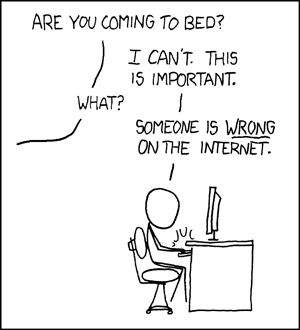
Technology is better than sex?

The results from rigorous scientific studies in

xkcd


and The New Yorker


tags: information, social, network, psychology, communications

Saturday, July 09, 2011

DARPA: Education Dominance research.

via Wired:

Darpa, the Defense Department blue sky research shop, has been hard at work on the muscularly-titled Education Dominance Program aimed at creating digital tutors for troops. It’s worked pretty well thus far, too. When researchers looked at students using Darpa’s digital tutors for Navy IT training last year, they found that those using Darpa’s digital study buddies learned “substantially more” (.pdf) and did so in a much shorter time period than other students.

Fifty years from now DARPA–inspired study buddy will come with a "textbook" as an automated tutor-friend on you favorite social network. We won't have Matrix-like direct skill download, but most of the basic training in core school subjects - Math, Language, Creativity - will be incorporated into virtual learning environment.

tags: education, information, innovation, technology, social, network, cognition, 3x3, interface, interaction, psychology

Wednesday, June 29, 2011

xkcd on the latest innovation from Google


tags: innovation, mousetrap, google, social, network

Thursday, June 02, 2011

The optimal number of legs is between 2 and 3

VentureBeat has a post with various metrics for startups, trying to capture the relationship between success and the team's level of commitment, technical expertise, ability to adapt to market requirements, etc.

I found it interesting that the most successful number of founders is 2 to 3, which is the same number recommended for problem–solving work. Generally, a person working alone can come up with better ideas than a group, but doing it alone is very difficult psychologically: tough problems tend to be frustrating, the problem-solver needs a lot of persistence, social support, access to additional information, and friendly criticism. As the team grows over the magic number of 3, tensions increase, social loafing kicks in, and productivity suffers. There's even what is called Philippe's Law for software development productivity, which states that a team's productivity declines by the factor of cube root of number of people on the team:

Continuing with team numerology, the theory of social information in small worlds says that the optimal number of worlds for discovering useful information is between 2 and 3, but closer to 2. With the new data from startup research, the magic number seems to gravitate to the same value.


tags: psychology, social, network, productivity, startup,

Monday, January 03, 2011

The future (one of many) of social networking

TechCrunch: Mark Suster of GRP Partners makes predictions about the future of “Social Networking." Gossip management is just one of them:

If you don’t manage what is said about you in social networks it could be detrimental.  Products such as Sprout Social and CoTweet are emerging to help businesses better track and communicate with their customers and leads.  Products like awe.sm (I’m an investor) will help you manage the efficacy of your social media marketing campaigns.


tags:

Monday, November 29, 2010

There's no solution!

With the latest Wikileaks dump, the US government ran into the same loss of privacy problem people experience every day: how to share information without surrendering control.

The biggest difficulty the government faces in this realm is how to share information among people who need it to do their jobs without surrendering control of it once they start using it. The fact that Bradley Manning got access to and removed so many documents has many asking just what type of security was employed. The fact is that the security measures were extensive and the failure was not in a lack of attention to detail. There simply is no solution that adequately addresses control of information while allowing those who need it to use it.

tags:control, information, system, security, social, network