Showing posts with label s-curve. Show all posts

Saturday, November 19, 2016

Stanford CSP. Business 152. Innovation Timing. Session 1, Quiz 2.

On November 14, 2016, the New York Times wrote a story about a Spark Capital, a 11-year old technology venture firm.


The article opened with a description of one of Spark's recent deals:
Betting on an automated driving start-up in 2015 may not have been the most intuitive gamble at a time when Google and Uber had already declared that self-driving vehicles were among their top research priorities. 
But in the fall of 2015, Spark Capital was one of a few established venture capital firms to wade into the industry, helping lead a $12.5 million investment in Cruise Automation, a start-up based in San Francisco whose software helps cars pilot themselves. One of Spark’s partners became the only outside board member of the firm. 
It was a bet that paid off quickly: Within six months, Cruise sold itself to General Motors for about $1 billion.

Questions:
1. In your opinion, why the timing of the deal turned out to be so good? Was it pure luck? If you were the analyst who "discovered" Cruise Automation back in 2015, how would you justify the $12.5M investment to your VC partners?
2. (optional) Consider the generic innovation diffusion S-curve, as described in Everett Rogers' "Diffusion of Innovations." What stage of the curve the self-driving car technology is now? Why?

tags: course, stanford, innovation, s-curve

Friday, January 02, 2015

Scalable Innovation (BUS 134) - Quiz, Session 3-1

This quarter I'll be teaching Scalable Innovation (BUS 134) - a new course at Stanford University Continuing Studies. One of the key topics for the course is innovation timing. That is, timing is everything; therefore, in order not to be too early or too late with the idea, the innovator has to be able to at least find a strong, valid signal in the avalanche of noise about the future. Here's an exercise I'm considering for my students.

Read wikipedia about Electronic Sports and consider the chart below (click to enlarge):

Does "Electronic Sports" represent a major technology/market innovation event? Why? Does the curve above represent the beginning of a long-term growth or is it just another hype cycle? If Electronic Sports is the wave of the future, who are the existing industry players that are going to benefit from it the most? What new system elements and interfaces still need to be invented?

tags: innovation, s-curve, gaming, synthesis

Wednesday, January 30, 2013

The Web is Dead, a social media edition.

(San Francisco. Jan 30, 2012) Facebook Inc. said its mobile daily active users exceeded its desktop daily active users for the first time in the fourth quarter of 2012.
The trend hasn't touched the enterprise world that much yet - a huge technology opportunity.

P.S. VentureBeat and Yahoo Mail web pages are the worst browser hogs ever. The pages contain sloppy scripts and flash widgets that pull data constantly, even when the the page is not visible in the tab view.

tags: s-curve, internet, web, mobile, social, networking

Monday, November 05, 2012

The essential non-essentials.

According to the Bureau of Labor Statistics, over the last 100 years household expenditures on non-essentials grew to 50%.

It appears that the beginning of growth coincided with the proliferation of the mass manufacturing system pioneered by Henry Ford.


tags: s-curve, process, innovation

Sunday, September 09, 2012

Teens flock to Instagram/Facebook. Youtube next?

(Sept. 8, 2012. CNet) According to Nielsen, Instagram is the top photography site among teens ages 12 to 17, with 1 million teens visiting the site during July.
Also, a Pew report presented over the summer about teenage online behavior found that 45 percent of online 12-year-olds use social-network sites and that the number doubles to 82 percent for 13-year-old Internet users. The most popular activity for teens on social networks is posting photos and videos, the study found.
10 years ago, the conventional wisdom was that mothers of small children were the most avid picture-takers.  Kodak, HP, and others spent billions of dollars marketing to this demographic. Furthermore, when digital cameras emerged, the old guard saw an increase in picture printing revenues because people took more pictures and, out of habit, printed them. The entire business model was based on the trade-off: the more pictures one wanted to share, the more money she had to spend on printing them.

On the other hand, social networking and cheap mobile cameras broke the trade-off. That is, taking/sharing pictures became free and teenagers could finally afford an infinite amount of sharing. As the result, Kodak went out of business and HP's printing division tanked. At the same time, Facebook and Instagram soared.

A similar situation happened in the personal video space. Sony and other consumer electronic companies lost, while Youtube and Facebook won. If Google continues its momentum with Android (driving video content to Youtube), they might capture a large portion of ad revenue associated with social interaction.

tags: s-curve, trade-off, media, facebook, social, networking, google

Monday, July 23, 2012

The Creative (self-)Destruction of Nokia.

(WSJ. July 18, 2012). More than seven years before Apple Inc. AAPL -0.08% rolled out the iPhone, the Nokia team showed a phone with a color touch screen set above a single button. The device was shown locating a restaurant, playing a racing game and ordering lipstick. In the late 1990s, Nokia secretly developed another alluring product: a tablet computer with a wireless connection and touch screen—all features today of the hot-selling Apple iPad.
"Oh my God," Mr. Nuovo says as he clicks through his old slides. "We had it completely nailed."
Consumers never saw either device. The gadgets were casualties of a corporate culture that lavished funds on research but squandered opportunities to bring the innovations it produced to market.

People tend to forget that the iPhone, with its beautiful design, was just a part of a new system Steve Jobs and his team at Apple put together with help from Google, ATT, Hollywood, Samsung, and the app development community. Furthermore, to succeed in the early stages (Synthesis), an innovation doesn't have to be perfect,
Nokia engineers' "tear-down" reports, according to people who saw them, emphasized that the iPhone was expensive to manufacture and only worked on second-generation networks—primitive compared with Nokia's 3G technology. One report noted that the iPhone didn't come close to passing Nokia's rigorous "drop test," in which a phone is dropped five feet onto concrete from a variety of angles. 
Not surprisingly, Nokia's patent portfolio is worth more than its business operations.

tags: mobile, system, synthesis, s-curve, evolution

Monday, July 16, 2012

Google vs Microsoft: the office battle.

WSJ (June 16, 2012) on the competition in the Office space.
Microsoft also is lavishing attention on businesses that have weighed switching to Google Apps, a corporate-software bundle that includes versions of Gmail and the Google Docs document, spreadsheet and presentation software.


To counter Google's momentum, Microsoft is using a "Google Compete" team, whose mission is to keep Office customers from buying Google Apps.

In a May report, Gartner said Google is winning one-third to half of new corporate users that are paying for Web-based software. In 2009, Gartner predicted that Microsoft by now would be outselling Google Apps by at least 4 to 1.
Microsoft was making so much money on Office that they fell asleep at the steering wheel and missed the beginning of the transition to a new S-curve.

 tags: s-curve, tool, payload, synthesis

The Creative Destruction of Nokia.

WSJ (June 15, 2012) on Nokia's remaining asset value:

BMO Capital Markets analyst Tim Long wrote that Nokia was grinding "its way toward irrelevancy" despite the new round of restructuring and management changes. As a result, he said BMO would take a new approach and value the company based on its cash and intellectual property. Mr. Long now values the company at less than $9 billion, which includes $6 billion of cash and $2.5 billion for its portfolio of patents and other intellectual property.

"We assume zero value for the device and Nokia Siemens Networks businesses," he wrote. "We see little hope for a turnaround from here even with a refined strategy."

Nokia's hardware and software combined seem to be worth nothing.  Only some electronic digits in the bank and some paper files on the shelves in the patent office can fetch some value on today's market.

tags: patents, notes, nokia, s-curve

Saving Yahoo, act 6.

NYT adds another detail to the story of Yahoo's demise:
[Marissa Mayer] said Yahoo was “one of the best brands on the Internet.”She recalled that when she first started at Google, the company would conduct user surveys and “people didn’t understand the difference between Yahoo and the Internet.”
At the turn of the century, Yahoo owned the web, had unrestricted access to Google's search technology, and was one of the largest e-mail providers in the world. And they managed to blow the lead.
As she hashes out Yahoo’s strategy, Ms. Mayer said she was intent on leveraging the Internet company’s strong franchises including e-mail, finance and sports. She also hopes to do more with its video broadband and its mobile businesses.
Let's do a reality check. Youtube dominates Internet video; GMail dominates e-mail (e-mail is dead anyway); Google and Apple share leadership in mobile; Apple gates access to Yahoo finance on the mobile. Facebook and Google are buying technology at the pace of a couple of startups a month. It will be a miracle if Ms Mayer pulls an upset using Yahoo's sports properties.

tag: s-curve, innovation, business, internet, web

Sunday, July 15, 2012

Predicting 30-year tech cycles.

 MIT TR on, presumably, predicted death of PC:
An interesting post from tech commentator Robert X. Cringely reveals how he predicted the death of the personal computer back in 1992, in his book Accidental Empires. He called the death for right about... now.

His logic, based on history, was that transformative information technologies take 30 years to essentially be digested by society. It took three decades before moveable type led to books. It took three decades before telephones truly began to permeate and transform our lives. Similarly, film was born in the last years of the 19th century but only took off in the 1920s, and TV was invented in the 1920s but didn’t really take off until the 1950s.
 Here, I agree John Geanokoplos, a professor of economics at Yale, that unconditional predictions are shots in the dark. Because there are so many unknowns, esp. at the macro level, that it's much more prudent to work on developing and tracking alternative future scenarios.

tags: s-curve, technology, method, prediction

Saturday, July 14, 2012

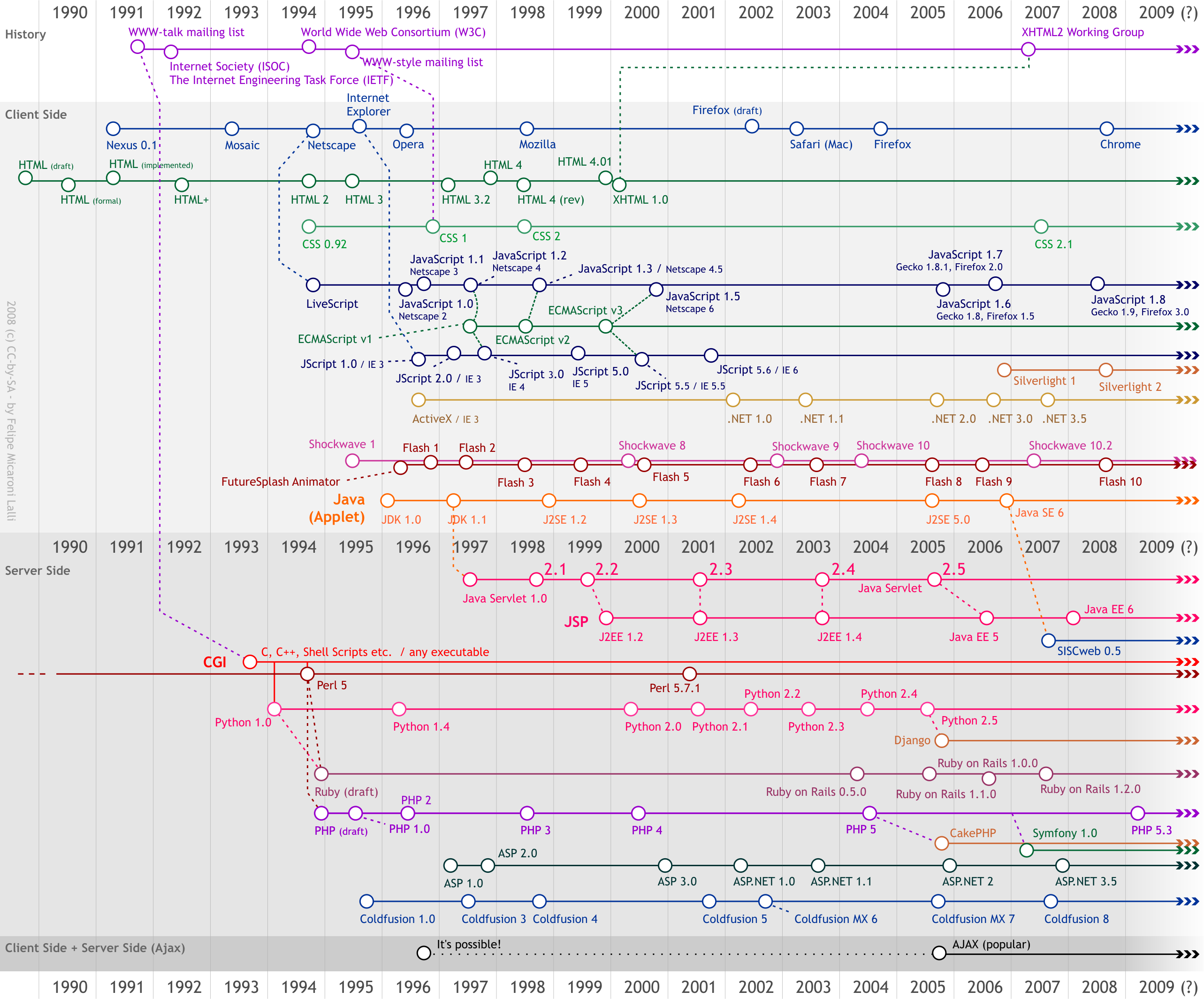
Web development timeline: Server and App side.

Web development timeline from Wikimedia:


Browser development timeline from Wikimedia


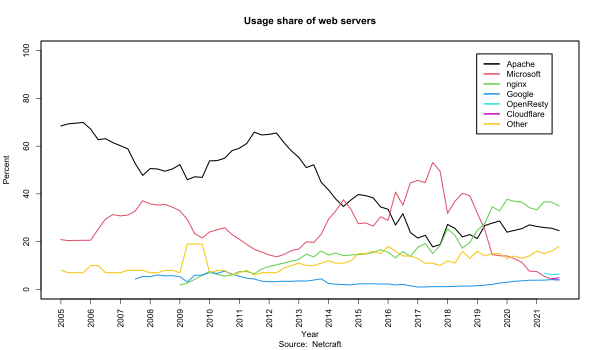
Market share of web servers
 

Wednesday, July 11, 2012

E-mail is dead.


CNet reports on the demographics of communications:
(July 11, 2012 12:03 PM PDT) The study shows that teens turn to text messaging for communication instead of writing e-mails. Six percent of teens use e-mail daily, while 39 percent say they never use e-mail. In contrast, 63 percent of teens text everyday, with some teens texting up to 100 messages a day.

tags: s-curve, payload, 10x, social, networking

Wednesday, July 04, 2012

Creative self-destruction of RIM.

When NTP sued RIM, the manufacturer of Blackberry phone/e-mail devices, for patent infringement, many people believed that patent trolls were the company's worst enemies. In 2006, after years of litigation, RIM ended up paying NTP a $612.5 million settlement.

It turns out, RIM's own management did a lot more damage to the company than any patent troll could even imagine. Because RIM missed on major innovation opportunities in the mobile industry, the company lost multiple billions of dollars in market value.


tags: innovation, patents, strategy, s-curve

Sunday, July 01, 2012

Same technology, different S-curves, different results.

Using solar power in areas where there's no power grid, e.g. in Asia and Africa, looks a lot more promising and cost-effective than introducing the same solar power technology in mature energy systems in the US or Europe.
(MIT Tech Review, June 8, 2012). Diesel is a major source of power in south Asia and Africa, where many areas lack access to the grid and frequent blackouts prompt those who can afford it to install backup generators. These markets could help a solar industry that’s struggling with low profit margins due to an oversupply of panels. In turn, the lower prices for solar power could speed up deployment in poor countries by providing a more economical alternative to diesel-powered pumps and generators, and a much faster path to electrification than waiting for grid infrastructure.

One of the first economical applications for solar is replacing diesel-powered irrigation pumps, Gopalan says. These pumps don’t have to run at night, so batteries aren’t needed, keeping costs down. “The total available market in India alone is 15 to 20 gigawatts, and irrigation pumping is a massive application in all of Asia and Africa,” he says. For perspective, the current total installed capacity for solar power is 65 gigawatts, according to the management consulting firm McKinsey.

In Asia and Africa, introduction of the technology does not depend on infrastructure investment. Furthermore, as recent power outages in the US show, the bottleneck in the energy system is not power generation, but power distribution.  Also, Germany's introduction of "green" energy involves massive investment into new distribution lines. As a result, adoption of the same technology in different areas produces dramatically different economic outcomes.

This difference is obvious to me on the personal level as well. Every day I walk my dog by our local high school. Two years ago it used a government subsidy and a local bond to install solar panels to cover its parking lot. Paradoxically, during the summer months when the largest amount of solar power is generated, the school is not in session. Therefore, the power cannot be used locally and has to be distributed through the grid - with losses - to remote users. In other words, there's a fundamental mismatch between the power generation and the power use patterns.

In contrast, the MIT article cited above talks about a solar panel installation in Asia that feeds irrigation pumps. Because the pumps have to work the hardest when there's a lot of sunshine, solar-based power generation and power consumption by the pumps are almost perfectly synchronized. Therefore, there's no need to store or distribute the power - with inevitable losses - to other users.

As we can see, economic efficiency of the same technology is quite different in these two cases. Here in California, we face a trade-off: the "greener" the energy, the more expensive it is. Opposite to that, in Asia the trade-off is broken: the "greener" the energy, the cheaper it is. Clearly, the technology's upside is much greater there.

tags: s-curve, synthesis, growth, distribution, infrastructure, niche construction, 4q diagram, market


Saturday, June 23, 2012

The new level of sophistication in cyber attacks.

June 23, 2012. VBeat:

Security firm ESET discovered the malware, now called ACAD/Medre.A, around February and noted it was “military-grade.” The worm attacks AutoCad, a popular piece of software used by architects and engineers to draw up blue prints and other infrastructure plans. It targets computers running the Windows operating system to steal and e-mail out AutoCad “drawings.” These drawings are then received by an e-mail that ESET found to be based in China.

Industrial cyber-espionage is now entering the Efficiency stage. Malware makers know exactly what, when, and why they want to steal.

tags: s-curve, system, maturity, efficiency, control, detection, security, business

Saturday, June 02, 2012

LunchTalk: Dr. Regina Dugan, DARPA Cyber Colloquium

During the Colloquium, more than 700 cyber experts from industry, academia and the hacker community learned how since 2009, DARPA has been steadily increasing its cyber research. Its budget submission for fiscal year 2012 increased cyber research funding by $88M. Over the next five years, the Agency's proposed cyber research investment expects to grow from 8 to 12 percent of its top line. These investments are shifting to activities that promise more convergence with the threat and recognize the unique needs of DoD. Dugan explained, "in the coming years DARPA will focus an increasing portion of its cyber research on the investigation of offensive capabilities to address military-specific needs."

link

- More video is uploaded in 60 days that's been created in 60 years by 3 major US TV networks combined.
- 29 chemical companies were subjects of computer attacks to extract data on formulas and manufacturing processes.
- in 2004 proceeds from cyber crime exceeded proceeds from selling drugs.

tags: lunchtalk, quote, security, growth,s-curve


Friday, February 10, 2012

The killer device.

For the first time, web traffic from Apple's mobile devices exceeded that of Macs. One revolution Steve Jobs started thirty years ago is coming to an end. The other one is just getting under way.


Feb 10, 2012. VBeat -- In the first quarter of 2012, for instance, Apple sold 37.04 million iPhones, 15.43 million iPads, and just 5.2 million Macs.

It’s not quite the death of the desktop, but mobile devices are gaining ground on their traditional brethren, at least within the Apple-centric world.
“There is cannibalization, clearly, of the Mac by the iPad, but we continue to believe that there’s much more cannibalization of Windows PCs by the iPad,” Cook said

tags: mobile, s-curve, web, tool, information, synthesis

Tuesday, February 07, 2012

Smartphones reincarnated.

Mass production of smartphone components creates opportunities for new embedded applications based on smartphone software and hardware. For example, Romo the robot.
Feb 4, 2012. CNet -- They wanted to build a robot that, like any software-based product, could be tweaked and changed over time. Their robot needed to evolve.
The problem was cost. Nguyen, who is 25, came up with the idea of tying it all to a smartphone in order to take advantage of the powerful processor already built into the phone. This way, the most expensive part of building a robot from scratch would, in effect, be taken care of by Apple or other smartphone makers

Now we know that in the future old phones will be reincarnated as robots or some other type of computing interface for various appliances.
The PC revolution created huge opportunities for embedded computing: from dental office equipment to PC-based supermarket checkout stands to blade servers that run on Intel processors. In a similar fashion, the smartphone revolution will power new connected appliances.

tags: computing, mobile, innovation, s-curve, 4q diagram


Lunchtalk: (TED) Back to the Future

From deep in the TED archive, Danny Hillis outlines an intriguing theory of how and why technological change seems to be accelerating, by linking it to the very evolution of life itself. The presentation techniques he uses may look dated, but the ideas are as relevant as ever.

link

tags: lunchtalk, forecast, 10X, s-curve

Wednesday, January 25, 2012

Mobile payments are in trouble (in the US)

Retail shops seem to be further away from adopting new types of mobile payments than we thought. It'll probably take another generation of technology to get them over their technological inertia. By that time, online retailers we'll be in an even stronger position to compete.
Jan 25, 2012. VBeat -- Because today’s retail systems are so inflexible, the integration of any third-party systems will result in a huge IT expense for implementation. The customization required so that all components of the point of sale system (including inventory management and payment processing) interact with a new mobile payment platform without disrupting the operation of the existing systems is cumbersome and expensive due to complex software integration.

The retailer’s cost to add even one type of mobile payment technology (such as Google Wallet) is currently very high, and since the market is so fragmented, adopting just one of the mobile payment platforms will only address a tiny portion of the market.

 A possible solution to the problem could be a partnership between online and brick-and-mortar retailers. In many ways, Amazon marketplace is this type of a distributed physical store, where a variety of retailers use Amazon's IT resources to sell their goods. The retail industry as a whole is at the end of their S-curve; therefore, transplanting it to a new payment technology is a big organizational challenge.