True Detective, Season 2 turned out to be a bit of a disappointment and I wanted to understand why. Reading TV critics and blogs didn't give me much insight beyond the typical "oh, the story was not good" or "oh, the director was not good" or "oh, the pace of the action was too slow", etc. Therefore, I decided to put my inventor hat on and compare the two Seasons as Systems. I applied to both TV series the same system analysis techniques I always use in my invention workshops.
I started the analysis by laying out each story as a system of perspectives. That is, each layer of narration in the series represents a Source of information for the viewers (Scalable Innovation, Section 1). Each Source covers the reality of events on the ground. Paradoxically, it turned out that despite Season 2 has more main characters than Season 1, it also has fewer unique Sources of representation.
In Season 1 we had four key perspectives (2 "real" and 2 "virtual"):
1. Detective Rust Cohle (Matthew McConaughey);
2. Detective Marty Hart (Woody Harrelson);
3. The Official Investigation - a narrative presented by the official police investigation;
4. The Narrator - a director narrative presented by the chronology of events described in an "objective" manner by the video camera and background characters.
The nature of perspectives was also different. All of them were extremely smart but with different flavors. Rust Cohle could be characterized as "weird smart". Marty Hart - "down-to-earth smart". The Investigation - "bureaucracy smart". The Narrator - "visual and story smart". Furthermore, we had variations of each perspective shifted in time and space. In addition to the mystery of the crime, we, as viewers, had to reconcile and process the mysteries of all these Sources that gave us complimentary and conflicting information. The structure of the system provided us with a intricate, intriguing pattern.
Importantly, the system of different perspectives felt natural due to the fact that detectives Cohle and Hart managed to solve their case _because_ they had different perspectives. They also had conflicts _because_ they had different perspectives. Since they broke multiple official rules — and The Narrator shows us how and why — the official investigation perspective provided us with an explanation why a standard bureaucratic police approach to detective work would not solve the mystery. As a result, we had a system of contrasting and explaining Sources that formed a complex but consistent, natural whole.
Finally, the perspectives were not just narrated from a character's point of view. They were SHOWN from that point of view. In short, Season 1 did an excellent job executing the rule "Show, don't tell".
Season 2 had more main characters, but fewer perspectives. Essentially, there was just one perspective - the Narrator, who guided us and the camera through the story. Basically, we had one Source which kept switching microphones and cameras for every character to tell his or her line.
Although the story itself was, arguably, more complicated and somewhat more mysterious, the system of perspectives was no different than in a regular criminal TV piece. As a system, Season 1 turned out to be flat.
Overall, the actors in both Seasons played great, stories were interesting, suspension was adequate for a crime drama, and camera work excellent, especially, the LA aerial shots in Season 2. Unfortunately for Season 2, the script didn't provide a system structure that could support a real thriller of the Season 1 caliber.
tags: system, source, control, entertainment, method
I use this blog to gather information and thoughts about invention and innovation, the subjects I've been teaching at Stanford University Continuing Studies Program since 2005. The current course is Principles of Invention and Innovation (Summer '17). Our book "Scalable Innovation" is now available on Amazon http://www.amazon.com/Scalable-Innovation-Inventors-Entrepreneurs-Professionals/dp/1466590971/
Showing posts with label source. Show all posts
Thursday, August 13, 2015
Friday, July 17, 2015
LunchTalk: Netflix CEO Reed Hastings
At the 37th annual ENCORE Award event on September 23, 2014, Stanford Graduate School of Business honored Netflix, and Netflix Founder and CEO Reed Hastings, MS '88. Reed Hastings speaks on the history of the company, the challenges they faced, and how Netflix became the innovative leader it is today.
tags: internet, media, video, streamternet, source, content
Friday, August 01, 2014
Invention of the Day: Wind-powered Sawmill
In the 17th century, the Dutch dominated sea trade and naval warfare. That time in European history is often referred to as the Dutch Golden Age. One Dutch inventor was particularly instrumental in giving his small independent nation a decisive advantage over Spain, the naval super-power of the 15th and 16th centuries.
In 1594-97, Cornelis Corneliszoon van Uitgeest (c. 1550 - c. 1600), a Dutch windmill owner, invented and perfected the first wind-powered sawmill. That is, before Cornelis two workers had to saw a log manually, using a specially designed pit. It was a long and ardious process.
Before:
After:
The new device allowed its operator to produce wooden planks 30 times faster than before.
Why this tech advance turned out to be strategically important for the Dutch nation?
Because wooden planks was the key material for building ships. In combination with ubiquitous windmills, the new technology enabled Dutch shipbuilders dramatically increase production of low-cost naval vessels, both military and commercial. As the result, the Dutch could not only swarm Spanish ships in sea battles, but also transport great amounts of commercial goods from newly discovered places in Africa and Asia, which gave them strong market advantages. The invention of the wind-powered sawmill brought about a 10X change in productivity that rippled through the entire world.
Eventually, the British overtook the Dutch, partly due to James Watt's improvements of the steam engine, which was much more powerful and reliable than the windmills.
tags: invention, innovation, 10X, source, tool, packaged payload,
In 1594-97, Cornelis Corneliszoon van Uitgeest (c. 1550 - c. 1600), a Dutch windmill owner, invented and perfected the first wind-powered sawmill. That is, before Cornelis two workers had to saw a log manually, using a specially designed pit. It was a long and ardious process.
Before:
After:
![]() |
| Source: Power from Wind: A History of Windmill Technology By Richard Leslie Hills. |
The new device allowed its operator to produce wooden planks 30 times faster than before.
Why this tech advance turned out to be strategically important for the Dutch nation?
Because wooden planks was the key material for building ships. In combination with ubiquitous windmills, the new technology enabled Dutch shipbuilders dramatically increase production of low-cost naval vessels, both military and commercial. As the result, the Dutch could not only swarm Spanish ships in sea battles, but also transport great amounts of commercial goods from newly discovered places in Africa and Asia, which gave them strong market advantages. The invention of the wind-powered sawmill brought about a 10X change in productivity that rippled through the entire world.
Eventually, the British overtook the Dutch, partly due to James Watt's improvements of the steam engine, which was much more powerful and reliable than the windmills.
tags: invention, innovation, 10X, source, tool, packaged payload,
Labels:
10x,
innovation,
invention,
packaged payload,
source,
tool
Thursday, June 12, 2014
Why Tesla gives away its patents to copycats?
Wired reports on the latest in patent news:
I looked up Tesla's patent portfolio on the US PTO website this afternoon: 156 issued US patents and nothing of great importance there. In comparison, BMW and Toyota have thousands of patents. In a patent fight against its direct competitors Tesla has a slim to none chance to win. Therefore, giving away a weak patent portfolio is not a big loss for Tesla. On the other hand, if the company succeeds inducing the competitors to give up their patents, that would be great! Besides, Tesla promises to gives its patents to those who want "to use our technology" only. Interesting. This brings our attention to Tesla's new business model.
Recently, the company announced that it is going to build a huge battery-making plant in the US. For this project to be successful, Tesla needs economies of scale: a lot of electric cars made by those who use Tesla batteries and electric drive technology. Selling batteries to a potentially huge market would be more profitable than trying to enforce weak patents in a small market. Giving away the patents is a shrewd PR move by Elon Musk. This reminds me of an ancient Chinese stratagem called "Tossing out a brick to get a jade gem." It means "Bait someone by making him believe he gains something or just make him react to it ("toss out a brick") and obtain something valuable from him in return ("get a jade gem")."
===
In the system model terms (see our book Scalable Innovation), Tesla intends to make money on the battery, i.e. the Packaged Payload, while encouraging others to build more electric cars, i.e. the Tools.
Tesla CEO Elon Musk announced today that his company will not “initiate patent lawsuits against anyone who, in good faith, wants to use our technology.” In plain English, that means that if other car companies want to produce electric cars, they can use Tesla’s technology to do it, and, in turn, advance Musk’s sustainability vision.What's the significance of that?
I looked up Tesla's patent portfolio on the US PTO website this afternoon: 156 issued US patents and nothing of great importance there. In comparison, BMW and Toyota have thousands of patents. In a patent fight against its direct competitors Tesla has a slim to none chance to win. Therefore, giving away a weak patent portfolio is not a big loss for Tesla. On the other hand, if the company succeeds inducing the competitors to give up their patents, that would be great! Besides, Tesla promises to gives its patents to those who want "to use our technology" only. Interesting. This brings our attention to Tesla's new business model.
Recently, the company announced that it is going to build a huge battery-making plant in the US. For this project to be successful, Tesla needs economies of scale: a lot of electric cars made by those who use Tesla batteries and electric drive technology. Selling batteries to a potentially huge market would be more profitable than trying to enforce weak patents in a small market. Giving away the patents is a shrewd PR move by Elon Musk. This reminds me of an ancient Chinese stratagem called "Tossing out a brick to get a jade gem." It means "Bait someone by making him believe he gains something or just make him react to it ("toss out a brick") and obtain something valuable from him in return ("get a jade gem")."
===
In the system model terms (see our book Scalable Innovation), Tesla intends to make money on the battery, i.e. the Packaged Payload, while encouraging others to build more electric cars, i.e. the Tools.
Creating a new Silicon Valley is more difficult than the original Silicon Valley
The original Silicon Valley started in the late 1950s. Since then, many countries tried to reproduce Silicon Valley success, but only Israel could sustain high-tech development over two consecutive innovation waves.
One of the major difficulties in creating a new Silicon Valley would be to talent retention. That is, it is easier than ever for a talented entrepreneur, engineer, or scientist to move to the greater Silicon Valley, which today includes San Francisco. A recent infographic from Bloomberg shows the impact immigrants make on high-tech innovation in the Bay Area (click to enlarge).
In 2010, Asian Americans became the majority of the high-tech workforce in the valley. One third of SV startups are founded by Indian Americans.
tags: silicon valley, innovation, demographics, tool, source
Labels:
demographics,
innovation,
silicon valley,
source,
tool
Thursday, January 09, 2014
The insanely great world of sports (and life in general)
Reading Nate Silver's "The Signal and the Noise" prompted me to consider the beautiful absurdity of human reality. For example, Silver devotes a large chunk of the book to various statistical systems that predict baseball player performance. He shows how scouts and geeks scour gigabytes of objective and subjective data about thousands of candidates: from high school, to minor leagues, to the Major League Baseball (MLB). It's understandable because top player contracts run easily into a hundred million dollars. The total 2013 MLB payroll is over $3 billion dollars.
This large-scale data gathering and analysis is not limited to pro teams. With proliferation of the web, amateurs are getting into the statistical game with online fantasy sports. (In fantasy sports, players draft virtual teams that collect points based on player stats during regular season "physical" games.) According to Bloomberg News, fantasy sports participants spent $3,4B on products, services, and entry fees. Huge business on imaginary teams!
Why is it absurd? Because from an information perspective, an outcome of a home team game produces just 1 bit of information.* That is, the home team either wins (1) or loses (0). Somehow, we humans managed to invent an elaborate process for generating reams of data that result in a minimal amount of information. Judging by the success of Twitter, our purpose in life seems to be pure data generation.
Speaking of human life, since all people die, the informational outcome of an individual human life equals to zero. That is, because there's no uncertainty of the biological outcome, one's life or death does not make any computational difference. What does make a difference though, is whether one has children or not. In that case, an uncertainty exists and we cannot be sure that the data generation process will continue into the future. No wonder God tells Noah, "Be fruitful and multiply, and replenish the earth." (Genesis, 9:1). What is s/he computing? :)
* Information is classically defined as reduction of uncertainty: the more numerous the alternatives that are ruled out, the greater the reduction of uncertainty, and thus the greater the information. It is usually measured using the entropy function, which is the logarithm of the number of alternatives (assuming they are equally likely). For example, tossing a fair coin and obtaining heads corresponds to log2(2) = 1 bit of information, because there are just two alternatives. (quoted from G. Tononi, Biol. Bull. 215, 216, http://www.biolbull.
org/content/215/3/216.full (2008).
This large-scale data gathering and analysis is not limited to pro teams. With proliferation of the web, amateurs are getting into the statistical game with online fantasy sports. (In fantasy sports, players draft virtual teams that collect points based on player stats during regular season "physical" games.) According to Bloomberg News, fantasy sports participants spent $3,4B on products, services, and entry fees. Huge business on imaginary teams!
Why is it absurd? Because from an information perspective, an outcome of a home team game produces just 1 bit of information.* That is, the home team either wins (1) or loses (0). Somehow, we humans managed to invent an elaborate process for generating reams of data that result in a minimal amount of information. Judging by the success of Twitter, our purpose in life seems to be pure data generation.
| http://en.wikipedia.org/wiki/DIKW_Pyramid |
Speaking of human life, since all people die, the informational outcome of an individual human life equals to zero. That is, because there's no uncertainty of the biological outcome, one's life or death does not make any computational difference. What does make a difference though, is whether one has children or not. In that case, an uncertainty exists and we cannot be sure that the data generation process will continue into the future. No wonder God tells Noah, "Be fruitful and multiply, and replenish the earth." (Genesis, 9:1). What is s/he computing? :)
* Information is classically defined as reduction of uncertainty: the more numerous the alternatives that are ruled out, the greater the reduction of uncertainty, and thus the greater the information. It is usually measured using the entropy function, which is the logarithm of the number of alternatives (assuming they are equally likely). For example, tossing a fair coin and obtaining heads corresponds to log2(2) = 1 bit of information, because there are just two alternatives. (quoted from G. Tononi, Biol. Bull. 215, 216, http://www.biolbull.
org/content/215/3/216.full (2008).
Saturday, July 20, 2013
Entrepreneurship: Singapore vs Silicon Valley
Singapore startups are relatively good on talent and funding, but their output it disproportionately low (data from the Startup Genome Report, Part I. 2012).
Entrepreneurs are much better educated than their Silicon Valley counterparts and they work harder. But I would argue that these advantages fail them because of the wrong market choice: niche vs new.
Singapore entrepreneurs and VCs seem to be suffering from the "Better Mouse Trap" syndrome, i.e. they focus too much on improving existing products/services instead of creating new markets.
tags: mousetrap, startup, entrepreneurship, source, control
Entrepreneurs are much better educated than their Silicon Valley counterparts and they work harder. But I would argue that these advantages fail them because of the wrong market choice: niche vs new.
Singapore entrepreneurs and VCs seem to be suffering from the "Better Mouse Trap" syndrome, i.e. they focus too much on improving existing products/services instead of creating new markets.
tags: mousetrap, startup, entrepreneurship, source, control
Labels:
control,
entrepreneurship,
mousetrap,
source,
startup
Sunday, July 14, 2013
Forming startup teams: an Israeli version of Silicon Valley
![]() |
| MIT Tech Review (7/11/2013). Israel’s Military-Entrepreneurial Complex Owns Big Data. |
By contrast, in the US, tightly knit entrepreneurial teams form in college dorms, labs, and high-tech workplaces. Working at the edge of technology is another critical ingredient for success. As a result, the startup team has the following essential characteristcs:MIT Tech Review: Each year, Israel’s military puts thousands of teenagers through technical courses, melds them into ready-made teams, and then graduates them into a country that attracts more venture capital investment per person than any in the world.
- - tech frontier proximity
- - alertness to opportunity
- - motivation (competitive drive)
- - focus on getting things done
- - high skills
- - high challenge (facing difficult open-ended problems)
- - connections necessary to recruit talent and obtain financing (network)
- - low costs
- - reputation for getting things done (see esp. p.4)
![]() | |
| Scalable Innovation. Fig 2.2. System Diagram. |
Saturday, July 14, 2012
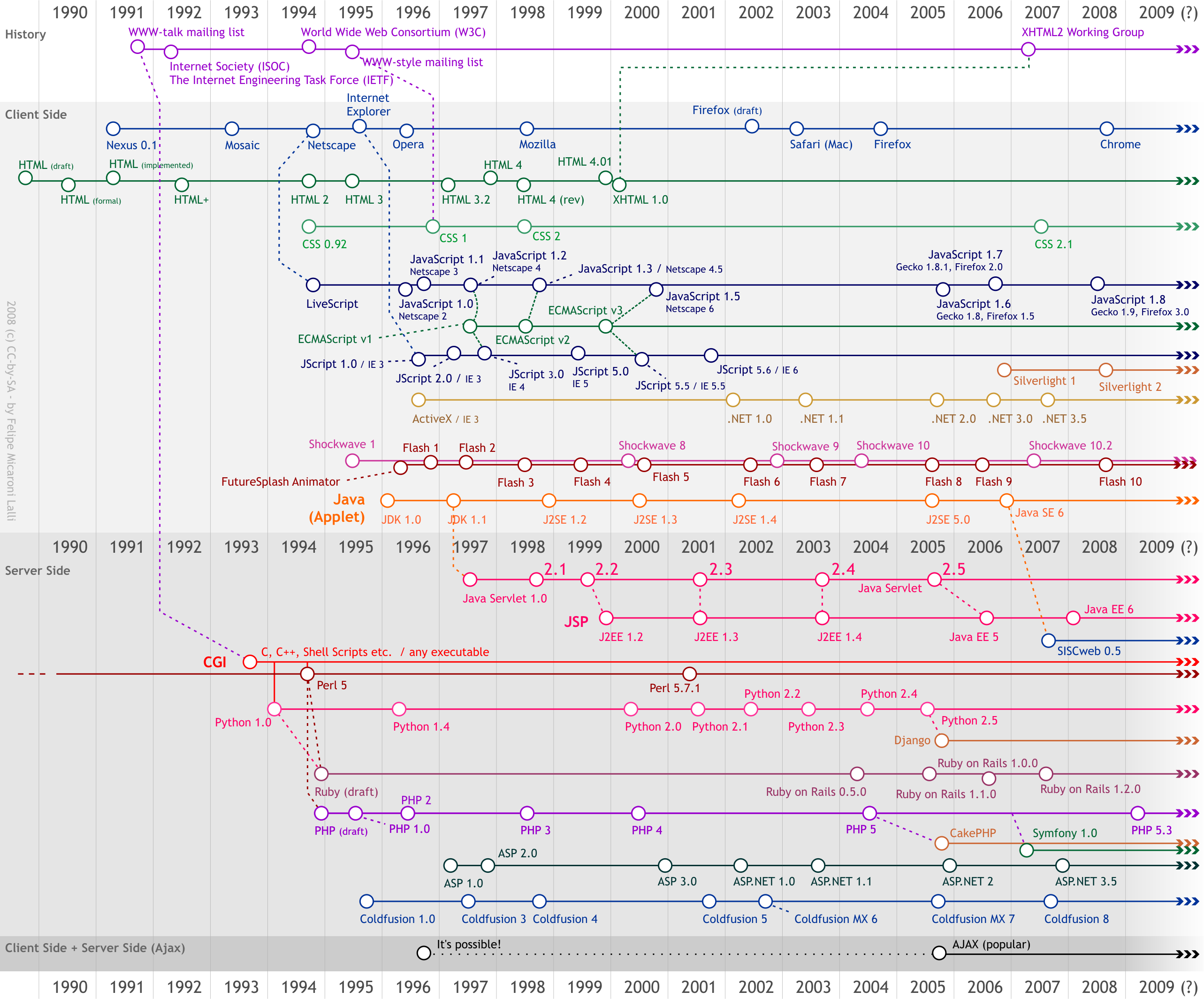
Web development timeline: Server and App side.
Web development timeline from Wikimedia:
Browser development timeline from Wikimedia
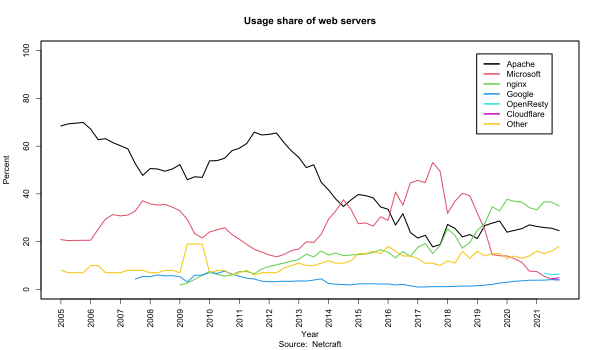
Market share of web servers
Saturday, February 18, 2012
TV vs Social networking
An inforgraphic from VBeat about Americans' social networking habits:
For comparison, Americans on average spend 4hrs 39min a day watching TV, which is more than 20 times greater than on social networking. The biggest difference in these two media activities is the mode of user participation: passive vs active. With TV viewers don't add anything to the content, while social networking works because they actively add content and links. It's easy to see that adding social element to TV viewing can help content providers and advertisers engage their audience and introduce various freemium biz models, similar to Zynga's.
Implications for cloud computing and bandwidth provisioning are going to be significant as well.
tags: media, trend, gaming, source, payload
For comparison, Americans on average spend 4hrs 39min a day watching TV, which is more than 20 times greater than on social networking. The biggest difference in these two media activities is the mode of user participation: passive vs active. With TV viewers don't add anything to the content, while social networking works because they actively add content and links. It's easy to see that adding social element to TV viewing can help content providers and advertisers engage their audience and introduce various freemium biz models, similar to Zynga's.
Implications for cloud computing and bandwidth provisioning are going to be significant as well.
tags: media, trend, gaming, source, payload
Monday, February 13, 2012
Lunchtalk: Open Science.
In Reinventing Discovery, Michael Nielsen argues that we are living at the dawn of the most dramatic change in science in more than 300 years. This change is being driven by powerful new cognitive tools, enabled by the internet, which are greatly accelerating scientific discovery. There are many books about how the internet is changing business or the workplace or government. But this is the first book about something much more fundamental: how the internet is transforming the nature of our collective intelligence and how we understand the world. Reinventing Discovery tells the exciting story of an unprecedented new era of networked science.
link
tags: science, source, lunchtalk
Friday, February 03, 2012
Finally, some good news for solar energy.
Because the electric grid in India is unreliable and solar panels keep getting cheaper, renewable energy becomes economically competitive with local diesel generators.
tags: system, evolution, mousetrap, energy, source, distribution
Feb 2, 2012. The New Scientist -- A quarter of people in India do not have access to electricity, according to the International Energy Agency's 2011 World Energy Outlook report. Those who are connected to the national grid experience frequent blackouts. To cope, many homes and factories install diesel generators.
Now the generators could be on their way out. In India, electricity from solar supplied to the grid has fallen to just 8.78 rupees per kilowatt-hour compared with 17 rupees for diesel.
The one thing stopping households buying a solar panel is the initial cost, says Amit Kumar, director of energy-environment technology development at The Energy and Resources Institute in New Delhi, India. Buying a solar panel is more expensive than buying a diesel generator, but according to Chase's calculations solar becomes cheaper than diesel after seven years.
tags: system, evolution, mousetrap, energy, source, distribution
Thursday, February 02, 2012
Lunchtalk: (TED) Swarms of robots.
Mick Mountz revolutionized the way warehouses pack and ship their inventory by using robots, mobile shelving, and algorithms based on complexity theory. What used to take hours of tedious tasks is transformed into fun, 15-minute, click-to-ship order processing.
link
tags: lunchtalk, distribution, control, source, payload,
link
tags: lunchtalk, distribution, control, source, payload,
Labels:
control,
distribution,
lunchtalk,
payload,
source
Monday, January 30, 2012
LunchTalk: (TED) How Wikipedia was created.
Jimmy Wales [the founder of Wikipedia] recalls how he assembled "a ragtag band of volunteers," gave them tools for collaborating and created Wikipedia, the self-organizing, self-correcting, never-finished online encyclopedia.
link
tags: web, internet, information, source, invention
Labels:
information,
internet,
invention,
source,
web
Sunday, January 22, 2012
A database to store the cloud.
Amazon continues to push hard into cloud services with a database designed to handle disjoint information.
tags: source, system, evolution, information, infrastructure
Jan 19, 2012. Wired -- NoSQL is a widespread effort to build a new kind of database for “unstructured” information — the sort of information that comes spilling off the internet with each passing second. Five years ago, Amazon introduced a NoSQL database service called SimpleDB, and now, it’s offering what you might think of as Amazon NoSQL Mark II. It’s called DynamoDB.This is an important technology transition. Until fairly recently, internet applications were re-using (and are still using) database designs created for the previous generations of IT applications. Now, we see internet-specific architectures becoming available as a 24/7 service. Should be really good for mobile apps, games, ads, and connected devices.
Like SimpleDB, DynamoDB is one of many Amazon Web Services (AWS), a set of tools offering online access to various computing resources, from virtual servers to virtual storage to databases and other software.
tags: source, system, evolution, information, infrastructure
Labels:
evolution,
information,
infrastructure,
source,
system
Saturday, January 07, 2012
Video streaming - winner-takes-all market.
Online video streaming is another high-tech winner-takes-all market, with YouTube totally dominating the field. I'm surprise Facebook is essentially non-existing in this space.
VBeat has a nice infographic (under the cut). They call it Digital Living Room, though online video use has nothing to do with the living room.
Data courtesy Nielsen via VBeat.
VBeat has a nice infographic (under the cut). They call it Digital Living Room, though online video use has nothing to do with the living room.
Labels:
entertainment,
information,
payload,
source,
system,
tool,
video
Thursday, January 05, 2012
What is Luck? [an inventor's perspective]
[This is a rough draft/outline of a section of the book I'm working on. I'm not sure this piece will make it into the book, though. ]
Let's take as a starting point Kahaneman's formula that "success is talent + luck" and "great success is a little more talent + a lot of luck."
It follows that in every highly successful invention we should be able to discover a lot of luck. What kind of luck? What should we be looking for?
The Merriam-Webster dictionary defines luck as
a: a force that brings good fortune or adversity;
b: the events or circumstances that operate for or against an individual;
c: favoring chance.
Definitions a and c are tautological; they won't survive logic analysis. Definition b is closer to what we need because it talks about circumstances that operate independently from an individual and don't contain fuzzy notions like "force" and "fortune." Thus, we can take Kahneman's formula and re-write it as follows:
great success = a little more talent + strong circumstances that operate for the individual.
Finding strong circumstances that help invention should be relatively easy.
Consider the example of Otto Frederick Rohwedder, the inventor of bread slicing machine. He started working on the idea in 1912. In 1916, he sold his jewelry stores and moved back to Davenport, his home town, to work full time on implementation. In 1917, he suffered a major setback [bad luck] when his blueprints and prototypes were destroyed in a fire.
While making a living as a financial agent, Rohwedder continued working on the idea. In 1927, fifteen years after starting the project, he came up with a machine that not only sliced, but also wrapped up the bread. [wrapping is important and it deserves a separate discussion]. In 1928, he built and sold his first machine - customers loved sliced bread.
In 1929, stock market crashes and, to stay afloat financially, Rohwedder sells rights to his technology [again bad luck]. In the meantime, consumer demand for sliced bread persists. In the beginning of the 1930s, Wonder Bread enters the market and by 1933 sales of sliced bread outpace those of unsliced bread. Sliced bread becomes proverbial. During WWII when authorities forbid its sale, the public complains and the authorities are forced to reconsider their decision.
Back to the formula for success. Definitely, Rohwedder has talent. But the sixty-four billion dollar question is, Where's a lot of luck? What are the strong circumstances that operate for the individual?
The answer seems to be, there's no good luck for Rohwedder. He suffers a fire, loses of assets, and faces strong competition. But there's a lot of luck for sliced bread and the bread slicing machine, i.e. his inventions. What are the circumstances that work for them?
Earlier I noted that in 1910, GE introduced first commercially successful toaster. With this information, the start of Rohwedder's quest for sliced bread in 1912 doesn't look accidental anymore. Successful toasters need sliced bread.
Let's follow the toaster thread further. In 1920, Charles P. Strite invents the pop-up toaster with timer. The new design solves two problems: bread slices don't get burned and the toasting process is sped up because heat is applied to both sides at the same time. By 1926, Strite's toaster is a major commercial success. People love the toaster, but slicing bread is a tedious task. Besides, to produce consistent results, the toaster requires uniform slices - something that can't be done consistently by a human. In short, because of the toaster success, there's a lot of demand for regularly sliced bread. The stage for the bread slicing machine is set. The toaster is it's luck, i.e. strong circumstances that favor an individual. If not for the improved toaster, nobody would care for high-performance bread slicing technology.
Two additional considerations. One: From the beginning of the 1900s, electricity becomes common in houses and businesses. In 1904, long-lasting tungsten filament for light bulbs is patented. In 1906, GE patents a process for mass production of tungsten wire for light bulbs. The same wire is used in toasters. Lucky toasters!
Two: In the early 1900s, Henry Ford begins using electric motors in his car factories. With the adoption of his mass manufacturing methods, the electric motor technology is improved dramatically. It is not a coincidence that by the 1930s Rohwedder's bread slicing machine uses electric motor. Lucky machine!
To summarize: First, when we talk about successful invention/innovation, the luck component operates not for an individual, but for his/her invention. Second, luck operates on at least three levels: 1) the invention works. e.g. the bread slicing machine is operational as designed; 2) the invention scales. e.g. the bread slicing machine with its mechanical and electric components can be mass produced; 3) there's a need to scale. e.g. there's a lot of hungry toasters out there in the wild.
tags: system, source, tool, scale, magicians
Let's take as a starting point Kahaneman's formula that "success is talent + luck" and "great success is a little more talent + a lot of luck."
It follows that in every highly successful invention we should be able to discover a lot of luck. What kind of luck? What should we be looking for?
The Merriam-Webster dictionary defines luck as
a: a force that brings good fortune or adversity;
b: the events or circumstances that operate for or against an individual;
c: favoring chance.
Definitions a and c are tautological; they won't survive logic analysis. Definition b is closer to what we need because it talks about circumstances that operate independently from an individual and don't contain fuzzy notions like "force" and "fortune." Thus, we can take Kahneman's formula and re-write it as follows:
great success = a little more talent + strong circumstances that operate for the individual.
Finding strong circumstances that help invention should be relatively easy.
Consider the example of Otto Frederick Rohwedder, the inventor of bread slicing machine. He started working on the idea in 1912. In 1916, he sold his jewelry stores and moved back to Davenport, his home town, to work full time on implementation. In 1917, he suffered a major setback [bad luck] when his blueprints and prototypes were destroyed in a fire.
While making a living as a financial agent, Rohwedder continued working on the idea. In 1927, fifteen years after starting the project, he came up with a machine that not only sliced, but also wrapped up the bread. [wrapping is important and it deserves a separate discussion]. In 1928, he built and sold his first machine - customers loved sliced bread.
In 1929, stock market crashes and, to stay afloat financially, Rohwedder sells rights to his technology [again bad luck]. In the meantime, consumer demand for sliced bread persists. In the beginning of the 1930s, Wonder Bread enters the market and by 1933 sales of sliced bread outpace those of unsliced bread. Sliced bread becomes proverbial. During WWII when authorities forbid its sale, the public complains and the authorities are forced to reconsider their decision.
Back to the formula for success. Definitely, Rohwedder has talent. But the sixty-four billion dollar question is, Where's a lot of luck? What are the strong circumstances that operate for the individual?
The answer seems to be, there's no good luck for Rohwedder. He suffers a fire, loses of assets, and faces strong competition. But there's a lot of luck for sliced bread and the bread slicing machine, i.e. his inventions. What are the circumstances that work for them?
Earlier I noted that in 1910, GE introduced first commercially successful toaster. With this information, the start of Rohwedder's quest for sliced bread in 1912 doesn't look accidental anymore. Successful toasters need sliced bread.
Let's follow the toaster thread further. In 1920, Charles P. Strite invents the pop-up toaster with timer. The new design solves two problems: bread slices don't get burned and the toasting process is sped up because heat is applied to both sides at the same time. By 1926, Strite's toaster is a major commercial success. People love the toaster, but slicing bread is a tedious task. Besides, to produce consistent results, the toaster requires uniform slices - something that can't be done consistently by a human. In short, because of the toaster success, there's a lot of demand for regularly sliced bread. The stage for the bread slicing machine is set. The toaster is it's luck, i.e. strong circumstances that favor an individual. If not for the improved toaster, nobody would care for high-performance bread slicing technology.
Two additional considerations. One: From the beginning of the 1900s, electricity becomes common in houses and businesses. In 1904, long-lasting tungsten filament for light bulbs is patented. In 1906, GE patents a process for mass production of tungsten wire for light bulbs. The same wire is used in toasters. Lucky toasters!
Two: In the early 1900s, Henry Ford begins using electric motors in his car factories. With the adoption of his mass manufacturing methods, the electric motor technology is improved dramatically. It is not a coincidence that by the 1930s Rohwedder's bread slicing machine uses electric motor. Lucky machine!
To summarize: First, when we talk about successful invention/innovation, the luck component operates not for an individual, but for his/her invention. Second, luck operates on at least three levels: 1) the invention works. e.g. the bread slicing machine is operational as designed; 2) the invention scales. e.g. the bread slicing machine with its mechanical and electric components can be mass produced; 3) there's a need to scale. e.g. there's a lot of hungry toasters out there in the wild.
tags: system, source, tool, scale, magicians
Sunday, December 11, 2011
Analog vs Digital: the sad story of Kodak.
An excellent article in MTR about the demise of Kodak, despite the company's pioneering efforts in digital photography.
It's easy to think that Kodak was disrupted by cheap digital cameras. This is less than a half-truth. If there were no web and Facebook (social networking), we would still be printing pictures using Kodak paper and Kodak chemical processes. And, because we'd be taking a lot more pictures, there would be more money for the company than ever before.
The real company that destroyed Kodak was Facebook, not Nikon, Canon, Olympus, and others.
tags: system, evolution, source, tool, battle, technology, magicians
In 1997, the stock market valued the company at over $30 billion. Today Kodak is worth only $265 million.
Kodak also invested extensively in research and development. In fact, the first electronic camera using a charge-coupled device was invented by a Kodak engineer named Steven Sasson in 1975, and Kodak in many ways led early development in digital photography. The company introduced the first megapixel sensor in 1986, and the QuickTake camera launched by Apple in 1994 had to a large extent been developed by Kodak. It looked like a pair of binoculars, stored 32 photos, and could be connected to a personal computer.
But the limited performance and the high price tag of such cameras (the QuickTake cost about $800 and a high-end digital news camera ran $15,000) meant that the market for digital photography was very small, almost insignificant for a multibillion-dollar company like Kodak.
It's easy to think that Kodak was disrupted by cheap digital cameras. This is less than a half-truth. If there were no web and Facebook (social networking), we would still be printing pictures using Kodak paper and Kodak chemical processes. And, because we'd be taking a lot more pictures, there would be more money for the company than ever before.
The real company that destroyed Kodak was Facebook, not Nikon, Canon, Olympus, and others.
tags: system, evolution, source, tool, battle, technology, magicians
Wednesday, November 30, 2011
What's good for shopping is good for Amazon.
VBeat has an interview with Thomas Kelly, enterprise architect for cloud services at Best Buy:
tags: cloud, source, tool, system, commerce, control, synthesis, platform
(November 30, 2011) - Today, Best Buy runs a hybrid cloud with best-of-breed applications and IT governance in place. It also leverages the entire suite of Amazon data products, and even encourages programmers to experiment with new technologiesAmazon is essentially a "shopping cloud" with Kindle Fire as a front end. Soon, no matter where you shop, the chances are your order will be executed by Amazon's servers.
“Anything without governance becomes a failure potential,” Kelly said. Best Buy manages enormous amounts of data, undertakes hundreds of new IT projects each year and is responsible for continuous lifecycle management, which makes governance a must, he said.
tags: cloud, source, tool, system, commerce, control, synthesis, platform
Saturday, November 12, 2011
A Yahoo! moment.
I'm reading a book by Steven Levy "In the Plex: How Google Thinks, Works, and Shapes Our Lives." It confirms the finding I've been teaching in my Principles class since 2005 that the main reason Google became successful as a business was the shortsightedness of Yahoo's management.
Just like IBM gave away future billions in revenue when they partnered with Microsoft to write a PC operating system, Yahoo gave away its future (a Yahoo! moment) when they agreed to put Google logo on their search results. The same happened to Apple when they cooperated with Google on putting together iPhone applications (GMail, Maps, Youtube, etc.). In contrast, Facebook rejected cooperation with Google and chose its own path.
Another interesting conclusion to draw from the episode is the resiliency of Yahoo. Despite all the dumb business decisions the company made over the years, they are still doing ok. In the automotive industry they'd be long dead or begging for a government bailout. As people say, the rising tide lifts all boats.
tags: business, google, trade-off, model, search, source
After testing Google and visiting Larry Page several times, Manber [the head of Yahoo search department] recommended that Yahoo use its technology. One concession that Yahoo gave Google turned out to be fateful: on the results page for a Yahoo search, the user would see a message noting that Google was powering the search. The page even had the Google logo. Thus Yahoo’s millions of users discovered a search destination that would become part of their lives.The common argument that Google won the search battle with Yahoo due to its superior search technology doesn't hold because there were no battle. Yahoo used Google as their search engine. The search results for Yahoo and Google users were practically identical. Moreover, Yahoo helped direct users to Google's search page because better search lead to higher fees.
They [Yahoo] noticed that search was better and used it more. “It increased traffic by, like, 50 percent in two months,” Manber recalls of the switch to Google. But the only comment he got from Yahoo executives was complaints that people were searching too much and they would have to pay to Google.In other words, Yahoo willingly directed its users to Google search page because there was no business model to make money on traffic. The breakthrough model to monetize search traffic was invented by Ted Meisel of Overture Services. As a result, Google’s search technology applied to traffic generated by Yahoo and monetized through Overture’s ad auction idea made Google a dominant player on the web. In 2003, Yahoo acquired Overture and sued Google for patent infringement. In 2004, the companies settled, with Google giving Yahoo 2.7 million of its shares in return for license rights to US Patent 6,269,361, and related filings.
Just like IBM gave away future billions in revenue when they partnered with Microsoft to write a PC operating system, Yahoo gave away its future (a Yahoo! moment) when they agreed to put Google logo on their search results. The same happened to Apple when they cooperated with Google on putting together iPhone applications (GMail, Maps, Youtube, etc.). In contrast, Facebook rejected cooperation with Google and chose its own path.
Another interesting conclusion to draw from the episode is the resiliency of Yahoo. Despite all the dumb business decisions the company made over the years, they are still doing ok. In the automotive industry they'd be long dead or begging for a government bailout. As people say, the rising tide lifts all boats.
tags: business, google, trade-off, model, search, source
Subscribe to:
Comments (Atom)