Showing posts with label tool. Show all posts

Thursday, January 07, 2016

Will Samsung write you a prescription and deliver your medicine?

At CES 2016 Samsung showed a number of wellness-related products, including the WELT:
The WELT communicates with your phone to tell you how many steps you've taken, how long you've been sitting, eating habits and your waistline size. It then sends the data to a specially-designed app for analysis, to tell you things like -- if you keep eating like you did today, you're going to gain 2 pounds this month. Samsung expects the WELT to go on sale this year.
If the product becomes a commercial success, it's easy to imagine how much historical data the company is going to collect across a broad range of demographic categories. Even if this particular product flops in the market, similar ones, e.g. made by FitBit or Apple, will emerge over time. The key difference between Samsung and others is that Samsung is now getting into pharmaceuticals. Here's a quote from a 2014 Bloomberg article:
South Korea’s biggest company is investing at least $2 billion in biopharmaceuticals, including the growing segment of biosimilars, which are cheaper versions of brand-name biotechnology drugs that have lost patent protection.

“We are in an infancy still,” Christopher Hansung Ko, chief executive officer at the Samsung Bioepis unit, said in an interview. “We are a Samsung company. Our mandate is to become No. 1 in everything we enter into, so our long-term goal is to become a leading pharmaceutical company in the world.”

Remarkably, Samsung has a chance to become the only company in the world capable of gathering real-time biological data, diagnosing diseases and delivering appropriate treatments to an individual at the right time, in the right place and at the right price.

tags: innovation, samsung, health, detection, tool, mobile

Monday, September 07, 2015

Predicting smartphone addiction in kids

A study of South Korean elementary school kids has found that stress and lack of self-control are the strongest predictors of the "smartphone" addiction. Although the device to deliver the addiction is the smartphone, the real hooks for the addiction are Social Networking (SNS) and entertainment services (via BBC news).


Since the mobile has become a dominant platform for delivering entertainment services, in a period of two generations we can expect a migration of television advertisement money into online services. The TV and the web are going to go into oblivion like the newsprint. We can also expect that Twitter will not catch up with Facebook or other major SNS'.

Also, it appears that the humanity is running a large-scale Stanford Marshmallow Experiment, dividing kids into those who can exert self–control and those who cannot. 

The first follow-up study, in 1988, showed that "preschool children who delayed gratification longer in the self-imposed delay paradigm, were described more than 10 years later by their parents as adolescents who were significantly more competent."
A second follow-up study, in 1990, showed that the ability to delay gratification also correlated with higher SATscores.[5]


From an innovation theory perspective, the smartphone represents the Dominant Design, while online services - the Dominant Use.

Sunday, July 19, 2015

Invention of the Day: Brain Cleanup

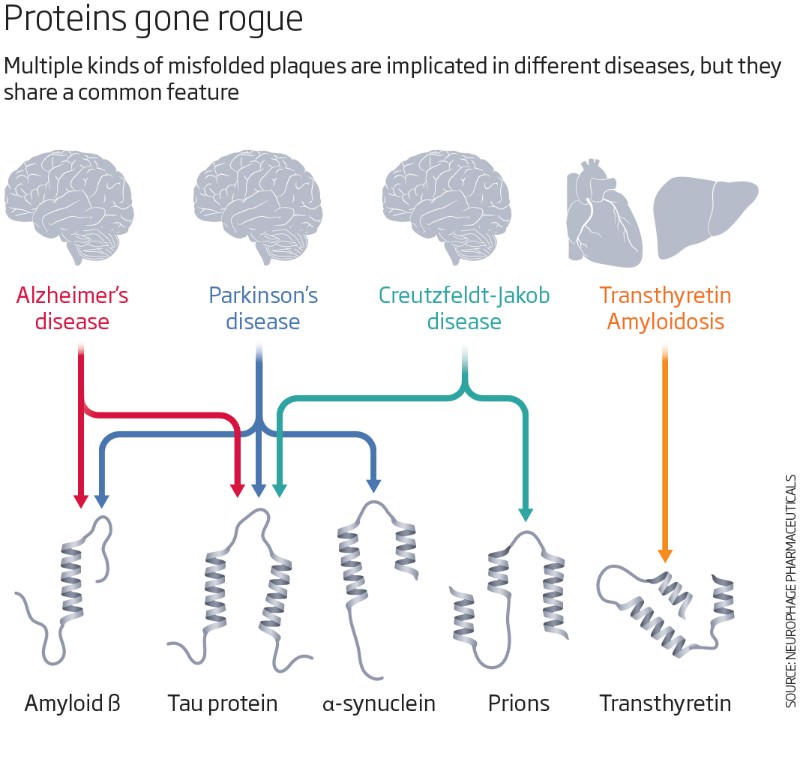
New Scientist reports that NeuroPhage Pharmaceuticals (Cambridge, MA) has found a way to cleanup rogue proteins that form in the brain, causing debilitating mental disorders, such as Alzheimer's and Parkinson's diseases:

The drug is the first that seems to target and destroy the multiple types of plaque implicated in human brain disease. Plaques are clumps of misfolded proteins that gradually accumulate into sticky, brain-clogging gunk that kills neurons and robs people of their memories and other mental faculties. Different kinds of misfolded proteins are implicated in different brain diseases, and some can be seen within the same condition.


The hope is that the novel drug will destroy the plaques but leave healthy brain cells alive.


NeuroPhage's US patent applications can be found here.

tags: medicine, brain, control, tool, entrepreneurship, biology

Wednesday, July 08, 2015

Lunchtalk: Wearable Health Records

Daniel Kivatinos, cofounder and COO of drchrono talks about Wearable Medical Records at the Wearable Tech Conference


Friday, November 07, 2014

ArborLight startup wins 2014 Next Generation Luminaires (NGL) competition

Congratulations to my co-author Max Shtein! The startup he co-founded won a national competition for innovative energy efficient indoor lighting fixtures.


<blockquote>Arborlight is virtually inventing a new lighting product category: daylight emulation. We all love daylight. It makes us feel good, be more productive, have more energy, the list goes on and on. Yet, the reality for many is that to work, learn, shop and generally go about our daily business, we are forced to spend most of our time indoors with little or no access to daylight. The aim of Arborlight’s Solis is to remedy that situation. The Solis product allows you to create an indoor environment that simulates daylight in where it would be otherwise impossible, literally mimicking the sun. It’s Wi-Fi enabled, has the appearance of a traditional skylight, emulates daylight conditions, and autonomously adjusts color, intensity, and directionality throughout the day to match outdoor illumination. Essentially, it provides people with the ability to experience morning, high noon, and evening light conditions in a windowless space.</blockquote>


Thursday, August 21, 2014

Quote of the Day: information vs data

Seek truth from facts.

- Deng Xiaoping


tags: information, data, quote, tool

Friday, August 01, 2014

Invention of the Day: Wind-powered Sawmill

In the 17th century, the Dutch dominated sea trade and naval warfare. That time in European history is often referred to as the Dutch Golden Age. One Dutch inventor was particularly instrumental in giving his small independent nation a decisive advantage over Spain, the naval super-power of the 15th and 16th centuries.

In 1594-97, Cornelis Corneliszoon van Uitgeest (c. 1550 - c. 1600), a Dutch windmill owner, invented and perfected the first wind-powered sawmill. That is, before Cornelis two workers had to saw a log manually, using a specially designed pit. It was a long and ardious process.

Before:


After:

Source: Power from Wind: A History of Windmill Technology
By Richard Leslie Hills.


The new device allowed its operator to produce wooden planks 30 times faster than before.

Why this tech advance turned out to be strategically important for the Dutch nation?

Because wooden planks was the key material for building ships. In combination with ubiquitous windmills, the new technology enabled Dutch shipbuilders dramatically increase production of low-cost naval vessels, both military and commercial. As the result, the Dutch could not only swarm Spanish ships in sea battles, but also transport great amounts of commercial goods from newly discovered places in Africa and Asia, which gave them strong market advantages. The invention of the wind-powered sawmill brought about a 10X change in productivity that rippled through the entire world.

Eventually, the British overtook the Dutch, partly due to James Watt's improvements of the steam engine, which was much more powerful and reliable than the windmills.

tags: invention, innovation, 10X, source, tool, packaged payload, 


Thursday, June 12, 2014

Why Tesla gives away its patents to copycats?

Wired reports on the latest in patent news:

Tesla CEO Elon Musk announced today that his company will not “initiate patent lawsuits against anyone who, in good faith, wants to use our technology.” In plain English, that means that if other car companies want to produce electric cars, they can use Tesla’s technology to do it, and, in turn, advance Musk’s sustainability vision.
What's the significance of that?

I looked up Tesla's patent portfolio on the US PTO website this afternoon: 156 issued US patents and nothing of great importance there. In comparison, BMW and Toyota have thousands of patents. In a patent fight against its direct competitors Tesla has a slim to none chance to win. Therefore, giving away a weak patent portfolio is not a big loss for Tesla. On the other hand, if the company succeeds inducing the competitors to give up their patents, that would be great! Besides, Tesla promises to gives its patents to those who want "to use our technology" only. Interesting. This brings our attention to Tesla's new business model.


Recently, the company announced that it is going to build a huge battery-making plant in the US. For this project to be successful, Tesla needs economies of scale: a lot of electric cars made by those who use Tesla batteries and electric drive technology. Selling batteries to a potentially huge market would be more profitable than trying to enforce weak patents in a small market. Giving away the patents is a shrewd PR move by Elon Musk. This reminds me of an ancient Chinese stratagem called "Tossing out a brick to get a jade gem." It means "Bait someone by making him believe he gains something or just make him react to it ("toss out a brick") and obtain something valuable from him in return ("get a jade gem")."

===
In the system model terms (see our book Scalable Innovation), Tesla intends to make money on the battery, i.e. the Packaged Payload, while encouraging others to build more electric cars, i.e. the Tools.


Creating a new Silicon Valley is more difficult than the original Silicon Valley

The original Silicon Valley started in the late 1950s. Since then, many countries tried to reproduce Silicon Valley success, but only Israel could sustain high-tech development over two consecutive innovation waves.

One of the major difficulties in creating a new Silicon Valley would be to talent retention. That is, it is easier than ever for a talented entrepreneur, engineer, or scientist to move to the greater Silicon Valley, which today includes San Francisco. A recent infographic from Bloomberg shows the impact immigrants make on high-tech innovation in the Bay Area (click to enlarge).


In 2010, Asian Americans became the majority of the high-tech workforce in the valley. One third of SV startups are founded by Indian Americans.

tags: silicon valley, innovation, demographics, tool, source

Sunday, January 26, 2014

Streamternet - a new term for describing our post-web world.

I've been struggling for a while to find a name for the new, post-web reality of the Internet. In Scalable Innovation (Section 3), we explain why we think that the web is dead, but we don't use any new word to mark the new reality. 

The core idea is that instead of sending files, we now deal with streams, e.g. video or update messages: Youtube, Twitter, Facebook, High-Frequency Trading, etc. In system terms, we see a dramatic change in the Packaged Payload and the intensity of its flow. 

Fundamentally, the iPhone and Google Glass are Streamternet devices. Their zoomable interfaces allow us to zoom in and out of the stream of information, and see it, e.g. in 2D, 3D, or 4D. The difference between the web and Streamternet is that time flows differently in them. That is, the intensity of data transactions is 100X higher on the Streamternet.

web, streamternet, system, packaged, payload, tool, 10X

Thursday, January 09, 2014

The insanely great world of sports (and life in general)

Reading Nate Silver's "The Signal and the Noise" prompted me to consider the beautiful absurdity of human reality. For example, Silver devotes a large chunk of the book to various statistical systems that predict baseball player performance. He shows how scouts and geeks scour gigabytes of objective and subjective data about thousands of candidates: from high school, to minor leagues, to the Major League Baseball (MLB). It's understandable because top player contracts run easily into a hundred million dollars. The total 2013 MLB payroll is over $3 billion dollars.

This large-scale data gathering and analysis is not limited to pro teams. With proliferation of the web, amateurs are getting into the statistical game with online fantasy sports. (In fantasy sports, players draft virtual teams that collect points based on player stats during regular season "physical" games.) According to Bloomberg News, fantasy sports participants spent $3,4B on products, services, and entry fees. Huge business on imaginary teams!

Why is it absurd? Because from an information perspective, an outcome of a home team game produces just 1 bit of information.* That is, the home team either wins (1) or loses (0). Somehow, we humans managed to invent an elaborate process for generating reams of data that result in a minimal amount of information. Judging by the success of Twitter, our purpose in life seems to be pure data generation.

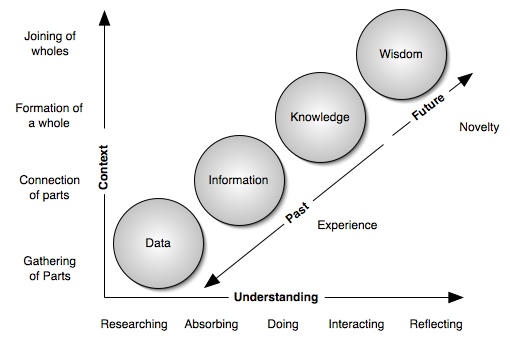
http://en.wikipedia.org/wiki/DIKW_Pyramid

Speaking of human life, since all people die, the informational outcome of an individual human life equals to zero. That is, because there's no uncertainty of the biological outcome, one's life or death does not make any computational difference. What does make a difference though, is whether one has children or not. In that case, an uncertainty exists and we cannot be sure that the data generation process will continue into the future. No wonder God tells Noah, "Be fruitful and multiply, and replenish the earth." (Genesis, 9:1). What is s/he computing? :)

Information is classically defined as reduction of uncertainty: the more numerous the alternatives that are ruled out, the greater the reduction of uncertainty, and thus the greater the information. It is usually measured using the entropy function, which is the logarithm of the number of alternatives (assuming they are equally likely). For example, tossing a fair coin and obtaining heads corresponds to log2(2) = 1 bit of information, because there are just two alternatives. (quoted from G. Tononi, Biol. Bull. 215, 216, http://www.biolbull.
org/content/215/3/216.full (2008).

Saturday, December 21, 2013

Lab Notebook: Why money technology works

5 goats = 1 cow
12 eggs = 4 loafs of bread
1 gun = 2 horses
....
1 goat = 20 loafs of bread
1 horse = 3 goats
...

All these barter equations carry enormous amount of information about goods involved in the exchange and rules to calculate their "aboutness," including expectations about the future (weather, hunger, wisdom of the ruling king, etc.) The more goods, services, and experiences (GSE) are available, the more information is necessary to make calculations and decisions whether to transfer the GSEs into one's future.
When instead of the barter equations we use money, we compress huge amounts of GSE aboutness into a single number. That is, from an innovation perspective, money and markets are compression mechanisms. The compress payloads, so that we can increase the GSE space exponentially.

Thousands years ago, Spartans used heavy metal bars to represent value. You couldn't carry it; only mark up one's ownership of a "slice" of iron.
Today, we use hard drives of financial institutions to accomplish the same task. Except, using computer technology and market mechanisms, we managed to compress our expectations about the past, present, and future of a myriad of GSEs in a bunch of zeros and ones.

5 goats = 0000010000
12 eggs = 0000001010
1 gun = 0001010010
...

The amazing aspect of this mechanism is that money and markets allow us to decompress a single number into all kinds of GSEs - pure magic.
tags: invention, innovation, money, technology, book, tool, control, deontic, payload, aboutness

Monday, July 16, 2012

Google vs Microsoft: the office battle.

WSJ (June 16, 2012) on the competition in the Office space.
Microsoft also is lavishing attention on businesses that have weighed switching to Google Apps, a corporate-software bundle that includes versions of Gmail and the Google Docs document, spreadsheet and presentation software.


To counter Google's momentum, Microsoft is using a "Google Compete" team, whose mission is to keep Office customers from buying Google Apps.

In a May report, Gartner said Google is winning one-third to half of new corporate users that are paying for Web-based software. In 2009, Gartner predicted that Microsoft by now would be outselling Google Apps by at least 4 to 1.
Microsoft was making so much money on Office that they fell asleep at the steering wheel and missed the beginning of the transition to a new S-curve.

 tags: s-curve, tool, payload, synthesis

Robots vs People, China edition.

(MIT Tech Review. July 16, 2012). Migrant Workers in China Face Competition from Robots. 

 Foxconn's Longhua factory complex, where Apple products are assembled. Most spend their days seated beside a conveyer belt, wearing white gowns, face masks, and hairnets so that stray hairs and specks of dust won't interfere as they perform simple but precise tasks, again and again. Each worker focuses on a single action, like putting stickers on the front of an iPhone or packing a finished product into a box. As managers told ABC's Nightline, which aired a rare look inside the factory in February, it takes five days and 325 steps to assemble an iPad.

Even assuming competition from nimble-fingered humans putting in 12-hour shifts, a single robot might replace two workers, and possibly as many as four.

If people's homes were less messy, robots would replace us in doing house chores. What is it that makes home environment so unstructured, compared to factory environment? Is it the children?

tags: control, tool, education, technology

Sunday, July 15, 2012

Lunch Talk: The Story of Television (1956)

The history of television produced by RCA in 1956. This is TV history according to RCA, focusing on the technological advances that could be attributed to RCA and de-emphasizing everything else. A lot of TV "firsts" are shown: first president to be televised, first televised baseball game, etc. David Sarnoff talks with Vladimir Zworykin about television's early development at RCA. The last third of the film suddenly breaks into color to talk about the development of color television.
 link


tags: system, invention, innovation, lunchtalk, tool

Saturday, July 14, 2012

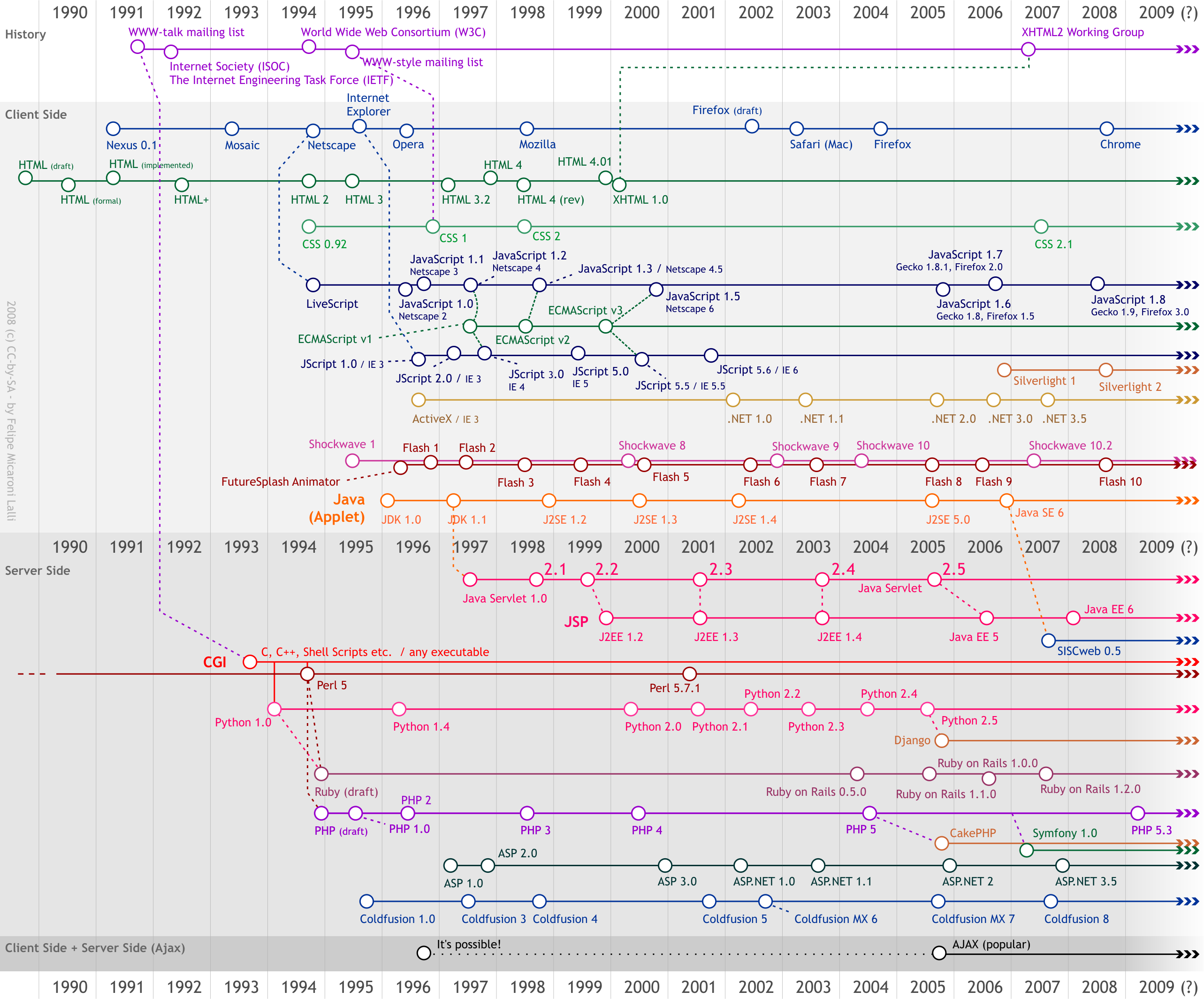
Web development timeline: Server and App side.

Web development timeline from Wikimedia:


Browser development timeline from Wikimedia


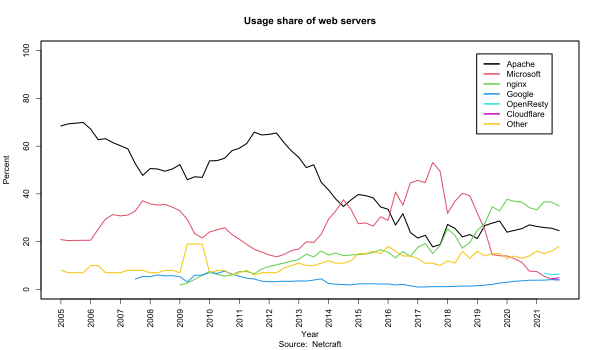
Market share of web servers
 

Friday, July 06, 2012

Invention of the Day: Robotic Legs. pls RT

BBC reports an invention that mimics the work of human legs by collecting and processing control information from the whole body, rather than the legs themselves:
US experts have developed what they say are the most biologically-accurate robotic legs yet. Writing in the Journal of Neural Engineering, they said the work could help understanding of how babies learn to walk - and spinal-injury treatment. They created a version of the message system that generates the rhythmic muscle signals that control walking.

The team, from the University of Arizona, were able to replicate the central pattern generator (CPG) - a nerve cell (neuronal) network in the lumbar region of the spinal cord that generates rhythmic muscle signals.


The CPG produces, and then controls, these signals by gathering information from different parts of the body involved in walking, responding to the environment.
This is what allows people to walk without thinking about it.
...
"Previous robotic models have mimicked human movement: this one goes further and mimics the underlying human control mechanisms driving that movement.

"It may offer a new approach to investigate and understand the link between nervous system control problems and walking pathologies."


Source: Theresa J Klein and M Anthony Lewis. A physical model of sensorimotor interactions during locomotion. 2012 J. Neural Eng. 9 046011. doi:10.1088/1741-2560/9/4/046011

tags: biology, medicine, control, tool,3x3

Saturday, June 02, 2012

Zumable User Interfaces (ZUIs)

The Economist (Jun 2nd 2012. Technology Quarterly Q2, 2012): the prophets of zoom:

Zoomable user interfaces (ZUIs), as they are known, are arriving on the coat-tails of touch-screen gadgets such as the iPhone that have popularised zooming to magnify graphics. With ZUIs (pronounced zoo-ees), information need not be chopped up to fit on uniformly sized slides. Instead, text, images and even video sit on a single, limitless surface and can be viewed at whatever size makes most sense—up close for details, or zoomed out for the big picture.

The system-level transition I was predicting two years ago is beginning to happen.

tags: trend, payload, tool, system, model, example, interface, synthesis

Friday, May 25, 2012

Winner-takes-all market in tablets (so far)

CNet reports on web traffic data originating from tablets. Because Apple is such a dominant force, the chart they refer to looks like this:


Note that Apple's iPad is not in the picture at all. When you add the iPad the chart looks like this:


Data Source: Chitika.

tags: market, domination, tool, synthesis, 4q diagram, business, model

Tuesday, March 06, 2012

Snack Talk: DARPA Nano Air Vehicle (NAV) program

One of the videos from DARPA's Youtube channel.


Link

tags: lunchtalk, control, tool, communications, detection