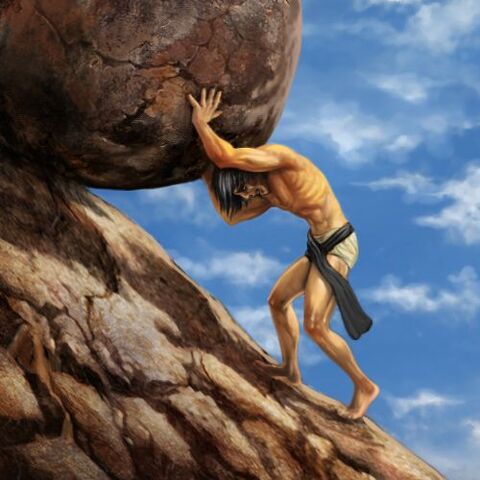
A quote from "Sapiens: A Brief History of Humankind",
Twitter is having trouble competing for users against Facebook and Youtube because it has failed to scale human relationships beyond the threshold of 150 individuals. That is, the social networking niche of "less than 150" is already occupied by Facebook and for Twitter to become successful, the company has to make it easy for each user to organize and curate information dynamically from thousands of people who are not in the immediate network. Moreover, since connections and information on Twitter is more (10X!) dynamic than on Facebook, the degree of organization of information streams has to be at least 10X more sophisticated as well.
Youtube has met its content scalability challenge by enabling users to create and share playlists, channels, and subscriptions. Every user on Youtube is a developer who produces new ways to access contents at a collection or stream level, rather than at single video level. In Scalable Innovation we call it scaling at the aboutness" layer. So far, Twitter can't find a way to enable its users to become developers. All they can do is propagate gossip, which worsens the information overload problem for everybody who gets over the "150 individuals" threshold.
To summarize, Twitter needs to find a way to help people become better Information Sapiens because the Information Neanderthal niche is already occupied by Facebook and Youtube.
tags:scale, innovation, control, aboutness, twitter, social
I use this blog to gather information and thoughts about invention and innovation, the subjects I've been teaching at Stanford University Continuing Studies Program since 2005. The current course is Principles of Invention and Innovation (Summer '17). Our book "Scalable Innovation" is now available on Amazon http://www.amazon.com/Scalable-Innovation-Inventors-Entrepreneurs-Professionals/dp/1466590971/
Showing posts with label aboutness. Show all posts
Thursday, January 28, 2016
Sunday, January 11, 2015
Facebook anticipates user engagement - a new US patent
On January 6, 2015 US PTO awarded Facebook patent 8,929,615 "Feature-extraction-based image scoring" (inventors David Harry Garcia and Justin Mitchell).
The new patent covers a technology that extracts features from a photo and makes clever decisions how to use it on a social networking; the decisions are based on predicted user engagement. For example, if you likedrinking women smiling babies the system will be able to include more baby pictures (and ads) into your news feed.
To put the matter in perspective: few months ago a lot of media hoopla was generated about Amazon being able to anticipate where to ship user packages. The new Facebook technology is much more interesting than that of Amazon because
a) it addresses the growing world of digital social media;
b) it enables anticipatory content distribution;
c) while Amazon can anticipate shipping to the right zipcode within a certain time interval, Facebook can "ship" the right content to the right user at the right time.
In short, Facebook anticipates more and with a greater precision.
Also relevant to this discussions are recent Facebook patents US 8,930,837 "Graphical user interface for map search" (inventors Brandon Marshall Walkin and Zhen Fang) and US 8,930,243 "System, process and software arrangement for providing multidimensional recommendations/suggestions" (inventors Alexander Tuzhilin and Gediminas Adomavicius). The latter patent goes back to a 2001 invention!
From our system model perspective, the patents describe novel Control systems that take advantage of the Aboutness, extracted from the Packaged Payload.
tags: control, aboutness, detection, model,
The new patent covers a technology that extracts features from a photo and makes clever decisions how to use it on a social networking; the decisions are based on predicted user engagement. For example, if you like
To put the matter in perspective: few months ago a lot of media hoopla was generated about Amazon being able to anticipate where to ship user packages. The new Facebook technology is much more interesting than that of Amazon because
a) it addresses the growing world of digital social media;
b) it enables anticipatory content distribution;
c) while Amazon can anticipate shipping to the right zipcode within a certain time interval, Facebook can "ship" the right content to the right user at the right time.
In short, Facebook anticipates more and with a greater precision.
Also relevant to this discussions are recent Facebook patents US 8,930,837 "Graphical user interface for map search" (inventors Brandon Marshall Walkin and Zhen Fang) and US 8,930,243 "System, process and software arrangement for providing multidimensional recommendations/suggestions" (inventors Alexander Tuzhilin and Gediminas Adomavicius). The latter patent goes back to a 2001 invention!
From our system model perspective, the patents describe novel Control systems that take advantage of the Aboutness, extracted from the Packaged Payload.
tags: control, aboutness, detection, model,
Tuesday, February 04, 2014
The Web is Dead - mobile edition.
The hyperlink (or URL) is one of the greatest inventions of the web era. It is excellent for linking pages, navigating between sites, downloading content, etc. Unfortunately, the URL is largely useless on mobile devices because it doesn't work outside the browser. To solve the problem, mobile technology companies develop alternatives that allow launching one app from another. MIT Tech Review reports that,
Once a suitable replacement for the URL is found, the decline of the web will become inevitable. Here's a cheesy Facebook video that explains the concept:
tags: web, technology, evolution, aboutness, mobile, application
Today mobile apps increasingly rule our free time and require us to dive into separate, walled-off digital containers that don’t link up.
The new kind of hyperlink could make apps seem less walled off from one another. Deep linking, as the technology is called, is also seen as a way to open up new forms of advertising that will provide revenue to make mobile advertising more closely match its online counterpart (see “Why No One Likes Mobile Ads”).
Once a suitable replacement for the URL is found, the decline of the web will become inevitable. Here's a cheesy Facebook video that explains the concept:
tags: web, technology, evolution, aboutness, mobile, application
Labels:
aboutness,
application,
evolution,
mobile,
technology,
web
Tuesday, January 28, 2014
Amazon patents - Content Management
Amazon continues its push into content management technology. Their US 8,639,817 patent issued on January 27, 2014) is the latest in a series that covers delivery of digital media.
The patent applies (among other things) to delivering ads based on the original content. In their terminology, a first set of users consumes the "real" content, while a second set gets [relevant] ads. For example, Claim 2 reads:
In claim 3, they continue using the anticipatory approach we found earlier in their other patents, which cover delivery of physical goods.
With physical goods, Amazon describes a scenario where the system
1) routes packages to a general geographical location in anticipation of demand;
2) re-routes packages to a specific address, based on a customer order.
With virtual goods, Amazon patents a scenario where the system
1) delivers content to a content delivery network in anticipation of content demand;
2) delivers content to a specific user device, based on user requests or targeting logic.
In system terms, Amazon creates a smart Distribution network, which sits in between the content providers and users. We model the arrangement in Scalable Innovation, Chapter 25. Anticipating Control Problems. Because Amazon collects a lot of information about both content (Packaged Payload), users (Tool), and providers (Source), it has the ability to determine and anticipate consumption patterns. The patents are a strong indication that business value migrates from the Tool -- Source axis, to the Distribution -- Control axis.
Similarly, Facebook, Google, Twitter, NSA, and others sit between users and content providers (e.g. other users). Remarkably, Amazon doesn't cover social networking scenarios in their patents. Vice versa, Facebook doesn't talk about content management in their patents.
tags: patent, system, aboutness, distribution, control, business, value, amazon, facebook
The patent applies (among other things) to delivering ads based on the original content. In their terminology, a first set of users consumes the "real" content, while a second set gets [relevant] ads. For example, Claim 2 reads:
In claim 3, they continue using the anticipatory approach we found earlier in their other patents, which cover delivery of physical goods.
With physical goods, Amazon describes a scenario where the system
1) routes packages to a general geographical location in anticipation of demand;
2) re-routes packages to a specific address, based on a customer order.
With virtual goods, Amazon patents a scenario where the system
1) delivers content to a content delivery network in anticipation of content demand;
2) delivers content to a specific user device, based on user requests or targeting logic.
In system terms, Amazon creates a smart Distribution network, which sits in between the content providers and users. We model the arrangement in Scalable Innovation, Chapter 25. Anticipating Control Problems. Because Amazon collects a lot of information about both content (Packaged Payload), users (Tool), and providers (Source), it has the ability to determine and anticipate consumption patterns. The patents are a strong indication that business value migrates from the Tool -- Source axis, to the Distribution -- Control axis.
Similarly, Facebook, Google, Twitter, NSA, and others sit between users and content providers (e.g. other users). Remarkably, Amazon doesn't cover social networking scenarios in their patents. Vice versa, Facebook doesn't talk about content management in their patents.
tags: patent, system, aboutness, distribution, control, business, value, amazon, facebook
Wednesday, January 22, 2014
Facebook patents secure upgrade of a wireless mobile device.
Facebook got a nice patent (US 8,631,239) that covers a secure software upgrade of a wireless mobile device. According to the specification, the system uses a public key to authenticate the software delivered over the air (OTA).
Wireless connections are notoriously unsafe and prone to hacker interception. The Facebook solution enables a service provider to perform a reliable upgrade over an unreliable channel. It's highly likely that in the future most software upgrades, especially in the enterprise environment, will be done using this approach - simple and powerful!
Unfortunately, the patent itself has an important flaw: it does not define the term "endpoint", which figures prominently in claim 1. Moreover, in Fig 1B it uses a different term "System Front End (120)."
As I noted several times before, the company's quality control over their patenting process seems to be spotty, at best. A simple document search would allow them to spot and fix the definition problem.
Model-wise, it is quite similar to my patent US 7,529,806. They have a different payload, but the aboutness is managed and created for the same purpose. I should use the Facebook patent as a system analysis homework assignment in BUS 74 this summer.
In view of the Nortel patent and invention principles listed above, the Facebook patent can be attacked as "obvious."
tags: patent, invention, innovation, security, mobile, enterprise, system, model, aboutness
Wireless connections are notoriously unsafe and prone to hacker interception. The Facebook solution enables a service provider to perform a reliable upgrade over an unreliable channel. It's highly likely that in the future most software upgrades, especially in the enterprise environment, will be done using this approach - simple and powerful!
Unfortunately, the patent itself has an important flaw: it does not define the term "endpoint", which figures prominently in claim 1. Moreover, in Fig 1B it uses a different term "System Front End (120)."
As I noted several times before, the company's quality control over their patenting process seems to be spotty, at best. A simple document search would allow them to spot and fix the definition problem.
1. A method comprising, by one or more computing systems: executing software from a first partition of system memory; requesting an over-the-air (OTA) software update from an endpoint; receiving a manifest for the OTA update; downloading a payload pursuant to the manifest; installing the payload into a second partition of system memory; and rebooting, pursuant to the manifest, to the second partition of system memory, wherein rebooting to the second partition of system memory comprises authenticating a bootloader signature with a bootloader public key.Brief system analysis: the manifest represents the "Aboutness"; encrypted software update - Packaged Payload; device - Tool; a process that runs on the device to verify authenticity - Control; endpoint - Source; over-the-air channel - Distribution. Overall, it's a textbook example of system composition (Scalable Innovation, Chapter 2). To solve the problem, the inventors use Separation in Space - one of the key TRIZ principles.
Model-wise, it is quite similar to my patent US 7,529,806. They have a different payload, but the aboutness is managed and created for the same purpose. I should use the Facebook patent as a system analysis homework assignment in BUS 74 this summer.
In view of the Nortel patent and invention principles listed above, the Facebook patent can be attacked as "obvious."
tags: patent, invention, innovation, security, mobile, enterprise, system, model, aboutness
Labels:
aboutness,
enterprise,
innovation,
invention,
mobile,
model,
patent,
security,
system
Tuesday, January 21, 2014
Nortel/Rockstar US Patent 6,378,069 - a ticking bomb for the smartphone industry?
In July 2011, a group of companies led by Apple, Microsoft, RIM and others bought 6,000 Nortel patents. The patents were assigned to a holding entity Rockstar Consortium, Inc. One of the patents in the portfolio is US 6,378,069 "Apparatus and methods for providing software updates to devices in a communication network," issued April 23, 2002. I ran into it while reviewing references for the newly issued Facebook patent US 8,631,239.
The original Nortel patent looks incredibly broad. Its claim 1 covers any system that has a database of subscriber records and can provide software updates to the subscribers.
Arguably, the patent covers software update systems for smartphones, PCs, tablets, ebook readers (hello, Amazon!), and everything on the Internet that requires a software update. One could try to circumvent the patent by delegating software distribution to third parties, i.e. decoupling the entity that holds the subscriber database and the one that actually communicates to the destination device. It's not clear how this solution could play out in courts. Litigation over this potential workaround would be an interesting case to watch.
Rockstar has not asserted the patent yet, but the consortium still has several years to do that. They've already sued Google for allegedly infringing Nortel patents on relevant advertisement. Most likely, the Nortel portfolio contains more patent gems; litigating them can prove extremely expensive. The industry would be wise to set up a standard-like body to figure out reasonable licensing terms, instead of engaging in a series of all-out patent wars.
From our system model point of view, the patent covers key Control Points (see Scalable Innovation, Chapter 5, System Control Points: Where To Aim Your Silver Bullets), i.e. using Aboutness to direct a Packaged Payload - this is as basic as it can possibly be. An equivalent broad patent for Facebook would cover using information about users for sending messages, including ads. For Netflix, it would be using subscriber database for sending recommendations, etc. Powerful, if you can get it issued.
tags: patent, invention, software, innovation, portfolio, communications, aboutness, packaged, payload
The original Nortel patent looks incredibly broad. Its claim 1 covers any system that has a database of subscriber records and can provide software updates to the subscribers.
Arguably, the patent covers software update systems for smartphones, PCs, tablets, ebook readers (hello, Amazon!), and everything on the Internet that requires a software update. One could try to circumvent the patent by delegating software distribution to third parties, i.e. decoupling the entity that holds the subscriber database and the one that actually communicates to the destination device. It's not clear how this solution could play out in courts. Litigation over this potential workaround would be an interesting case to watch.
Rockstar has not asserted the patent yet, but the consortium still has several years to do that. They've already sued Google for allegedly infringing Nortel patents on relevant advertisement. Most likely, the Nortel portfolio contains more patent gems; litigating them can prove extremely expensive. The industry would be wise to set up a standard-like body to figure out reasonable licensing terms, instead of engaging in a series of all-out patent wars.
From our system model point of view, the patent covers key Control Points (see Scalable Innovation, Chapter 5, System Control Points: Where To Aim Your Silver Bullets), i.e. using Aboutness to direct a Packaged Payload - this is as basic as it can possibly be. An equivalent broad patent for Facebook would cover using information about users for sending messages, including ads. For Netflix, it would be using subscriber database for sending recommendations, etc. Powerful, if you can get it issued.
tags: patent, invention, software, innovation, portfolio, communications, aboutness, packaged, payload
Labels:
aboutness,
communications,
innovation,
invention,
packaged,
patent,
payload,
portfolio,
software
Monday, January 20, 2014
Amazon's "anticipatory" patent: Let's cut through the BS!
Many news outlets, including the Wall Street Journal, wrote recently about Amazon's US Patent 8,615,473, issued on December 24, 2013, titled "Method and system for anticipatory package shipping." For example, Tyler Cowen, of the marginalrevolution.com fame, quoted a catchy 2-liner to describe the invention:
That is, the patent is a lot more mundane than journalists and bloggers imagine. It covers a scenario where a particular item can be re-routed to a specific address while it is still being shipped to a general geographical area.
The pre-emptive part of the invention is not new at all. Retailers routinely ship products before people buy the stuff. When you go to a grocery store you buy a watermelon that was pre-emptively shipped to this location for your buying convenience. The same goes for TVs, cameras, flowers, etc. It's obvious that the retailer takes into account what Amazon calls "business variables," e.g. that people buy more flowers before the Valentine's Day, than the Father's Day.
Let's de-glamourize the patent by thinking that we deal with low-tech railroad coal shipments, instead of high-tech Amazon robotic drones. Imagine that the year is 1914 and you are in the coal business. You know seasonal patterns and you anticipate customer orders based, e.g. on the weather. If it's going to be cold in Michigan you know that people will burn more coal to heat their houses. They've done it year after year after year. Being smart, you start shipping coal to Michigan by railroad before you receive specific orders. Then, when you receive the actual orders you send a telegram to the railroad company and ask them to re-route some of the coal cars to Detroit an Ann Arbor, which happen to be close to one of your Michigan coal warehouses. That's it. Only instead of coal cars in 1914, Amazon ships socks and shoes in 2014. Nothing magically pre-emptive here.
Amazon's US Patent 8,615,473 is one of the three the company received so far on various aspects of the same invention.
The patents cover the same basic scenario: ship a package to a general geographic area, then notify the shipping company of a specific address in the area before the final delivery. Most likely, the patents will never be used because Amazon is already a dominant force in the industry.
To me, this particular media event illustrates multiple layers of "aboutness" that people pile up on top of each other when describing a hypothetical object or process. First, Amazon writes a patent application about a proposed modification to a shipping process. Then, the US Patent Office issues office actions that finalize patent claims about the invention and grants a patent. Then, a blogger reads the patent and writes a blog post about it. Then, an economist twits about the blog post. Etc. etc. Once an error creeps into the aboutness process, the entire information trail ends up leading nowhere.
tags: invention, innovation, patent, hype, amazon, media, aboutness
The Seattle retailer in December gained a patent for what it calls “anticipatory shipping,” a method to start delivering packages even before customers click “buy.”The title of Cowen's blog entry "Back to the Amazon future" tells more about people's hyped-up perception of Amazon's delivery prowess than the actual invention.
That is, the patent is a lot more mundane than journalists and bloggers imagine. It covers a scenario where a particular item can be re-routed to a specific address while it is still being shipped to a general geographical area.
The pre-emptive part of the invention is not new at all. Retailers routinely ship products before people buy the stuff. When you go to a grocery store you buy a watermelon that was pre-emptively shipped to this location for your buying convenience. The same goes for TVs, cameras, flowers, etc. It's obvious that the retailer takes into account what Amazon calls "business variables," e.g. that people buy more flowers before the Valentine's Day, than the Father's Day.
Let's de-glamourize the patent by thinking that we deal with low-tech railroad coal shipments, instead of high-tech Amazon robotic drones. Imagine that the year is 1914 and you are in the coal business. You know seasonal patterns and you anticipate customer orders based, e.g. on the weather. If it's going to be cold in Michigan you know that people will burn more coal to heat their houses. They've done it year after year after year. Being smart, you start shipping coal to Michigan by railroad before you receive specific orders. Then, when you receive the actual orders you send a telegram to the railroad company and ask them to re-route some of the coal cars to Detroit an Ann Arbor, which happen to be close to one of your Michigan coal warehouses. That's it. Only instead of coal cars in 1914, Amazon ships socks and shoes in 2014. Nothing magically pre-emptive here.
Amazon's US Patent 8,615,473 is one of the three the company received so far on various aspects of the same invention.
The patents cover the same basic scenario: ship a package to a general geographic area, then notify the shipping company of a specific address in the area before the final delivery. Most likely, the patents will never be used because Amazon is already a dominant force in the industry.
To me, this particular media event illustrates multiple layers of "aboutness" that people pile up on top of each other when describing a hypothetical object or process. First, Amazon writes a patent application about a proposed modification to a shipping process. Then, the US Patent Office issues office actions that finalize patent claims about the invention and grants a patent. Then, a blogger reads the patent and writes a blog post about it. Then, an economist twits about the blog post. Etc. etc. Once an error creeps into the aboutness process, the entire information trail ends up leading nowhere.
tags: invention, innovation, patent, hype, amazon, media, aboutness
Thursday, January 16, 2014
Facebook gets a patent on the "What's his face?" feature.
Facebook's US Patent 8,631,084, issued on January 14, 2014, covers (among other things) a user scenario where you can send one's picture or a video clip from your smartphone to a server and receive a list of people in your social network who are likely to be in the vicinity. You can also tag the picture with the name from the list.
I like the idea. If Facebook donated the patent to a privacy watchdog, unauthorized snoopers, including NSA, can be sued for patent infringement. The patent would probably cover similar Google Glass applications.
From the system point of view, the patent covers the process of matching different types of aboutness to an object. That is, textual contact information about a person (name, etc.) is complemented by a photo/video. Essentially, we create an aboutness management system, where the right item can be selected based on the context of object use/interaction. The application provides the context for the matching process. In this case, it's social networking, which is "hardwired" into the patent. I would try to push the concept into other contexts, industrial, commercial, navigational (GPS), medical, office, the internet of things, AI, etc.
A generic pattern for the invention would be something like: obtaining an aboutness of type 1, obtaining a context of use, ranking objects according to the context of use, associating the aboutness of type 1 with aboutness of type 2.
I like the idea. If Facebook donated the patent to a privacy watchdog, unauthorized snoopers, including NSA, can be sued for patent infringement. The patent would probably cover similar Google Glass applications.
From the system point of view, the patent covers the process of matching different types of aboutness to an object. That is, textual contact information about a person (name, etc.) is complemented by a photo/video. Essentially, we create an aboutness management system, where the right item can be selected based on the context of object use/interaction. The application provides the context for the matching process. In this case, it's social networking, which is "hardwired" into the patent. I would try to push the concept into other contexts, industrial, commercial, navigational (GPS), medical, office, the internet of things, AI, etc.
A generic pattern for the invention would be something like: obtaining an aboutness of type 1, obtaining a context of use, ranking objects according to the context of use, associating the aboutness of type 1 with aboutness of type 2.
Sunday, January 12, 2014
Facebook US Patent 8,627,506: a blunder or strategic omission?
The vagueness of Facebook patent claims keeps surprising me. Take, for example, their latest one: US 8,627,506 "Providing privacy settings for applications associated with a user profile," (Inventors: Nico Vera, James Wang, Arieh Steinberg, Chris Kelly, and Adam D'Angelo).
The patent is supposed to cover a transfer of user private information to third party apps based on friendship relationships (social graph) in a social networking system. I wanted to use the invention to illustrate the concept of "aboutness" in our system model (Scalable Innovation, Chapter 5).
Even a brief system analysis of the claims shows that the third party app does not provide any definite information about the second user to the social networking system, i.e. a key "aboutness" element is simply missing. Only in claim 4 we find a vague statement about a second user "who is connected to the [first] user in the social networking system." We don't know the nature of the connection, nor the degree of connectedness. Maybe she is a direct connection, or maybe she is one of the billion people on Facebook. Who knows...
Since the social networking system doesn't know much about the second user, it can either give out all private data or no data at all. In short, according to the patent, where third party apps are concerned privacy is non-existent; the apps are entitled to receive the first user's entire social graph. Using this graph, they can fish for other users' social graphs, and so on.
Let's give the patent the benefit of the doubt and assume that it tries to cover a minimally useful configuration with no privacy. Then, there should be at least one dependent claim that describes what information about the second user is required to determine the amount of private data transferred to a third-party app. Unfortunately, no such claim exists in the patent.
Some people believe that such vagueness — they often confuse it with broadness — is harmless. But is it? Imagine that a patent troll looks up Facebook patent applications when they are just published and files a patent application that covers a scenario with a more specific privacy information exchange. When the troll gets its patent issued, it can sue Facebook for damages because in a real social networking system specific "aboutness" for the second user has to be exchanged to determine privacy boundaries. As a result, Facebook is going to be rightfully punished for sloppiness and vagueness in its patent portfolio.
Complaining about trolls and software patents is easy. Getting your patent house in order is more difficult.
tags: system, aboutness, patent, invention, social, networking
The patent is supposed to cover a transfer of user private information to third party apps based on friendship relationships (social graph) in a social networking system. I wanted to use the invention to illustrate the concept of "aboutness" in our system model (Scalable Innovation, Chapter 5).
Even a brief system analysis of the claims shows that the third party app does not provide any definite information about the second user to the social networking system, i.e. a key "aboutness" element is simply missing. Only in claim 4 we find a vague statement about a second user "who is connected to the [first] user in the social networking system." We don't know the nature of the connection, nor the degree of connectedness. Maybe she is a direct connection, or maybe she is one of the billion people on Facebook. Who knows...
Since the social networking system doesn't know much about the second user, it can either give out all private data or no data at all. In short, according to the patent, where third party apps are concerned privacy is non-existent; the apps are entitled to receive the first user's entire social graph. Using this graph, they can fish for other users' social graphs, and so on.
Let's give the patent the benefit of the doubt and assume that it tries to cover a minimally useful configuration with no privacy. Then, there should be at least one dependent claim that describes what information about the second user is required to determine the amount of private data transferred to a third-party app. Unfortunately, no such claim exists in the patent.
Some people believe that such vagueness — they often confuse it with broadness — is harmless. But is it? Imagine that a patent troll looks up Facebook patent applications when they are just published and files a patent application that covers a scenario with a more specific privacy information exchange. When the troll gets its patent issued, it can sue Facebook for damages because in a real social networking system specific "aboutness" for the second user has to be exchanged to determine privacy boundaries. As a result, Facebook is going to be rightfully punished for sloppiness and vagueness in its patent portfolio.
Complaining about trolls and software patents is easy. Getting your patent house in order is more difficult.
tags: system, aboutness, patent, invention, social, networking
Saturday, January 04, 2014
Lab Notebook: Strange connections between baseball and Netflix
I discovered another repeating pattern for problem solving in baseball scouting and ... movie classification. In baseball, scouts and managers have to process a lot of vague information about many prospects. Nate Silver writes how Billy Beane ("a phenom in baseball management" and the main character in Moneyball, one of my favorite movies about sports) addressed the problem:
In short, Beane developed an elaborate system and a large number of explicit categories that his brain could rationally handle instead of relying on subconscious, gut-feel decisions. Using lots of categories enabled him to pick the right player among many candidates.
Where do people experience a similar problem? In "scouting" movies on Netflix! To help users solve the problem, Netflix engineers developed a detailed content categorization system with thousands of fine distinctions, so that people can select the right movie among lots of candidates. Here's an example of their movie subjects:
A couple of learning points:
- In Scalable Innovation (Chapter 5), we talk about the concept of "Aboutness" - an element that facilitates decision making in systems. The Netflix chart above would be a great way to show how generating movie aboutness helps solve detection problems for the users.
- "Gut-feel" decisions are a poor substitute for systematic thinking about the problem. Fundamentally, they are limited by our working memory and don't scale to handle complex choice situations.
tags: aboutness, problem, solution, detection, control, pattern
...when we have trouble categorizing something, we’ll often overlook it or misjudge it. This is one of the reasons that Beane avoids what he calls “gut-feel” decisions. (The Signal and the Noise. 2013.)
In short, Beane developed an elaborate system and a large number of explicit categories that his brain could rationally handle instead of relying on subconscious, gut-feel decisions. Using lots of categories enabled him to pick the right player among many candidates.
Where do people experience a similar problem? In "scouting" movies on Netflix! To help users solve the problem, Netflix engineers developed a detailed content categorization system with thousands of fine distinctions, so that people can select the right movie among lots of candidates. Here's an example of their movie subjects:
![]() |
| Source: Alexis C. Madrigal. How Netflix Reverse Engineered Hollywood. The Atlantic. Jan 2, 2014. |
A couple of learning points:
- In Scalable Innovation (Chapter 5), we talk about the concept of "Aboutness" - an element that facilitates decision making in systems. The Netflix chart above would be a great way to show how generating movie aboutness helps solve detection problems for the users.
- "Gut-feel" decisions are a poor substitute for systematic thinking about the problem. Fundamentally, they are limited by our working memory and don't scale to handle complex choice situations.
tags: aboutness, problem, solution, detection, control, pattern
Saturday, December 21, 2013
Lab Notebook: Why money technology works
5 goats = 1 cow
12 eggs = 4 loafs of bread
1 gun = 2 horses
....
1 goat = 20 loafs of bread
1 horse = 3 goats
...
All these barter equations carry enormous amount of information about goods involved in the exchange and rules to calculate their "aboutness," including expectations about the future (weather, hunger, wisdom of the ruling king, etc.) The more goods, services, and experiences (GSE) are available, the more information is necessary to make calculations and decisions whether to transfer the GSEs into one's future.
When instead of the barter equations we use money, we compress huge amounts of GSE aboutness into a single number. That is, from an innovation perspective, money and markets are compression mechanisms. The compress payloads, so that we can increase the GSE space exponentially.
Thousands years ago, Spartans used heavy metal bars to represent value. You couldn't carry it; only mark up one's ownership of a "slice" of iron.
Today, we use hard drives of financial institutions to accomplish the same task. Except, using computer technology and market mechanisms, we managed to compress our expectations about the past, present, and future of a myriad of GSEs in a bunch of zeros and ones.
5 goats = 0000010000
12 eggs = 0000001010
1 gun = 0001010010
...
The amazing aspect of this mechanism is that money and markets allow us to decompress a single number into all kinds of GSEs - pure magic.
tags: invention, innovation, money, technology, book, tool, control, deontic, payload, aboutness
12 eggs = 4 loafs of bread
1 gun = 2 horses
....
1 goat = 20 loafs of bread
1 horse = 3 goats
...
All these barter equations carry enormous amount of information about goods involved in the exchange and rules to calculate their "aboutness," including expectations about the future (weather, hunger, wisdom of the ruling king, etc.) The more goods, services, and experiences (GSE) are available, the more information is necessary to make calculations and decisions whether to transfer the GSEs into one's future.
When instead of the barter equations we use money, we compress huge amounts of GSE aboutness into a single number. That is, from an innovation perspective, money and markets are compression mechanisms. The compress payloads, so that we can increase the GSE space exponentially.
Thousands years ago, Spartans used heavy metal bars to represent value. You couldn't carry it; only mark up one's ownership of a "slice" of iron.
Today, we use hard drives of financial institutions to accomplish the same task. Except, using computer technology and market mechanisms, we managed to compress our expectations about the past, present, and future of a myriad of GSEs in a bunch of zeros and ones.
5 goats = 0000010000
12 eggs = 0000001010
1 gun = 0001010010
...
The amazing aspect of this mechanism is that money and markets allow us to decompress a single number into all kinds of GSEs - pure magic.
tags: invention, innovation, money, technology, book, tool, control, deontic, payload, aboutness
Labels:
aboutness,
book,
control,
deontic,
innovation,
invention,
money,
payload,
technology,
tool
Monday, December 09, 2013
Logical Reasoning: Twitter popularity numbers
According to @Mediabistro, the current popularity ratings for individuals look like this:
Find a name that DOES NOT belong with the others.
tags: media, aboutness, logic, social, networking
Find a name that DOES NOT belong with the others.
tags: media, aboutness, logic, social, networking
Friday, November 08, 2013
Lunch Talk: Changing your brain (TEDxToronto)
Barbara Arrowsmith-Young talks about brain plasticity and how mental exercises can help overcome problems with one's own thinking.
tags: aboutness, brain, lunchtalk, psychology, biology
Labels:
aboutness,
biology,
brain,
lunchtalk,
psychology
Wednesday, October 09, 2013
Silicon Valley majors back Angellist, a marketplace for startups.
According to Bloomberg (Sept 23, 2013),
[Angellist] raised $24 million from 116 investors, including Google Ventures, Kleiner Perkins Caufield & Byers and Draper Fisher Jurvetson, as well as prominent angels such as Yuri Milner, Mitch Kapor and Max Levchin.There's a good chance that after over 50 years of evolution, the VC industry will go through a consolidation. Angellist can help streamline startup-related services, from hiring to financing, reference checking, etc. If they are successful, they'll have in their possession a business graph of Silicon Valley entrepreneurial community - an invaluable tool for investors, recruiters, corporate technology buyers, and social scientists. Theoretically, one could determine emerging innovation patterns based the flow of money and people into certain technology directions.
Wednesday, July 24, 2013
Sisyphus 2.0: predicting the future is easy.
Despite all the technological change, our daily lives are quite similar to that of Sisyphus, a character from an ancient Greek myth. As a punishment, the gods condemned him to" roll an immense boulder up a hill, only to watch it roll back down, and to repeat this action forever."
A research paper from Microsoft shows that а modern person's future is highly predictable:
tags: process, creativity, prediction, mobile, aboutness
A research paper from Microsoft shows that а modern person's future is highly predictable:
It turns out that no matter how spontaneous we think we are, humans are actually quite predictable in our movements, even over extended periods of time. Not only did Far Out predict with high accuracy the correct location of a wide variety of individuals, but it did so even years into the future.The researchers note that frequently visited locations can be further linked to people's actions. One could reasonably guess that people who happen to be at the same location do similar things. As a result, knowing what one person does on a regular basis helps predict what other people do on a regular basis. Quite likely, companies like Google, with access to lots of user data, will soon be able to predict (among other things) a country's economic activity better than the government statistics.
tags: process, creativity, prediction, mobile, aboutness
Labels:
aboutness,
creativity,
mobile,
prediction,
process
Sunday, July 14, 2013
Forming startup teams: an Israeli version of Silicon Valley
![]() |
| MIT Tech Review (7/11/2013). Israel’s Military-Entrepreneurial Complex Owns Big Data. |
By contrast, in the US, tightly knit entrepreneurial teams form in college dorms, labs, and high-tech workplaces. Working at the edge of technology is another critical ingredient for success. As a result, the startup team has the following essential characteristcs:MIT Tech Review: Each year, Israel’s military puts thousands of teenagers through technical courses, melds them into ready-made teams, and then graduates them into a country that attracts more venture capital investment per person than any in the world.
- - tech frontier proximity
- - alertness to opportunity
- - motivation (competitive drive)
- - focus on getting things done
- - high skills
- - high challenge (facing difficult open-ended problems)
- - connections necessary to recruit talent and obtain financing (network)
- - low costs
- - reputation for getting things done (see esp. p.4)
![]() | |
| Scalable Innovation. Fig 2.2. System Diagram. |
Sunday, July 15, 2012
Predicting people's future locations with mobile data.
MIT Tech Review reports on an algorithm that allows mobile tracking systems to predict our future locations:
tags: social, networking, mobile, detection, control, aboutness
Beyond merely tracking where you've been and where you are, your smartphone might soon actually know where you are going—in part by recording what your friends do.From a philosophical point of view, in a dense social network one's freedom of the will seems to be quite limited.
Researchers in the U.K. have come up with an algorithm that follows your own mobility patterns and adjusts for anomalies by factoring in the patterns of people in your social group (defined as people who are mutual contacts on each other's smartphones).
The method is remarkably accurate. In a study on 200 people willing to be tracked, the system was, on average, less than 20 meters off when it predicted where any given person would be 24 hours later. The average error was 1,000 meters when the same system tried to predict a person's direction using only that person's past movements and not also those of his friends, says Mirco Musolesi, a computer scientist at the University of Birmingham who led the study.
tags: social, networking, mobile, detection, control, aboutness
Labels:
aboutness,
control,
detection,
mobile,
networking,
philosophy,
social
Wednesday, July 04, 2012
Day and Night: Twitter vs Facebook.
VBeat shows an offsetting time pattern for Facebook and Twitter. It is consistent with often stated Zuckerberg's intent to keep Facebook fun-oriented rather than work-oriented.
Twitter marketers should definitely include a link in their tweet. “We saw 86 percent higher engagement for tweets with links,” Ciarallo told VentureBeat. This is another difference vis-a-vis Facebook, where links can be counterproductive.
And while some might think that 140 characters is already pretty short, another thing that Buddy Media found is that even shorter tweets were the most successful.tags: payload, aboutness, storage, 10x, time, facebook, twitter, attention
“Tweets that contain less than 100 characters have 17 percent higher engagement,” said Ciarallo. “What they’re doing is leaving room for others to add their own thoughts and comments in a retweet.”
Tuesday, June 26, 2012
Invention of the Day: the Political Cookie.
From the June 27 MIT Review:
TV ads are expensive because
a) broadcasters have to buy content to attract viewers;
b) the ads also poorly targeted because they don't necessarily know who is watching what.
The Political Cookie solves this problem because
a) on the web the content is cheap due to the fact that users create it themselves;
b) the ads are precisely targeted because sites and apps know exactly who's is watching what.
As the result, the politicians get the best of both worlds. Now, we need to figure out what the voters get.
tags: problem, solution, trade-off, internet, control, aboutness
Cookies are short bits of code that identify a person's browser. With the help of advertising exchanges and media partners, a political campaign can use cookies to serve specific ads to, for example, all registered 50- to 60-year-old male Democrats in Pennsylvania's 6th district who are frequent voters and care about the environment. A campaign could even see whether specific individuals click on the ad and what they do once on its landing page.
The firm gathers publicly available voter files from all 50 states and supplements this with records of political donations and other profiles purchased from commercial data brokers, says CEO Jeff Dittus. Then, working with about 100 high-traffic websites that register their users, they can match the offline data to the online identities of individuals.
TV ads are expensive because
a) broadcasters have to buy content to attract viewers;
b) the ads also poorly targeted because they don't necessarily know who is watching what.
The Political Cookie solves this problem because
a) on the web the content is cheap due to the fact that users create it themselves;
b) the ads are precisely targeted because sites and apps know exactly who's is watching what.
As the result, the politicians get the best of both worlds. Now, we need to figure out what the voters get.
tags: problem, solution, trade-off, internet, control, aboutness
Subscribe to:
Comments (Atom)