Showing posts with label payload. Show all posts

Wednesday, January 21, 2015

Want to understand your own personality? Ask Facebook!

Stanford researchers have found that computers can judge personality traits more accurately than one's friends and colleagues.

The computer predictions were based on which articles, videos, artists and other items the person had liked on Facebook. The idea was to see how closely a computer prediction could match the subject's own scores on the five most basic personality dimensions: openness, conscientiousness, extraversion, agreeableness and neuroticism.

The researchers noted, "This is an emphatic demonstration of the ability of a person's psychological traits to be discovered by an analysis of data, not requiring any person-to-person interaction.

http://www.pnas.org/content/early/2015/01/07/1418680112

The original idea of using Thumbs UP and Thumbs DOWN buttons in the digital world belongs to TiVo. Facebook took this idea — knowingly or unknowingly — and scaled it across the entire range of digital content, making every piece of communication "likeable."


In System Model terms, Like helps solve Detection and Control problems. We discuss it briefly in Scalable Innovation, Chapter 22, Seeing the Invisible. "Like" represents the Aboutness of an element. Once the Aboutness detected, the Control sub-system uses it to compose and channel content streams according to its policies.


Sunday, August 17, 2014

Invention of the Day: SGML (Standard Generalized Markup Language)

SGML is the second great invention (that I know of) by an American lawyer; the first one being the Cotton Gin, by  Eli Whitney.

The Cotton Gin (1793) revolutionized the cotton industry in the US and, arguably, triggered the Industrial Revolution in England. Similarly, the SGML, co–invented by Charles F. Goldfarb, revolutionized the way we work with electronic documents. For example, the World Wide Web would be impossible without HTML, a simplified extension of SGML. Another extension of SGMIL is XML, a critically important document format used extensively in modern web and mobile applications.


In 1969, together with Ed Mosher and Ray Lorie, Goldfarb invented the SGML to make electronic documents compatible between different computing systems. Before SGML, a document would have instructions on how to handle it — procedural markup — embedded into the text. Since different IBM computer systems had different command sets, moving documents with procedural markup created a problem, because the same document would not "work" on a different computer. To solve the problem, the inventors came up with a language that could describe the contents of the document independently from the application or computer system that stored or processed it. Here's how Goldfarb wrote about the breakthrough in a 1971 paper:
The principle of separating document description from application function makes it possible to describe the attributes common to all documents of the same type.
20 years later, this feature of SGML turned out to be highly useful for the World Wide Web, a system designed for a seamless exchange of documents from networked computer systems around the world. HTML, a simplified version of SGML, allowed web enthusiasts to put together simple web pages that could be rendered in browsers on all kinds of machines. With the web, the invention turned into a great innovation.

tags: invention, innovation, separation, internet, web, packaged, payload,  

Tuesday, February 04, 2014

Facebook wireless wake-up patent (US 8,644,892)

Today, US Patent Office awarded Facebook a patent on a wireless device with a passive RFID tag that can trigger different power modes. In one scenario, when your iPhone is in sleep mode it receives a wake-up call from an RFID reader, powers up the main battery, and transfers the data from the tag to the device.


Again, the easiest way to explain the patent is through the train analogy we used in Scalable Innovation (Chapter 3). 

Imagine that instead of wireless devices and Radio Frequency signals you are running a train station operation. You also have a telegraph machine that allows you to receive and read telegrams from neighboring stations. It's early in the morning; no major load-unload processes are in progress; the only half-awake person in the building is one Thomas Alva Edison, your trainee telegraph operator.
Suddenly, his telegraph machine starts chattering and he receives a telegram from a neighboring station that a big train is departing toward you. Mr. Edison reads the telegram, wakes up your station crew, and reads the contents of the telegram to the station manager.


In the Facebook patent, the wireless device is your train station in wake up or sleep mode. The RFID tag is Edison with his telegraph apparatus. First, he can receive a telegram that no trains are coming and send everybody home. Then, the tag receives a wake-up signal from an RFID reader (the neighboring station) and transfers the contents of the signal (the telegram) to the main memory with a processor (the manager), which is configured to run a pre-defined program. That's it. The rest of the wording in the patent is for obfuscation purposes.

The invention fits the Telegram before the Train invention pattern we consider in detail in Chapter 25. 

tags: patent, packaged, payload, control, system, example, facebook


Thursday, January 30, 2014

Smartphone apps: mobile and insecure.

MIT Technology review writes:

A 2012 study of 13,500 Android apps by researchers in Germany found that only 0.8 percent used encrypted connections exclusively, and that 43 percent use no encryption at all. Last week mobile app security company MetaIntell reported that 92 percent of the 500 most popular Android applications communicated some data insecurely.

To move into the enterprise on scale, mobile devices and apps have to become secure. The same goes for mobile payments and NFC-based apps. Enhanced security requirements will demand more computing power, which many companies would not able to afford. As a result, secure cloud-based services will have an opportunity for long-term growth. Although before that, NSA surveylance issues have to be resolved, so that customers feel comfortable with having their vital data hosted externally.

tags: mobile, security, packaged, payload, control, business, enterprise

Sunday, January 26, 2014

Streamternet - a new term for describing our post-web world.

I've been struggling for a while to find a name for the new, post-web reality of the Internet. In Scalable Innovation (Section 3), we explain why we think that the web is dead, but we don't use any new word to mark the new reality. 

The core idea is that instead of sending files, we now deal with streams, e.g. video or update messages: Youtube, Twitter, Facebook, High-Frequency Trading, etc. In system terms, we see a dramatic change in the Packaged Payload and the intensity of its flow. 

Fundamentally, the iPhone and Google Glass are Streamternet devices. Their zoomable interfaces allow us to zoom in and out of the stream of information, and see it, e.g. in 2D, 3D, or 4D. The difference between the web and Streamternet is that time flows differently in them. That is, the intensity of data transactions is 100X higher on the Streamternet.

web, streamternet, system, packaged, payload, tool, 10X

Wednesday, January 22, 2014

BitCoin vs PayPal: a 100X+ difference

Both BitCoin and PayPal allow parties who don't trust each other's identity to exchange money electronically. The big difference is transaction costs. Because PayPal uses the existing system for electronic payments, it extracts high fees from the seller; the smaller the transaction, the larger the percentage of the fee. In short, PayPal doesn't scale down.


In contrast, BitCoin transactions are almost free. Moreover, they scale down as computing power (thanks to the Moore's law) becomes cheaper over time. The adoption of BitCoin or any similar monetary transaction system should stimulate development of businesses that involve high-volume payments. If posting on Twitter is free, BitCoin transactions should also be free.

Companies that will make Bitcoin payments reliable and secure are going to reap huge benefits in the mobile and financial markets.

tags: money, deontic, payload, control, machine1, machine2, finance, commerce, 10x, innovation

Tuesday, January 21, 2014

Nortel/Rockstar US Patent 6,378,069 - a ticking bomb for the smartphone industry?

In July 2011, a group of companies led by Apple, Microsoft, RIM and others bought 6,000 Nortel patents. The patents were assigned to a holding entity Rockstar Consortium, Inc. One of the patents in the portfolio is US 6,378,069 "Apparatus and methods for providing software updates to devices in a communication network," issued April 23, 2002. I ran into it while reviewing references for the newly issued Facebook patent US 8,631,239.


The original Nortel patent looks incredibly broad. Its claim 1 covers any system that has a database of subscriber records and can provide software updates to the subscribers.


Arguably, the patent covers software update systems for smartphones, PCs, tablets, ebook readers (hello, Amazon!), and everything on the Internet that requires a software update. One could try to circumvent the patent by delegating software distribution to third parties, i.e. decoupling the entity that holds the subscriber database and the one that actually communicates to the destination device. It's not clear how this solution could play out in courts. Litigation over this potential workaround would be an interesting case to watch.

Rockstar has not asserted the patent yet, but the consortium still has several years to do that. They've already sued Google for allegedly infringing Nortel patents on relevant advertisement. Most likely, the Nortel portfolio contains more patent gems; litigating them can prove extremely expensive. The industry would be wise to set up a standard-like body to figure out reasonable licensing terms, instead of engaging in a series of all-out patent wars.

From our system model point of view, the patent covers key Control Points (see Scalable Innovation, Chapter 5, System Control Points: Where To Aim Your Silver Bullets), i.e. using Aboutness to direct a Packaged Payload - this is as basic as it can possibly be. An equivalent broad patent for Facebook would cover using information about users for sending messages, including ads. For Netflix, it would be using subscriber database for sending recommendations, etc. Powerful, if you can get it issued.

tags: patent, invention, software, innovation, portfolio, communications, aboutness, packaged, payload


Saturday, January 18, 2014

Lab Notebook: the meaning of Bitcoin

Money has been around for thousands of years. Amazingly, people keep reinventing it over and over again. Money innovation (not invention!) is always a telltale sign of a deep, underlying change in large-scale commercial systems. It serves two vitally important tasks: value exchange and information diffusion. The growing acceptance of Bitcoin sends a loud and clear message:
Dear Government, we the People, no longer trust your ability to manage our money (The Fed). We also don't trust your shameless handling of our privacy (NSA). Therefore, we are going to create an alternative mechanism for commercial transactions and sharing information about them. The new computing and communication technologies give us the power to do so. 
In the 6th century BC, Lydians developed silver and gold coinage, which made them incredibly rich and powerful. In the 21st century AD, the first respectable government that will support a new trusted currency will have a once-in-a-thousand-years chance to create an economic miracle out of, practically, nothing. I hope it will be an American government.

tags: invention, innovation, deontic, payload, problem, money, solution, growth, economics, commerce

Friday, January 17, 2014

Lab Notebook: a computer security disaster waiting to happen.

Legacy computing systems are notoriously difficult to retrofit for new threats. Recently, Target got hacked, with in a possible loss of 110 million user records (including mine). Now, the banks have discovered that their good old ATMs need to be upgraded to new software to be ready for new hacking dangers. According to Bloomberg Newsweek,

When ATMs were introduced more than 40 years ago, they were considered advanced technology. Today, not so much.
Inside every ATM casing is a computer, and like all such devices, each one runs on an OS. Microsoft’s 12-year-old Windows XP dominates the ATM market, powering more than 95 percent of the world’s machines and a similar percentage in the U.S., according to Robert Johnston, a marketing director at NCR (NCR), the largest ATM supplier in the U.S.

For banks, investing into a massive upgrade of an old computer system would be a waste of money because customers are switching to mobile payments. We can deposit checks, pay bills, and invest with a smartphone. The only thing we can't get from the smartphone is beer physical cash. A lot of startups and established companies, including Square and PayPal, are going after this market. The success of BitCoin is also a strong indicator that physical banking is dying.


If the banks don't invest in a rigorous new security system, old ATM networks will become a juicy target for hackers. Like any other parasites, hackers love weak targets: newborns and elderly, a legacy ATM system being the latter. A computer security disaster with a major ATM network will speed up the adoption of digital currencies immensely. A great financial play would be to buy a lot of bitcoins, then hack an ATM system just to scare people into using the new technology.

tags: innovation, deontic, payload, system, money, business

Friday, January 03, 2014

Lab Notebook: Amazon drones for local marijuana delivery

The drone technology can potentially cut out the middleman from pot retail, now legal in Washington and Colorado. Moreover, in the future the entire process — from growing the plant to harvesting, packaging, and delivery — can be fully automated using Google robotics systems. :)

On a related topic, we can use banking problems of Colorado marijuana retailers to show the importance of Packaged Payload (Scalable Innovation, Chapter 2). According to Huffington Post (Jan 3, 2014),
Owners in the city expressed concern about taking in large amount of cash, since federal banking regulations currently prohibit banks from working with the marijuana industry while the drug remains classified as illegal by the federal government.
In System terms, cash is a physical "mass" type of Packaged Payload; its handling requires a complex set of procedures to control the transfer. The entire system is not scalable because it is subject to a trade-off between the amount of cash to handle and system security costs. That is, the more cash is available in the system, the more expensive security procedures have to become. By contrast, electronic bank money is an information type of Packaged Payload. The change in PP type breaks the trade-off and allows for unlimited, nearly costless money transfers.

tags: trade-off, packaged, payload, example, control, system, deontic, innovation, scalability

Saturday, December 21, 2013

Lab Notebook: Why money technology works

5 goats = 1 cow
12 eggs = 4 loafs of bread
1 gun = 2 horses
....
1 goat = 20 loafs of bread
1 horse = 3 goats
...

All these barter equations carry enormous amount of information about goods involved in the exchange and rules to calculate their "aboutness," including expectations about the future (weather, hunger, wisdom of the ruling king, etc.) The more goods, services, and experiences (GSE) are available, the more information is necessary to make calculations and decisions whether to transfer the GSEs into one's future.
When instead of the barter equations we use money, we compress huge amounts of GSE aboutness into a single number. That is, from an innovation perspective, money and markets are compression mechanisms. The compress payloads, so that we can increase the GSE space exponentially.

Thousands years ago, Spartans used heavy metal bars to represent value. You couldn't carry it; only mark up one's ownership of a "slice" of iron.
Today, we use hard drives of financial institutions to accomplish the same task. Except, using computer technology and market mechanisms, we managed to compress our expectations about the past, present, and future of a myriad of GSEs in a bunch of zeros and ones.

5 goats = 0000010000
12 eggs = 0000001010
1 gun = 0001010010
...

The amazing aspect of this mechanism is that money and markets allow us to decompress a single number into all kinds of GSEs - pure magic.
tags: invention, innovation, money, technology, book, tool, control, deontic, payload, aboutness

Monday, December 09, 2013

Steve Jobs vs Elon Musk: an innovation perspective

Some raw notes for the BUS/SCI 117 course and book draft:

1. Many in the media and VC community say that Elon Musk is "Steve Jobs today."
-- 1.1. Based, e.g., on the marketing flair he presents his products.
2. How can we evaluate these statements?
3. Let's take an "innovation impact" point of view
4. Steve Jobs was instrumental in 3 technology/business revolutions
-- 4.1. PC (Apple)
-- 4.2. computer animation (Pixar)
-- 4.3. smartphone and connected media (Apple)
5. Elon Musk  was instrumental in 3 technology/business developments
-- 5.1. Person-to-person electronic payments (PayPal)
-- 5.2. Private space vehicle operations (Space X)
-- 5.3. Luxury electric car (Tesla Motors)
6. Steve Jobs' innovations initiated major changes in lives of billions of people (the "New World" test)
-- 6.1. Applications of Moore's, Nielsen's, Kryder's laws
-- 6.2. System-level impact: solving a Synthesis problem for new industries
----6.2.1. Exponential growth of devices, apps, services, communications
7. Elon Musk's innovations target(ed) lucrative niches
-- 7.1. long-distance money transactions between untrusted market participants
---- 7.1.1. One element of a much larger system (Deontic Payload)
-- 7.2. US government exit from space exploration
-- 7.3. Green-minded segment of the "conspicuous consumption" population
---- 7.3.1. Compare to Hummer, BMW, Nissan Leaf and Toyota Prius
8. Conclusion: Elon Musk's innovations are not even close to those of Steve Jobs' (yet)
-- 8.1. Has a chance if somebody develops an energy element (e.g. battery) with exponential growth of energy density or an extremely low resistance material (superconductor at high T)

tags: innovation, system, creativity, synthesis, deontic, payload, battle

Just for fun, a highly superficial visual comparison bw EM and SJ at businessinsider.com


Thursday, July 26, 2012

Lunch Talk: BBC - The History of Ready Meals. Part 2.

History of TV dinners (ctd).  link

Emergence of freezers; demographic changes - single working women, divorces; supermarkets; television advertisement; microwave.

The transition from frozen food to chilled food - innovation in retail distribution. Supermarket dominance of the food industry - Control.

Adaptable to social changes (lean cuisine) - Packaged Payload.

tags: packaging, payload, history, lunchtalk, distribution, control

Wednesday, July 25, 2012

Lunch Talk: BBC - The History of Ready Meals. Part 1.

Invention of the TV dinner.

link
tags: lunchtalk, health, packaging, payload

Monday, July 16, 2012

Google vs Microsoft: the office battle.

WSJ (June 16, 2012) on the competition in the Office space.
Microsoft also is lavishing attention on businesses that have weighed switching to Google Apps, a corporate-software bundle that includes versions of Gmail and the Google Docs document, spreadsheet and presentation software.


To counter Google's momentum, Microsoft is using a "Google Compete" team, whose mission is to keep Office customers from buying Google Apps.

In a May report, Gartner said Google is winning one-third to half of new corporate users that are paying for Web-based software. In 2009, Gartner predicted that Microsoft by now would be outselling Google Apps by at least 4 to 1.
Microsoft was making so much money on Office that they fell asleep at the steering wheel and missed the beginning of the transition to a new S-curve.

 tags: s-curve, tool, payload, synthesis

Winner-takes-all market: Internet video.

Pew Research Center released its report on Youtube and news. According to the report, Youtube now dominates Internet news and even beats TV in the current events category.

(July 16, 2012) Seven years after it was developed by three former employees of PayPal, the reach of YouTube is enormous. The video sharing site is now the third most visited destination online, behind only Google (which owns YouTube) and Facebook, based on data compiled by Netcraft, a British research service. According to the company's own statistics, more than 72 hours of video are uploaded to YouTube every minute. The site gets over 4 billion video views a day. Slightly under a third of those, 30%, come from the United States.

Fully 71% of adults have used sites like YouTube or Vimeo at some time, according to a 2011 survey by the Pew Research Center's Internet & American Life Project. That is up from 66% in 2010. And 28% visit them daily.

Saturday, July 14, 2012

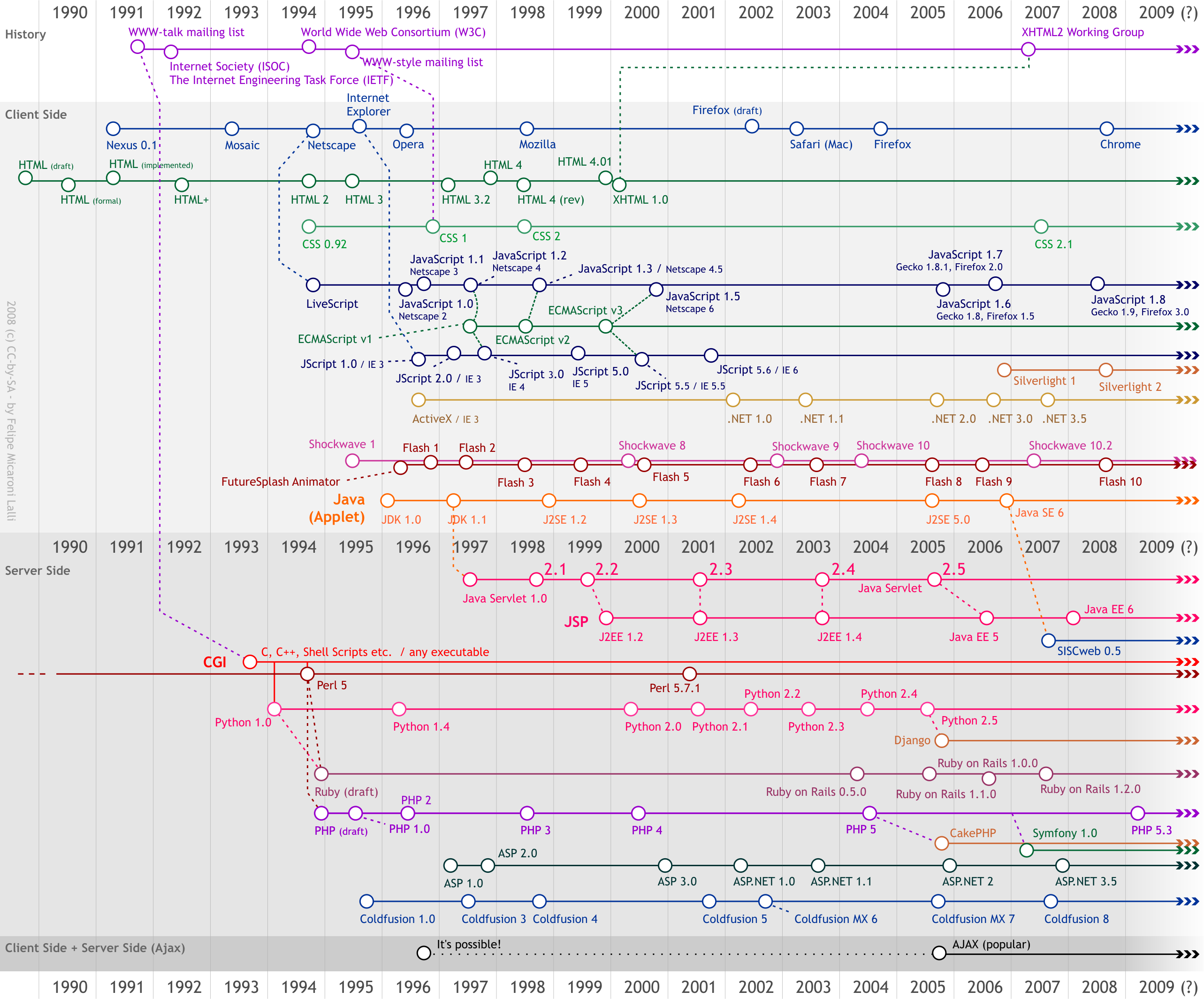
Web development timeline: Server and App side.

Web development timeline from Wikimedia:


Browser development timeline from Wikimedia


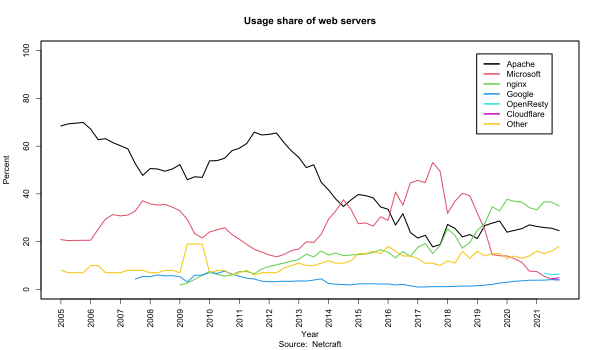
Market share of web servers
 

Wednesday, July 11, 2012

E-mail is dead.


CNet reports on the demographics of communications:
(July 11, 2012 12:03 PM PDT) The study shows that teens turn to text messaging for communication instead of writing e-mails. Six percent of teens use e-mail daily, while 39 percent say they never use e-mail. In contrast, 63 percent of teens text everyday, with some teens texting up to 100 messages a day.

tags: s-curve, payload, 10x, social, networking

Lunch Talk: Internet and the brain.

(7/9/12. Newsweek.) The brains of Internet addicts, it turns out, look like the brains of drug and alcohol addicts. In a study published in January, Chinese researchers found “abnormal white matter”—essentially extra nerve cells built for speed—in the areas charged with attention, control, and executive function. A parallel study found similar changes in the brains of videogame addicts. And both studies come on the heels of other Chinese results that link Internet addiction to “structural abnormalities in gray matter,” namely shrinkage of 10 to 20 percent in the area of the brain responsible for processing of speech, memory, motor control, emotion, sensory, and other information. And worse, the shrinkage never stopped: the more time online, the more the brain showed signs of “atrophy.”


tags: 10x, internet, payload, niche construction, psychology, brain, social

Wednesday, July 04, 2012

Day and Night: Twitter vs Facebook.

VBeat shows an offsetting time pattern for Facebook and Twitter. It is consistent with often stated Zuckerberg's intent to keep Facebook fun-oriented rather than work-oriented.

Twitter marketers should definitely include a link in their tweet. “We saw 86 percent higher engagement for tweets with links,” Ciarallo told VentureBeat. This is another difference vis-a-vis Facebook, where links can be counterproductive.
And while some might think that 140 characters is already pretty short, another thing that Buddy Media found is that even shorter tweets were the most successful.
“Tweets that contain less than 100 characters have 17 percent higher engagement,” said Ciarallo. “What they’re doing is leaving room for others to add their own thoughts and comments in a retweet.”
 tags:  payload, aboutness, storage, 10x, time, facebook, twitter, attention