Showing posts with label art. Show all posts

Tuesday, February 17, 2015

Invention of the Day: Piano

In the end of the 17th century, Bartolomeo Cristofori di Francesco (May 4, 1655 – January 27, 1731), a maker of musical instruments working for the Medici family in Florence, invented the piano.

A Cristofori piano at the Metropolitan Museum of Art in New York.
From a modern inventor perspective, the Cristofori's solution deserves our attention because its success can be directly attributed to breaking a trade-off. In the case of the piano, the trade-off was between the sound volume and the expressive control that a musical instrument afforded the player. Before the piano, musicians had to use two instruments: clavichord and harpsichord,
While the clavichord allowed expressive control of volume and sustain, it was too quiet for large performances. The harpsichord produced a sufficiently loud sound, but offered little expressive control over each note. The piano offered the best of both, combining loudness with dynamic control.
Although we are taught throughout engineering, design, economics, and business courses that good solutions create trade-offs, the invention of the piano shows us that great solutions break trade-offs.

We discuss the topic in greater detail in the Prologue of Scalable Innovation. Some of the invention techniques for breaking trade-offs and dilemmas can also be found in my blog.

tags: trade-off, invention, innovation, art

Wednesday, February 13, 2013

Sunday, February 10, 2013

Lunch Talk: (@TED) The math and magic of origami.

Robert Lang is a pioneer of the newest kind of origami -- using math and engineering principles to fold mind-blowingly intricate designs that are beautiful and, sometimes, very useful.

At 13:53 Robert Lang spells out the dilemma origami helps to solve: something has to be small when folded, and it has to be large (and shaped in a certain way) when unfolded. Examples: space lenses, a heart stent, an airbag, etc. tags: lunchtalk, science, art, dilemma

Sunday, September 23, 2012

A new application for your old light bulbs.

As energy efficient lighting devices take over, some people invent new ways to use the traditional Edison's (or, if you are British, Swan's) light bulb.


Source: New ideas for old tech (Russian).

tags: innovation, mousetrap, invention, art

Saturday, July 14, 2012

Lunch Talk: (@TED) How to listen to music with your whole body

In this soaring demonstration, deaf percussionist Evelyn Glennie illustrates how listening to music involves much more than simply letting sound waves hit your eardrums.


tags: lunchtalk, art, perception

Friday, February 03, 2012

Russian Revolution: Angry Birds vs The Kremlin

Public protest in Russia over rigged parliamentary elections draws on a popular game as a metaphor for action. The vote-stealing pigs in the Kremlin must go!

Thursday, January 12, 2012

Lunch Talk: The meaning of innovation (@GoogleTalks)

Through his experiences as president of the US's leading art and design college, Maeda argues that the critical thinking, critical making and creative leadership which is embodied at RISD can lead us to an enlightened form of innovation where art, design, technology, and business meet. He shares lessons from his journey as an artist-technologist-professor turned president to reveal a new model of leadership for the next generation of leaders.


tags: lunchtalk, innovation, art, technology, creativity

Tuesday, December 27, 2011

Lunch Talk: (TED) Leading like a great conductor.

An orchestra conductor faces the ultimate leadership challenge: creating perfect harmony without saying a word. In this charming talk, Itay Talgam demonstrates the unique styles of six great 20th-century conductors, illustrating crucial lessons for all leaders.

tags: lunchtalk, art, control

Friday, December 09, 2011

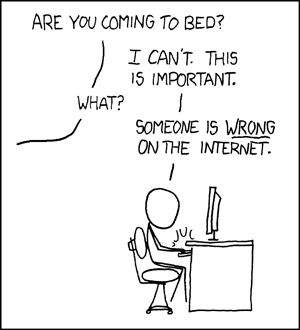
Lunchtalk: Randal Munroe, of xkcd fame.

Here's my favorite comic of the social networking era


And here's a somewhat geeky talk by its creator.

Randall Munroe is the creator of xkcd, a webcomic of romance, sarcasm, math, and language. Munroe on Munroe: "I'm just this guy, you know? I'm a CNU graduate with a degree in physics. Before starting xkcd, I worked on robots at NASA's Langley Research Center in Virginia. 


tags: creativity, art, web, lunchtalk

Saturday, July 30, 2011

Weekend edition: A prescription for happiness.

I read the prescription. It ran:

“1 lb. beefsteak, with
1 pt. bitter beer
every 6 hours.
1 ten-mile walk every morning.
1 bed at 11 sharp every night.
And don’t stuff up your head with things you don’t understand.”

I followed the directions, with the happy result – speaking for myself – that my life was preserved, and is still going on.

Three Men in a Boat, by Jerome K. Jerome.

Tuesday, July 26, 2011

How embodied math shapes us, humans.

Kevin Slavin about the world of algorithms (15 min TED video):

"... these complex computer programs determine: espionage tactics, stock prices, movie scripts, and architecture. ... we are writing code we can't understand, with implications we can't control. ... we are writing what we can't read."


tags: problem, solution, control, 10x, tool, cloud, art, science, deontic, video, social, intelligence, scale, detection, creative crowd


Saturday, March 12, 2011

A Random Act of Creativity


I stole this picture from the cloud.

tags: creativity, picture, art

Wednesday, September 22, 2010

Cloud computing: the gossip of virtual crops

Each day, Facebook game developer and FarmVille creator Zynga delivers about a petabyte of data — that’s 1 million gigabytes, or more than six Libraries of Congress — for its array of social games, chief technology officer Cadir Lee said.

The challenge for Zynga is unique compared to other large sites that are “read-only” or “input-only,” such as photo-sharing sites like Flickr or e-commerce sites like Amazon.com, Lee said. Zynga instead faces an environment that is constantly updating, with each new crop planted or fertilized and each message left on a friend’s farm.

In many ways today's gaming environments create a ubiquitous communications fabric reminiscent of the planet Pandora from James Cameron's movie Avatar; environments where virtual plants and animals communicate to real people, generating enormous streams of information, connecting experiences bordering on magic, giving players a feeling of being a part of a growing social organism.
It would be an interesting experiment to use these messages to drive Leo Villareal's LED art mentioned in my previous post. Some incredible light patterns may emerge from the gossip of virtual crops.

tags: games, cloud, information, communications, environment, virtual, art, 10x, content, synthesis

LED art

Leo Villareal uses LED (Light Emitting Diod) canvas to create his immersive art:

"Solid state lighting is exciting for several reasons including longevity and energy efficiency," Villareal said. "The ability to create over 16 million colors is truly incredible and offers a tremendous range of subtle and sophisticated possibilities."

Skip to the 1:20 mark in the video (below) to see an installation that impressed me the most.


tags: technology, control, tool, energy, art

Tuesday, February 16, 2010

As I sit in a hotel in Flagstaff, Arizona, reading The Cambridge History of Science and watching an Olympic ice hockey game between Latvia and Russia, I come to a paragraph that talks about modern misconceptions about the past:

The multifaceted “Renaissance man” is to some extent a trick of historical perspective, which creates polymathesis out of what was simply a different classification of knowledge and a different professional division of labor.

Leonardo was a man of what was considered at the time as practical arts: designer, painter, builder, engineer, and inventor. It was his professional duty to be a Renaissance man.

tags: creativity, science, art, history

Monday, August 24, 2009

Business Art: Health Care #2

My boss at HP used to call me a business artist because I always explained to him my strategy ideas in pictures and drawings. Today's piece is called "Evolution of Health Care #2"