Dr. Darlene Lim is a geobiologist and an expert in the development of concepts for human scientific exploration. She has spent over two decades leading field research around the world, including the Arctic, the Antarctic, and various underwater environments (where she has spent many hours piloting submersibles as a scientist and explorer). Darlene is also Founder of the Haven House Family Shelter "STEM Explorers' Speakers Series", which brings NASA and academic researchers to homeless children in the Bay Area.
tags: lunchtalk, science, biology, time, communications
Showing posts with label communications. Show all posts
Showing posts with label communications. Show all posts
Sunday, January 11, 2015

Tuesday, January 21, 2014
Nortel/Rockstar US Patent 6,378,069 - a ticking bomb for the smartphone industry?
In July 2011, a group of companies led by Apple, Microsoft, RIM and others bought 6,000 Nortel patents. The patents were assigned to a holding entity Rockstar Consortium, Inc. One of the patents in the portfolio is US 6,378,069 "Apparatus and methods for providing software updates to devices in a communication network," issued April 23, 2002. I ran into it while reviewing references for the newly issued Facebook patent US 8,631,239.

The original Nortel patent looks incredibly broad. Its claim 1 covers any system that has a database of subscriber records and can provide software updates to the subscribers.

Arguably, the patent covers software update systems for smartphones, PCs, tablets, ebook readers (hello, Amazon!), and everything on the Internet that requires a software update. One could try to circumvent the patent by delegating software distribution to third parties, i.e. decoupling the entity that holds the subscriber database and the one that actually communicates to the destination device. It's not clear how this solution could play out in courts. Litigation over this potential workaround would be an interesting case to watch.
Rockstar has not asserted the patent yet, but the consortium still has several years to do that. They've already sued Google for allegedly infringing Nortel patents on relevant advertisement. Most likely, the Nortel portfolio contains more patent gems; litigating them can prove extremely expensive. The industry would be wise to set up a standard-like body to figure out reasonable licensing terms, instead of engaging in a series of all-out patent wars.
From our system model point of view, the patent covers key Control Points (see Scalable Innovation, Chapter 5, System Control Points: Where To Aim Your Silver Bullets), i.e. using Aboutness to direct a Packaged Payload - this is as basic as it can possibly be. An equivalent broad patent for Facebook would cover using information about users for sending messages, including ads. For Netflix, it would be using subscriber database for sending recommendations, etc. Powerful, if you can get it issued.
tags: patent, invention, software, innovation, portfolio, communications, aboutness, packaged, payload
The original Nortel patent looks incredibly broad. Its claim 1 covers any system that has a database of subscriber records and can provide software updates to the subscribers.

Arguably, the patent covers software update systems for smartphones, PCs, tablets, ebook readers (hello, Amazon!), and everything on the Internet that requires a software update. One could try to circumvent the patent by delegating software distribution to third parties, i.e. decoupling the entity that holds the subscriber database and the one that actually communicates to the destination device. It's not clear how this solution could play out in courts. Litigation over this potential workaround would be an interesting case to watch.
Rockstar has not asserted the patent yet, but the consortium still has several years to do that. They've already sued Google for allegedly infringing Nortel patents on relevant advertisement. Most likely, the Nortel portfolio contains more patent gems; litigating them can prove extremely expensive. The industry would be wise to set up a standard-like body to figure out reasonable licensing terms, instead of engaging in a series of all-out patent wars.
From our system model point of view, the patent covers key Control Points (see Scalable Innovation, Chapter 5, System Control Points: Where To Aim Your Silver Bullets), i.e. using Aboutness to direct a Packaged Payload - this is as basic as it can possibly be. An equivalent broad patent for Facebook would cover using information about users for sending messages, including ads. For Netflix, it would be using subscriber database for sending recommendations, etc. Powerful, if you can get it issued.
tags: patent, invention, software, innovation, portfolio, communications, aboutness, packaged, payload
Monday, February 11, 2013
Lunch Talk: Staying productive in the office; e-mail, tasks, etc.
Jared Goralnick, CEO of Awayfind.com speaking on time management hacks to advice for making the most of your relationships at the Googleplex.
tags: lunchtalk, control, communications, packaged payload
tags: lunchtalk, control, communications, packaged payload
Thursday, January 31, 2013
e-mail is a security black hole.
(NYT. Jan 31, 2013) SAN FRANCISCO — For the last four months, Chinese hackers have persistently attacked The New York Times, infiltrating its computer systems and getting passwords for its reporters and other employees.
Security experts found evidence that the hackers stole the corporate passwords for every Times employee and used those to gain access to the personal computers of 53 employees, most of them outside The Times’s newsroom.
Over the course of three months, attackers installed 45 pieces of custom malware. The Times — which uses antivirus products made by Symantec — found only one instance in which Symantec identified an attacker’s software as malicious and quarantined it, according to Mandiant.
E-mail is a mature technology where bugs and security holes were all supposed to be extinguished. If e-mail servers at a major news institution cannot be protected from outside intruders, the situation with thousands of mobile apps is probably much worse.
The effectiveness of anti-virus software is quite pathetic - 44 our 45 malware pieces not detected.
tags: security, internet, control, mobile, communications
Monday, August 06, 2012
Reality Distortion Field (RDF) discovered.
Here's what Wikipedia tells us about Steve Jobs' RDF:
Reality distortion field (RDF) is a term coined by Bud Tribble at Apple Computer in 1981, to describe company co-founder Steve Jobs' charisma. The RDF was said by Andy Hertzfeld to be Steve Jobs' ability to convince himself and others to believe almost anything with a mix of charm, charisma, bravado, hyperbole, marketing, appeasement and persistence. RDF was said to distort an audience's sense of proportion and scales of difficulties and made them believe that the task at hand was possible.

Is RDF real? Yes, seems the the answer. According to an MRI study conducted at Aarhus University in Denmark,
We find that recipients’ assumptions about senders’ charismatic abilities have important effects on their executive network. Most notably, the Christian participants deactivated the frontal network consisting of the medial and the dorsolateral prefrontal cortex bilaterally in response to speakers who they believed had healing abilities. An independent analysis across subjects revealed that this deactivation predicted the Christian participants’ subsequent ratings of the speakers’ charisma and experience of God’s presence during prayer.


In summary, interaction with a perceived charismatic person inhibits critical thinking. Furthermore, once the charismatic person becomes an authority figure ("genius"), the effect is combined with people's natural tendency to conform.
tags: psychology, control, communications, innovation, effect, cognition
Source: Uffe Schjoedt, et. al. The power of charisma—perceived charisma inhibits the frontal executive network of believers in intercessory prayer. Soc Cogn Affect Neurosci (2011) 6 (1): 119-127. doi: 10.1093/scan/nsq023 First published online: March 12, 2010.
Friday, July 27, 2012
Lunch Talk: (@TED) Goodman: The Future of Crime.
Marc Goodman imagines the future crime and terrorism challenges we will all face as a result of advancing technologies. He thinks deeply about the disruptive security implications of robotics, artificial intelligence, social data, virtual reality and synthetic biology. Technology, he says, is affording exponentially growing power to non-state actors and rogue players, with significant consequences for our common global security. How to respond to these threats? The crime-fighting solution might just lie in crowdsourcing.
tags: lunchtalk, control, communications
Tuesday, March 06, 2012
Snack Talk: DARPA Nano Air Vehicle (NAV) program
One of the videos from DARPA's Youtube channel.
Link
tags: lunchtalk, control, tool, communications, detection
Link
tags: lunchtalk, control, tool, communications, detection
Sunday, January 29, 2012
Sunday biography: Nikola Tesla.
This amazing documentary gives long overdue recognition to a great and misunderstood man of science. The life of Nikola Tesla is an inspiring example of the power of one man to change the world with technology and revolutionary ideas.
Nikola Tesla (1856-1943) was one of the most fascinating scientists of the 20th century. He invented, developed or imagined the technology that brought us electricity, remote control, neon and florescent lighting, radio transmission and much more... all the basic inventions that now connect the world with power and information.
link
tags: lunchtalk, innovation, invention, energy, communications
Saturday, January 28, 2012
Lunchtalk: (TED) Creating Twitter
Co-founder Evan Williams reveals that many of the ideas driving that growth came from unexpected uses invented by the users themselves.
link
tags: lunchtalk, communications, information,
link
tags: lunchtalk, communications, information,
Tuesday, January 24, 2012
Remotely controlled brain.
Switching technology from lasers to LEDs lets an MIT startup plant a light-weight controller right into a lab animal brain.
tags: control, energy, storage, communications, biology, brain, startup
Jan 23, 2012. MTR -- Optogenetics relies on genetically altering certain cells to make them responsive to light, and then selectively stimulating them with a laser to either turn the cells on or off. Instead of a laser light source, Kendall Research uses creatively packaged LEDs and laser diodes, which are incorporated into a small head-borne device that plugs into an implant in the animal's brain. The device, which weighs only three grams, is powered wirelessly by supercapacitors stationed below the animal's cage or testing area.Data collection is also seems to be one of their key applications. Maybe when people agree to genetically modify their brains to emit lights, this technology will be invaluable for a new kind of communications.
The wireless capabilities allow researchers to control the optogenetics equipment remotely, or even schedule experiments in advance.
tags: control, energy, storage, communications, biology, brain, startup
Thursday, January 19, 2012
Your wrist as a gadget real estate.
Mobile phones effectively killed wrist watches. Now, electronic gear manufacturers are trying to reclaim your wrist for their devices. For example, this NYT article describes a variety of wristbands that can help you with your New Year resolutions. In addition to that,
- Nike introduced FuelBand, a wristband device to track calories burned during the day;
- Sony Ericsson brings to the market Smartwatch, an Android-based communicator;
- MIT is working on a wristband for controlling your home devices;
- Basis made waves at CES with its Basis Band, a vitals tracking device to monitor your lifestyle, including stress levels.
It appears Personal Area Network is becoming a reality. At least some of its aspects are covered in my US Patent 6,838,986 (claim 1.)
- Nike introduced FuelBand, a wristband device to track calories burned during the day;
- Sony Ericsson brings to the market Smartwatch, an Android-based communicator;
- MIT is working on a wristband for controlling your home devices;
- Basis made waves at CES with its Basis Band, a vitals tracking device to monitor your lifestyle, including stress levels.
It appears Personal Area Network is becoming a reality. At least some of its aspects are covered in my US Patent 6,838,986 (claim 1.)
Sunday, January 01, 2012
Invention of the Day: a Pack of Warhorses.
Over the last week during my regular dog walks, I've been listening to an audio course about China - From Yao to Mao: 5000 Years of Chinese History. (Visit your local library often this year!)
Lecture 20 covers a world upheaval in the 13th and 14th century: Mongol conquests. An important invention that powered the conquests (see map) was a novel use of horses.
The horses provided the Mongols with a huge communications advantage. Because horse-mounted troops were so fast it was practically impossible for cities to prepare for an attack. Intelligence, i.e. information about Mongol military movements, could not be delivered faster than the arrival of the Mongol troops to the battlefield. Since standing armies at the time were small, the cities did not have time to gather their forces from neighboring towns and villages. Essentially, the Mongol's "nervous system" worked faster than anything developed by their competitors.
It's the same pattern that worked for telegraph improve the railroad system; radio for tanks and motorized military units; DHL's breakthrough in document delivery; creation and distribution of playlists ahead of music collections; tweets and facebook messages ahead of demonstrations, and etc.
tags: system, payload, communications, control, telegraph, invention
Lecture 20 covers a world upheaval in the 13th and 14th century: Mongol conquests. An important invention that powered the conquests (see map) was a novel use of horses.
Genghis Khan understood the importance of horses and insisted that his troops be solicitous of their steeds. A cavalryman normally had three or four, so that each was, at one time or another, given a respite from bearing the weight of the rider during a lengthy journey. Mongol horses could traverse the most rugged terrain and survive on little fodder.
According to Marco Polo, the horse also provided sustenance to its rider on long trips during which all the food had been consumed. On such occasions, the rider would cut the horse’s veins and drink the blood that spurted forth. Marco Polo reported, perhaps with some exaggeration, that a horseman could, by nourishing himself on his horse’s blood, “ride quite ten days’ marches without eating any cooked food and without lighting a fire.” And because its milk offered additional sustenance during extended military campaigns, a cavalryman usually preferred a mare as a mount.

The horses provided the Mongols with a huge communications advantage. Because horse-mounted troops were so fast it was practically impossible for cities to prepare for an attack. Intelligence, i.e. information about Mongol military movements, could not be delivered faster than the arrival of the Mongol troops to the battlefield. Since standing armies at the time were small, the cities did not have time to gather their forces from neighboring towns and villages. Essentially, the Mongol's "nervous system" worked faster than anything developed by their competitors.
It's the same pattern that worked for telegraph improve the railroad system; radio for tanks and motorized military units; DHL's breakthrough in document delivery; creation and distribution of playlists ahead of music collections; tweets and facebook messages ahead of demonstrations, and etc.
tags: system, payload, communications, control, telegraph, invention
Friday, December 16, 2011
Mobile phone is not a phone.
The new data is in and it confirms the prediction (iPhone is not a phone) I made two and a half years ago. Mobile devices we buy and use today are computers that live on data. Voice is but one application that runs on them.
tags: mobile, communications, infrastructure, information, apple
Dec 15, 2011. VBeat ...data usage is up 256 percent from last year with the average 13- to 17-year-old teen now consuming 320 MB of data per month. Should the trend continue — and we think it will — teens will easily get up to 1 GB of data usage a month by next year.Mobile communications infrastructure will have to be rebuilt with new technologies to accommodate the emerging usage patterns.
The cell phone’s primary purpose (i.e. to make calls), according to the data, is quickly becoming lost on teens. Voice usage dropped from 685 to 572 minutes in one year.
tags: mobile, communications, infrastructure, information, apple
Sunday, October 16, 2011
Mobile text vs Web
VentureBeat has a remarkable infographic about world-wide impact of mobile phone texting (click to enlarge).

tags: mobile, commerce, communications

tags: mobile, commerce, communications
Tuesday, August 02, 2011
Technology is better than sex?
The results from rigorous scientific studies in
xkcd

and The New Yorker

tags: information, social, network, psychology, communications
xkcd
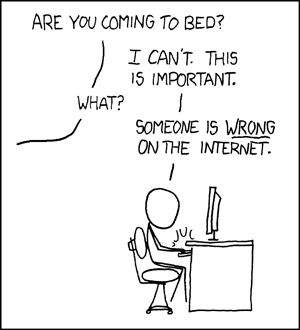
and The New Yorker

tags: information, social, network, psychology, communications
Thursday, July 14, 2011
Online Dating: the business of unhappiness.
The New Yorker has a big article on the state of affairs in $1B/year business of online dating. With what we know about the psychology of choice and happiness, the current model is bound to generate regrets about imperfect choices. And the more regrets, the more "inventory" turnover. That is, unhappy people come back for a dip into potential happiness. In some ways, the business model with a flat-rate pre-paid fee is bound to create more "purchases." We've seen this effect at work at all-you-can-eat buffets or, more recently, with Amazon introducing free or flat-fee shipping plan for their customers. That is, when the total price is fixed, people try to maximize the number of transactions, which, in turn, leads to a higher turnover, and as a result to low happiness.
Furthermore, the reward structure for service providers is not tied to happiness:
tags: business, model, innovation, problem, psychology, control, information, market, communications, internet
Furthermore, the reward structure for service providers is not tied to happiness:
There is, as yet, a disconnect between success and profit. “The way these companies make money is not directly correlated to the utility that users get from the product,” Harj Taggar, a partner at the Silicon Valley seed fund Y Combinator, told me. “What they really should be doing is making money if they match you with people you like.”
tags: business, model, innovation, problem, psychology, control, information, market, communications, internet
Wednesday, June 01, 2011
Problem solving and bilingualism.
- Why did the cat bark?
- He wanted to learn a second language.
(A children joke).
NYTimes publishes an interview with Ellen Bialystok, a neuroscientist who has spent almost 40 years learning about how bilingualism sharpens the mind. Her recent work shows that, among other things, bilingualism delays the onset of Alzheimer's symptoms.- He wanted to learn a second language.
(A children joke).
I also find it interesting that researchers see differences in physical brain activity when mono- and bilinguals solve the same problems:
...when we look in their [bilinguals'] brains through neuroimaging, it appears like they’re using a different kind of a network that might include language centers to solve a completely nonverbal problem. Their whole brain appears to rewire because of bilingualism.
On the problem-solving side, I find that using abstract system-level language instead of a specific engineering or technology jargon helps me and my students approach the problem from a different perspective. I call this language "Inventorese." Maybe it should count as my 5th one :)
Finally, long-held common sense belief on the subject turned out to be wrong:
Until about the 1960s, the conventional wisdom was that bilingualism was a disadvantage.
tags: brain, mind, communications, psychology, creativity, system, five element analysis, health, bias
Wednesday, May 25, 2011
Are we Borg yet?
Another indication (via CNET) that proliferation of mobile devices creates a 24/7 workplace:
On top of that, some companies, e.g. Netflix, don't even have a vacation policy; you can take as much vacation as your can agree upon with your manager. Eventually, all these trends have to lead to much higher productivity, or at least more work hours per week/year.

tags: trend, economics, information, mobile, communications
Based on a survey of more than 3,700 mobile employees from more than 1,000 companies, the iPass Global Mobile Workforce Report (PDF) found that downtime may be a thing of the past. More workers (91 percent) are using their free time, both day and night, to check their smartphones. Among those, almost 30 percent check their smartphones three to five times an hour, and 20 percent check them five to ten times an hour.
On top of that, some companies, e.g. Netflix, don't even have a vacation policy; you can take as much vacation as your can agree upon with your manager. Eventually, all these trends have to lead to much higher productivity, or at least more work hours per week/year.
tags: trend, economics, information, mobile, communications
Tuesday, May 10, 2011
Invention of the Day: "next to the telephone, the most useful communication device"
Before the radio, heliograph was the first wireless communications device
To think of it, today's fiber-optics switches use the same principles as the heliograph from 2500 years ago. Note, how Morse code migrated from telegraph, to heliograph, to radio.
tags: communications, information, system, payload
(from Wikipedia) that [sent] signals using Morse code flashes of sunlight reflected by a mirror. The flashes are produced by momentarily pivoting the mirror, or by interrupting the beam with a shutter.
The first recorded use of a heliograph was in 405 BC, when the Ancient Greeks used polished shields to signal in battle.
Sir Henry Christopher Mance (1840–1926), of British Army Signal Corps, developed the first apparatus while stationed at Karachi, Bombay.

The simple and effective instrument that Mance invented was to be an important part of military communications for over 60 years. Although limited to use in sunlight, the heliograph was the most powerful visual signalling device known. In pre-radio days it was often the only means of communication that could span ranges of up to 100 miles with a lightweight portable instrument.

In 1909, the use of the heliograph for forestry protection was introduced in the United States. By 1920 such use was widespread in the US and beginning in Canada, and the heliograph was regarded as "next to the telephone, the most useful communication device that is at present available for forest-protection services"
The first recorded use of a heliograph was in 405 BC, when the Ancient Greeks used polished shields to signal in battle.
Sir Henry Christopher Mance (1840–1926), of British Army Signal Corps, developed the first apparatus while stationed at Karachi, Bombay.

The simple and effective instrument that Mance invented was to be an important part of military communications for over 60 years. Although limited to use in sunlight, the heliograph was the most powerful visual signalling device known. In pre-radio days it was often the only means of communication that could span ranges of up to 100 miles with a lightweight portable instrument.
In 1909, the use of the heliograph for forestry protection was introduced in the United States. By 1920 such use was widespread in the US and beginning in Canada, and the heliograph was regarded as "next to the telephone, the most useful communication device that is at present available for forest-protection services"
To think of it, today's fiber-optics switches use the same principles as the heliograph from 2500 years ago. Note, how Morse code migrated from telegraph, to heliograph, to radio.
tags: communications, information, system, payload
Wednesday, February 09, 2011
Channeling free money
Another sign that virtual goods are becoming as important as real goods and services:
Also related, according to NYT, Apple wants to channel all in-application sales through its AppStore:
tags: money, virtual, games, social, market, communications, 4q diagram, control
Visa has agreed to buy virtual goods company PlaySpan for $190 million in a big move into the market for digital goods.
PlaySpan enables game companies and video publishers to make money through the buying and selling of virtual goods. It’s a key part of the food chain in the free-to-play business model.
PlaySpan enables game companies and video publishers to make money through the buying and selling of virtual goods. It’s a key part of the food chain in the free-to-play business model.
Also related, according to NYT, Apple wants to channel all in-application sales through its AppStore:
Apple is now saying the app makers must allow those purchases to happen within the app, not in a separate browser window, with Apple getting its standard 30 percent cut of the transaction. At the moment this applies only to e-book purchases.
tags: money, virtual, games, social, market, communications, 4q diagram, control
Subscribe to:
Posts (Atom)