Showing posts with label information. Show all posts

Wednesday, July 20, 2016

A new way to map brains

Neuroscientists at Washington University Medical School created a method to build maps for individual brains:

(MIT Tech Review) Researcher Matthew Glasser says that unlike many previous studies, this map considers several features of the brain simultaneously to mark its boundaries. Some neuroscientists still define brain regions based on a historical map called Brodmann’s areas that was published in 1909. That map divided each half of the brain into 52 regions. Each hemisphere on the new map has 180 regions.

Glasser defined these regions by looking for places where multiple traits—such as the thickness of the cortex, its function, or its connectivity to other regions—were changing together. After drawing the map onto one set of brains, the researchers developed an algorithm to recognize the regions in a new set of brains where the size and boundaries vary from person to person. “It’s not just a map that people can make reference to,” Glasser says. “You can actually find the areas in the individuals that somebody is studying.”

From an innovation perspective, mapping methods create opportunities to systematically explore and coordinate knowledge about a broad class of objects. This particular approach enables scientists and engineers to move back and forth from generalized information about human brain to specific aspects in a particular brain. For example, we might be able to understand why 3D VR can replace painkillers in some medical applications.

Wednesday, August 19, 2015

Facebook is taking over Google in sourcing the flow of news

Fortune runs an article showing Facebook's influence growing in the news segment:
...it’s clear that search has hit a kind of plateau and isn’t really growing any more as a referral source for media. Meanwhile, Facebook’s influence has “shown it’s on a continued growth trajectory."

Source: Forbes.com (click images to enlarge)

The competition for advertisers' money between Facebook and Google is heating up. We should expect that Facebook will make further inroads into information segments other than news. Although it's too early to pronounce Search dead, its dominance on the web no longer translates directly into the mobile space, especially, when users spend more and more time on social. (Based on system analysis, we anticipated this trend in Scalable Innovation, Chapters 20-22).

It is also somewhat surprising that Twitter is such a non-factor in the race. Despite the "freshness" of their links, they don't have enough users to play the game. Furthermore, unlike the Facebook's, Twitter connections don't have the strength of social relations.
tags: mobile, information, control, google, facebook, twitter, system

Saturday, July 11, 2015

Lunch Talk: How to Tell Stories with Data

Pulitzer-prize winning journalist and editor of the New York Times’ data journalism website The Upshot, David Leonhardt, shares the tricks of the master storyteller’s trade. In conversation with Google News Lab data editor Simon Rogers, he shows how data is changing the world; and your part in the revolution.


tags: media, lunchtalk, information, trend, data, story,

Tuesday, January 13, 2015

Popular media hypes up a trivial Apple 3-D gesture patent

Science fiction writer Michael Crichton once said about journalists' cluelessness on subjects that require special knowledge:
“Briefly stated, the Gell-Mann Amnesia effect is as follows. You open the newspaper to an article on some subject you know well. In Murray's case, physics. In mine, show business. You read the article and see the journalist has absolutely no understanding of either the facts or the issues. Often, the article is so wrong it actually presents the story backward—reversing cause and effect. I call these the "wet streets cause rain" stories. Paper's full of them.
In any case, you read with exasperation or amusement the multiple errors in a story, and then turn the page to national or international affairs, and read as if the rest of the newspaper was somehow more accurate about Palestine than the baloney you just read. You turn the page, and forget what you know.”

The recent media coverage of US 8,933,876 awarded to Apple is a remarkable case of baloney reporting. For example, in a CNBC news segment Dan Costa, the Editor-in-Chief of PCMag.com says, he's surprised how broad the patent is. Obviously, Dan is clueless because in reality the patent claims only a vertical unlock gesture - a narrow set of functionality that is extremely easy to work around, e.g. by implementing it horizontally.

The Business Insider header says, "Apple Just Patented 'Minority Report'-Style Gesture Controls." This statement is a huge stretch of reality because Apple patented just a tiny extension of the technology already implemented in, e.g. Microsoft Kinect, Nintendo, and other devices.

As a rule, when you read something about patents in popular media consider yourself under the influence of the Gell-Mann Amnesia effect.

tags: patents, apple, media, information, error

Monday, January 12, 2015

Lunch Talk: ( @Stanford ) Turing, the Pioneer of the Information Age

(May 2, 2012) Following a three minute introduction by Steven Ericsson-Zenith, Jack Copeland discusses Alan Turing's impact on information technology. Turing is often considered to be one of the greatest minds in the 20th century, and Copeland looks at how many of Turing's ideas lie behind some of information technology's most fundamental theories.


tags: lunchtalk, innovation, innovation, information

Thursday, August 21, 2014

Quote of the Day: information vs data

Seek truth from facts.

- Deng Xiaoping


tags: information, data, quote, tool

Friday, January 10, 2014

Lunch Talk: Inventions that shook the world (1940s)


The 1940s - It was a decade of big bands and big bangs. During the Second World War, the 1940s bring us some of the greatest inventions of all time. And in the peaceful years that followed, all that inventing know-how would carry on in ways we never imagined.

Featured Inventions: Jet Engine, Computer, Microwave Oven, Kitty Litter, Crash Test Dummy

"Inventions That Shook The World" is a 10-part documentary by Discovery Channel.

Update: the video contains the answer to Review Question 1 of the Prologue in Scalable Innovation (page xxiv).

Thursday, January 09, 2014

The insanely great world of sports (and life in general)

Reading Nate Silver's "The Signal and the Noise" prompted me to consider the beautiful absurdity of human reality. For example, Silver devotes a large chunk of the book to various statistical systems that predict baseball player performance. He shows how scouts and geeks scour gigabytes of objective and subjective data about thousands of candidates: from high school, to minor leagues, to the Major League Baseball (MLB). It's understandable because top player contracts run easily into a hundred million dollars. The total 2013 MLB payroll is over $3 billion dollars.

This large-scale data gathering and analysis is not limited to pro teams. With proliferation of the web, amateurs are getting into the statistical game with online fantasy sports. (In fantasy sports, players draft virtual teams that collect points based on player stats during regular season "physical" games.) According to Bloomberg News, fantasy sports participants spent $3,4B on products, services, and entry fees. Huge business on imaginary teams!

Why is it absurd? Because from an information perspective, an outcome of a home team game produces just 1 bit of information.* That is, the home team either wins (1) or loses (0). Somehow, we humans managed to invent an elaborate process for generating reams of data that result in a minimal amount of information. Judging by the success of Twitter, our purpose in life seems to be pure data generation.

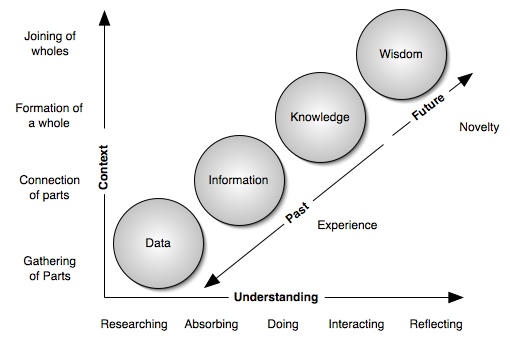
http://en.wikipedia.org/wiki/DIKW_Pyramid

Speaking of human life, since all people die, the informational outcome of an individual human life equals to zero. That is, because there's no uncertainty of the biological outcome, one's life or death does not make any computational difference. What does make a difference though, is whether one has children or not. In that case, an uncertainty exists and we cannot be sure that the data generation process will continue into the future. No wonder God tells Noah, "Be fruitful and multiply, and replenish the earth." (Genesis, 9:1). What is s/he computing? :)

Information is classically defined as reduction of uncertainty: the more numerous the alternatives that are ruled out, the greater the reduction of uncertainty, and thus the greater the information. It is usually measured using the entropy function, which is the logarithm of the number of alternatives (assuming they are equally likely). For example, tossing a fair coin and obtaining heads corresponds to log2(2) = 1 bit of information, because there are just two alternatives. (quoted from G. Tononi, Biol. Bull. 215, 216, http://www.biolbull.
org/content/215/3/216.full (2008).

Thursday, December 05, 2013

Social Networking is the new TV, only much better

A study of new mothers shows that social networking has a strong positive effect on their well-being:
On average, mothers were 27 years old (SD = 5.15) and infants were 7.90 months old (SD = 5.21). All mothers had access to the Internet in their home. New mothers spent approximately 3 hours on the computer each day, with most of this time spent on the Internet. Findings suggested that frequency of blogging predicted feelings of connection to extended family and friends which then predicted perceptions of social support. This in turn predicted maternal well-being, as measured by marital satisfaction, couple conflict, parenting stress, and depression. In sum, blogging may improve new mothers’ well-being, as they feel more connected to the world outside their home through the Internet.
Source: Brandon T. McDaniel • Sarah M. Coyne • Erin K. Holmes. New Mothers and Media Use: Associations Between Blogging, Social Networking, and Maternal Well-Being. DOI 10.1007/s10995-011-0918-2
 
Another study of random 79 undegrads shows that:
In Experiment 2, those who focused on their Facebook page scored significantly higher in general self-esteem, but not narcissism, than a control group.
Across both experiments we found consistent evidence that narcissists reported having more ‘‘friends’’ on the SNSs. Partici- pants with higher NPI scores reported having more friends and more page views on MySpace and reported having more friends on Facebook.  

 The paper also notes that the new generation of students is quite different from the general population
 A recent Pew Research Center survey found that, com- pared to 20 other countries, rates of SNSs usage in America were among the highest (Pew Research Center, 2011). Among Americans, 80% of respondents aged 18–29 used SNSs (compared to 62% of those aged 30–49 and 26% of those 50 and older) and that 61% of users had college degrees, indicating that SNSs users are dis- proportionately young, educated adults. 

Looks like SNSs provide opportunities to improve social well-being by starring in one's own show.

tags: network, social, information, graph, research, science, book, facebook

Friday, March 09, 2012

Lunch Talk: (@Google) Infinite Reality

The coming explosion of immersive digital technology, combined with recent progress in unlocking how the mind works, will soon revolutionize our lives in ways only science fiction has imagined. In Infinite Reality, Jeremy Bailenson (Stanford University) and Jim Blascovich (University of California, Santa Barbara)—two of virtual reality's pioneering authorities whose pathbreaking research has mapped how our brain behaves in digital worlds—take us on a mind-bending journey through the virtual universe.

link

tags: lunchtalk, psychology, gaming, information, social

Monday, February 20, 2012

Luncht Talk: (@Berkeley) Writing Systems

This is lecture 4 of History of Information course (C103 Cognitive Science) at UC Berkeley.


link

tags: lunchtalk, information, history, payload

Tuesday, February 14, 2012

Your social privacy is dead too.

Mobile apps freely access user contact information. Even if you personally take care of your private data, there's still a way to pierce you privacy veil through your friends, colleagues, and acquaintances.
Feb 14, 2012. VBeat -- Facebook, Twitter, Instagram, Foursquare, Foodspotting, Yelp, and Gowalla are among a smattering of iOS applications that have been sending the actual names, email addresses and/or phone numbers from your device’s internal address book to their servers, VentureBeat has learned. Several do so without first asking permission, and Instagram and Foursquare only added permissions prompts after the Path flare-up.
tags: privacy, information, control, social, networking

Monday, February 13, 2012

Zynga vs Personalized Media Communications.

Feb 14, 2012. WebProNews -- Personalized Media Communications filed a patent suit in the U.S. District Court for the Eastern District of Texas against Zynga. They claim that the social games maker has infringed on four of their patents.

The four patents in the suit ( US7,797,717; US7,908,638; US7,734,251; US7,860,131) are continuations of an application filed in 1981, now US4,694,490.


tags:patents, information, deontic, gaming, business


Friday, February 10, 2012

The killer device.

For the first time, web traffic from Apple's mobile devices exceeded that of Macs. One revolution Steve Jobs started thirty years ago is coming to an end. The other one is just getting under way.


Feb 10, 2012. VBeat -- In the first quarter of 2012, for instance, Apple sold 37.04 million iPhones, 15.43 million iPads, and just 5.2 million Macs.

It’s not quite the death of the desktop, but mobile devices are gaining ground on their traditional brethren, at least within the Apple-centric world.
“There is cannibalization, clearly, of the Mac by the iPad, but we continue to believe that there’s much more cannibalization of Windows PCs by the iPad,” Cook said

tags: mobile, s-curve, web, tool, information, synthesis

Invention of the Day: Nerve Repair.

The New Scientist reports on a new, potentially breakthrough technique, to repair nerve damage in injuries.


10 February 2012. NS -- When a nerve is severed through injury, surgeons must suture the two stumps together as quickly as possible. Yet even under controlled lab conditions, Bittner's tests in rats suggest that these conventional sutures restore little more than 30 per cent of previous mobility, even three months after surgery.


Put bluntly, the body botches nerve repair. It forms seals over the two severed stumps of a broken nerve within an hour, says Bittner, but it doesn't reconnect them first. Even if surgeons then suture the two ends, the seals will prevent nerve signals from passing easily across the join.

Bittner realised that we need a system that blocks the body's repair process. The way to do that, he discovered, is to immediately flush the injury site with a calcium-free salty solution that also contains methylene blue, a chemical that blocks oxidation reactions. Calcium and oxidation drive the formation of tiny spheres called vesicles, which in turn seal the nerve stumps.


tags: health, distribution, information, control, invention, biology, science

Why the content industry has to innovate to survive.

Because of its reputation of being "infamous for stealing money from artists", the content industry is going to lose jury verdicts in the majority of copyright violation trials.  Psychologically, jurors will have a hard time punishing individual users for "robbing the robbers."

SOPA  (the Stop Online Piracy Act) was designed, at least in part, to preempt copyright violations and as a result avoid court cases involving copyright infringement. SOPA's failure shows that to survive the industry hast to find a way to provide digital content conveniently and economically to the general public. Therefore, it is relatively easy to predict that within the next 5 years a new business model is going to emerge in content distribution.

RFS 9: Kill Hollywood

How do you kill the movie and TV industries? Or more precisely (since at this level, technological progress is probably predetermined) what is going to kill them? Mostly not what they like to believe is killing them, filesharing. What's going to kill movies and TV is what's already killing them: better ways to entertain people. So the best way to approach this problem is to ask yourself: what are people going to do for fun in 20 years instead of what they do now?
Hat tip to Max Shtein for the Y Incubator link.

tags: information, control, business, model, innovation, problem, information, media

Monday, February 06, 2012

More 3D implants on the way.

Printing bones and joints seems to be an important application  for 3D printing. A woman in Belgium got her jawbone printed and replaced with a titanium implant.
Feb 6, 2012. NS -- By using an MRI scan of their patient's ailing jawbone to get the shape right, they fed it to a laser sintering 3D printer which fused tiny titanium particles layer by layer until the shape of her jawbone was recreated. It was then coated in a biocompatible ceramic layer. No detail was spared: it even had dimples and cavities that promoted muscle attachment, and sleeves that allowed mandibular nerves to pass through - plus support structures for dental implants the patient might need in future.
I wonder how long will it take to figure out how to print neurons or their equivalent, so that motor and sensory functions can be restored in, e.g. paraplegics.

 tags: health, detection, information, control, biology

Saturday, February 04, 2012

Seeing without recognition.

A paper in Cognition describes a series of experiments where participants had to search through a heap of overlapping items. To locate the target, they had to 'unpack' the heap by moving objects aside. It turns out, a purely mechanical task of moving things aside interferes with the process of recognition, as if the motor system dictates the pace of mental work to the rest of the brain.
We report that during this task participants often fail to recognize the target despite moving it, and despite having looked at the item. The rate of this ‘unpacking error’ was minimally affected by set size and dual task manipulations, but was strongly influenced by perceptual difficulty and perceptual load. We suggest that the error occurs because of a dissociation between perception for action and perception for identification, providing further evidence that these processes may operate relatively independently even in naturalistic contexts, and even in settings like search where they should be expected to act in close coordination.
Grayden J.F. Solman, et. al. 2011. Found and missed: Failing to recognize a search target despite moving it. http://dx.doi.org/10.1016/j.bbr.2011.03.031
From a practical perspective, having large working surfaces, e.g. desks or screens, can improve recognition (or intuitive judgement) because there's no need to move things around in order to find what you are looking for. (The Whiteboard Effect?) In clutter situations machine-based search should be more effective than human-based one.

tags: detection, psychology, brain, information, control

Twitter bots as community organizers.

Human copycat behavior can be exploited to increase social interaction online. When social bots start following and retwitting members of a group of real people, the rate of following among the group increases as well.
January 23, 2012. MTR -- a group of freelance Web researchers has created more sophisticated Twitter bots, dubbed "socialbots," that can not only fool people into thinking they are real people, but also serve as virtual social connectors, speeding up the natural rate of human-to-human communication.

...the group tracked 2,700 Twitter users, divided into randomly assigned "target groups" of 300, over 54 days.

On average, each bot attracted 62 new followers and received 33 incoming tweets (mentions and retweets). But Hwang and his colleagues also found that the human-to-human activity changed within the target groups when the socialbots were introduced. They noted a 43 percent increase in follows, compared to the control period averaged over all the groups. However, one group exhibited a 355 percent increase in this connection rate. 
Could it be that twitter is as contagious as laughing?

 tags: social, networking, psychology, 10X, biology, information

Wednesday, February 01, 2012

Pop culture and the great American divide.


In a NYT column David Brooks reviews Charles Murray’s book “Coming Apart.” He talks about the great social divide between two tribes of Americans:
... there are vast behavioral gaps between the educated upper tribe (20 percent of the country) and the lower tribe (30 percent of the country). This is where Murray is at his best, and he’s mostly using data on white Americans, so the effects of race and other complicating factors don’t come into play.
Roughly 7 percent of the white kids in the upper tribe are born out of wedlock, compared with roughly 45 percent of the kids in the lower tribe. In the upper tribe, nearly every man aged 30 to 49 is in the labor force. In the lower tribe, men in their prime working ages have been steadily dropping out of the labor force, in good times and bad.
I've started reading Murray's book and the data he presents looks both impressive and disturbing. It's also disturbing to see how popular media exploits the upper/lower tribe stereotypes to sell its product. See for example, how the new Britney Spears music video presents a conflict over a girl between an abusive upper tribe hipster and a lower tribe waiter.


tags: culture, social, media, information