Showing posts with label example. Show all posts

Wednesday, September 27, 2017

Invention of the Day: Hypodermic Syringe

I'm reading a wonderful book by Roger Bridman - 1,000 Inventions and Discoveries. It documents an incredible range of human ingenuity from thousands years ago to our days. For example, here's an invention that we take for granted today: hypodermic syringe.


Remarkably, it was invented by two people in different countries. As the book says, "[in 1853] In Scotland, physician Alexander Wood invented the hollow needle and adapted Pravaz’s device to go with it, forming the first hypodermic syringe." That is, the invention cannot be attributed to each of them separately because a new system — the syringe — provides functionality beyond the sum of its parts. A well-defined interface between the parts, the cylinder and the needle respectively, enabled rapid innovation in manufacturing technologies and use. For example, here's how hollow needles are produced today.


From an innovation timing perspective, we need to be aware that the business success of the new injection technology was determined by a major invention that came about much later.
By the late 1800s hypodermic syringes were widely available, though there were few injectable drugs (less than 2% of drugs in 1905). Insulin was discovered in 1921. This drug had to be injected into the bloodstream, so it created a new market for manufacturers of hypodermic needles and drugs.

Overall, the invention of the hypodermic syringe illustrates a number of important principles for pragmatic creativity:
- a new combination of parts has to produce a new system effect;
- no new science is necessary for making a technology breakthrough;
- a well-defined interface between parts enables rapid innovation on both sides, e.g. the cylinder and the needle;
- the success of the invention comes from a new use, which may require a new science, e.g. liquid penicillin;
- the combination of new parts (cylinder + needle) and use (liquid drug) form Dominant Design and Use patterns that remain stable for decades, if not centuries.

Thursday, December 04, 2014

Invention of the Day: the Tea Bag

In our book, Scalable Innovation, Max Shtein and I introduce the concept of Packaged Payload, an element of the system that encapsulates an essential ingredient — mass, energy, information — that moves within the system. The Packaged Payload is critically important for the functioning of the system.

Paradoxically, most people don't see it in their everyday lives because engineers do a good job at hiding the functionality. For example, we can't see AC electricity because it's securely insulated within the wires. Also, we can't see data packages because they are transmitted over wireless connections. We can't see ocean shipping containers either because we buy products in retail, not in bulk.


Explaining the Packaged Payload to students and inventors can be a challenge; therefore, Max Shtein and I are always on the lookout for good examples. Today Max sent me several pictures — a Packaged Payload galore, as he called it — that make the concept easier to grasp. For example, in the picture above you can see chocolate milk and tea packaged in single-shot bags.


Remarkably, the tea bag was invented more than 100 years ago (US Patent 723, 287), but it got popular relatively recently when a new system of fast-food establishments, e.g. McDonald's restaurants, Starbucks Coffee shops, and others became a common place.

US Patent 723, 287, issued March, 1903.

The tea bag represents the Packaged Payload in a food distribution system. Similarly, many other food items are available for one-time use. All of them are standardized for mass production, delivery, and dispensation (see below).


Thank you, Max!

tags: packaged payload, distribution, system, example

Saturday, February 15, 2014

Invention of the Day: High-Speed Roller-Coaster

Inventor and entrepreneur J.A. Miller (Mueller) started working on roller coaster designs and implementations in 1893, when he was just 19. During his entire career, he kept creating installations that provided greater and greater thrills to the riding public. At a certain point, he hit a problem: the more exciting the curves of the coaster are, the less safe the roller coaster becomes for the riders. On vertical curves especially, the more abrupt the turn, the greater the chances that the ride will fly off the rails, injuring or even killing the thrill-seekers.
Here's how the inventor describes his challenge:

...vertical curves on pleasure railway structures have been limited on account of centrifugal force, the curves being` confined within limits which will permit gravity to overcome centrifugal force sufficiently to keep the cars on the rails and the passengers in their seats. More abrupt vertical curves will be more sensational as it will give the passengers the feeling of being lifted off their seats as the cars take the incline.


It seems like the only way to provide for user safety is to reduce the acceleration on the curve and the thrill, which would be a typical trade-off. As with many other breakthrough inventions, Miller found a solution that allowed a roller-coaster designer to escape the trade-off: the car would stay on a sharp vertical curve, held on the rails with three pairs of wheels: two vertical and one horizontal.


Before the Miller's solution, the force of gravity was not strong enough to hold the car in place when it accelerated along sharp curves, either vertical or horizontal. After the new side and bottom rollers were introduced, the car would stay on rails, compensating for centrifugal acceleration. Today, many roller-coasters use the 90 year-old solution to give the riders as much fun as they can bear.

tags: invention, trade-off, solution, problem

Tuesday, February 11, 2014

Facebook's new patent from the AOL portfolio (US 8,648,801).

Today, the US PTO awarded Facebook an interesting patent (US 8,648,801) with a funny title, "Aligned display navigation." Since the patent references one of my early patents, I've decided to check it out; and in the beginning it looked quite hot!

First, a little bit of background:

The patent belongs to the AOL portfolio that Facebook acquired from Microsoft for $550 Million. It covers user interactions with content using the touchscreen - a dominant UI solution in modern smartphones and tablets. The inventor, Luigi Lira, has a number of patents in this domain; most of them go back to 2002. For example, the original provisional application for this patent was filed in March, 2002.


The patent specification describes a touchscreen system that helps the user navigate between different sections of a web page. After 12 years of back-and-forth arguments with the US PTO, the patent lawyers for Facebook/AOL managed to generalize the notion of the page into "the content comprises a plurality of portions." The purpose of the generalization is clear: try to cover the modern multi-screen "swipe" interface for smartphones. One of the claims specifically mentions finger as the object being tracked by the system.


On the surface, the patent looks really broad and strong. Nevertheless, using our train analogy*, we can easily spot a logical flaw right in the middle of a long, somewhat obfuscated series of steps:


If I were to attack the patent in court, I would point out to the judge and jury that the patent describes a scenario where the move to the next screen happens BEFORE the system determines whether the user's "swipe" has been validated. That is, according to Claim 1, we move the screen first, and think second. If the system makes a mistake, i.e. the "swipe" turns out to be invalid, we return the user to the previous screen. In essence, we jerk the interface in reaction to any object flying near the screen. Obviously, modern systems do the opposite: they validate user input first, then move to the next screen.

The verdict: after 12 years of patent prosecution, Facebook received a marginally useful patent. It's biggest value would be in threatening other companies with a lawsuit that is not obviously frivolous.

-------
* The train analogy goes as follows:

Imagine that instead of the content with multiple portions (e.g. a web page or app) that needs to be presented on a touchscreen, we have to unload a train with multiple cars. Note that each car has to be unloaded separately: one by one. To make our life easier, someone has sent us a telegram with a detailed description of each car and its relative positions in the train ( in Claim 1 they call it "data representative of content to be displayed on a touchscreen display" - typical aboutness).

Your station manager reads the telegram aloud to the workers and they do the unloading. According to the patent, as soon as the train engineer hears the manager say anything or even sneezes, he moves the next car into the unloading position. If the manager makes a mistake - Ooops! - the engineer moves the train back. Clearly, this is not the best way to organize the operations. The main reason for having a qualified crew, including the manager, is to avoid unnecessary jerking of the heavy train in response to the manager's every sneeze.

tags: patent, facebook, example


Tuesday, February 04, 2014

Facebook wireless wake-up patent (US 8,644,892)

Today, US Patent Office awarded Facebook a patent on a wireless device with a passive RFID tag that can trigger different power modes. In one scenario, when your iPhone is in sleep mode it receives a wake-up call from an RFID reader, powers up the main battery, and transfers the data from the tag to the device.


Again, the easiest way to explain the patent is through the train analogy we used in Scalable Innovation (Chapter 3). 

Imagine that instead of wireless devices and Radio Frequency signals you are running a train station operation. You also have a telegraph machine that allows you to receive and read telegrams from neighboring stations. It's early in the morning; no major load-unload processes are in progress; the only half-awake person in the building is one Thomas Alva Edison, your trainee telegraph operator.
Suddenly, his telegraph machine starts chattering and he receives a telegram from a neighboring station that a big train is departing toward you. Mr. Edison reads the telegram, wakes up your station crew, and reads the contents of the telegram to the station manager.


In the Facebook patent, the wireless device is your train station in wake up or sleep mode. The RFID tag is Edison with his telegraph apparatus. First, he can receive a telegram that no trains are coming and send everybody home. Then, the tag receives a wake-up signal from an RFID reader (the neighboring station) and transfers the contents of the signal (the telegram) to the main memory with a processor (the manager), which is configured to run a pre-defined program. That's it. The rest of the wording in the patent is for obfuscation purposes.

The invention fits the Telegram before the Train invention pattern we consider in detail in Chapter 25. 

tags: patent, packaged, payload, control, system, example, facebook


Thursday, January 30, 2014

Facebook latest patents - connectivity.

In 2012, Facebook bought a large patent portfolio from AOL for $550M. Now, we can see some of the results from the new owner. For example, here's five US Patents with the same title:


A couple of days ago, the US PTO office awarded the #1 on the list with a new set of claims. While the original invention was about establishing an alternative connection when setting a broadband link, the latest patent claims a broad concept of a mobile device with two connections. Arguably, the patent covers a smartphone app that first uses a low-bandwidth 3G connection, then switches to Wi-Fi.

1. A method comprising: establishing a first communications connection between a mobile user device and a host, the first communications connection enabling an application on the mobile user device to exchange data; establishing a second communications connection between the mobile user device and the host; enabling, using at least one processor, display of an indication that the second communications connection is established; and enabling the application on the mobile user device to continue to exchange data by way of the second communications connection.
For example, the claim describes a scenario when I start downloading a song on 3G, then switch to Wi-Fi to save mobile bandwidth. Not bad. After 10 years of lawyering, a black pig turns into a white swan.

In system terms, we have a Distribution element that has different Routes. The Control system selects a specific set, based on operating conditions, e.g. failure. Conceptually, this is no different from our favorite 19th century railroad analogy: if the Indians destroy one rail link try to ship your troops via another one. In a more sophisticated shipping system, heavy loads are shipped by sea; light ones by air.

tags: patent, example, distribution, control


Friday, January 03, 2014

Lab Notebook: Amazon drones for local marijuana delivery

The drone technology can potentially cut out the middleman from pot retail, now legal in Washington and Colorado. Moreover, in the future the entire process — from growing the plant to harvesting, packaging, and delivery — can be fully automated using Google robotics systems. :)

On a related topic, we can use banking problems of Colorado marijuana retailers to show the importance of Packaged Payload (Scalable Innovation, Chapter 2). According to Huffington Post (Jan 3, 2014),
Owners in the city expressed concern about taking in large amount of cash, since federal banking regulations currently prohibit banks from working with the marijuana industry while the drug remains classified as illegal by the federal government.
In System terms, cash is a physical "mass" type of Packaged Payload; its handling requires a complex set of procedures to control the transfer. The entire system is not scalable because it is subject to a trade-off between the amount of cash to handle and system security costs. That is, the more cash is available in the system, the more expensive security procedures have to become. By contrast, electronic bank money is an information type of Packaged Payload. The change in PP type breaks the trade-off and allows for unlimited, nearly costless money transfers.

tags: trade-off, packaged, payload, example, control, system, deontic, innovation, scalability

Lab Notebook: Jobs' "A team" vs creative malcontents (black sheep)

Steve Jobs famously insisted on working only with an "A team" at Apple. Remarkably, an experience from his other company, Pixar, shows that a group of malcontents, i.e. employees who have something to prove, can be as creative. Here's a quote from a Brad Bird's interview about his work on The Incredibles and Ratatouille:
So I said, “Give us the black sheep. I want artists who are frustrated. I want the ones who have another way of doing things that nobody’s listening to. Give us all the guys who are probably headed out the door.” A lot of them were malcontents because they saw different ways of doing things, but there was little opportunity to try them, since the established way was working very, very well.

We gave the black sheep a chance to prove their theories, and we changed the way a number of things are done here. For less money per minute than was spent on the previous film, Finding Nemo, we did a movie that had three times the number of sets and had everything that was hard to do.

I would say that involved people make for better innovation. Passionate involvement can make you happy, sometimes, and miserable other times. You want people to be involved and engaged. Involved people can be quiet, loud, or anything in-between—what they have in common is a restless, probing nature: “I want to get to the problem.

One of the "secrets" of Silicon Valley is that malcontents from one company can form highly successful startups. (Adobe, 3Com, SGI, Netscape, Seagate, Palm, etc.)

tags: innovation, book, example, creativity

Lab Notebook: Desalination in Israel (example of Invention vs Innovation)

For the second edition of Scalable Innovation we can use the example of desalination to show the difference between invention and innovation. After a series of droughts, Israeli government went ahead and built multiple desalination plants capable of satisfying up to 80% of the country's water needs. See,
In Israel, desalination provides 300 million cubic meters of water per year – about 40 percent of the country’s total water needs. That number will jump to 450 million when Sorek opens, and will hit nearly 600 million as plants expand in 2014, providing up to 80 percent of Israel’s potable water.

IDE opened the first major desalination plant in the country in the southern coastal city of Ashkelon in 2005, following success with a similar plant in nearby Cyprus. With Sorek, the company will own three of Israel’s four plants, and 400 plants in 40 countries worldwide. The company’s U.S. subsidiary is designing a new desalination plant in San Diego, the $922 million Carlsbad Desalination Project, which will be the largest desalination plant in America.

The innovation is based on a 1960s invention by Sidney Loeb and Srinivasa Sourirajan, of UCLA (US Patent 3,133,132. High Flow Porous Membranes for Separating Water from Saline Solutiosn). Unlike previous desalination techniques, the invention is not based on the evaporation/condensation cycle, which makes it energy-efficient and highly scalable.


It took the original invention more than 40 years to become a successful innovation. We can project that a combination of wind/solar power and novel desalination techniques will solve the clean water supply problem for many developed and developing countries. For example, with enough political will, California droughts can become a thing of the past. In my opinion, water-related innovations would be more useful to the state than high speed rail and other expensive transportation projects.

tags: invention, innovation, example, scale, scalable

Saturday, December 21, 2013

Lab Notebook: NSA, Google, cookies

In Scalable Innovation (Chapter 5. System Control Points: Where to Aim the Silver Bullets), we introduce the concept of aboutness and use the example of web cookies to explain how it helps solve detection problems. In the second edition of the book, we should illustrate the concept with the recent revelation that NSA uses Google cookies to identify targets for hacking. This is exactly the use our system model predicts.

The National Security Agency is secretly piggybacking on the tools that enable Internet advertisers to track consumers, using "cookies" and location data to pinpoint targets for government hacking and to bolster surveillance.
The agency's internal presentation slides, provided by former NSA contractor Edward Snowden, show that when companies follow consumers on the Internet to better serve them advertising, the technique opens the door for similar tracking by the government. The slides also suggest that the agency is using these tracking techniques to help identify targets for offensive hacking operations. (Source: Washington Post, December 10, 2013).

tags: detection, control, system, model, example

Thursday, December 19, 2013

Lab Notebook: an illustration to Machines 1 & 2 concepts

Two Silicon Valley companies merge, citing the need to build computing capabilities (Machine 1 is a bottleneck for Machine 2):

Rosati [the CEO of the merged company] added, “If we are to become the workplace for the world, we need to make massive investments in technology, massive investments in data science, massive investments in predictable business outcomes. Fundamentally, we have a shot at building a business on the scale of Amazon or LinkedIn or iTunes.” (ref: Gannes, Liz. oDesk and Elance Merge to Create One Big Freelancer Company. All Things D, December 18, 2013.)

I can use this example in explaining Machines 1&2 in the Greatest Innovations of Silicon Valley course/book.

tags: tgisv, book, example, machine1, machine2


Lab Notebook: an example to illustrate Invention vs Innovation and 10X

This example can be added to the 2nd edition of Scalable Innovation or elsewhere:

So he [Steve Jobs] explains it, and he says, ‘You know, [the Xerox mouse] is a mouse that cost three hundred dollars to build and it breaks within two weeks. Here’s your design spec: Our mouse needs to be manufacturable for less than fifteen bucks. It needs to not fail for a couple of years, and I want to be able to use it on Formica and my bluejeans.’ (ref: Gladwell, M. Creation Myth. The New Yorker, May 16, 2011).

The Xerox mouse was an invention with an innovation potential. Steve Jobs was able to organize an effort to realize the potential, i.e. create the innovation. Xerox just couldn't do it at all (see the failed Alto attempt).

Source: Scalable Innovation. Fig P.4.

Also, note Jobs' exponential (10X) thinking: from two weeks to two years; from special pads to common surfaces.

tags: creativity, innovation, invention, 10X, example


Tuesday, July 02, 2013

Google patent: If you don't skip ads you'll be watching them until we get tired showing them to you.

On July 2, 2013 USPTO issued to Google US Patent 8,474,713 "Targeted video advertising."


The patent covers a business model where a user can skip ads and the advertiser is charged only for the ads that actually get watched. In Claim 2 we read:

"...withholding display of a non-advertisement based video program to the user until the user has been shown a predetermined number of video advertisements without the user choosing to skip the displaying of one of the video advertisements."

Unlike in TV advertisement, video ads on the Internet will not stop if you just wait for them to stop. They will go on forever or until Google decides to stop them. As a result (since most services are personalized, claim 27) patient people will see tons of ads.

If you see an ad, skip it immediately!

Thursday, September 06, 2012

Quote of the Day: Geoffrey Moore about the invention of the Integrated Circuit.

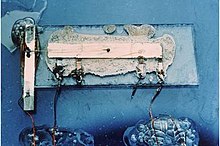
The Integrated Circuit (IC) invented in the late 1950s is one of the greatest inventions of all time. We'll be discussing the impact of ICs on the world in Lecture 2 of the Greatest Innovations of Silicon Valley course John Kelley and I will be teaching this quarter at Stanford University CSP.


Today, all computing devices — from tiny brain implants to giant data centers — use the technology for running a myriad of applications. Nevertheless, according to Gordon Moore, the author of the famous Moore's Law, at the time of the invention it was extremely difficult to envision the future importance of IC. Here's an excerpt from an interview Gordon Moore gave to Michael Wolff in 1976,

Wolff:
You didn't realize at the time how significant this would be?
Moore:
Absolutely not. Even after a family of integrated circuits was introduced, we didn't have the remotest idea that this was truly a major difference in the way electronics was going to be done in the future.

In my view, the moral of the story is, when you've made an invention use your imagination to see how the invention can scale up to revolutionize the world. Several tools would be particular applicable in this situation: the STM operator, 10X diagram, 4Q diagram, a system diagram in combination with the S-curve (to check for Synthesis).

tags: quote, invention, innovation, example, technology, 10X, imagination, creativity

Sunday, June 17, 2012

Saturday, June 02, 2012

Zumable User Interfaces (ZUIs)

The Economist (Jun 2nd 2012. Technology Quarterly Q2, 2012): the prophets of zoom:

Zoomable user interfaces (ZUIs), as they are known, are arriving on the coat-tails of touch-screen gadgets such as the iPhone that have popularised zooming to magnify graphics. With ZUIs (pronounced zoo-ees), information need not be chopped up to fit on uniformly sized slides. Instead, text, images and even video sit on a single, limitless surface and can be viewed at whatever size makes most sense—up close for details, or zoomed out for the big picture.

The system-level transition I was predicting two years ago is beginning to happen.

tags: trend, payload, tool, system, model, example, interface, synthesis

Monday, January 02, 2012

Patent rights: breakthrough vs incremental improvements.

Arguably, Watt's steam engine is one of the greatest inventions of the time. For over a century, from the late 1700s till the early 1900s Watt's condenser-based design dominated power generation in a variety of industries, from mining to transportation to electricity generation. Remarkably, the success of Watt's business venture with Boulton was based entirely on the patent:
The profits for Boulton & Watt resulted from the royalties they charged for the use of their engine. Watt’s invention was protected by the patent for the separate condenser he took in 1769, which an Act of Parliament had prolonged until 1800. The pricing policy of the two partners was to charge an annual premium equal to one-third of the savings of the fuel-costs attained by the Watt engine in comparison to the Newcomen engine. This required a number of quite complicated calculations, amounting at identifying the hypothetical coal consumption of a Newcomen engine supplying the same power of that Watt engine installed in the mine. (Alessandro Nuvolari, 2001. doi: 10.1093/cje/beh011 )
As a matter of fact, the enforcement of an almost absolute control on the evolution of the steam technology during the duration of Watt’s patent was a crucial component of Boulton and Watt’s business strategy.

Despite Watt's crucial contribution to the technology, engineers and entrepreneurs who were constrained by his patent rights resented the legal monopoly. Similarly, the mobile industry today resents Apple's attempts to enforce its iPhone/iPad patents.

Once the inventive breakthrough is accomplished, everybody wants a piece of the action. As the result of massive technical attention and investment, engineers create a multitude of incremental improvements, targeting cost reduction and increases in performance.

tags:  patent, example, invention, business, model, energy

Tuesday, December 27, 2011

Invention of the Day: Charge Coupled Device (CCD)

The 2009 Nobel Prize in Physics was awarded to Willard S. Boyle and George E. Smith "for the invention of an imaging semiconductor circuit – the CCD sensor". [ Today, CCD is the dominant sensor used in digital cameras.]


According to Smith's Nobel Prize lecture, the driving force behind the invention was an inter-departmental competition for resources inside Bell Labs (a purely bureaucratic affair.)

Bill Boyle was Executive Director of the semiconductor part and I was a Department Head under him. Jack Morton was anxious to speed up the development of magnetic bubbles as a major memory technology, and there was talk of transferring resources from Bill’s division to the other where the bubble work was being done. For this not to happen, Morton demanded that Bill’s division come up with a semiconductor device to compete with bubbles. To address this demand, on October 17, 1969, Bill and I got together in his office. In a discussion lasting not much more than an hour, the basic structure of the CCD was sketched out on the blackboard, the principles of operation defined, and some preliminary ideas concerning applications were developed.
Remarkably, ATT didn't benefit commercially from this and many other inventions developed at Bell Labs.

The figure from US Patent 3,792,322 (below) shows an improved version of the sensor: Buried Channel CCD.


Here's how Smith describes the train of thought they used to come up with the invention:

Thursday, December 08, 2011

Invention of the Day: 3D memristor circuit.

Memristor is the fourth fundamental passive electronic circuit element (the other three are resistor, capacitor, and inductor). Memristor "remembers" the amount of current that passed through it. In the video below Stan Williams explains how it works.


An HP patent application (Strukov, Williams, Shteyn WO2011014156) published earlier this year shows a 3D structure that can implement a wide array of electronic applications in a compact form factor.


An integrated sensor-processor

tags: invention, electronics, information, patent, example