tags: startup, stanford, entrepreneurship, innovation, lunchtalk,
Showing posts with label entrepreneurship. Show all posts
Showing posts with label entrepreneurship. Show all posts
Thursday, November 17, 2016
Lunch Talk: Counterintuitive approach to building startups (Stanford University)
This is Lecture 3 from a Stanford University course "How to start a startup". The speaker is Paul Graham; his transcript is here: http://tech.genius.com/Paul-graham-lecture-3-counterintuitive-parts-of-startups-and-how-to-have-ideas-annotated
tags: startup, stanford, entrepreneurship, innovation, lunchtalk,
tags: startup, stanford, entrepreneurship, innovation, lunchtalk,

Monday, January 04, 2016
Lunch Talk: (at Stanford) What they don't teach you about entrepreneurship
Part of 2010 Conference on Entrepreneurship at Stanford Graduate School of Business.
Description: A group of entrepreneurs talk about what they learned in the trenches that they never could have learned in a classroom. The panelists will also share the courses that were most helpful to them in their entrepreneurial ventures, the courses that they wished they had taken, and the topics that business schools should be teaching to aspiring entrepreneurs.
Thursday, July 23, 2015
How marketing affects the brain
I'm taking Dr. Hunt's History of Wine course at Stanford University CSP - a great learning experience. Wine fascinates me not only because (in moderate amounts) it stimulates creative thinking. From an inventor perspective, wine is interesting because it defies the common wisdom "Necessity is the mother of invention." We, humans, invented and perfected an incredible variety of wines and spirits just to make our lives more enjoyable. Arguably, the invention of wine turned enjoyment into a necessity in the modern society. Since enjoyment is a highly subjective matter, wine can serve as our entry point into the world of studying how attitudes affect human perceptions and thinking.
In 2007, a group of scientists from CalTech used wine tasting to study the impact of marketing on people's brains.

It's been widely reported that when subjects know the price of wine they consistently give high ratings to expensive wines. It's also known that in blind trials subjects don't find much difference between expensive and cheap wines. The important questions are, "How does the price information skew our brainwork? Does expensive wine taste better because we anticipate a better tasting experience from an implicit marketing message that a higher price means a higher product quality?" Here's an excerpt from the published paper:

In short, a $90 price tag activated the brain's pleasure center more than a $10 one - an almost 10X impact! Since in both cases researchers used the same wine, areas of the brain responsible for the more basic perceptions, including smell and taste, did not make any difference. The findings of the study was consistent with the placebo effect. External marketing information dominates internal perceptions.
As an exercise in creative thinking, we can try to use these results beyond the realm of wine tasting. For example, how does a perceived value of a startup or its founders affect the valuation in the early stages of financing when no objective data can be found yet? Are hype cycles are endemic in the high-tech industry because there's an inevitable time gap between the real and imaginary results of proposed innovations? Is the Mathew Effect hardwired into human brains?
tags: effect, brain, entrepreneurship, biology, research, science, perception, hype
In 2007, a group of scientists from CalTech used wine tasting to study the impact of marketing on people's brains.

It's been widely reported that when subjects know the price of wine they consistently give high ratings to expensive wines. It's also known that in blind trials subjects don't find much difference between expensive and cheap wines. The important questions are, "How does the price information skew our brainwork? Does expensive wine taste better because we anticipate a better tasting experience from an implicit marketing message that a higher price means a higher product quality?" Here's an excerpt from the published paper:
Because perceptions of quality are known to be positively correlated with price (9), the individual is likely to believe that a more expensive wine will probably taste better. Our hypothesis goes beyond this by stipulating that higher taste expectations would lead to higher activity in the medial orbitofrontal cortex (mOFC), an area of the brain that is widely thought to encode for actual experienced pleasantness (6, 10–16). The results described below are consistent with this hypothesis. We found that the reported price of wines markedly affected reported EP and, more importantly, also modulated the blood-oxygen-level-dependent (BOLD) signal in mOFC.

In short, a $90 price tag activated the brain's pleasure center more than a $10 one - an almost 10X impact! Since in both cases researchers used the same wine, areas of the brain responsible for the more basic perceptions, including smell and taste, did not make any difference. The findings of the study was consistent with the placebo effect. External marketing information dominates internal perceptions.
As an exercise in creative thinking, we can try to use these results beyond the realm of wine tasting. For example, how does a perceived value of a startup or its founders affect the valuation in the early stages of financing when no objective data can be found yet? Are hype cycles are endemic in the high-tech industry because there's an inevitable time gap between the real and imaginary results of proposed innovations? Is the Mathew Effect hardwired into human brains?
tags: effect, brain, entrepreneurship, biology, research, science, perception, hype
Monday, July 20, 2015
Lunch Talk: Sequoia Capital's Doug Leone on Luck & Taking Risks
Sequoia Capital Managing Partner Doug Leone addresses risk taking in his Stanford GSB View From The Top talk on November 4. He also discussed the venture capital industry, what his team looks for in entrepreneurs, and more.
tags: entrepreneurship, vc, risk, management, investment
tags: entrepreneurship, vc, risk, management, investment
Sunday, July 19, 2015
Invention of the Day: Brain Cleanup
New Scientist reports that NeuroPhage Pharmaceuticals (Cambridge, MA) has found a way to cleanup rogue proteins that form in the brain, causing debilitating mental disorders, such as Alzheimer's and Parkinson's diseases:
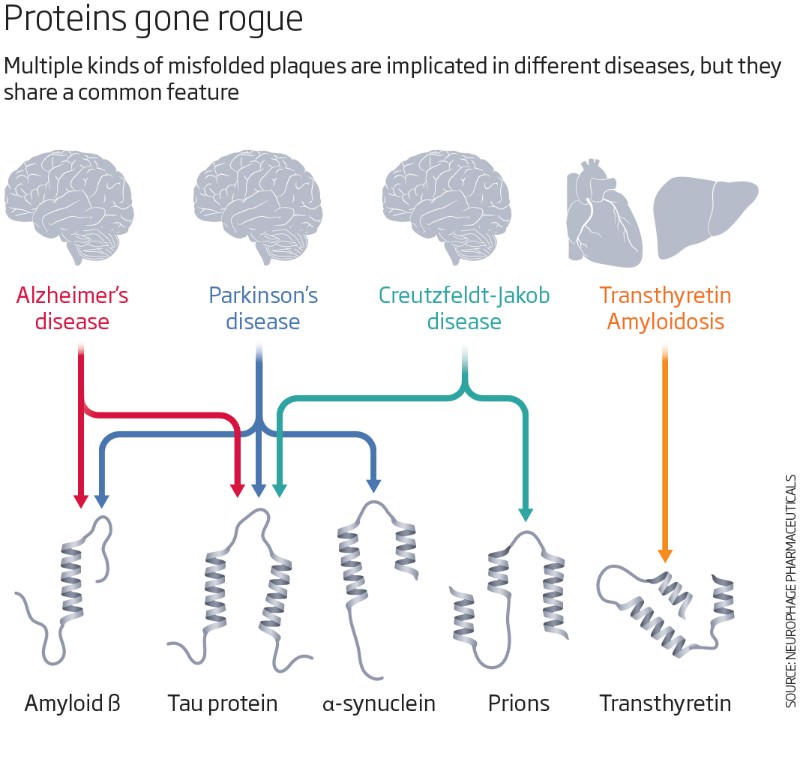
The hope is that the novel drug will destroy the plaques but leave healthy brain cells alive.

NeuroPhage's US patent applications can be found here.
tags: medicine, brain, control, tool, entrepreneurship, biology
The drug is the first that seems to target and destroy the multiple types of plaque implicated in human brain disease. Plaques are clumps of misfolded proteins that gradually accumulate into sticky, brain-clogging gunk that kills neurons and robs people of their memories and other mental faculties. Different kinds of misfolded proteins are implicated in different brain diseases, and some can be seen within the same condition.
The hope is that the novel drug will destroy the plaques but leave healthy brain cells alive.

NeuroPhage's US patent applications can be found here.
tags: medicine, brain, control, tool, entrepreneurship, biology
Sunday, July 12, 2015
Lunch Talk: an interview with Eric Ries of Lean Startup
The interview is a part of the This Week In Startup series (episode 199).
Jason interviewed Eric Ries, entrepreneur and author of The Lean Startup. Eric gave advice for all levels and phases of startups, from idea inception and shortening incubation times to managing the inevitable pivots. Later in the episode, Jason and Eric team up to deliver an 'Old Time Revival,' where audience members bring their business woes to the stage to have them healed by these two experts.
startup, entrepreneurship, lunchtalk
Jason interviewed Eric Ries, entrepreneur and author of The Lean Startup. Eric gave advice for all levels and phases of startups, from idea inception and shortening incubation times to managing the inevitable pivots. Later in the episode, Jason and Eric team up to deliver an 'Old Time Revival,' where audience members bring their business woes to the stage to have them healed by these two experts.
startup, entrepreneurship, lunchtalk
Friday, July 03, 2015
Principles of Invention and Innovation (BUS 74), Session 2, Quiz 1
A 2008 Harvard Business Review article by Noam Wasserman describes a difficult choice that a start-up founder faces when his company begins to grow rapidly:
-------------------------
Since the publication of the artcile, a number of successful technology companies, including Google, Facebook, Twitter, and Uber, managed to break, rather than make the trade-off. That is, the founders have retained a large degree of control while building highly valuable companies.
Question 1: What's common between these companies with regard to the relationship between control and funding? Describe the existing or propose a new breakthrough solution to the founder's trade-off.
Question 2: Provide at least one example where the investors' decision to fire the founder(s)
a) destroyed value of the company;
b) greatly increased value of the company.
tags: innovation, entrepreneurship, vc, trade-off, dilemma, bus74
As start-ups grow, entrepreneurs face a dilemma — one that many aren’t aware of, initially. On the one hand, they have to raise resources in order to capitalize on the opportunities before them. If they choose the right investors, their financial gains will soar. My research shows that a founder who gives up more equity to attract cofounders, non-founding hires, and investors builds a more valuable company than one who parts with less equity. The founder ends up with a more valuable slice, too. On the other hand, in order to attract investors and executives, entrepreneurs have to give up control over most decision making.
This fundamental tension yields “rich” versus “king” trade-offs. The “rich” options enable the company to become more valuable but sideline the founder by taking away the CEO position and control over major decisions. The “king” choices allow the founder to retain control of decision making by staying CEO and maintaining control over the board—but often only by building a less valuable company.

-------------------------
Since the publication of the artcile, a number of successful technology companies, including Google, Facebook, Twitter, and Uber, managed to break, rather than make the trade-off. That is, the founders have retained a large degree of control while building highly valuable companies.
Question 1: What's common between these companies with regard to the relationship between control and funding? Describe the existing or propose a new breakthrough solution to the founder's trade-off.
Question 2: Provide at least one example where the investors' decision to fire the founder(s)
a) destroyed value of the company;
b) greatly increased value of the company.
tags: innovation, entrepreneurship, vc, trade-off, dilemma, bus74
Friday, January 16, 2015
Lunch Talk: Tools for Entrepreneurs - Making Something People Love
Renowned entrepreneur and Reddit cofounder Alexis Ohanian, will inspire you to think of unique ways to connect with your customers, and to build a community of users who want your business to succeed. In this class you'll learn some key branding, marketing, and user experience principles, plus specific tactics and strategies that you can use to create a company people love.
Note emotional vs cognitive appeal of a new product/service in a new market.
tags: lunchtalk, innovation, entrepreneurship, internet, web, creativity, emotion
Note emotional vs cognitive appeal of a new product/service in a new market.
tags: lunchtalk, innovation, entrepreneurship, internet, web, creativity, emotion
Wednesday, December 03, 2014
Lunch Talk: Stanford Entrepreneurship Corner (Ben Horowitz)
Entrepreneur and venture capitalist Ben Horowitz shares which entrepreneurial skills truly matter, and why learning to manage well may be the most critical skill of all. Horowitz, a founding partner of Andreessen Horowitz, discusses the value of learning inside a large company, some of the exciting technology frontiers ahead, and the purpose and philosophy of his firm, in conversation with Stanford Engineering Professor Tom Byers.
Quote: The basis of a good company is to figure out something about the world that nobody else knows, and the secret becomes the company.
http://ecorner.stanford.edu/authorMaterialInfo.html?mid=3425
tags: lunchtalk, entrepreneurship, innovation
Thursday, August 07, 2014
Left Brain, Right Brain - no difference!
In 2013, a group of scientist from the University of Utah decided to test the popular hypothesis that the left hemisphere of the brain is responsible for different cognitive functions than the right hemisphere. "Left-brain" people were supposed to be more logical, while "right-brain" ones more spontaneous.
The scientists ran a number of experiments by analysing their subjects' — 1011 individuals between the ages of 7 and 29 — on various tasks, while observing their brain activity using Magnetic Resonance Imaging (MRI). No significant difference was found.
The study is "old news", so why do I write about it now? Mainly, because I just found the study, but also because I deal with human creativity issues on an everyday basis. To me, there are two important points to that relate to the study:
First, a person's creativity is not confined to a specific portion of the brain. Therefore, conclusions like "I'm a left-brain person and I can't be creative" are wrong. Creativity is about having created something new and useful to other people, rather than pigeonholing yourself into a "creative vs non-creative" categories. In many ways, creativity is a self-fulfilling prophecy.
Second, the study highlights the difference between science and entrepreneurship. Science moves slowly, by creating insights, postulating hypothesis, then testing and re-testing them. Initial scientific results can be invalidated much later, which only adds to the value of science. The brain study from the University of Utah is good science.
On the other hand, entrepreneurship requires us to move fast, act on incomplete or even wrong information, take huge risks, and make outrageous claims in order to gain advantage in the marketplace. For example, Christopher Columbus was not a good scientist because his calculations assumed that the Earth was 3 times smaller than it turned out in reality. Scientists of his time already knew that and were highly skeptical of his idea!
Nevertheless, he was a great entrepreneur because he not only convinced the king of Spain to give hime ships for discovering a new way to Asia, but did succeed in discovering a new continent, although by mistake. Eventually, scientists proved him wrong, but it didn't diminish the value of his accomplishment.
One of the most striking aspects of Silicon Valley's success is its reliance on an entrepreneur's desire to discover a new business "continent", rather than do perfect science. Most remarkable examples would be the Moore's Law, Computer Games, the Web, Social Networking, and the iPhone.
tags: creativity, innovation, science, entrepreneurship,
The scientists ran a number of experiments by analysing their subjects' — 1011 individuals between the ages of 7 and 29 — on various tasks, while observing their brain activity using Magnetic Resonance Imaging (MRI). No significant difference was found.
 |
| Source: DOI: 10.1371/journal.pone.0071275 |
The study is "old news", so why do I write about it now? Mainly, because I just found the study, but also because I deal with human creativity issues on an everyday basis. To me, there are two important points to that relate to the study:
First, a person's creativity is not confined to a specific portion of the brain. Therefore, conclusions like "I'm a left-brain person and I can't be creative" are wrong. Creativity is about having created something new and useful to other people, rather than pigeonholing yourself into a "creative vs non-creative" categories. In many ways, creativity is a self-fulfilling prophecy.
Second, the study highlights the difference between science and entrepreneurship. Science moves slowly, by creating insights, postulating hypothesis, then testing and re-testing them. Initial scientific results can be invalidated much later, which only adds to the value of science. The brain study from the University of Utah is good science.
On the other hand, entrepreneurship requires us to move fast, act on incomplete or even wrong information, take huge risks, and make outrageous claims in order to gain advantage in the marketplace. For example, Christopher Columbus was not a good scientist because his calculations assumed that the Earth was 3 times smaller than it turned out in reality. Scientists of his time already knew that and were highly skeptical of his idea!
Nevertheless, he was a great entrepreneur because he not only convinced the king of Spain to give hime ships for discovering a new way to Asia, but did succeed in discovering a new continent, although by mistake. Eventually, scientists proved him wrong, but it didn't diminish the value of his accomplishment.
One of the most striking aspects of Silicon Valley's success is its reliance on an entrepreneur's desire to discover a new business "continent", rather than do perfect science. Most remarkable examples would be the Moore's Law, Computer Games, the Web, Social Networking, and the iPhone.
tags: creativity, innovation, science, entrepreneurship,
Saturday, July 20, 2013
Entrepreneurship: Singapore vs Silicon Valley
Singapore startups are relatively good on talent and funding, but their output it disproportionately low (data from the Startup Genome Report, Part I. 2012).

Entrepreneurs are much better educated than their Silicon Valley counterparts and they work harder. But I would argue that these advantages fail them because of the wrong market choice: niche vs new.
 Singapore entrepreneurs and VCs seem to be suffering from the "Better Mouse Trap" syndrome, i.e. they focus too much on improving existing products/services instead of creating new markets.
tags: mousetrap, startup, entrepreneurship, source, control

Entrepreneurs are much better educated than their Silicon Valley counterparts and they work harder. But I would argue that these advantages fail them because of the wrong market choice: niche vs new.

tags: mousetrap, startup, entrepreneurship, source, control
Monday, January 28, 2013
Failure rates in startups with funding above $1M
According to the Wall Street Journal (Sept 20, 2012):
tags: business, technology, market, entrepreneurship, startup
...findings are based on data from more than 2,000 companies that received venture funding, generally at least $1 million, from 2004 through 2010.
About three-quarters of venture-backed firms in the U.S. don't return investors' capital, according to recent research by Shikhar Ghosh, a senior lecturer at Harvard Business School.
There are also different definitions of failure. If failure means liquidating all assets, with investors losing all their money, an estimated 30% to 40% of high potential U.S. start-ups fail, he says. If failure is defined as failing to see the projected return on investment—say, a specific revenue growth rate or date to break even on cash flow—then more than 95% of start-ups fail, based on Mr. Ghosh's research.In part, startup incubators allow companies fail fast without getting a lot of VC money.
tags: business, technology, market, entrepreneurship, startup
Subscribe to:
Posts (Atom)