Showing posts with label computing. Show all posts

Wednesday, July 08, 2015

Wires are dead?

Gizmodo reviews the new line of IKEA's wireless chargers:
IKEA’s wireless charging technology is exactly what it sounds like. It’s a feature being built into a small number of furniture items—namely, lamps and nightstands—but also sold independently as charging pads that you can set on top of a surface or install in any piece of furniture. Once the charging pad is plugged in, you just set your phone on top of a rubber “+” sign. And it charges!
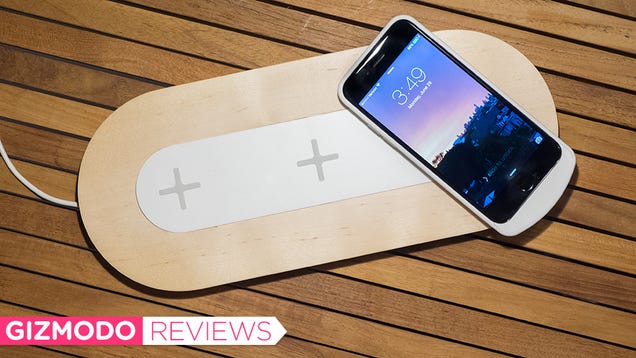

100 years from now you will have your electronic brain implants recharged with a wireless electric pillow while you are sleeping! :)

Speaking of the brain, a group of computer scientists from UCSD and Politechnico di Torino published a paper that describes an implementation of a memory cell-based computing architecture. From the abstract:
Memcomputing is a novel non-Turing paradigm of computation that uses interacting memory cells (memprocessors for short) to store and process information on the same physical platform. It was recently proven mathematically that memcomputing machines have the same computational power of nondeterministic Turing machines. Therefore, they can solve NP-complete problems in polynomial time and, using the appropriate architecture, with resources that only grow polynomially with the input size. The reason for this computational power stems from properties inspired by the brain and shared by any universal memcomputing machine, in particular intrinsic parallelism and information overhead, namely, the capability of compressing information in the collective state of the memprocessor network. We show an experimental demonstration of an actual memcomputing architecture that solves the NP-complete version of the subset sum problem in only one step and is composed of a number of memprocessors that scales linearly with the size of the problem. We have fabricated this architecture using standard microelectronic technology so that it can be easily realized in any laboratory setting.

It's too early to call, but an alternative to the Universal Turing Machine can lead to the creation of novel brain-like applications.

Tuesday, February 26, 2013

No Singularity in sight. Ever.

The debate between proponents and opponents of strong Artificial Intelligence (AI) continues. A biologist specializing in the field calls Kurzweil's bluff:

(MTR 2/18/13) “The brain is not computable and no engineering can reproduce it,” says Nicolelis, author of several pioneering papers on brain-machine interfaces.

[F]uturist Ray Kurzweil, recently hired on at Google as a director of engineering, has been predicting that not only will machine intelligence exceed our own, but people will be able to download their thoughts and memories into computers.

Nicolelis calls that idea sheer bunk. “Downloads will never happen,” he said during remarks made at the annual meeting of the American Association for the Advancement of Science in Boston on Sunday. “There are a lot of people selling the idea that you can mimic the brain with a computer.”

Nicolelis thinks in the future humans with brain implants might be able to sense x-rays, operate distant machines, or navigate in virtual space with their thoughts, since the brain will accommodate foreign objects including computers as part of itself.

Recently, Nicolelis’s Duke lab has been looking to put an exclamation point on these ideas. In one recent experiment, they used a brain implant so that a monkey could control a full-body computer avatar, explore a virtual world, and even physically sense it.
 tags: control, brain, interface, computing, intelligence

Sunday, August 12, 2012

Lunch Talk: Steve Jobs' presentation in 1980.

This video was gifted to Computer History Museum by Regis McKenna and can be found on their online exhibit about Steve Jobs here: http://www.computerhistory.org/highlights/stevejobs/


tags: lunchtalk, computing, history, apple

Monday, February 13, 2012

Quote of the Day: Turing Machine.

It was also disappointing that when in January 1937 Computable Numbers at last appeared in print, there was so little reaction. Church reviewed it for the Journal of Symbolic Logic and thereby put the words "Turing machine" into published form. But only two people asked for offprints.   -- Alan Turing: The Enigma, by Andrew Hodges.
As we can see, one of the major discoveries of the 20th century that set up the computing revolution went largely unnoticed not only for the general public, but for professional mathematicians as well.

tags: detection, creativity, computing, quote

Tuesday, February 07, 2012

Smartphones reincarnated.

Mass production of smartphone components creates opportunities for new embedded applications based on smartphone software and hardware. For example, Romo the robot.
Feb 4, 2012. CNet -- They wanted to build a robot that, like any software-based product, could be tweaked and changed over time. Their robot needed to evolve.
The problem was cost. Nguyen, who is 25, came up with the idea of tying it all to a smartphone in order to take advantage of the powerful processor already built into the phone. This way, the most expensive part of building a robot from scratch would, in effect, be taken care of by Apple or other smartphone makers

Now we know that in the future old phones will be reincarnated as robots or some other type of computing interface for various appliances.
The PC revolution created huge opportunities for embedded computing: from dental office equipment to PC-based supermarket checkout stands to blade servers that run on Intel processors. In a similar fashion, the smartphone revolution will power new connected appliances.

tags: computing, mobile, innovation, s-curve, 4q diagram


Wednesday, November 02, 2011

Genetic sequencing: from $3B to $1K in 12 years

The cost of human genome sequencing is dropping incredibly fast. Jonathan Rothberg, CEO of Ion Torrent, claims that in a year, using their Personal Genome Machine, doctors will be able to do the job for $1,000. The new technology will allow, among other things, for efficient analysis of cancer cell mutations and development personalized drug therapies similar to the ones used to prolong Steve Jobs' life (According to Isaacson's book, Jobs' treatments cost $100K per pop.)
The key to this breakthrough, says Rothberg, is that the PGM does not rely on conventional wet chemistry to sequence DNA. Instead, it works almost entirely through conventional microchip technology, which means Ion Torrent is leveraging decades of investment in conventional transistors and chips. (click to watch a 24min video of Rothberg's talk at MIT.)
Here's a cost curve for human DNA sequencing over time. The breakthrough happened around 2007.


Source:  the National Human Genome Research Institute (NHGRI).

tags: 10x, health, biology, computing, breakthrough

Monday, September 19, 2011

Internet weather forecast: cloudy, with lots of smartphones.

Transition to Internet cloud is becoming unstoppable. One of the strongest indications of impending massive growth is concerted industry efforts to standardize a new technology. By standardizing, market players try to turn a unique technical solution into a commodity so that they can ship boatloads of cheap substitutes as well as complimentary products.

Today, the Open Virtualization Alliance, a standards consortium of companies focused on server-side virtualization, announced new membership numbers - 200 from 65 three month ago. According to CNet, the key issues they are trying to address:
  • Economics--VMware [the dominant virtualization vendor] currently controls pricing. Having a credible choice gives customers an ability to negotiate with their vendors. An open alternative gives more leverage.
    •  ...They [VMWare] are also seeing customers moving from testing private clouds to starting to deploy automated, standardized infrastructure at scale.

Even if the consortium does not succeed for a while - standards always take time - the standardization effort itself shows that:
a) the technology works and many people know how to produce it;
b) the technology scales, i.e. it can be deployed in a large number of instances;
c) the need to scale the technology is real.

In addition to that, Microsoft announced that Windows 8, its next generation OS will be more virtualization friendly than Windows 7, and [separately] the company is in discussions with Comcast and Verizon to enable video streaming to XBox. Again, the intent is to make the cloud cheap and scalable.

tags: cloud, system, s-curve, infrastructure, information, computing, 10X, growth, source, microsoft, internet