Wednesday, April 23, 2008

"Neuroeconomics: cross-currents in research on decision-making" Trends in Cognitive Sciences, Volume 10, Issue 3, March 2006, Pages 108-116
Alan G. Sanfey, George Loewenstein, Samuel M. McClure, Jonathan D. Cohen

psychologists make between automatic and controlled processes. Automatic processes are fast and efficient, can often be carried out in parallel, but are highly specialized for domain-specific operations and therefore relatively inflexible. They are thought to reflect the operation of highly over-trained (and, in some cases, possibly ‘hardwired’) mechanisms. However, humans also have a capability for controlled processing underlying our higher cognitive faculties. Controlled processes are highly flexible, and thus able to support a wide variety of goals, but are relatively slow to engage and rely on limited capacity mechanisms – that is, they can support only a small number of pursuits at a time.


Creative thinking and problem solving when they lie outside of domain-specific expertise is a slow process. As G.Altshuller used to say, "Good thinking is slow thinking." This may also relate to the social facilitation effect studied extensively by Robert Zajonc.

From this perspective, effective brainstorm is an information exchange exercise rather than a problem solving session.

Tuesday, April 22, 2008

BBC Science story: Dull jobs really do numb the mind

Boring jobs turn our mind to autopilot, say scientists - and it means we can seriously mess up some simple tasks.

Monotonous duties switch our brain to "rest mode", whether we like it or not, the researchers report in Proceedings of National Academy of Sciences.

They found mistakes can be predicted up to 30 seconds before we make them, by patterns in our brain activity.

The team hopes to design an early-warning brain monitor for pilots and others in "critical situations".


This seems to be a localized version of the Einstellung effect. It affects people as well as organizations as a whole.

It's quite possible that art is a way to overcome the problem on the "culture" level. Similar to the way junk food parasitizes on our evolution-induced taste for fat and sugar, TV shows ride our need to un-dull ourselves from monotonous environment.

Saturday, April 19, 2008

A simple solution to a difficult problem - chores and walks!

One 20-minute session of housework or walking reduced the risk of depression by up to 20 per cent. A sporting session worked better, reducing risk by a third or more. Failing housework or sport, says Hamer, try to find something physical to do. "Something - even for just 20 minutes a week - is better than nothing."

Tuesday, April 08, 2008

An internet platform with hooks attached

Google has announced its Google App Engine.

TechCrunch notices that:
Unlike Amazon Web Services’ loosely coupled architecture, which consists of several essentially independent services that can optionally be tied together by developers, Google’s architecture is more unified but less flexible. For example, it is possible with Amazon to use their storage service S3 independently of any other services, while with Google using their BigTable service will require writing and deploying a Python script to their app servers, one that creates a web-accessible interface to BigTable.

What this all means: Google App Engine is designed for developers who want to run their entire application stack, soup to nuts, on Google resources. Amazon, by contrast, offers more of an a la carte offering with which developers can pick and choose what resources they want to use.


This is the type of customer lock-in ( control point) that Google lacks in the search space. Strategically, very similar to what Salesforce.com is doing with its Force.com .

It appears that server-side business models, which originated in the Open Source revolution, are going to dominate computing during the next decade.

Google now has a shot at dominating two key application+service platforms: mobile( Android) and web utility ( App Engine).

Monday, April 07, 2008

I just realized that in 3+ years of teaching Principles of Invention and 10+ years of running invention workshops at major global companies I never had a black student or participant. Not even once. This is truly amazing. I wonder what national invention/patent statistics say about race.
A beautiful little story from Turin via London:

In a bid to keep its municipal lawns trim while saving money, the city of Turin has done away with lawn mowers and brought in 700 sheep to graze in two parks.


Sheep rentals in major US suburban areas, anyone?
Reorg at Adobe:

Adobe Systems, maker of Photoshop and Acrobat software, is folding the company's mobile group into its platform operations as a way to create one platform for computers, handsets, and other consumer devices.


Another piece of evidence that PC is losing ground as a de facto platform for consumer applications. Server-based business models become dominant, pushing software makers to rethink their strategies.

Sunday, April 06, 2008

Surprisingly accurate predictions from 1968:

Computers also handle travel reservations, relay telephone messages, keep track of birthdays and anniversaries, compute taxes and even figure the monthly bills for electricity, water, telephone and other utilities. Not every family has its private computer. Many families reserve time on a city or regional computer to serve their needs. The machine tallies up its own services and submits a bill, just as it does with other utilities.

Money has all but disappeared. Employers deposit salary checks directly into their employees’ accounts. Credit cards are used for paying all bills. Each time you buy something, the card’s number is fed into the store’s computer station. A master computer then deducts the charge from your bank balance.

Computers not only keep track of money, they make spending it easier. TV-telephone shopping is common. To shop, you simply press the numbered code of a giant shopping center. You press another combination to zero in on the department and the merchandise in which you are interested. When you see what you want, you press a number that signifies “buy,” and the household computer takes over, places the order, notifies the store of the home address and subtracts the purchase price from your bank balance. Much of the family shopping is done this way. Instead of being jostled by crowds, shoppers electronically browse through the merchandise of any number of stores.


This is very close to utility computing of today. On the other hand, predicting physical infrastructure proved to be much more difficult:

IT’S 8 a.m., Tuesday, Nov. 18, 2008, and you are headed for a business appointment 300 mi. away....

The car accelerates to 150 mph in the city’s suburbs, then hits 250 mph in less built-up areas, gliding over the smooth plastic road. You whizz past a string of cities, many of them covered by the new domes that keep them evenly climatized year round. Traffic is heavy, typically, but there’s no need to worry. The traffic computer, which feeds and receives signals to and from all cars in transit between cities, keeps vehicles at least 50 yds. apart.


Somewhat predictably, descriptions of "final needs", like business travel, shopping, and etc. are very well understood. The difficulties arise when people try to forecast change in the often "invisible" infrastructure: roads, networks, transportation devices. The bigger the system, the greater the discrepancy. The same pattern shows up in people's inventive thinking. They tend to focus their effort on "tools", i.e. elements and applications that fulfill a well understood function, and forget about the "distribution", i.e. infrastructure that enables scalable growth.

I wonder if this another case of the availability heuristics bias.

Friday, March 28, 2008

The march to add spy drones to local law enforcement arsenal continues:

A small pilotless vehicle manufactured by Honeywell International, capable of hovering and "staring" using electro-optic or infrared sensors, is expected to be introduced soon in the skies over the Florida Everglades.

If use of the drone wins U.S. Federal Aviation Administration approval after tests, the Miami-Dade Police Department will start flying the 14 pound, or 6.35 kilogram, drone over urban areas with an eye toward full-fledged employment in crime fighting.

"Our intentions are to use it only in tactical situations as an extra set of eyes," said Detective Juan Villalba, a police department spokesman.

He acknowledged strong interest from law enforcement agencies in getting drones up and running, however, and said the smaller aircraft were particularly likely to have a "huge economic impact" over the next 10 years.

Tuesday, March 25, 2008

Strategy as a set of trade-offs

Defining the objective, scope, and advantage requires trade-offs, which Porter identified as fundamental to strategy. If a firm chooses to pursue growth or size, it must accept that profitability will take a back seat. If it chooses to serve institutional clients, it may ignore retail customers. If the value proposition is lower prices, the company will not be able to compete on, for example, fashion or fit. Finally, if the advantage comes from scale economies, the firm will not be able to accommodate idiosyncratic customer needs. Such trade-offs are what distinguish individual companies strategically.
Harvard Business Review, April 2008, p. 85.


Invention of a new business model usually breaks through an "unavoidable" trade-off. For example, Google and Amazon.com found ways to get around the scale vs. customization trade-off. Hotel chains solved institutional vs retail, and etc. Companies that define themselves as a trade-off maintainer are prone to disruptions from their more innovative peers.

Thursday, March 20, 2008

Scientific American proposes a grand scheme for solar power:
Solar energy’s potential is off the chart. The energy in sunlight striking the earth for 40 minutes is equivalent to global energy consumption for a year. The U.S. is lucky to be endowed with a vast resource; at least 250,000 square miles of land in the Southwest alone are suitable for constructing solar power plants, and that land receives more than 4,500 quadrillion British thermal units (Btu) of solar radiation a year. Converting only 2.5 percent of that radiation into electricity would match the nation’s total energy consumption in 2006.

To convert the country to solar power, huge tracts of land would have to be covered with photovoltaic panels and solar heating troughs. A direct-current (DC) transmission backbone would also have to be erected to send that energy efficiently across the nation.

The technology is ready. On the following pages we present a grand plan that could provide 69 percent of the U.S.’s electricity and 35 percent of its total energy (which includes transportation) with solar power by 2050. We project that this energy could be sold to consumers at rates equivalent to today’s rates for conventional power sources, about five cents per kilowatt-hour (kWh). If wind, biomass and geothermal sources were also developed, renewable energy could provide 100 percent of the nation’s electricity and 90 percent of its energy by 2100.


While British researchers see environmental dangers everywhere, except in massive installations of solar panels:
the great environmental concerns of the future should be nanomaterials, manmade viruses and biomimetic robots.

So say researchers, policymakers and environmental campaigners, who have identified 25 potential future threats to the environment in the UK, which they say researchers should focus on.

In addition to well-publicised risks such as toxic nanomaterials, the acidification of the ocean and increasingly frequent extreme weather events, the list includes some more outlandish possibilities. These include:

• Biomimetic robots that could become new invasive species.

• Experiments involving climate engineering, for instance ocean 'fertilisation' and deploying solar shields

• Increased demand for the biomass needed to make biofuel.

• Disruption to marine ecosystems caused by offshore power generation.

• Experiments to control invasive species using genetically engineered viruses.
Paul Lockhart writes:

The main problem with school mathematics is that there are no problems. Oh, I know what
passes for problems in math classes, these insipid “exercises.” “Here is a type of problem. Here is how to solve it. Yes it will be on the test. Do exercises 1-35 odd for homework.” What a sad way to learn mathematics: to be a trained chimpanzee.


This is a big problem with education in general. Students are not taught to look for cool open-ended problems. Inventiveness and creativity are presented as simple puzzle-solving exercise, where answers are known before hand and are really easy to test against.

Wednesday, March 12, 2008

Dilemma of the Day

Economist Paul Romer:


So with ideas, you have this tension: You want high prices to motivate discovery, but you want low prices to achieve efficient widespread use.

Wednesday, February 20, 2008

Trade-off of the Day

These strategies reflect an underlying tension when the forces of innovation meet up with network externalities: is it better to wipe the slate clean and come up with the best product possible ( revolution) or to give up some performance to ensure compatibility and thus ease consumer adoption (evolution)?


You can increase performance at the cost of increasing customer switching costs, or vice-versa. Ideally, you would like to have an improved product that is also compatible with the installed base, but technology is usually not so forgiving, and adapters and emulators are notoriously buggy. You will inevitably face the trade-off.

Shapiro, C. and Varian H.R. 1998. Information Rules. Boston: HBSP. p. 191

Monday, February 18, 2008

Trade-off of the Day


"When choosing terms and conditions, recognize the basic trade-off: more liberal terms and conditions will tend to raise the value of your product to consumers but may reduce the number of units sold."

Shapiro, C. and Varian H.R. 1998. Information Rules. Boston: HBSP. p. 103.

Saturday, February 09, 2008

A Bloomberg article about possible Microsoft Yahoo merger:
The New York Times reported Feb. 4 that Google CEO Eric Schmidt contacted Yang to suggest a partnership between their companies. A partnership with Google may allow Yahoo to outsource its search service, shedding the costs of running its own search engine and sharing ad revenue with its larger rival.


What a way for Google to get rid of all competition in the search technology! A very smart move because it could potentially deny Microsoft access to a high quality search engine. If that happens the Yahoo acquisition does not make sense for Microsoft at all.
A CNN article about Osprey, a plane-helicopter hybrid:
The Osprey, which takes off and lands like a helicopter but flies like a plane, was designed to replace the Corps' aging and less-capable helicopter fleet.

The military, which has ordered 360 of the aircraft, said the 10 deployed to Iraq are doing what they are supposed to do -- carrying troops faster, farther and safer than the copters can.

In December, commanders gave the planes a more risky mission called "aero-scout" in which a group of V-22s flies into a relatively unsecured location and drops off Marines for a search mission.

The Osprey seems to have become a favorite of commanders who need to get to places quickly, including Gen. David Petraeus, the top U.S. military commander in Iraq. Petraeus used one to fly around the country on Christmas Day to visit troops.

"Gen. Petraeus flew in the jump seat and was very impressed by the aircraft's capabilities," according to Col. Steve Boylan, a spokesman for the general.

"The rate of climb is exceptional, and it can fly about twice as fast as a Black Hawk [helicopter], without needing to refuel as frequently," Boylan said. "Beyond that, its automatic-hover capability for use in landing in very dusty conditions, even at night, is tremendous."

Petraeus chose the Osprey for that mission because it was the only aircraft in the inventory that could fly around the country without refueling and not rely on runways, Boylan said.


Another indicator that helicopters are going to yield the scene to other flying apparatuses, like ospreys and drones.

Friday, January 25, 2008

The "Aha!" moment.

Scientific American:
At the end of each trial, subjects reported whether or not they had a strong "Aha!" moment. Interestingly, researchers found that subjects who were aware that they had found a new way to tackle the problem (and so, had consciously restructured their thinking) were less likely to feel as if they'd had eureka moment compared to more clueless candidates.


People who are better aware of their problem-solving strategies are less likely to experience surprise at the moment of discovery. I've seen it over and over again in invention workshops. Clueless people have a lot of "wonderful discoveries" during brainstorming sessions, but the end result often is not that interesting.

Sunday, December 30, 2007

12/29/07 many news agencies picked up analysis provided by research firm Basex, which chose "information overload" as its 2008 "Problem of the Year."

Many Americans share this concern. In a 2007 Pew survey, 49 percent of Americans described themselves as having "few tech assets" and said that constant connectivity was an annoyance, not a liberation.

But young people don't seem to have (yet, anyway) developed the same sense of aggravation toward technology that forces them to multitask. Many choose to do so, in fact. The Kaiser Family Foundation found in a study this year that most junior high and high school students train themselves early in the dark arts of multitasking, with most listening to music or watching TV while they read books or surf the Internet. 30 percent of students even multitask while doing their homework.

Will these students feel the multitasking pinch when they grow up to become the new generation of "knowledge workers," or will constant exposure to interruptions make them more adept at handling the massive torrent of information that flows through modern computers and cell phones? Or is the "do more things at once philosophy" simply a dead end that produces only monstrosities, like the Internet-connected refrigerator we've heard so much about?


We should probably add to it calorie-, TV-, guns-, and other overloads that we've been suffering for years now. Though, I am yet to hear anything about vacation overload :)

Friday, December 28, 2007

12/27/07 News Agencies
Beijingers were warned to stay indoors on Thursday as pollution levels across the capital hit the top of the scale, despite repeated assurances by the government that air quality was improving.

"This is as bad as it can get," a spokeswoman for the Beijing Environmental Protection Bureau told AFP.

"Level five is the worst level of air pollution. This is as bad as it has been all year."

According to the bureau's website, 15 out of the 16 pollution monitoring stations in urban Beijing registered a "five" for air quality rating.

The main pollutant was suspended particulate matter, which is usually attributed to coal burning and automotive exhaust.


Chinese cities are reaching growth limits.
12/28/27 Reuters:

Warren Buffett's Berkshire Hathaway Inc (BRKa.N) (BRKb.N) is starting a bond insurer that would help state and local governments lower their borrowing costs, and is likely to lure business from established rivals struggling with credit market turmoil.

Buffett, often called the world's greatest investor, is known for taking large business and investment risks.

He has said, for example, that Berkshire is willing to suffer a $6 billion insurance loss on a single storm. The company was able to boost premiums following Hurricane Katrina after weaker rivals reduced underwriting risk.


Buffet's risk profile fits the one of a risk-taker, while in reality his larger-than-life bets decrease risks because they enable him to shape the situation. He always buys control, not risk. He times his purchases so that his ability to control the developments in the industry is at a maximum. For example, now everybody is out of cash and he can come in and define his new rules for the game.
Kinsey Steven G., Bailey Michael T., Sheridan John F., Padgett David A., The Inflammatory Response to Social Defeat is Increased in Older Mice, Physiology & Behavior (2007), doi: 10.1016/j.physbeh.2007.11.003
As seen previously in young adult mice, social defeat caused an increase in anxiety-like behavior in the open field test, but had no effect on learned helplessness in the forced swim test. These data indicated that repeated social defeat results in a proinflammatory state that is exacerbated in older mice. The implications of these data are noteworthy, given the strong role of inflammation in many age-related diseases.


These findings relate to the problem we considered during the Summer 2006 Principles of Invention course: physical injures cause older people disproportionate amount of suffering, and often are a precursor to a downward health spiral.
12/28/07 By JEANNINE AVERSA, AP Economics writes:
New-home sales tumbled 9 percent in November from October to a seasonally adjusted annual sales pace of 647,000, the Commerce Department reported Friday. That was the worst sales pace since April 1995.

"It was ugly," declared Richard Yamarone, economist at Argus Research. "It is the one sector of the economy that doesn't show any signs of life. It doesn't look like there is any resuscitation in store for housing over the next year," he said.

The housing picture turned out to be more grim than most anticipated. Many economists were predicting sales to decline by 1.8 percent to a pace of 715,000.

By region, sales fell in all parts of the country, except for the West.

In the Midwest, new-home sales plunged 27.6 percent in November from October. Sales dropped 19.3 percent in the Northeast and fell 6.4 percent in the South. In the West, however, sales rose 4 percent.

Over the last 12 months, new-home sales nationwide have tumbled by 34.4 percent, the biggest annual slide since early 1991, and stark evidence of the painful collapse in the once high-flying housing market.

"I think you can classify what we are seeing in the housing market as a crash," said Mark Zandi, chief economist at Moody's Economy.com. "Sales and home prices are in a free fall. The downturn is intensifying."


A very interesting trend. People will be spending less money on housing and loan servicing, and probably more on staples, entertainment, and communications.

Monday, December 10, 2007


Seth Godin talks about his newest book "All Marketers are Liars".

02:50 into the video he says: "Technology gives you a shot at marketing".

This is control point of the first kind: "remarkable product", i.e. something that gets you a foot in the market's door. Two more control points to go: ... still need to find good words to describe them.

Saturday, December 08, 2007

Why do some theaters innovate more than others?

An Empirical Study. Paul Dimaggio and Kristen Stenberg. Poetics, Volume 14, Issues 1-2, April 1985, Pages 107-122.

Abstract

The authors develop a measure of the ‘innovativeness’ of the repertoires of U.S. resident nonprofit theatres and test hypotheses about the relationship between environmental and organizational factors and innovation. Access to potential patrons rich in cultural capital appears to make theatre repertoires more innovate, while dependence upon the market (as opposed to grants and contributions) is associated with greater conformity of repertoire. Theatres with smaller budgets to maintain, fewer seats to fill, and less need for earned income are less conformist in their programming than are large theatres with capacious houses and high rates of earned income. Holding size and dependence on earned income constant, there is no evidence that age, structural differentiation, or the presence of subscription audiences—all associated with ‘institutionalization’ – have either a negative or a positive impact on innovation. New York theatres innovate more, and are less negatively affected by growth and the market, than theatres elsewhere in the U.S. It is suggested that artistic innovation has come to depend overwhelmingly on the behavior of formal organizations and that, consequently, we must understand the principles that govern the relationship of such organizations to their economic and social environments in order to understand artistic change.


Market breeds conformity. Very similar to ideas expressed in Christensen's "Innovator's Dilemma": one one hand you have to listen to your customers, because they pay your money; on the other hand you don't want to listen to them, because they do not know what they are going to need tomorrow.
That which is hateful to you, do not do to your fellow; this, in a few words, is the entire Torah; all the rest is but an elaboration of this one, central point. - Rabbi Hillel, 1st Cent, BCE.

quoted from The Happiness Hypothesis, by Jonathan Haidt, p. 45, NY. 2006

The question of technology

Prof. Hubert L.Dreyfus writes

How can we relate ourselves to technology in a way that not only resists its devastation but also gives it a positive role in our lives? This is an extremely difficult question to which no one has yet given an adequate response, but it is perhaps the question for our generation.


I think I am getting close to answering this question. The key is to consider various aspects of the innovation process and determine pathways through which we become devastated or enslaved by technology.

We start by thinking about technology as an evolving system of interacting elements. The devastation occurs when on a certain step of the system evolution we, without realizing the consequences, become objects of control rather its subjects.

Consider iPod.
When we buy one in a store on or on the internet, we acquire not just the device itself, but also cables, iTunes software, automatic connections to iTunes internet service, and, finally, a certain way to interface with media devices. We say we by an iPod, but in reality, we pay for one thing, specifically a piece of hardware, but acquire a whole system of elements and relationships that has products, services, and processes built into it.
The enslavement begins in this cognitive gap between "pay money for" and "acquire" which we tend to hide from ourselves by using just one word "buy".
In order to enjoy our purchase, we have to plug ourselves into a technology, which is being continuously developed by Apple corporation. In other words, we become a part of Apple technology - a living, breathing, consuming, paying part, capable of acquiring further products, services, processes, and, ultimately, led to the next Apple technology.

References.
1. Reinventing the Wheel: A Buddhist Response to the Information Age", by Peter D. Hershock.
2. H.L.Dreyfus (above)
3. Faïz Gallouj, 2002, Innovation in services and the attendant old and new myths. Journal of Socio-Economics, Volume 31, Issue 2, 2002, Pages 137-154.
4. Jeffrey A. Martin and Kathleen M. Eisenhardt, 2004, COPING WITH DECLINE IN DYNAMIC MARKETS: CORPORATE ENTREPRENEURSHIP AND THE RECOMBINATIVE ORGANIZATIONAL FORM. Advances in Strategic Management, Volume 21, 2004, Pages 357-382
5. Jonathan D. Lintona, and Steven T. Walsh, 2007, A theory of innovation for process-based innovations such as nanotechnology, Technological Forecasting and Social Change ( Article in press).

Friday, December 07, 2007

Voter fraud detection in Russian elections

gaika on slashdot writes
"A graph in the best traditions of Edward Tufte shows how the voting was rigged in Russian parliament elections. Initially some regions were showing higher than 100% attendance, but later on everything was corrected, or way too much corrected, as the correlation between winning party's vote and attendance now stands at 90%. I guess the people who have rigged the vote have never heard about Correlation Cofficient."

Putin's Party Share and Invalid Ballots vs Turnout (Relative %)


A fraud detection problem has been solved. There's a strong indication that election laws were broken. The Systematic Innovation theory predicts that within an unconstrained system the next step would be activation of the "control" element, capable of addressing the abnormality. For example, in a country with independent press and/or judiciary an investigation and, possibly, a lawsuit would follow.

Now, I wonder what is going to happen with this discovery in Putin's Russia. In my opinion, there are several ways the situation can unfold:

1. Nothing happens. The government and the press ignores this information.
2. Strong negative reaction. The findings are suppressed and steps are taken to discredit the authors of the study.
3. A weak positive reaction. An independent investigation is initiated and it produces a credible explanation of the events.
4. A strong positive reaction. A government investigation is launched and it produces a credible explanation of the events.
4a. same as 4, but the government doesn't find anything suspicious.

Depending on the outcome, we'll be able to see which "control" mechanisms are the strongest, and which ones are entirely missing.

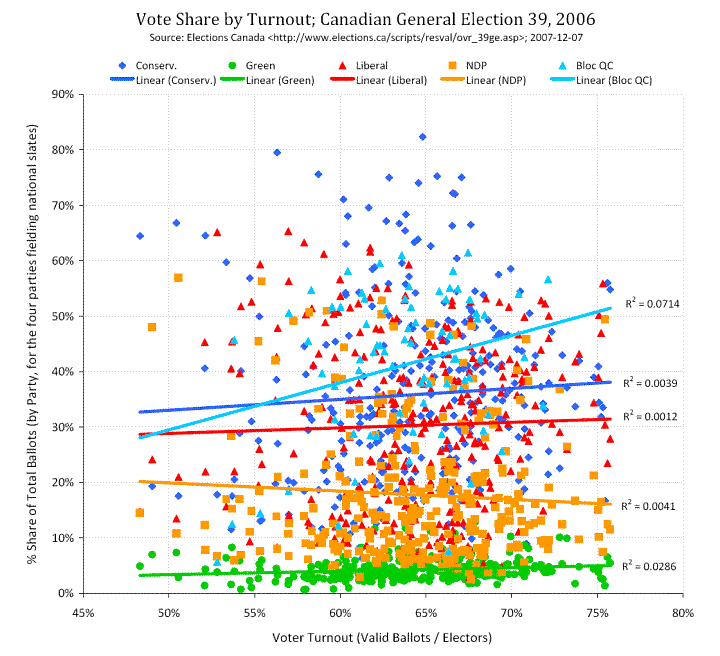
For comparison: Voting results in Canada.

Macrovision continues moving into meta-data


Macrovision, which makes technology that protects videos and music against illegal copying, said on Friday it agreed to buy Gemstar-TV Guide in a cash-and-stock deal worth about $2.8 billion.
Macrovision is betting that a combination of its security software with Gemstar's interactive program guide, technology used by cable and satellite television companies, will allow protected TV shows, films, personal photos, or music to be available on numerous devices beyond the television.

Gemstar-TV Guide shareholders will get $6.35 per share in cash or 0.2548 of a share of common stock in a new holding company that will own both Gemstar-TV Guide and Macrovision.


Macrovision is trying to jump to a different S-curve. The industry transition to digital video formats makes their analog content security system obsolete. The gravy train they were riding all these years is about to run out of space.
They recently bought another meta-data supplier - AMG(?).
Google's acquisition list keeps growing, and growing, and growing...

http://en.wikipedia.org/wiki/List_of_Google_acquisitions

Over the last three years there were no major innovation from Google's internal development team. All this despite their reputation for being the best and brightest.

Tuesday, December 04, 2007

Absolutely no bubble in technology

A new concept from Philips Design
http://www.design.philips.com/probes/projects/tattoo/index.page

The Electronics Tattoo film expresses the visual power of sensitive technology applied to the human body. The film subtly leads the viewer through the simultaneous emotional and aesthetic transformations between two lovers.

via http://centralasian.vox.com


This effect would look really cool in movies, stills, and live picture frames.

Predictions for 2008: A massive data meltdown

http://www.news.com/8301-10784_3-9828570-7.html?tag=nefd.top
"You'll see a massive failure in a year," Bapat said at a dinner with reporters on Monday. "We are going to see a data center failure of that scale."

"That scale" referred to the problems caused by the worm created by Cornell grad student Robert Morris Jr. in 1988. His worm infected about 5 percent of the Unix boxes on the Internet, freaked people out, and helped jump-start the security industry.


On a more cheery note, Bapat and other Sun executives said that the IT industry is also on the verge of a construction boom that, if it happens, will lead to big orders for equipment for makers of servers, storage systems, and other data center equipment.

The typical life span of a data center is only about 10 to 12 years, said the Sun executives. Thus, a lot of those data centers built at the beginning of the dot-com era need to be rebuilt. Other companies like Facebook are expanding rapidly as well. (Sun CTO Greg Papadopoulos mentioned Facebook several times, so it sounds like maybe Sun is working with, or trying to work with, them. Just a thought.)

National labs and universities are also looking at new centers. Next year, one of the national labs has plans to build a data center that will take up 500,000 square feet and consume 50 megawatts. (Big data centers now take up 400,000 square feet and chew up 40 megawatts, Sun executives said.)


Looks like a great opportunity to inject new technologies and/or capture market share from the existing players.

Another angle: solar power. Some of those data centers will be equipped with autonomous power units. http://money.cnn.com/2007/10/03/technology/solar_servers.biz2/

Tuesday, November 20, 2007

Will drones kill helicopters?

September 10, 2007 8:20 AM PDT
http://www.news.com/2300-11397_3-6207078-1.html
On September 7, NASA launched the Ikhana unmanned aerial vehicle (UAV) from Dryden Air Force Base to take a series of smoke-free images from the Lick wildfire near Gilroy, Calif. After sending images of the Lick fire, the drone was flown over Oregon and Washington to observe 10 other fires before returning after a 20-hour mission.

Ikhana, the Choctaw Nation word for "intelligent," is a Predator B unmanned aircraft system which has been refit with scientific instruments. It is being flown out of NASA's Dryden Flight Research Center, Edwards, Calif.


Drones have been extensively tested in various military applications. Now they are finding their way into multiple civilian usage scenarios. My prediction is that they will replace helicopters as high resolution air vehicles: from traffic monitoring to neighborhood policing to forest fired detection to geological research.

Sunday, November 04, 2007

Another sign that PC is losing its relevance:

Sunday November 4, 3:23 pm ET
By Hiroko Tabuchi, Associated Press Writer
TOKYO (AP) -- Masaya Igarashi wants $200 headphones for his new iPod Touch, and he's torn between Nintendo Co.'s Wii and Sony's PlayStation 3 game consoles. When he has saved up again, he plans to splurge on a digital camera or flat-screen TV.

There's one conspicuous omission from the college student's shopping list: a new computer.

The PC's role in Japanese homes is diminishing, as its once-awesome monopoly on processing power is encroached by gadgets such as smart phones that act like pocket-size computers, advanced Internet-connected game consoles, and digital video recorders with terabytes of memory.

"A new PC just isn't high on my priority list right now," said Igarashi, who was shopping at a Bic Camera electronics shop in central Tokyo and said his three-year-old desktop was "good for now."


Smart phones and gaming machines seem to be the next area of growth. The only constraint remaining is service providers desire to restrict access to third party software. Nevertheless, I think in 2008 we'll see major shifts in the industry.

Thursday, October 25, 2007

WSJ writes:
Microsoft Corp.'s $240 million investment in Facebook Inc. -- a three-year-old company with more promise than profit -- represents a huge bet that the online advertising boom will continue and the popular social networking site will be among the biggest beneficiaries.
[Faceoff]

The software giant said yesterday that it will buy a 1.6% stake in Facebook, beating out Google Inc. after intense lobbying. The deal places a $15 billion valuation on the closely held Palo Alto, Calif., start-up. Facebook, which runs a site where people set up personal Web pages, expects to break even this year, on a cash-flow basis, with revenue of $150 million, according to people familiar with the company.


Facebook and Google move further into the competition for controlling the social graph. Microsoft's money give Facebook a little bit of a breathing room to improve their technology.
Also, it reminds me the early days of Internet Search engines when banner ads were all the rage. This is another sign that there's no new social networking business model yet. Good :)

From a system evolution perspective, the synthesis stage in social networking is over. Time to invest in performance improvement and discovery of a new business model. Remarkably, Google has not come up with anything new since search relevant ads.

Tuesday, October 23, 2007

Steve Balmer at CTIA show ( on mobile phone):
The goal of the industry--and of Microsoft--should be to create devices that work for both home and work and are capable of handling running business applications, unified messaging and gaming.

"In a sense we have to think about the phone as almost a universal remote control for your life," Ballmer said.

Ballmer even conceded that the phone is taking on a more central role than the computer for many people.

"The phone has a unique role," he said. "While the PC is the most powerful device, the phone is most popular device." In a world of services (think Windows Live) that run over a variety of devices, it is the phone that any individual is most likely to have at any given time, he said.

In some cases, the phone will be the computer.

"In many countries the phone will be the PC for people that have very little money," he said, pointing to a scenario in which the phone plugs into a docking station and connects up to a keyboard and television to act as a PC-like device, something Microsoft has been developing in its labs and hopes to start testing over the next 12 months.


As I noticed earlier, the phone becomes a disruptor for the PC ( displacement would be a more precise term). There are several factors that help it: the moore's law, maturing communications infrastructure, and, of course, opening up of APIs ( see Apple's announcement earlier this month).
Ad social networking, and you get an incredible potential for growth.

Tuesday, October 16, 2007

Brad Fitzpatrick on the Social Graph problem:
There are an increasing number of new "social applications" as well as traditional application which either require the "social graph" or that could provide better value to users by utilizing information in the social graph. What I mean by "social graph" is a the global mapping of everybody and how they're related, as Wikipedia describes and I talk about in more detail later. Unfortunately, there doesn't exist a single social graph (or even multiple which interoperate) that's comprehensive and decentralized. Rather, there exists hundreds of disperse social graphs, most of dubious quality and many of them walled gardens.


Social graph is becoming an important infrastructure for content/ad/goods distribution. Facebook emerged as an early leader in this space, but, clearly, Google intends to wrestle this control point from them. Brad proposes an open framework that would benefit a major established player, which doesn't have access to the graph.

Sunday, October 14, 2007

Forty years after the publication of his law, which states that transistor density on integrated circuits doubles about every two years, Moore said this morning: "It can't continue forever. The nature of exponentials is that you push them out and eventually disaster happens.

"In terms of size [of transistor] you can see that we're approaching the size of atoms which is a fundamental barrier, but it'll be two or three generations before we get that far - but that's as far out as we've ever been able to see. We have another 10 to 20 years before we reach a fundamental limit. By then they'll be able to make bigger chips and have transistor budgets in the billions."


UCB Prof. John D. Kubiatowicz said in his CS162 lecture that Moore's law died in 2002. Silicon manufacturers moved from pushing clock speeds to building multi-core systems. This probably means that PC growth will slow down dramatically over the next decade. On the other hand, portable, mobile, and embedded computers, e.g. phones, that have a lot processing power headroom will spawn a large software industry.

Friday, October 12, 2007

Fernando J. Corbato in his 1991 Turing Lecture On Building Systems That Will Fail said:
What I am really trying to address is the class of systems that for want of a better phrase, I will call "ambitious systems." It almost goes without saying that ambitious systems never quite work as expected. Things usually go wrong and sometimes in dramatic ways. And this leads me to my main thesis, namely, that the question to ask when designing such systems is not: "if something will go wrong, but when will it?"


All inventions are, to follow his definition, seeds of ambitious systems.

need to work through this paper to extract good complexity/scalability problems

Thursday, October 11, 2007

Guardian on the latest trends in book publishing:
The survey reached across the globe, from Afghanistan to Vietnam, with book industry workers, whose professions ranged from editorial to marketing to booksellers and literary agents, responding from 86 countries. Over half identified digitisation as the greatest challenge facing the industry, with concerns strongest in Anglophone countries (71% of North Americans and 68% of UK respondents). User-generated content was cited as a challenge by 22%.

Digitisation is one of the key themes of this year's fair, with a number of sessions aimed at helping publishers learn how to tackle the developments in electronic publishing. Amazon and Google are in attendance, and suppliers of digital products have taken around 10% more exhibition space than in previous years.


Well, maybe I shouldn't be trying to publish my book through traditional channels.

From a system evolution point of view this would be a change in packaged payload that will ripple through the whole publishing business.
Guardian on social aspects of book purchase motivation:


Social competitiveness about which titles we read has become one of the new mass forces of the era and only middle-aged people are relatively free of it.

Driven partly by pressure from incessant literary prize shortlists, more than one in three consumers in London and the south-east admit having bought a book "solely to look intelligent", the YouGov survey says.

The biggest group, more than two in every five people, follows the traditional method of choosing their reading; relying on recommendations from close family and friends.
I started listening to UC Berkeley podcast CS 162 Operating Systems and Systems Programming with John Kubiatowicz as it star performer, and was immediately rewarded with phrases like "taming complexity" and "scalable madness". He is absolutely right - programming billions of transistors, living and breathing electrons at astronomical speeds, is a huge control challenge. Operating system presents a software engineer with a "virtual machine" that is orders of magnitude simpler, and therefore much easier to deal with.
In a similar fashion we give students, inventors, and innovators a five-element system model, i.e. a technology-independent virtual machine, that they can play with without knowing all the gory details about mechanics, psychology, or biology of the underlying elements. Like a child, who accepts the magical nature of things around her, a person working with a model frees her mind to focus on her creative transformation impulse.

Should use it as an example in the five element analysis chapter
Tyler Cowen writes about, what he calls the "Me Factor" in "his book "Discover your inner economist (p. 52):
To put it crudely, we must force ourselves to keep on paying attention. Ranking the pictures focuses our attention on our favorites. It also focuses our attention on ourselves, which is in fact our favorite topic. Me, me, me. It sounds crude, doesn't it? But if the "Me Factor", as I will call it, is operating against the art rather than working with it, our love affair with museums won't last very long.


This a very effective technique. We deliberately activate this factor during Reverse Brainstorm sessions, when participants are asked to "invest" into problems. The attention, and as a consequence, the quality of input is much higher than during regular brainstorming. People tend to take their investment responsibilities very seriously, even when it is done with "funny money". We further strengthen their motivation later, by giving them several more opportunities to make their choice count, either through problem analysis or problem solving.

on p. 54 he also mentions the biggest scarcity of all: "our time and attention are scarce."

another thing that is really scarce, especially in the group dynamics context, is trust.
Stephen B. Dubner writes about energy creation and consumption in the new SimCity:

On a broader scale, it will be interesting to see how the millions of people who spend time in SimCity, Second Life, and other virtual worlds contribute to solving real-world problems. Experimenting virtually with the costs and benefits of different energy sources is a great start.


Virtual environment is quickly becoming an experimentation ground for exploration of social phenomena. This trend can be compared to the Gallup revolution of the 1930s when a new opinion measurement technique (model) led to much better predictions of complex society-wide outcomes.

Friday, October 05, 2007

Power generation-usage mismatch

the grid is currently constructed to accommodate capital-intensive fossil fuel plants that need to run 24/7 to be most efficient and economical. The natural load, on the other hand, is the demand for electricity created by people's and the economy's daily rhythm. That demand naturally peaks when people are up and about and falls at night when they're asleep. Renewable energy sources, Mills argues, more closely mirror human behavior. Solar electricity production soars when demand does during the day. At night, stored solar energy and other renewable sources like wind, which tends to blow strongest in the evening, can more closely match lower demand as people and machines wind down.


The end-to-end power consumption grid is a large scale mature system, where infrastructure and control dominates production and use. As any other mature system it eventually gets out of sync with new ways to produce and/or consume goods/services/content/energy.
A mismatch between generation (Source) and consumption (Tool) patterns create an opportunity for new solutions, that enable more dynamic control over the flow of payloads ( electricity, in this particular case).

Thursday, October 04, 2007


The game [Halo 3] is crucial to Microsoft's efforts to establish dominance in the $30 billion global video game industry that has been dominated by Sony the past few years. Microsoft also competes against Nintendo's Wii console, which has enjoyed stronger sales this year.


Successful innovation creates non-linear growth effects. Cool products lead to more device sales and service subscriptions, which in turn create a larger installed base that feeds demand for additional games and services.

The game is a control point of the first type ( Geoffrey More calls it "unmatchable differentiation").
Installed based is a CP of the second type ( often called "platform").

Domination, i.e. a company's ability to dictate the pace of innovation in the industry is a CP of the third type.

Saturday, June 23, 2007

In attribution theory, the fundamental attribution error (also known as correspondence bias or overattribution effect) is the tendency for people to over-emphasize dispositional, or personality-based, explanations for behaviors observed in others while under-emphasizing situational explanations. In other words, people have an unjustified tendency to assume that a person's actions depend on what "kind" of person that person is rather than on the social and environmental forces that influence the person. Overattribution is less likely, perhaps even inverted, when people explain their own behavior; this discrepancy is called the actor-observer bias.


This is rampant in literature on invention and creativity. Attribution to personality is most often used to describe his/her work that had a major influence on the society.

From this perspective it is useful to describe invention as a personal event, while innovation as a social event. This way we can shift participants' attention from psychological to systematic effects.

Friday, June 22, 2007

As a result, some sites are turning to a new strategy to keep their services "sticky" and their users satisfied: They're not just encouraging them to network online, but to attend offline events and parties in the real world as well. Yelp now regularly hosts parties in big cities around the country.

Now smaller start-ups are trying use the offline-online hybrid model to gain momentum against community heavyweights like Yelp and Meetup.

Recently relaunched Going, for example, is a "social-event calendar" that aggregates announcements, encourages members to network with each other online beforehand, and lets them maintain profiles with favorite events and photo galleries.

"The secret to Yelp bridging the online-offline gap is the reviews," Yelp user Adrian said. "Someone's writing can reveal a lot about that person, so before I meet a reviewer in real life, I have a general idea of who they are and what they are like. With Facebook, I might get an idea of what a person looks like, what movies and music they enjoy, but reading something (that) someone has put a piece of themselves into makes a complete difference."

http://news.com.com/Social+networks+geared+for+offline+success+-+page+2/2100-1038_3-6192780-2.html?tag=st.num


For social networking web is becoming an orchestration layer that allows people to identify potential friends and control the flow of social events in their lives. Very similar to what Dell, for example, did to PC manufacturing, Amazon to book shopping, and etc. Also, very relevant to the emerging click-to-brick model.

ARM dominance

What's the most dominant company in the technology industry? Microsoft? Google? Intel? How about a 1,300-employee British company named ARM?

ARM has created the chip design that is at the center of virtually every mobile phone on the planet. About 98 percent of all mobile phones use at least one ARM-designed core on their motherboards, according to research from the analyst firm the Linley Group.
http://news.com.com/ARMed+for+the+living+room/2100-1006_3-6056729.html

Monday, June 18, 2007

On the history of the Cartoon Bank:

Q: Tell us about how the idea first came about for Cartoon Bank. Was it yours exclusively?

A: I’ve been a cartoonist for the New Yorker magazine since 1977. For most of those years I would submit between 10 and 15 cartoons each week and might get one accepted for publication. That’s the case for most of the other cartoonists at the magazine. In 1990, during a week when I had sold no cartoons to the magazine (despite having drawn 15, some of which I thought were pretty good), it dawned on me that perhaps there was a market for the cartoons that the New Yorker rejected. I convinced friends of mine, who, not coincidentally, were also New Yorker cartoonists, and who, not coincidentally, I was buying drinks for, that they had nothing to lose by having me scan their rejects and try to market them.

So, the original Cartoon Bank was made up not of New Yorker cartoons, but of the rejects. The New Yorker got the cream of the crop, and the Cartoon Bank got the rest. Commercially, second-best proved good enough, and these rejected cartoons went into many textbooks, newsletters, CD’s, intranets, and onto the fledgling Internet, creating a profitable business.

Monday, May 14, 2007

The network's patents are available royalty-free to any party that agrees not to file infringement suits involving its own patents "against the Linux environment." Under the network's terms, that environment includes not just the kernel at the heart of the open-source operating system, but also higher-level components including the open-source MySQL and PostgreSQL databases that compete with Oracle's own core products.
http://news.com.com/Oracle+bands+with+open-source+patent+group/2100-7344_3-6170717.html


Patent aggregation/pool as a way to stave off competition.

Sunday, May 13, 2007

For EA and its industry brethren, USC is looking more and more like it will be an invaluable source of talent and ideas. That's because the university is in the process of forming what it calls the USC Games Institute, an "umbrella of activity" surrounding the research, development and design of video games that is set to encompass the various programs of study currently being held at the university's engineering school, its School of Cinematic Arts, its Annenberg School for Communication, its Institute for Creative Technologies and its Roski School of Fine Arts.

http://news.com.com/At+USC%2C+developing+game+coders/2100-1043_3-6183014.html?tag=nefd.lede


Virtual world is increasingly becoming real.

Monday, April 30, 2007

SCOTUS majority opinion on non-obviousness
http://www.supremecourtus.gov/opinions/06pdf/04-1350.pdf

One of the ways in which a patent’s subject matter can beproved obvious is by noting that there existed at the timeof invention a known problem for which there was anobvious solution encompassed by the patent’s claims.

So if I teach in my class that there's only four types of problems, and there's only three types of solutions, then every patent claim that uses any of the 4x3 combinations should be denied as obvious.
The question isnot whether the combination was obvious to the patentee but whether the combination was obvious to a person withordinary skill in the art. Under the correct analysis, anyneed or problem known in the field of endeavor at the time of invention and addressed by the patent can provide areason for combining the elements in the manner claimed.
I guess there's a premium now on discovery of a new problem.
A person of ordinary skill is also a person of ordinary creativity, not an automaton.
A curious statement. Before courts had trouble identifying what "ordinary skill" was. Now they will have to figure out what "ordinary creativity" is.

We build and create by bringing to the tangible and palpable reality around us new works based on instinct, simple logic, ordinary inferences, extraordinary ideas, and sometimes even genius. These advances, once part of our
shared knowledge, define a new threshold from which innovation starts once more. And as progress beginning from higher levels of achievement is expected in the normal course, the results of ordinary innovation are not the subject of exclusive rights under the patent laws.
The difficulty of course is how to establish the threshold in each and every technology area at any given time.

Saturday, April 28, 2007

BBC NEWS | Technology | Mouse brain simulated on computer

BBC NEWS | Technology | Mouse brain simulated on computer: "US researchers have simulated half a virtual mouse brain on a supercomputer.

The scientists ran a 'cortical simulator' that was as big and as complex as half of a mouse brain on the BlueGene L supercomputer."

The researchers say that although the simulation shared some similarities with a mouse's mental make-up in terms of nerves and connections it lacked the structures seen in real mice brains.

Imposing such structures and getting the simulation to do useful work might be a much more difficult task than simply setting up the plumbing.

Monday, April 23, 2007

Botanists discover the signal that triggers flowering - life - 20 April 2007 - New Scientist

Botanists discover the signal that triggers flowering - life - 20 April 2007 - New Scientist: "After a quest lasting more than 70 years, botanists may finally have found what one leading textbook describes as 'the Holy Grail of plant biology' – the molecular command that tells a plant it is time to flower.

The discovery may help scientists tailor crops to different latitudes – an especially valuable ability as global warming begins to shift climate zones towards the poles."


A good example how solution to a detection problem creates potential for a much more efficient control in its supersystem.
http://news.com.com/Google+rises+at+Yahoos+expense/2100-1038_3-6178164.html?tag=nefd.top
Yahoo, founded in 1995, had a three-year head start on Google when it was launched as a human-created directory. Google has always relied on software spiders to crawl the Web and create its index. Hard as it is to believe now, Yahoo invested in Google early on and used its engine to power Yahoo search results until early 2004 when it began using its own search technology.

Google founders Larry Page and Sergey Brin were unsure what business model they would use when they started their business. After snubbing merger talks in 2001 with Overture, the first search provider to use ads, Google launched its own pay-per-click model in early 2002. Overture sued for patent infringement and the case was later settled. Yahoo acquired Overture in 2003.


Technology story very similar to IBM/Microsoft deal in the early 1980s. A dominant company outsources service that doesn't make money. Then a new business model is discovered that boosts the upstart. The lesson: check outsourced technology for potentially new business models, i.e. the ability of the component to become the foundation of a new system.

Yahoo was too early in its quest to become a media company. After ten years of development Internet-based content distribution business model has not materialized yet.

Saturday, April 21, 2007

Keeping clean tech down-to-earth | Perspectives | CNET News.com: "Electric power worldwide is over 40 percent of total global carbon dioxide releases, and it is the fastest-growing portion (in terms of human-released greenhouse gases). India, China and other countries are rapidly industrializing and bringing basic electric power services to their peoples. Their development, like U.S. electric power, follows least-cost options.

Our least-cost electric power options--coal-fired power plants--are by far our most destructive and dangerous ones. Coal burning directly kills hundreds of thousands of people worldwide in particulate, sulfate and mercury releases, thousands of tons of radioactive emissions yearly, and emits over twice as much carbon dioxide per kilowatt-hour (kWh) as any other form of power generation. The coming costs from worsening droughts from Africa to Indiana, intensified storms, and rising sea levels will bring misery to billions."

PC World - Three Minutes With: Second Life Exec

PC World - Three Minutes With: Second Life Exec: "But they're not using traditional advertising means. The ones that do it effectively are providing a capability, service or product in Second Life to residents that they'll use while in Second Life. The actual proposition of creating a message or value around your brand takes quite a different form when you have a place to exhibit and make it real in the virtual world of Second Life."


Interesting problem - what and how to advertise in a virtual world.

Wednesday, April 11, 2007

G.S. Altshuller. The Fantogram Method. 1971.


1. The success of any problem-solving method depends, to a large degree, on the imagination of the inventor applying the method. Therefore, we recommend that inventors systematically develop personal creativity.

Inventing a magical plant is one of many tools that can be used for such purpose. The goal is to stretch and extend one’s imagination beyond the limits of everyday experience, so that a lack of "fantastic" thinking would not be a barrier to creating new ideas.

In this exercise [creating a magic object - ES], the task is to choose a set of common objects (M) and add to it one or more fantastic objects (x).

The set may comprise a certain type of objects: animals, birds, plants, flowers, sentient beings, machines, communication means, planets, hypothesis, elementary particles, etc. In the beginning of the course, it is more practical to use non-technical sets such as animals and plants because psychological barriers to understanding them are usually lower and easier to overcome.


2. The major difficulties in inventing a novel magical object are as follows: a) Identifying the boundaries for a selected set of objects, e.g. animals; and b) a psychological tendency to stay attached to common objects from the selected set.

One of the most common mistakes is combining two well-known animals and creating a chimera. Historically, this approach was used in myths and fairy tales to create more compelling stories. Some commonly featured chimeras were mermaids, centaurs, and sphinxes. Today, this method tends to generate trivial combinations that no longer excite readers.

Since the boundaries between common ideas and creative, imaginary ones are rather unclear, commonly “invented” fantastic objects tend to remain relatively close to everyday experience, or stay somewhere near its outer edges.

Our analysis shows that good sci-fi writers approach this problem from a slightly different angle. The writers begin with objects taken right from the border line between a common object to a more exotic one. For example, an average person may combine a dog with a dear and come up with a “dog with horns”. A good sci-fi writer would take a wolf and combine it with telepathy, thus inventing an animal that hunts its prey by tracking its victim’s thoughts. (R. Sheckley, The Odor of Thought). The difference between the results is quite striking. Nevertheless, we find that even the most talented sci-fi and fantasy writers actively employ a relatively small number of techniques and objects.

3. To have a productive “invent a magic object” session an inventor must learn how to determine boundaries for different object sets. Practice shows that even the simple step of identifying certain parts of a boundary line, i.e. different criteria for determining what would be a typical boundary, is often sufficient for making good progress.
To enhance the results we recommend using certain “boundary crossing” techniques according to the Fantogram method.
A fantogram, or fantasy table, lists typical attributes for different sets as well as recommended techniques for changing their characteristics ( see Table 1). It is a variation of the morphological analysis method proposed by F.Zwicky.


1
2
Transformation techniques
Generic Characteristic Specific Characteristic A B C D E F G H I
1g 1s


2g 2s


3g 3s


4g 4s


5g 5s


6g 6s


7g 7s


8g 8s


9g 9s


10g 10s


11g 11s


Table 1. A general purpose fantogram.
For an imagination development exercise we recommend the following generic boundary charactheristics (Column 1):
1g – chemical composition or physical state
2g – micro-structure ( e.g.. a sub-system of a object from the M group)
3g – object itself
4g – super-structure ( e.g. a super-system for the object)
5g – direction of evolution
6g – replication
7g – energy source
8g – transportation method
9g – habitat
10g – level of organization and/or control
11g – purpose, meaning of existence
These characteristics are key boundary segments for many technical and non-technical groups of objects.
Since any particular exercise involves objects from just one group, e.g. animals, we fill in some specific attributes for Column 2:
1s – proteins
2s – cells
3s - body
4s – pack, community, etc.
5s – from cell to organ, body
6s – reproduction, e.g. sexual, cloning, etc.
7s – oxidation of food
8s – walking, running, swimming, flying
9s – soil, water, air, etc.
10s – from chemical reactions within cell to laws in society
11s – food source, biological regulator, etc.

The transformation techniques can vary, but for traing purposes we use the following:
A – increase, decrease
B – combine, break apart
C – “anti-attribute” , i.e. change property to its opposite
D – speed up, slow down
E – shift forward and/or shift backward in time
F – change key dependencies, e.g. “property – time”, “structure – time”
G – separate the object from its function and/or attribute
H – change key relationship between the object and its environment
I – change an environmental ( physical) constant

The process of inventing a magic object using a fantogram involves five steps:
Step 1: Select a group of objects and fill in its specific characteristics in Column 2. (We just did it above for “animals”).
Step 2. Select a cell from the table that combines a characteristic of the group and a transformation technique
For example, take a combination of attribute 3S with technique A, i.e. “body – increase”. This means we are going to consider an animal whose size increases beyond customary boundaries.
Step 3. Run a “thought experiment” by applying the transformation technique to the characteristic.
Begin by imagining the animal gradually growing in size, as big as a mountain, a continent, an ocean, a planet a star.. (E.g. “ocean animal” in Solaris, by Stanislaw Lem; “planet animal in “When the World Screamed”, by A.C. Doyle).
Note: * Pay attention to concepts concepts created in the process because once in a while novel ideas start showing up in step 3.
Step 4. Select one of the ideas generated in the previous step. For example, let’s focus on an animal-mountain.
Step 5. Consider other characteristics from the table and apply them to the idea selected in step 4. For example, how does our animal-mountain grow (5s)? What does it eat (7s)? How does it move around (8s)? Where does it live (9s)?
Even first attempts to answer these questions may lead to interesting variations on the initial idea of the animal-mountain.
For example, a whale can be considered an “animal half-mountain” that lives in water. Animal-mountains could also live in solid environments or in an atmosphere. Imagine that The Great Red Spot on Jupiter is one of those animal-mountains…

Now that we have a specific object and have determined some of its characteristics, shift your attention to unexplored transformation techniques in columns B through I. Tackle the questions, “how does it eat?” etc mentioned in Step 5. For example, pick G, “separate the object from its characteristic.” Consider a small animal that can transform into a big one or behave like something other that itself. This means that the animal itself is small, but it looks or behaves like a big one. An example from nature would be a tiny spider that builds a large web, a foldable extension of its body. The spider spreads the web to capture its prey, and then takes it down before moving on to new hunting grounds ( a spider usually eats its old web before building a new one).
So, the animal has to be small AND big at the same time. Maybe it expands like gas? Let’s see how this could work. A relaxed, solid or liquid, animal lies quietly on the lawn. But when it wants to catch its prey, it “evaporates”, and becomes the size of a mountain, and hunts down its food. Such transition can be accomplished, for example, by a change in body temperature: warm-up, evaporate, condense, merge back into one small quiet body. An animal made of mercury rather than proteins.
This is just one of simple combinations of a characteristic and a transformation technique. If we try other combinations we may come up with a more exotic species. For example, in one of the training sessions, students combined characteristic 5k with technique G. They considered the same group, animals, but chose to separate its evolution from the animal itself.
In the beginning, this approach felt completely unworkable: how is it possible to separate the animal from its evolution? After some thinking, they figured out that technology evolution develops along similar lines: new ideas are tried on models, the best ones are selected, and mass production begins.
This way of thinking lead them to imagine a fish that, due to climate or other environmental changes, had to move to dry land. They imagined a fish that could create new variations of itself. The fish approached dry land. It didn’t know what dry land was, so it spawned lots of different fish variations. Some crawling, some jumping, some cold blooded, some warm blooded, etc. The vast majority of them died, but few returned – they passed the survival test. The parent fish then chose its favorite offspring model. The new generation of fish was created from the best model and moved onto dry land. Mission accomplished!
Later, the students found that this idea was genuinely new and it had not been anticipated in sci-fi literature. And it’s quite good too, since it’s built upon a fantastic notion, not a logical one.
Well, is this idea just a fantasy? Probably not. It’s quite possible that 30-50 years from now, space vehicles will be built using this principle. They might become capable of replicating and advancing in completely unknown, unpredictable environments.

Recommended exercises:
  1. Identify fantogram cells that represent:
    1. plasma creatures that live on the Sun;
    2. evolution that unfolds through changes in the same body, not through generational change;
    3. sentient ants;
    4. The Cheshire Cat.
  2. Describe a fantastic plant per 8u-C.
  3. Describe a fantastic plant per 8u-G.
  4. Describe fantastic clothing per 3u-H.
  5. Describe a fantastic building per 9u-C.
  6. Describe a fantastic source of light per 7u-C

P.S.
A most common mistake in fantogram-based training is haste. We don’t recommend more than one imagination development session per day. Concepts must be thought through thoroughly, without unnecessary jumping from one concept to another. It is very important to learn focused imaginative thinking before taking on more difficult inventive tasks.


© G. Altshuller, 1971.
© E. Shteyn, 2007. English translation.

The association is urging locals to come up with their own ideas for the area's gardens and post them in the online world of Second Life, where people create virtual doubles of themselves called avatars.

Accomplir will shortlist five of the best projects, which will then be displayed on an island in Second Life.

The winner will be announced at the end of June and receive a reward of 275,000 linden dollars (785 euros, £530), the currency used in Second Life.

Accomplir will then go to the town hall with the winning idea, aiming to put pressure on officials to speed up the redevelopment process.
http://news.bbc.co.uk/2/hi/europe/6544377.stm


The alternative universe provides more opportunities for influencing the so-called real life. Blogging was just the beginning of the evolution. With regard to ideas, virutal world is a lot more productive than the material one. The selection process is also very scalable.

Sunday, April 08, 2007

Research by security firm Symantec suggests that the raw value of a WoW account is now higher than a credit card and its associated verification data.

One card can be sold for up to $6 (£3) suggests Symantec, but a WoW account will be worth at least $10. An account that has several high level characters associated with it could be worth far more as the gold and rare items can be sold for real cash.
http://news.bbc.co.uk/2/hi/technology/6526851.stm


The value of virtual goods is increasing.

Thursday, April 05, 2007

Microsoft has followed a rival in advocating virtualization as a way to try out software painlessly.

Microsoft's Virtual Hard Disk (VHD) format can be used to collect an operating system, higher-level software and specific configuration details into a single package. A particular VHD image can be loaded into a virtual machine software such as Microsoft's Virtual Server product.


A good example of the "virutalization" trend.
Larry Sanger was a co-founder and first paid editor of the free online encyclopedia Wikipedia.

Wikipedia has grown to be quite big. How do you plan on competing with them? Do you really think we need another wiki?
Sanger: I think we absolutely need another wiki--first of all, simply because Wikipedia lacks credibility, unfortunately. It's a good starting place, as people say--on some subjects anyway--but it isn't really what we want out of a reliable reference resource. And frankly, I don't think that the Wikipedia community is prepared to make the changes that I think need to be made in order to transform Wikipedia into something that's really reliable.


Integrity problem. The new site tries to compete with a "good enough solution". History shows that this approach rarely leads to success. Maybe there's a specialization area where they can establish credibility.
Google makes mashup easy to make

a new feature of its maps service that it plans to launch on Thursday called My Maps. It lets anyone create mashups by essentially pointing, clicking, dragging and dropping. I used a temporary log in and password since the feature hadn't publicly launched yet, but normally I would log in using my Google account information.


Simplifying user control enables greater flow of information. Users can easily add his/her own software "tools" to Google's ecosystem. Each tool has a built-in control dependency on Google Maps ( source), which creates a long-term control point in the mashup application space.
Control is made easy and its elements are given away - a powerful approach to control point creation.

Thursday, March 29, 2007

WASHINGTON--A rift has arisen among larger technology companies and smaller venture capital firms over whether dramatic changes to U.S. patent law are necessary.
http://news.com.com/Tech+companies%2C+investors+clash+over+patent+law/2100-1028_3-6171866.html?tag=nefd.top


You can clearly see the difference in opinion between players primarily associated with invention e.g. VCs, vs. the those who's business is almost pure innovation, e.g. Cisco.

Thursday, March 22, 2007


http://news.com.com/Companies%20like%20Web%202.0%20tech-but%20from%20big%20vendors/2100-1032_3-6169675.html?tag=nefd.top
The preferred delivery for these Web 2.0 technologies, however, is through integrated product suites, the CIOs said. That's because these corporations are concerned with integrating new tools with the software from their existing suppliers.

"When asked if they would prefer offerings from major incumbent vendors like Microsoft, IBM, or Oracle rather than from smaller pure play firms like Socialtext, NewsGator, or MindTouch, the vast majority of CIOs indicated a preference for large vendors," according to the study which was written by G. Oliver Young.

Tuesday, March 20, 2007

Blogs turn 10--who's the father?
Blogs: The evolution

Sometime in 1971
Stanford's Les Earnest creates the "finger" protocol.

December 1977
The finger protocol becomes an official standard.

January 1994
Swarthmore student Justin Hall begins compiling lists of links at his site, links.net, and continues adding to the site for 11 years.

January 1995
Early online diarist Carolyn Burke publishes her first entry for Carolyn's Diary.

April 1997
Dave Winer launches Scripting News, which he calls the longest-running Web log currently on the Internet.

September 1997
Slashdot begins publishing "News for Nerds."

December 1997
Jorn Barger's RobotWisdom.com site apparently becomes the first to call itself a Web log.

Sometime in 1999
• Brad Fitzpatrick launches Livejournal, which he calls his "accidental success."
• Peter Merholz of Peterme.com declares he has decided "to pronounce the word 'weblog' as 'wee-blog.' Or 'blog' for short."
• The word "blog" first appears in print, according to dictionary publisher Merriam-Webster.

August 1999
Three friends who founded a San Francisco start-up called Pyra Labs create a tool called Blogger "more or less on a whim."

January 2001
First crop of blogs nominated for the "Bloggies" award.

October 2001
First version of Movable Type content management software becomes available.

February 2003
Google acquires Pyra and its Blogger software.

May 2003
First official version of WordPress open-source blogging software released for download.

October 2003
Six Apart releases first version of its Typepad blogging service.

January 2004
Boston-based Steve Garfield launches his video blog, considered one of the first such "vlogs."

October 2005
VeriSign buys Dave Winer's Weblogs.com. Around the same time, AOL snaps up blog publisher Weblogs Inc.

February 2006
Veteran blogger Jason Kottke abandons his yearlong attempt to live off of micropayments through his blog.

January 2007
Members of the Media Bloggers Association are among the first bloggers to receive press credentials from a federal court.

February 2007
Freelance video blogger Josh Wolf becomes the longest-serving journalist behind bars in U.S. history, on contempt charges.

Monday, March 19, 2007

Mystery mashup of Apple 1984 ad could mark new campaign era | News.blog | CNET News.com

Mystery mashup of Apple 1984 ad could mark new campaign era | News.blog | CNET News.com: "March 19, 2007 11:09 AM PDT
Mystery mashup of Apple 1984 ad could mark new campaign era

No one is taking credit for a presidential campaign ad buzzing around the Web via YouTube that plays off Apple Computer's famous 1984 Super Bowl ad teasing the introduction of the Macintosh. But bloggers have their own theories--and plenty of them--on its origin and its significance as an example of a new political advertising frontier resulting from emerging and converging media."

Sunday, March 18, 2007

http://www.variety.com/article/VR1117961277.html?categoryid=1&cs=1
Box office data this year suggests that filmgoers seem to be having a great time at the multiplexes. The critics, by contrast, may be shopping around for a new line of work.

In reviewing "300" last week, for example, A.O. (Tony) Scott of the New York Times, said the movie was "as violent as 'Apocalypto' and twice as stupid."

That comment reflected the consensus among critics not only on "300" but also on "Ghost Rider," "Wild Hogs," "Norbit" and the other movie miscreants unleashed on the public since Oscar time.

The situation underscores yet again the disconnect between the cinematic appetites of critics vs. those of the popcorn crowd. The kids who storm their multiplexes to catch the opening of "Night at the Museum" don't give a damn what the critics think ("Museum" has passed $525 million worldwide).

The distribution gurus say they prefer "four-quadrant movies," but I"d suggest that there are only two: One quadrant consists of the hardcore fans who are propelled by "buzz" and the second embraces the rest of the filmgoing public who wait to learn whether the movie"s any good or not.

So several questions present themselves: If the established media want to stay relevant, should their critics make a passing attempt to tune in to pop culture? In short, should at least someone on the reviewing staff try to be relevant to both quadrants?

Wednesday, March 14, 2007

Mobile advertising hits wireless Web first | CNET News.com: "Fox News announced Monday that it is partnering with Third Screen Media to help it inject advertising throughout its mobile properties. Initially, Third Screen Media will insert banner advertising on Fox News' mobile Web site. While no further plans have been announced, Fox News will likely add video advertising and other forms of advertising using Third Screen's technology at a later date."