Why PhDs voted overwhelmingly for Barak Obama in this election cycle?
One explanation would be that so far the scientific community took the biggest employment hit during this recession, therefore people voted with their wallets. For example, Monster Employment Index for the San Francisco Bay Area shows that over the last 12 months job demand in Life, Physical, and Social Sciences category fell 50% ( Oct, 07 - 121; Oct, 08 - 61).
http://corporate.monster.com/Press_Room/MEI/Oct08/DMA/MonsterLEI_SF_Oct08.pdf
Military and Maintenance/Repair jobs were among the least affected.
Tuesday, December 02, 2008

Monday, December 01, 2008
Winner-takes-all holiday markets
Shopping news ( amazon.com 8:04pm PST, 12/1/08):
- 9 out 10 bestsellers in the mp3/audio category are iPods;
- LCD TVs: 5 Samsung, 2 Panasonic, 2 Toshiba, 1 Sony;
- Car GPS: 5 Garmin, 2 TomTom; 2 Magellan; 1 Other;
- Car audio and speekers: totally dominated by Pioneer (9 out 10);
- Shredders are split between Fellowes and Aurora;
- All-in-one (printer/fax/copier): 7 HP, 3 Canon;
- Home/Office phones: 10 out 10 Panasonic
If you are a #3, you are nobody.
- 9 out 10 bestsellers in the mp3/audio category are iPods;
- LCD TVs: 5 Samsung, 2 Panasonic, 2 Toshiba, 1 Sony;
- Car GPS: 5 Garmin, 2 TomTom; 2 Magellan; 1 Other;
- Car audio and speekers: totally dominated by Pioneer (9 out 10);
- Shredders are split between Fellowes and Aurora;
- All-in-one (printer/fax/copier): 7 HP, 3 Canon;
- Home/Office phones: 10 out 10 Panasonic
If you are a #3, you are nobody.
Sunday, November 30, 2008
Cloud Computing and HD Television
The benefits of cloud computing to mobile devices and smart phones has been discussed at length in the industry press. What's been missing is a discussion about the impact of Cloud Computing on High Definition TV. Today, most of HDTV sets, even those with highest screen resolutions, act as dumb terminals incapable of providing users with multi-application multi-window experiences. Cloud Computing can address this "dumbness", provided TV makers figure out a way to accommodate multiple inputs on the screen and give users free-hand navigation devices, similar to vii remote or, to go further, enable touchscreen phones work as mousepads.
What's the incentive for TV manufacturers to do all this work? First of all, it will give them a relatively easy way to differentiate their devices. Secondly, getting a larger TV set would make a lot more sense for users who want to access multiple apps/feeds at the same time. TV and news shows are not as immersive as movies. Packing more information on that 60-inch screen would make TV experience much more tolerable.
What's the incentive for TV manufacturers to do all this work? First of all, it will give them a relatively easy way to differentiate their devices. Secondly, getting a larger TV set would make a lot more sense for users who want to access multiple apps/feeds at the same time. TV and news shows are not as immersive as movies. Packing more information on that 60-inch screen would make TV experience much more tolerable.
Friday, November 28, 2008

Tuesday, November 25, 2008
A good paper by Ronald S. Burt on brokerage-based innovation model:
A positive side effect for an enterprise-wide social network could be a clear map of structural holes within the organization. By analyzing connections between groups and people we could identify most valuable avenues for internal and external innovation. Especially so, if the company's suppliers and customers can be viewed/represented as a part of the network.
Brokerage across the structural holes between groups provides a vision of options otherwise unseen, which is the mechanism by which brokerage becomes social capital.
The organization is rife with structural holes, and brokerage has its expected correlates. Compensation, positive performance evaluations, promotions, and good ideas are disproportionately in the hands of people whose networks span structural holes. The between-group brokers are more likely to express ideas, less likely to have ideas dismissed, and more likely to have ideas evaluated as valuable.
People connected to groups beyond their own can expect to find themselves delivering valuable ideas, seeming to be gifted with creativity. This is not creativity born of genius; it is creativity as an import-export business. An idea
mundane in one group can be a valuable insight in another.
A positive side effect for an enterprise-wide social network could be a clear map of structural holes within the organization. By analyzing connections between groups and people we could identify most valuable avenues for internal and external innovation. Especially so, if the company's suppliers and customers can be viewed/represented as a part of the network.
Monday, November 24, 2008
Cnet, among others, reports on RPX,
Several considerations seem to be important here:
1. Third-party management of patent risks is becoming a legitimate business model.
2. The market for patents is going to be more liquid, i.e. it will be easier to buy and sell patents.
3. Deverticalization of the innovation supply chain will accelerate.
4. In the long run, people will start looking for process improvements, i.e. better, more efficient ways to create inventions.
5. Patent evaluation methods will have to improve dramatically too.
a San Francisco-based start-up, calls itself a "defensive patent aggregator." The company plans to buy available patents to keep them out of the hands of "patent trolls," or firms that obtain patents for the purpose of suing other companies for royalties or licensing fees.
RPX will sell memberships to companies for a fixed annual fee that could range from $35,000 to $4.9 million, depending on the member company's operating income. For the price of the annual membership, companies will receive the patent licenses purchased by RPX. The Wall Street Journal reported that Cisco Systems and IBM have already signed up.
Several considerations seem to be important here:
1. Third-party management of patent risks is becoming a legitimate business model.
2. The market for patents is going to be more liquid, i.e. it will be easier to buy and sell patents.
3. Deverticalization of the innovation supply chain will accelerate.
4. In the long run, people will start looking for process improvements, i.e. better, more efficient ways to create inventions.
5. Patent evaluation methods will have to improve dramatically too.
Tuesday, November 04, 2008
Who is going to win this battle of technologies?
Battle of technologies:
Laser fruit "stickers" vs regular fruit labels.
The conventional ones are high resolution, wear-tear resistant, and easy to use.
But the laser "stickers" are coming:

Laser fruit "stickers" vs regular fruit labels.
The conventional ones are high resolution, wear-tear resistant, and easy to use.
Have you noticed the little "brand" stickers on your bananas, apples, peaches, pears, mangos, kiwi, and other seasonal fruits?
The number on that little sticker, not only is the price look number, it also tells how the product is grown or created. This has made news recently with the release of the new rules for "organic" labeling. For conventionally grown fruit, the PLU code on the sticker consists of four numbers. Organically grown fruit have a five-numeral PLU beginning with the number 9. Genetically engineered fruit has a five-numeral PLU beginning with the number 8.
But the laser "stickers" are coming:
A growing number of produce packers and distributors are experimenting with natural-light labeling, a new process that uses a laser to etch identifying information (country of origin, variety, etc.) into the skins of fruits and vegetables without bruising or causing other damage.
Sunday, November 02, 2008
Cnet on Microsoft's strategic move into cloud computing:
Microsoft's best shot would be to go after the enterprise market. They can leverage MS Office installed base and enable access to shared documents and applications for smartphones, netbooks, laptops, etc. The enterprise market is a better business target because it allows Microsoft to move away from the ad-supported model where Google dominates.
As we discussed in the class last spring, the battle for the back-end, i.e. the cloud, is the next step in technology-business evolution of computing. Proliferation of smartphones, spurred by iPhone, is going to accelerate user adoption.
p.s. I wish blogger would allow me to draw diagrams!
Microsoft also now understands that its platform must span every kind of device--PC, notebook, smartphone, car, home, etc.--and offline scenarios. Microsoft missed the Web search revolution, but it's not going to miss out on the much bigger revolution--the move to the cloud over the next two decades.
Google is building a competing ecosystem from the ground up with similar characteristics and a desire to attract millions of developers. Amazon is pushing its elastic computer cloud, and Rackspace, EMC, IBM, and many other companies are trying to get a piece of the action. Most the cloud companies are focused on hosting services, but the biggest piece will be platforms-as-a-service with developers creating and running their applications for on a cloud operating system.
Microsoft's best shot would be to go after the enterprise market. They can leverage MS Office installed base and enable access to shared documents and applications for smartphones, netbooks, laptops, etc. The enterprise market is a better business target because it allows Microsoft to move away from the ad-supported model where Google dominates.
As we discussed in the class last spring, the battle for the back-end, i.e. the cloud, is the next step in technology-business evolution of computing. Proliferation of smartphones, spurred by iPhone, is going to accelerate user adoption.
p.s. I wish blogger would allow me to draw diagrams!
Saturday, November 01, 2008
Americans becoming more obese. This paper by Harvard economists David M. Cutler, Edward L. Glaeser and Jesse M. Shapiro highlights the "control" aspects of the problem. As in the cases of information overload or personal asset management or company growth, the ability to orchestrate the flow of goods and services is absolutely critical to the overall success of the system. Its control function or the lack of thereof tends to become the most important limiting or even harmful factor.
A good exercise for the The Magicians and Reverse Brainstorm. A long-term trend/process frames behavior of the system.
While the medical profession deplores the increase in obesity, the standard economic view is the opposite. Lower prices for any good – either monetary or time costs – expand the budget set and make people better off. But self-control issues complicate this interpretation. If people have difficulty controlling how much they eat, lowering the time costs of food consumption may exacerbate these problems. Certainly, the $30-$50 billion spent annually on diets testifies to the
self-control problems that many people face. In the last part of the paper, we consider the welfare implication of lower food production costs in a model where individuals have self-control problems. Such a model helps explain why the increases in weight have been biggest at the upper end of the weight distribution, where self-control problems are the most severe.
A good exercise for the The Magicians and Reverse Brainstorm. A long-term trend/process frames behavior of the system.
Monday, October 20, 2008
A good post by Steve Waldman on financial innovation:
I'll come back to discuss it in more detail.
(e.g. good)
* Exchange-traded funds
* The growth of venture capital and angel investing
* The democratization of access to financial information (e.g. Yahoo! finance)
* The democratization of participation in financial markets (e.g. the growth of internet and discount brokerages that offer easy access to a wide variety of stocks, bonds, and exchange-traded derivatives, both domestic and international).
(and bad)
[*] CDOs, and etc.
* 401-K plans with limited investment menus
*
* The conventional wisdom that long-term savings ought by default be placed in passive stock funds
* The conflation of ordinary saving and financial return seeking
* The tolerance, advocacy, and subsidy of financial leverage throughout the economy
* The move towards large-scale, delegated, and professionalized of money management
* The growth of investment vehicles accessible primarily or solely to professional and institutional investors
I'll come back to discuss it in more detail.
Dilemma of the Day
As an inventor you want to create a snob effect, i.e. to find an exclusive path (solution) in a problem space.
As an innovator you want to create a bandwagon effect, i.e. to find a most common path in the problem space.
As an innovator you want to create a bandwagon effect, i.e. to find a most common path in the problem space.
Sunday, October 19, 2008
on October 1, 1908, to be exact--that Ford Motor built the very first of the iconic gasoline-powered automobiles to be sold. By the time formal production halted in May 1927, more than 15 million had been built, and American lives and landscapes had been set on a very new road.
One of the few instances in the history of technology when product and process innovation went hand in hand. ( a shift to the left on the graph below).

Thursday, October 16, 2008
Cloud computing: emerging trade-off
Pew Research issued a research note on cloud computing.
So far, web-based e-mail has emerged as a dominant application. 77% among 18-29 year-olds use it on a regular basis. Personal photos is a close second.

I am surprised, though, that gaming is not on the radar. It's not clear whether this is a gap in the study, or a sign of low demand. In general, my impression is that "cloud computing" is not about computing. Rather, the cloud plays the role of a convenient remote storage for "communicatable" information ( e-mail, photos, common files).
In addition to that, a clear trade trade-off between convenience and privacy shows up in the data.

vs

On the other hand, people do use online banking extensively, which means that privacy concerns are probably based on an unclear business model ( why there's free lunch in the cloud?), rather than a technology issue.
So far, web-based e-mail has emerged as a dominant application. 77% among 18-29 year-olds use it on a regular basis. Personal photos is a close second.
I am surprised, though, that gaming is not on the radar. It's not clear whether this is a gap in the study, or a sign of low demand. In general, my impression is that "cloud computing" is not about computing. Rather, the cloud plays the role of a convenient remote storage for "communicatable" information ( e-mail, photos, common files).
In addition to that, a clear trade trade-off between convenience and privacy shows up in the data.
vs
On the other hand, people do use online banking extensively, which means that privacy concerns are probably based on an unclear business model ( why there's free lunch in the cloud?), rather than a technology issue.
Monday, October 13, 2008

I find this optical illusion - young girl or old hag - a good metaphor for inventive thinking. As an inventor you've got to be able to see both, old and new, in the technology you are trying to improve, disrupt, or displace. You need to understand how a recipe for success in the old world picture became a recipe for disaster in the new world. What are the useful features that you need to preserve in your future solution? What are the harmful factors that have to be overcome? If you don't the both sides of the innovation equation, the path to creative destruction can rather quickly become a road to self-destruction.
Friday, October 10, 2008

Sunday, September 28, 2008
Technology-Market revolution as it happens
bloomberg.com reports:
MidAmerican, a unit of Buffett's Berkshire Hathaway Inc., said on Sept. 27 it agreed to invest HK$1.8 billion ($232 million) to buy about 10 percent of BYD Co., citing the parent's focus on environmental products. The U.S. billionaire was attracted by the Shenzhen, south China-based company's ``strong position'' in the development of batteries used in electric vehicles, according to JPMorgan Chase & Co. analyst Charles Guo.Battery technology is key to breaking the old "efficiency vs road performance" trade-off for electric cars. Buffet's bet signifies a major upheaval in the automotive industry and around it: car design, infrastructure, oil consumption, services, electricity generation, and etc. This is also a very good indicator that global warming can and will be avoided.
Watermellon cubes

BBC News writes about Japanese cuboid watermelons. The unusual shape was thought up by enterprising farmers to lower the storage and transportation costs. Well, they did not succeed in that department, but square watermelons found their way to upscale grocery shops:
Here in California you can buy a traditional green-black-red spheroid for no more than $10. What a bargain!
Sunday, September 07, 2008
Just wanted to add another consideration to my previous message about the new Google browser. The move into the browser space can be a defensive strategy against Microsoft Explorer 8. Here's a description of a feature that could help destroy Google's advertisement-based business model:
A good example for the Technology Battle tool
Why it is so important? Because in InPrivate mode Explorer 8 will be able to block all Google Ads and Analytics tools. No ads, no analytics, no money for Google. Finita la comedia.InPrivate Blocking
Today websites increasingly pull content in from multiple sources, providing tremendous value to consumer and sites alike. Users are often not aware that some content, images, ads and analytics are being provided from third party websites or that these websites have the ability to potentially track their behavior across multiple websites. InPrivate Blocking provides users an added level of control and choice about the information that third party websites can potentially use to track browsing activity.To use this feature, open a new tab and select InPrivate Browsing, or select "InPrivate Browsing" from the Safety menu. To end your InPrivate Browsing session, simply close the browser window.
A good example for the Technology Battle tool
The Independent writes:
A note from a system evolution perspective: the ultimate goal is a control point of the 3rd type ( pace of innovation). In this particular system, browser is a Tool; cloud services - Source; Internet - Distribution; application logic - Control; data + scripts - Payload. Google has a chance to tightly couple Tool, Source, Control, and Payload. That'll give them full control over the evolution of the system.
Bill Stewart, the internet historian and founder of livinginternet.com, said Google's image took a nosedive last week. "There has been a tremendous amount of goodwill for Google but the announcement of the browser is a tipping point.Google lacks a mass market device-based distribution platform. Android OS and the browser are designed to address this strategic hole. If Google succeed, they will be capable of tying people to Google's own "cloud" services. We are running a risk of one day waking up inside a walled garden, where all information is packaged and presented to us by an advertisement giant, which Google has become. And it'll be as free, as free television.
"It indicates that they are out to dominate and are mimicking their worst enemy: Microsoft. There has been a change in sentiment. The goodwill has evaporated and turned to concern."
A note from a system evolution perspective: the ultimate goal is a control point of the 3rd type ( pace of innovation). In this particular system, browser is a Tool; cloud services - Source; Internet - Distribution; application logic - Control; data + scripts - Payload. Google has a chance to tightly couple Tool, Source, Control, and Payload. That'll give them full control over the evolution of the system.
Wednesday, July 23, 2008
cnet reports that The Lightning GT, a new electric car, boasts not only four seconds 0 to 60mph acceleration, but also a super-fast charging time:
The Lightning GT has a technological advantage over the Roadster, or so it seems, depending on whether recharge time is an issue for owners. The company says the car takes 10 minutes to recharge, if charged from a three-phase power supply (those found in industrial buildings, compared to the residential single phase). The Tesla Roadster has an estimated 3.5-hour charge time from a residential outlet.This approach to charging electric batteries might solve a critical problem for the industry. A 10-minute wait is not that much different from the time people usually spend today filling up their cars.
Tuesday, July 15, 2008
12:32 15 July 2008 New Scientist and Reuters report
I should develop a technology battle case study to analyze and forecast possible implications of the announcement.
Intel, the world's biggest PC chip maker, has launched the next-generation of its Centrino wireless chips for use in laptop computers and other non-PC devices.This is an interesting development in the battle between WiMax and 3G. If we do a system, element-by-element, analysis, we discover that 3G has significant advantage because it has service providers, distribution network, and cool client devices, such as iPhone, compared to just PCs on the WiMax side. Will WiMax follow the WiFi citywide deployment pattern, when services chains, e.g. Starbucks, install access points to attract customers? Unlikely. Coffee shops are local, and so are WiFi configurations. WiMax are WAN-bound, therefore only a citywide business entity would benefit from it.
The chips combine Wi-Fi capability with a newer wireless technology called WiMax, which allows for high-speed data transmission over much bigger distances, such as across entire cities. The WiMax-enabled version of the chips should be available later this year.
I should develop a technology battle case study to analyze and forecast possible implications of the announcement.
Saturday, July 12, 2008
As we discussed in class a couple of months ago, iPhone is not a phone. Rather, it is a sophisticated software application platform. Apple is extremely smart in helping its customers to jump over the abyss between mobile voice and mobile computing in two easy steps: (1) iPhone -> (2) iPhone 3G. Neither Windows Mobile, nor Android demonstrate the ability to move seamlessly between the two worlds.
Speaking of the App Store, it's easily the best thing about the iPhone 3G—although it also happens to be available on the old iPhone via the firmware 2.0 update. I've already posted my impressions of the App Store, plus a handful of the more than 500 available applications (Gina has also posted some reviews), but I'll say it again—if you're looking for something new to get excited about in iPhoneland, this is it. The 3-D, accelerometer-enabled games like Super Monkey Ball look amazing on the iPhone, the TypePad blogging app lets you post thoughts and photos on the fly, Pandora delivers free, streaming music channels, and Loopt lets you keep track of your pals in real time—and that's just the tip of the iceberg.
Friday, June 27, 2008
Analysts use US customs data to detect indicators for an impending iPhone 3G product launch.
“They have never before reported this product on their customs declarations,” says Ryan Petersen of ImportGenius.com. “The fact that they are importing millions of units, combined with dwindling stocks of the first generation of iPhones, clearly supports the Citi analysts predictions.”
Two of Apple’s long-time manufacturing partners for desktop computers —Hon Hai Precision Corp. and Quanta Computer—have been rumored to be working on the newest generation of the popular cell phone.
On March 19 Quanta delivered 20 ocean containers of merchandise, described on the Bills of Lading as “electric computers,” to Apple, Inc. Neither Apple, Quanta, nor any other company has ever used this product description for any shipments to the U.S.
The advanced features of the iPhone make it perfectly legitimate for Apple to declare the products as computers, rather than telephones. By doing this, the company may hope to avoid the attention that a massive influx of phones may bring about, while simultaneously maintaining secrecy as to the true identify of the phone’s manufacturers.
People are finally acknowledging that iPhone is a computer, not a phone.
Monday, June 23, 2008
Dilemma of the Day
Gallup Management Journal writes:
And here lies the dilemma. The factors that have typically had the greatest impact on customer engagement -- and that have offered service marketers (including banks) the greatest opportunities to exceed customer expectations and differentiate the customer experience -- are the "people" factors. (See "People Who Need People" in the "See Also" area on this page.) But these human interaction opportunities are the ones that are being reduced or, in some cases, eliminated.
Thursday, June 19, 2008
Facebook. A social networking study from 2005-06
http://video.google.com/videoplay?docid=3910777240176719644
Friday, June 13, 2008
mobile browser interface
Firefox Mobile Concept Video from Aza Raskin on Vimeo.
A number of interesting solutions here. May use it for the class this summer
Thursday, June 05, 2008
Challenges that we face today ( in no particular order):
- high energy costs
- global warming
- rising food prices
- lots of hungry people in developing countries
- lack of business models for social networking
- international terrorism
- war in Iraq
- shifts in global economic and political power ( from US and Europe to Asia Pacific)
- low us dollar
- financial crisis
- budget deficits in the US
- growing number of people with no medical insurance in the US
- slowdown/recession in the US
- etc.
Wonderful times. All these crisis, problems, and challenges mean that for a while there will be sustained demand for new technology developments and problem solving. Most likely, innovations will come from individuals and small companies, rather than large corporations. A great time to be an entrepreneur or tech investor in the US. The country still has the best research universities, VC infrastructure, and good demographics. Full steam ahead!
- high energy costs
- global warming
- rising food prices
- lots of hungry people in developing countries
- lack of business models for social networking
- international terrorism
- war in Iraq
- shifts in global economic and political power ( from US and Europe to Asia Pacific)
- low us dollar
- financial crisis
- budget deficits in the US
- growing number of people with no medical insurance in the US
- slowdown/recession in the US
- etc.
Wonderful times. All these crisis, problems, and challenges mean that for a while there will be sustained demand for new technology developments and problem solving. Most likely, innovations will come from individuals and small companies, rather than large corporations. A great time to be an entrepreneur or tech investor in the US. The country still has the best research universities, VC infrastructure, and good demographics. Full steam ahead!
Thursday, May 29, 2008
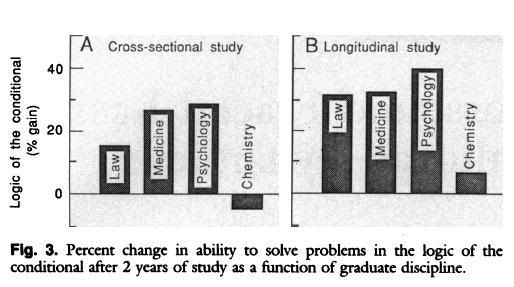
Twentieth-century psychologists have been pessimistic about teaching reasoning, prevailing opinion suggesting that people may possess only domain-specific rules, rather than abstract rules; this would mean that training a rule in one domain would not produce generalization to other
domains. Altematively, it was thought that people might possess abstract rules (such as logical ones) but that these are induced developmentally through self-discovery methods and cannot be trained. Research suggests a much more optimistic view: even briefformal training in inferential
rules may enhance their use for reasoning about everyday life events. Previous theorists may have been mistaken about trainability, in part because they misidentified the kind of rules that people use naturally.
Teaching Reasoning. RICHARD E. NISBETT, GEOFFREY T. FONG, DARRIN R. LEHMAN, PATRICIA W. CHENG.
Science Magazine, 30 October 1987.
Another confirmation that model-based approach to teaching invention skills can be extremely useful when abstract rules are illustrated with examples from different domains. Just teaching-by-example or abstract reasoning logic may not be enough to get the knowledge transfer effect.
Wednesday, May 28, 2008
As we've discovered during the last session of the Principles of Invention class at Stanford, server technology is going to be a strong control point in the emerging mobile applications space. Google continues to build a leadership position in technology and mind share among software developers and corporations. They (Google) become embedded into the fabric of the new generation of web applications.
For example, CNET writes:
We'll probably explore further invention/innovation opportunities in this space during our next class, BUS75
For example, CNET writes:
MySpace's announcement that it has integrated Gears into its messaging system to create a backup of messages (email) to a user's computer and thereby enable faster searching and sorting of the messages. With 170 million messages sent each day on MySpace, this adds up to cost-savings as it needn't process all of the email searching and sorting server-side.Or look at Google's App Engine, which is one area in which Google keeps trying to "mak[e] clouds of computing power more accessible to all developers." Google is now opening up App Engine to everyone, not an elect few, at pricing that is very compelling.
We'll probably explore further invention/innovation opportunities in this space during our next class, BUS75
Tuesday, May 27, 2008
History of DHL:
This is an example of a system evolution pattern where control information "finds" a fast channel to improve the overall system performance. In this case, DHL found a way to increase productivity in the global shipping industry by delivering customs documents to foreign ports while freight ships were still en route. Officials were able to review the documents before the goods arrived, thus cutting the time that ships had to spend in port.
In 1969, Adrian Dalsey, Larry Hillblom and Robert Lynn (D, H, and L) founded DHL as a service shuttling bills of lading between San Francisco and Honolulu. The company grew rapidly and in a few years initiated service to the Philippines, Japan, Hong Kong, Singapore and Australia, creating an entirely new industry of international door-to-door express service in the Pacific Basin. Steady expansion continued in the 1970's as DHL initiated service to Europe (1974), Latin America (1977), the Middle East (1978) and Africa (1978).
This is an example of a system evolution pattern where control information "finds" a fast channel to improve the overall system performance. In this case, DHL found a way to increase productivity in the global shipping industry by delivering customs documents to foreign ports while freight ships were still en route. Officials were able to review the documents before the goods arrived, thus cutting the time that ships had to spend in port.
From the history of Fedex Corp:
A good example how an alternative distribution system emerges by capturing large volumes of new types of payloads. Also of interest is coupling of distribution with storage ( parts warehousing ). A pattern familiar from the early banking systems.
FedEx was founded as Federal Express Corporation in 1971, by 28-year-old Memphis, Tennessee, native Frederick W. Smith. Smith, a former Marine pilot, originally outlined his idea for an overnight delivery service in a term paper he wrote for a Yale University economics class. He felt that air freight had different requirements than air passenger service and that a company specializing in air freight rather than making it an add-on to passenger service would find a lucrative business niche. Speed was more important than cost, in Smith's view, and access to smaller cities was essential. His strategies included shipping all packages through a single hub and building a private fleet of aircraft. Company-owned planes would free the service from commercial-airline schedules and shipping regulations, while a single hub would permit the tight control that got packages to their destinations overnight. In making his dream a reality, Smith selected Memphis as his hub: it was centrally located and despite inclement weather its modern airport rarely closed.
A good example how an alternative distribution system emerges by capturing large volumes of new types of payloads. Also of interest is coupling of distribution with storage ( parts warehousing ). A pattern familiar from the early banking systems.
Tuesday, May 20, 2008
May 20, 2008. An update on the mobile application space
Google continues to position itself as a premier, if not dominant, player in the emerging mobile software space.
Google could soon find itself as the iPhone’s largest independent software vendor, while at the same time becoming its biggest competitor through the launch of the company’s own mobile platform. While browser-based versions of Google’s Web applications will run via both Android and the iPhone’s Web browser with little or no modifications (since both use WebKit), native apps for either platform aren’t compatible. In many instances Google may pick and choose which of its services to build native iPhone clients for, and which should remain browser-based or exclusively native for Android devices. As an example, the pre-release version of Google Maps for Android already has features missing from the iPhone version.
Google continues to position itself as a premier, if not dominant, player in the emerging mobile software space.
Monday, May 19, 2008
The Promise of Prediction Markets article in Science magazine makes a point that over time people get better at forecasting event outcomes ( see the graph below).

But we can turn this argument on its head and say that while crowds are generally good at predicting short-term events, they are not that great in predicting long-term outcomes. Furthermore, the farther the crowds are removed from an event, the worse their accuracy rate is. It is the job of inventors/innovators, not the crowds, to not only predict the future, but also make it happen. Truly great innovators, like Edison, Disney, Moore, Gates, and Jobs, have the ability to lead the crowds onto "predicting" the success of their innovations.
But we can turn this argument on its head and say that while crowds are generally good at predicting short-term events, they are not that great in predicting long-term outcomes. Furthermore, the farther the crowds are removed from an event, the worse their accuracy rate is. It is the job of inventors/innovators, not the crowds, to not only predict the future, but also make it happen. Truly great innovators, like Edison, Disney, Moore, Gates, and Jobs, have the ability to lead the crowds onto "predicting" the success of their innovations.
Sunday, May 18, 2008
herding cats
However, Peterson found a negative relationship between creative cities and strength that connects people to one another - such as modesty, gratitude, spirituality, teamwork, kindness, and fairness. ... This jibes with my research teams findings which show that regional creativity and innovation are related to diversity and openness, but not to social capital of the sort Robert Putnam has written about. Putnam's most recent research has also found that diversity hinders social capital. This is all very troubling news for our sense of community and social cohesion. The very strengths that make places diverse and creative seem to damage our social capital and community commitment. ( Florida, R. Who's your city. Basic Books, 2008 p. 210-211 )
A interesting trade-off: more creative people - fewer/shallower social connections. Makes perfect sense in terms of system analysis, because connection creation and maintenance require time and resources that can be better spent on developing new ideas. Online social networking, with its "low-touch" relationships, serves this environment much better than more traditional forms of social interaction, like family, clubs, churches, and etc. May also relate to the Tipping Point phenomenon described by Malcolm Gladwell and Andrew Hargadon's concept of technology brokering ( How Breakthroughs Happen).
I will use this problem as an example in my next Principles of Invention class.
Personality Maps
 The maps show distribution of the Big Five Personality Traits in the United States.
Extroverted, Agreeable, Neurotic, Conscientious, Open-to-Experience
I wonder what kind of processes sustain these distributions. For example, a person with new ideas can be easily accommodated in Silicon Valley, but rejected in the South ( Georgia, Missouri, etc.) The network-centric view that Richard Florida proposes in Who's Your City is limited to the "Distribution" system component and does not explain a self-perpetuating cycle. Various institutions have to work together to convert ideas into cool products and high-paying jobs.
click on the picture to enlarge
(Source: Jason Rentfrow, Cambridge University; Kevin Stolarick, University of Toronto. Original maps by Ryan Morris. )
Friday, May 16, 2008
The brain has to be set up in such a way that we can perceive and understand all of these aspects of the external world. Basic brain functions are called "cognitive operators" (d'Aquili 1978). A cognitive operator is a function of either a specific brain structure or a group of brain structures working in conjunction to help us order our reality. We have identified seven cognitive operators: Holistic Operator, Reductionistic Operator, Causal Operator, Abstractive Operator, Binary Operator, Quantitative Operator, and Emotional Value Operator.
The Holistic Operator takes all of the particulars that we might experience and creates a sense of the general or holistic nature of the particulars. There are many instances, both in the sciences as well as in other academic pursuits, when an investigator will examine how the parts make up the whole. The Holistic Operator also plays an important role in everyday life, particularly in relation to aesthetics, myth, and religious experience. The Reductionistic Operator has a function that is opposite that of the Holistic Operator, it takes the whole and breaks it down into its individual parts. Science is particularly dependent on the functioning of the Reductionistic Operator. The Causal Operator helps us to observe causality and to relate one event to another in a sequential ordering. The Abstractive Operator allows us to generate abstract concepts - for example, that objects such as an elm, spruce, and oak can be categorized as "trees". The Binary Operator helps us generate a sense of opposites such that we can compare the concepts good and evil or right and wrong. This operator has particular relevance to religious and aesthetic experiences and particularly to myth formation. Religious myths tend to involve opposites that are in some form of conflict, which is then resolved through the myth (d'Aquili 1978). Likewise, many aesthetic works make use of opposites, such as light and dark or wholeness and fragmentation, which are brought together to comprise the work. When we initially observe a pair of opposites, we encounter a sense of arousal because of the incongruity between the opposites. We desire a resolution and revised understanding because of the Holistic Operator. Thus, in art, in particular, the "tense and happy indecision" (Schaible 1998) may be directly related to the functioning of the Binary Operator. These tensions enhance activity in the arousal system initially, with quiescent activity being stimulated upon resolution of the opposites within either a myth or an aesthetic work. The Quantitative Operator is involved in the generation of numbers and quantity. Thus, whenever we observe objects in the external world, we have a tendency to try to determine how many there are. Finally, the Emotional Value Operator connects the limbic system to the other operators and provides an emotional response to all of the input and thoughts that we have. This Operator tells us how we feel about everything. In order to do this, the Emotional Value Operator must be able to connect to all the other operators. Clearly, this operator is crucial for the emotional response people have during aesthetic and religious experiences.
The Creative Brain / The Creative Mind
by Andrew B. Newberg and Eugene G. d'Aquili
Zygon, vol 35, no 1 (March 2000)
It would be very useful to develop/refine tools that exercise all these brain operators. We already have The Three Magicians and Five-Element Analysis methods to engage most of them. The Binary Operator probably relates to dilemma formulation, while The 10x Diagram taps into The Quantitative Operator. The only thing that is missing is The Emotional Value Operator. This is where the Red Hat from the Six Thinking Hats method might be very useful.
Friday, May 09, 2008
Here is the first video I am going to embed into my Model-based Invention course this summer. This particular clip shows how "spontaneous creativity" can be shaped by previous experiences. Something to be aware of when you do real inventive work.
Thursday, May 08, 2008
MOUNTAIN VIEW, Calif.--Google's top executives on Thursday gave a glimpse into how it might try to deflect antitrust concerns of a possible ad-sharing deal with rival Yahoo, advising observers to look at the overall ad market.
-------------
With all the talk about creative destruction and competition, technology keeps creating monopolies: General Electric ( electric machines and distribution); ATT ( phone networks); IBM ( business computers); Microsoft ( PC OS and office software); Google ( web advertisement).
-------------
With all the talk about creative destruction and competition, technology keeps creating monopolies: General Electric ( electric machines and distribution); ATT ( phone networks); IBM ( business computers); Microsoft ( PC OS and office software); Google ( web advertisement).
Wednesday, May 07, 2008
The race for mobile processors is heating up:
On a somewhat related topic, Google keeps perfecting cloud-to-cloud communications. This time it's multi-size embedded presentations. And you can add youtube videos too. Pretty cool. I would probably start using the technology in class this summer, if youtube/docs allowed me to insert snippets of videos, rather than the whole video stream.
In any case, this approach is a sure sign of a potential ms office killer. It offers a combination of a new technology and a new application. Quite a good bet.
Nvidia is betting a big part of its future on boosting graphics performance in fit-in-your-pocket mobile internet devices (MIDs). iPhone-style devices with Nvdia's APX 2500 system-on-a-chip--due late this year and next year--incorporate most of the functionality of a PC.
On a somewhat related topic, Google keeps perfecting cloud-to-cloud communications. This time it's multi-size embedded presentations. And you can add youtube videos too. Pretty cool. I would probably start using the technology in class this summer, if youtube/docs allowed me to insert snippets of videos, rather than the whole video stream.
In any case, this approach is a sure sign of a potential ms office killer. It offers a combination of a new technology and a new application. Quite a good bet.
Just like viruses, elements of previous technologies embed themselves into inventors' designs:
On 21-22 October 1879, Edison and his staff conducted their first successful experiments with a carbon-filament lamp in a vacuum. The filament was made from a piece of carbonized thread. By New Year's he was demonstrating lamps using carbonized cardboard filaments to large crowds at the Menlo Park laboratory. A year later, Edison began manufacturing commercial lamps using carbonized Japanese bamboo as filaments.
1904 Fleming invents the vacuum diode
British engineer Sir John Ambrose Fleming invents the two-electrode radio rectifier; or vacuum diode, which he calls an oscillation valve. Based on Edison's lightbulbs, the valve reliably detects radio waves. Transcontinental telephone service becomes possible with Lee De Forest's 1907 patent of the triode, or three-element vacuum tube, which electronically amplifies signals.
1943 First vacuum-tube programmable logic calculator
Colossus, the world’s first vacuum-tube programmable logic calculator, is built in Britain for the purpose of breaking Nazi codes. On average, Colossus deciphers a coded message in two hours.
Monday, May 05, 2008
Associated Press has created a news service for iPhone:
Of course, iPhone is not a phone. Apple were very smart to name a very un-familiar device with a very familiar word. In the age of cloud computing iPhone is a media contraption that hosts service cloudlets. As Winnie the Pooh would put it:
The new mobile Web site is targeted at people who want access to international, national, and local news all the time. It aggregates news from more than 100 news publishers and offers text plus multimedia coverage including, photo galleries of sports events, and video coverage of the presidential campaign. The Web application is currently optimized for the iPhone, but the news service plans to add support for other smartphones in the future.
Of course, iPhone is not a phone. Apple were very smart to name a very un-familiar device with a very familiar word. In the age of cloud computing iPhone is a media contraption that hosts service cloudlets. As Winnie the Pooh would put it:
An old hymn to the new brave world.How sweet to be a Cloud
Floating in the Blue!
Every little cloud
Always sings aloud.
"How sweet to be a Cloud
Floating in the Blue!"
It makes him very proud
To be a little cloud.
Saturday, May 03, 2008
To honk or not to honk, that is the question!
Today was the last session of my Spring '08 BUS 74 Principles of Invention class. We focused on the mobile application space, and I will probably write more about it later ( the Yahoo - Microsoft relationship, or the lack of thereof makes this topic very interesting).
In the meantime, I would like to go back to the problem that group 2 brought to the class' attention. The group participants did a great job of finding a good problem and formulating its core dilemma. Unfortunately, we didn't choose it for the problem-solving session, and I felt somewhat bad about leaving a quality problem "hanging" without a solution session. So, while driving back home, I started thinking about the dilemma, exploring it further and identifying ideas for possible solution. Here's what I got.
The problem: Hybrid cars are very quiet, especially, at speeds below 40 mph. This feature is great for reducing city traffic noise, but it creates a hazard for pedestrians, who have hard time hearing approaching "silent" cars. Blind people suffer the most. There are multiple examples of accidents caused by hybrids ( e.g. see
http://wheels.blogs.nytimes.com/2008/04/22/are-hybrids-too-quiet/ )
The problem got so bad that, according to the Associated Press, the Congress is about to introduce a bill intended to protect blind people and other pedestrians from the dangers posed by quiet cars. Furthermore, the National Highway Traffic Safety Administration is planning a listening session this spring to consider possible solutions to the quiet-car problem and is already working with manufacturers.
One of the ideas is make cars noisier, etc. etc. But if we just make cars noisier we lose the benefit of quiet streets that hybrid cars brought to the cities. A good feature will be lost.
Let's try to analyze the problem and see if we can come up with better ideas. First, lets formulate main useful and harmful functions.
A noisy car is good because its loud sound alerts pedestrians and other traffic "members" to a moving hazard.
A noisy car is bad because it contributes to city "noise" pollution.
Ideally, our solution would preserve the useful function, while eliminating the harmful one.
Therefore, a first level dilemma would be: the car should be noisy ( to alert pedestrians), and the car should not be noisy ( to prevent noise pollution).
A second level dilemma would be: the car should be loud ( to alert pedestrians); the car should be quiet ( to prevent noise pollution).
A third level dilemma would be: a car should produce a sensory perception in pedestrians and others ( to alert ); the car should not produce a sensory perception ( to not annoy everybody).
There's a forth one, but I will stop here for now.
Let's dig into the first dilemma. What's bad about vehicle noise? Are there cases when such noise is considered to be "good" rather than bad? What is the difference, for example, between a good noise, like loud chirping birds or ambulance signal, and a bad noise, like heavy trucks or airplane engine?
The two most obvious sound characteristics would be magnitude, i.e. the loudness, and its pattern. Some patterns, even when they are relatively loud, are better than others. For example, Harley-Davidson company created and patented a distinct "potato-potato" pattern for its motorcycles. It helped company to sell products and strengthen brand loyalty.
Therefore, following H-D example, we can propose a first-level solution: let's equip silent hybrid cars with a sound source that produces certain, more pleasant, sound patterns. These patterns can be different per brand, model, and etc. Moreover, they can be customized by car owners, dillers, and etc. We can go even further and propose a"ring-tone for cars" business model, and enable people to download and modify their "engine" sound. The magnitude of such sound should be reduced relative to regular cars, but the patterns should be distinct enough to alert pedestrians.
There's probably more to it, but for now I will leave it for others to explore the idea further.
Now, consider the second-level dilemma: car should be loud; car should be quiet.
Let's get back to basics and determine the useful function of a loud car. IMO, it should be to alert pedestrians and others. Ideally, the car should produce the alert without producing any sound. This way we preserve the useful function, while eliminating the harmful one. By separating in space, e.g. spectrum, we get a "loud" signal that lies outside of the audible range.
Of course, pedestrians, e.g. blind people, must have a special device that detects this signal. Or, even better, it should be implemented as a functionality on a common device, e.g. a mobile phone, a portable player, etc. For example, a mobile device detects the "incoming car" signal and produces a "localized" sound, vibration, electric shock ;) and etc. Of course, we don't want to alert everybody in the neighborhood, therefore the car has to produce a signal that is projected into the "hazard" space.
A side thought: this alert system can be used to interact not only with pedestrians, but with other cars as well. For example, on a freeway it can be applied to eliminate the so-called blind spot. One implementation would be to equip all cars with both signal and detection systems. This way drivers can be alerted to various hazardous situations.
By separating in time, we get an alert system that is activated in special circumstances, e.g. poor visibility, pedestrian crossing, intersection, and etc.
By separating in action, we get various types of signals, e.g. ultrasound, modulated, and etc. There's probably more, but it's time to walk the dog. She's been really patient with me today.
To be continued....
In the meantime, I would like to go back to the problem that group 2 brought to the class' attention. The group participants did a great job of finding a good problem and formulating its core dilemma. Unfortunately, we didn't choose it for the problem-solving session, and I felt somewhat bad about leaving a quality problem "hanging" without a solution session. So, while driving back home, I started thinking about the dilemma, exploring it further and identifying ideas for possible solution. Here's what I got.
The problem: Hybrid cars are very quiet, especially, at speeds below 40 mph. This feature is great for reducing city traffic noise, but it creates a hazard for pedestrians, who have hard time hearing approaching "silent" cars. Blind people suffer the most. There are multiple examples of accidents caused by hybrids ( e.g. see
http://wheels.blogs.nytimes.com/2008/04/22/are-hybrids-too-quiet/ )
The problem got so bad that, according to the Associated Press, the Congress is about to introduce a bill intended to protect blind people and other pedestrians from the dangers posed by quiet cars. Furthermore, the National Highway Traffic Safety Administration is planning a listening session this spring to consider possible solutions to the quiet-car problem and is already working with manufacturers.
One of the ideas is make cars noisier, etc. etc. But if we just make cars noisier we lose the benefit of quiet streets that hybrid cars brought to the cities. A good feature will be lost.
Let's try to analyze the problem and see if we can come up with better ideas. First, lets formulate main useful and harmful functions.
A noisy car is good because its loud sound alerts pedestrians and other traffic "members" to a moving hazard.
A noisy car is bad because it contributes to city "noise" pollution.
Ideally, our solution would preserve the useful function, while eliminating the harmful one.
Therefore, a first level dilemma would be: the car should be noisy ( to alert pedestrians), and the car should not be noisy ( to prevent noise pollution).
A second level dilemma would be: the car should be loud ( to alert pedestrians); the car should be quiet ( to prevent noise pollution).
A third level dilemma would be: a car should produce a sensory perception in pedestrians and others ( to alert ); the car should not produce a sensory perception ( to not annoy everybody).
There's a forth one, but I will stop here for now.
Let's dig into the first dilemma. What's bad about vehicle noise? Are there cases when such noise is considered to be "good" rather than bad? What is the difference, for example, between a good noise, like loud chirping birds or ambulance signal, and a bad noise, like heavy trucks or airplane engine?
The two most obvious sound characteristics would be magnitude, i.e. the loudness, and its pattern. Some patterns, even when they are relatively loud, are better than others. For example, Harley-Davidson company created and patented a distinct "potato-potato" pattern for its motorcycles. It helped company to sell products and strengthen brand loyalty.
Therefore, following H-D example, we can propose a first-level solution: let's equip silent hybrid cars with a sound source that produces certain, more pleasant, sound patterns. These patterns can be different per brand, model, and etc. Moreover, they can be customized by car owners, dillers, and etc. We can go even further and propose a"ring-tone for cars" business model, and enable people to download and modify their "engine" sound. The magnitude of such sound should be reduced relative to regular cars, but the patterns should be distinct enough to alert pedestrians.
There's probably more to it, but for now I will leave it for others to explore the idea further.
Now, consider the second-level dilemma: car should be loud; car should be quiet.
Let's get back to basics and determine the useful function of a loud car. IMO, it should be to alert pedestrians and others. Ideally, the car should produce the alert without producing any sound. This way we preserve the useful function, while eliminating the harmful one. By separating in space, e.g. spectrum, we get a "loud" signal that lies outside of the audible range.
Of course, pedestrians, e.g. blind people, must have a special device that detects this signal. Or, even better, it should be implemented as a functionality on a common device, e.g. a mobile phone, a portable player, etc. For example, a mobile device detects the "incoming car" signal and produces a "localized" sound, vibration, electric shock ;) and etc. Of course, we don't want to alert everybody in the neighborhood, therefore the car has to produce a signal that is projected into the "hazard" space.
A side thought: this alert system can be used to interact not only with pedestrians, but with other cars as well. For example, on a freeway it can be applied to eliminate the so-called blind spot. One implementation would be to equip all cars with both signal and detection systems. This way drivers can be alerted to various hazardous situations.
By separating in time, we get an alert system that is activated in special circumstances, e.g. poor visibility, pedestrian crossing, intersection, and etc.
By separating in action, we get various types of signals, e.g. ultrasound, modulated, and etc. There's probably more, but it's time to walk the dog. She's been really patient with me today.
To be continued....
Friday, May 02, 2008
Interesting links about learning
Math seems to be is better learned in abstract rather than in concrete
How the brain learns to read depenqds on language
both of these link may relate to my previous post about Cerf's article in RTM.
Is interacting with people and content on the net is better than watching tv?
--- what about talking to people or playing a game while watching tv? ;) i often find myself watching sports on TV( on mute) and e-mailing or listening to audio books at the same time.
How the brain learns to read depenqds on language
both of these link may relate to my previous post about Cerf's article in RTM.
Is interacting with people and content on the net is better than watching tv?
--- what about talking to people or playing a game while watching tv? ;) i often find myself watching sports on TV( on mute) and e-mailing or listening to audio books at the same time.
New Business Development (NBD) process efficiency. It would be interesting to explore similarities between innovation and other "noisy" messaging environments, e.g. hormone signaling.

from Piloting the rocket of radical innovation
Greg A Stevens; James Burley
Research Technology Management; Mar/Apr 2003; 46, 2. p. 17.

from Piloting the rocket of radical innovation
Greg A Stevens; James Burley
Research Technology Management; Mar/Apr 2003; 46, 2. p. 17.
Research Technology Management in its Jan-Feb 2008 issue published "Innovation and the Internet" paper by Vinton G. Cerf. He writes:
The ability to find the right level of abstractions for the problem is another skill that a good inventor has to master. Working with system models, 10x diagrams, and Scale-Time-Cost operator addresses this need by developing flexible abstract thinking and stretching imagination.
Innovation also arises out of discontent with the status quo. People who complain are often precisely the ones who have ideas for change. Of course, not every whiner is an innovator, but some see how to turn lemons into lemonade. I’ve learned to tolerate a certain degree of complaint when it points to possibilities for improvement.The Reverse Brainstorm technique that I teach and extensively use in invention workshops was developed to stimulate quality "complaints". Very often, finding a high value problem is key to a good invention. ( also see Creativity, by Mihaly Csiksentmihaly).
Finding just that small thing that will make a huge, enabling difference is often the key to significant change. In fact, it is frequently the case that tough problems are solved only after figuring out what is the best way to express them.
Sometimes this is a matter of stating the problem at the right level of abstraction: too detailed and the critical issues are obscured; too high level and the problem is too generally stated to admit of a useful answer.
The ability to find the right level of abstractions for the problem is another skill that a good inventor has to master. Working with system models, 10x diagrams, and Scale-Time-Cost operator addresses this need by developing flexible abstract thinking and stretching imagination.
Tuesday, April 29, 2008
The value of a good problem just went up a notch. New Scientist writes that the Molecular Frontier Foundation just announced "a Nobel for children":
I wonder why the prize is limited to children. Are we giving up on adults?
Starting this May, the prize will be awarded annually to an equal number of girls and boys from around the world for posing the most penetrating and insightful questions related to molecular science, which encompasses everything from physics and chemistry to physiology and medicine.
I wonder why the prize is limited to children. Are we giving up on adults?
Wednesday, April 23, 2008
"Neuroeconomics: cross-currents in research on decision-making" Trends in Cognitive Sciences, Volume 10, Issue 3, March 2006, Pages 108-116
Alan G. Sanfey, George Loewenstein, Samuel M. McClure, Jonathan D. Cohen
Creative thinking and problem solving when they lie outside of domain-specific expertise is a slow process. As G.Altshuller used to say, "Good thinking is slow thinking." This may also relate to the social facilitation effect studied extensively by Robert Zajonc.
From this perspective, effective brainstorm is an information exchange exercise rather than a problem solving session.
Alan G. Sanfey, George Loewenstein, Samuel M. McClure, Jonathan D. Cohen
psychologists make between automatic and controlled processes. Automatic processes are fast and efficient, can often be carried out in parallel, but are highly specialized for domain-specific operations and therefore relatively inflexible. They are thought to reflect the operation of highly over-trained (and, in some cases, possibly ‘hardwired’) mechanisms. However, humans also have a capability for controlled processing underlying our higher cognitive faculties. Controlled processes are highly flexible, and thus able to support a wide variety of goals, but are relatively slow to engage and rely on limited capacity mechanisms – that is, they can support only a small number of pursuits at a time.
Creative thinking and problem solving when they lie outside of domain-specific expertise is a slow process. As G.Altshuller used to say, "Good thinking is slow thinking." This may also relate to the social facilitation effect studied extensively by Robert Zajonc.
From this perspective, effective brainstorm is an information exchange exercise rather than a problem solving session.
Tuesday, April 22, 2008
BBC Science story: Dull jobs really do numb the mind
This seems to be a localized version of the Einstellung effect. It affects people as well as organizations as a whole.
It's quite possible that art is a way to overcome the problem on the "culture" level. Similar to the way junk food parasitizes on our evolution-induced taste for fat and sugar, TV shows ride our need to un-dull ourselves from monotonous environment.
Boring jobs turn our mind to autopilot, say scientists - and it means we can seriously mess up some simple tasks.
Monotonous duties switch our brain to "rest mode", whether we like it or not, the researchers report in Proceedings of National Academy of Sciences.
They found mistakes can be predicted up to 30 seconds before we make them, by patterns in our brain activity.
The team hopes to design an early-warning brain monitor for pilots and others in "critical situations".
This seems to be a localized version of the Einstellung effect. It affects people as well as organizations as a whole.
It's quite possible that art is a way to overcome the problem on the "culture" level. Similar to the way junk food parasitizes on our evolution-induced taste for fat and sugar, TV shows ride our need to un-dull ourselves from monotonous environment.
Saturday, April 19, 2008
A simple solution to a difficult problem - chores and walks!
One 20-minute session of housework or walking reduced the risk of depression by up to 20 per cent. A sporting session worked better, reducing risk by a third or more. Failing housework or sport, says Hamer, try to find something physical to do. "Something - even for just 20 minutes a week - is better than nothing."
Tuesday, April 08, 2008
An internet platform with hooks attached
Google has announced its Google App Engine.
TechCrunch notices that:
This is the type of customer lock-in ( control point) that Google lacks in the search space. Strategically, very similar to what Salesforce.com is doing with its Force.com .
It appears that server-side business models, which originated in the Open Source revolution, are going to dominate computing during the next decade.
Google now has a shot at dominating two key application+service platforms: mobile( Android) and web utility ( App Engine).
TechCrunch notices that:
Unlike Amazon Web Services’ loosely coupled architecture, which consists of several essentially independent services that can optionally be tied together by developers, Google’s architecture is more unified but less flexible. For example, it is possible with Amazon to use their storage service S3 independently of any other services, while with Google using their BigTable service will require writing and deploying a Python script to their app servers, one that creates a web-accessible interface to BigTable.
What this all means: Google App Engine is designed for developers who want to run their entire application stack, soup to nuts, on Google resources. Amazon, by contrast, offers more of an a la carte offering with which developers can pick and choose what resources they want to use.
This is the type of customer lock-in ( control point) that Google lacks in the search space. Strategically, very similar to what Salesforce.com is doing with its Force.com .
It appears that server-side business models, which originated in the Open Source revolution, are going to dominate computing during the next decade.
Google now has a shot at dominating two key application+service platforms: mobile( Android) and web utility ( App Engine).
Monday, April 07, 2008
I just realized that in 3+ years of teaching Principles of Invention and 10+ years of running invention workshops at major global companies I never had a black student or participant. Not even once. This is truly amazing. I wonder what national invention/patent statistics say about race.
A beautiful little story from Turin via London:
Sheep rentals in major US suburban areas, anyone?
In a bid to keep its municipal lawns trim while saving money, the city of Turin has done away with lawn mowers and brought in 700 sheep to graze in two parks.
Sheep rentals in major US suburban areas, anyone?
Reorg at Adobe:
Another piece of evidence that PC is losing ground as a de facto platform for consumer applications. Server-based business models become dominant, pushing software makers to rethink their strategies.
Adobe Systems, maker of Photoshop and Acrobat software, is folding the company's mobile group into its platform operations as a way to create one platform for computers, handsets, and other consumer devices.
Another piece of evidence that PC is losing ground as a de facto platform for consumer applications. Server-based business models become dominant, pushing software makers to rethink their strategies.
Sunday, April 06, 2008
Surprisingly accurate predictions from 1968:
This is very close to utility computing of today. On the other hand, predicting physical infrastructure proved to be much more difficult:
Somewhat predictably, descriptions of "final needs", like business travel, shopping, and etc. are very well understood. The difficulties arise when people try to forecast change in the often "invisible" infrastructure: roads, networks, transportation devices. The bigger the system, the greater the discrepancy. The same pattern shows up in people's inventive thinking. They tend to focus their effort on "tools", i.e. elements and applications that fulfill a well understood function, and forget about the "distribution", i.e. infrastructure that enables scalable growth.
I wonder if this another case of the availability heuristics bias.
Computers also handle travel reservations, relay telephone messages, keep track of birthdays and anniversaries, compute taxes and even figure the monthly bills for electricity, water, telephone and other utilities. Not every family has its private computer. Many families reserve time on a city or regional computer to serve their needs. The machine tallies up its own services and submits a bill, just as it does with other utilities.
Money has all but disappeared. Employers deposit salary checks directly into their employees’ accounts. Credit cards are used for paying all bills. Each time you buy something, the card’s number is fed into the store’s computer station. A master computer then deducts the charge from your bank balance.
Computers not only keep track of money, they make spending it easier. TV-telephone shopping is common. To shop, you simply press the numbered code of a giant shopping center. You press another combination to zero in on the department and the merchandise in which you are interested. When you see what you want, you press a number that signifies “buy,” and the household computer takes over, places the order, notifies the store of the home address and subtracts the purchase price from your bank balance. Much of the family shopping is done this way. Instead of being jostled by crowds, shoppers electronically browse through the merchandise of any number of stores.
This is very close to utility computing of today. On the other hand, predicting physical infrastructure proved to be much more difficult:
IT’S 8 a.m., Tuesday, Nov. 18, 2008, and you are headed for a business appointment 300 mi. away....
The car accelerates to 150 mph in the city’s suburbs, then hits 250 mph in less built-up areas, gliding over the smooth plastic road. You whizz past a string of cities, many of them covered by the new domes that keep them evenly climatized year round. Traffic is heavy, typically, but there’s no need to worry. The traffic computer, which feeds and receives signals to and from all cars in transit between cities, keeps vehicles at least 50 yds. apart.
Somewhat predictably, descriptions of "final needs", like business travel, shopping, and etc. are very well understood. The difficulties arise when people try to forecast change in the often "invisible" infrastructure: roads, networks, transportation devices. The bigger the system, the greater the discrepancy. The same pattern shows up in people's inventive thinking. They tend to focus their effort on "tools", i.e. elements and applications that fulfill a well understood function, and forget about the "distribution", i.e. infrastructure that enables scalable growth.
I wonder if this another case of the availability heuristics bias.
Friday, March 28, 2008
The march to add spy drones to local law enforcement arsenal continues:
A small pilotless vehicle manufactured by Honeywell International, capable of hovering and "staring" using electro-optic or infrared sensors, is expected to be introduced soon in the skies over the Florida Everglades.
If use of the drone wins U.S. Federal Aviation Administration approval after tests, the Miami-Dade Police Department will start flying the 14 pound, or 6.35 kilogram, drone over urban areas with an eye toward full-fledged employment in crime fighting.
"Our intentions are to use it only in tactical situations as an extra set of eyes," said Detective Juan Villalba, a police department spokesman.
He acknowledged strong interest from law enforcement agencies in getting drones up and running, however, and said the smaller aircraft were particularly likely to have a "huge economic impact" over the next 10 years.
Tuesday, March 25, 2008
Strategy as a set of trade-offs
Defining the objective, scope, and advantage requires trade-offs, which Porter identified as fundamental to strategy. If a firm chooses to pursue growth or size, it must accept that profitability will take a back seat. If it chooses to serve institutional clients, it may ignore retail customers. If the value proposition is lower prices, the company will not be able to compete on, for example, fashion or fit. Finally, if the advantage comes from scale economies, the firm will not be able to accommodate idiosyncratic customer needs. Such trade-offs are what distinguish individual companies strategically.Harvard Business Review, April 2008, p. 85.
Invention of a new business model usually breaks through an "unavoidable" trade-off. For example, Google and Amazon.com found ways to get around the scale vs. customization trade-off. Hotel chains solved institutional vs retail, and etc. Companies that define themselves as a trade-off maintainer are prone to disruptions from their more innovative peers.
Thursday, March 20, 2008
Scientific American proposes a grand scheme for solar power:
While British researchers see environmental dangers everywhere, except in massive installations of solar panels:
Solar energy’s potential is off the chart. The energy in sunlight striking the earth for 40 minutes is equivalent to global energy consumption for a year. The U.S. is lucky to be endowed with a vast resource; at least 250,000 square miles of land in the Southwest alone are suitable for constructing solar power plants, and that land receives more than 4,500 quadrillion British thermal units (Btu) of solar radiation a year. Converting only 2.5 percent of that radiation into electricity would match the nation’s total energy consumption in 2006.
To convert the country to solar power, huge tracts of land would have to be covered with photovoltaic panels and solar heating troughs. A direct-current (DC) transmission backbone would also have to be erected to send that energy efficiently across the nation.
The technology is ready. On the following pages we present a grand plan that could provide 69 percent of the U.S.’s electricity and 35 percent of its total energy (which includes transportation) with solar power by 2050. We project that this energy could be sold to consumers at rates equivalent to today’s rates for conventional power sources, about five cents per kilowatt-hour (kWh). If wind, biomass and geothermal sources were also developed, renewable energy could provide 100 percent of the nation’s electricity and 90 percent of its energy by 2100.
While British researchers see environmental dangers everywhere, except in massive installations of solar panels:
the great environmental concerns of the future should be nanomaterials, manmade viruses and biomimetic robots.
So say researchers, policymakers and environmental campaigners, who have identified 25 potential future threats to the environment in the UK, which they say researchers should focus on.
In addition to well-publicised risks such as toxic nanomaterials, the acidification of the ocean and increasingly frequent extreme weather events, the list includes some more outlandish possibilities. These include:
• Biomimetic robots that could become new invasive species.
• Experiments involving climate engineering, for instance ocean 'fertilisation' and deploying solar shields
• Increased demand for the biomass needed to make biofuel.
• Disruption to marine ecosystems caused by offshore power generation.
• Experiments to control invasive species using genetically engineered viruses.
Paul Lockhart writes:
This is a big problem with education in general. Students are not taught to look for cool open-ended problems. Inventiveness and creativity are presented as simple puzzle-solving exercise, where answers are known before hand and are really easy to test against.
The main problem with school mathematics is that there are no problems. Oh, I know what
passes for problems in math classes, these insipid “exercises.” “Here is a type of problem. Here is how to solve it. Yes it will be on the test. Do exercises 1-35 odd for homework.” What a sad way to learn mathematics: to be a trained chimpanzee.
This is a big problem with education in general. Students are not taught to look for cool open-ended problems. Inventiveness and creativity are presented as simple puzzle-solving exercise, where answers are known before hand and are really easy to test against.
Wednesday, March 12, 2008
Dilemma of the Day
Economist Paul Romer:
So with ideas, you have this tension: You want high prices to motivate discovery, but you want low prices to achieve efficient widespread use.
Wednesday, February 20, 2008
Trade-off of the Day
 These strategies reflect an underlying tension when the forces of innovation meet up with network externalities: is it better to wipe the slate clean and come up with the best product possible ( revolution) or to give up some performance to ensure compatibility and thus ease consumer adoption (evolution)?
 You can increase performance at the cost of increasing customer switching costs, or vice-versa. Ideally, you would like to have an improved product that is also compatible with the installed base, but technology is usually not so forgiving, and adapters and emulators are notoriously buggy. You will inevitably face the trade-off.
Shapiro, C. and Varian H.R. 1998. Information Rules. Boston: HBSP. p. 191
Monday, February 18, 2008
Trade-off of the Day

"When choosing terms and conditions, recognize the basic trade-off: more liberal terms and conditions will tend to raise the value of your product to consumers but may reduce the number of units sold."
Shapiro, C. and Varian H.R. 1998. Information Rules. Boston: HBSP. p. 103.
Saturday, February 09, 2008
A Bloomberg article about possible Microsoft Yahoo merger:
What a way for Google to get rid of all competition in the search technology! A very smart move because it could potentially deny Microsoft access to a high quality search engine. If that happens the Yahoo acquisition does not make sense for Microsoft at all.
The New York Times reported Feb. 4 that Google CEO Eric Schmidt contacted Yang to suggest a partnership between their companies. A partnership with Google may allow Yahoo to outsource its search service, shedding the costs of running its own search engine and sharing ad revenue with its larger rival.
What a way for Google to get rid of all competition in the search technology! A very smart move because it could potentially deny Microsoft access to a high quality search engine. If that happens the Yahoo acquisition does not make sense for Microsoft at all.
A CNN article about Osprey, a plane-helicopter hybrid:
Another indicator that helicopters are going to yield the scene to other flying apparatuses, like ospreys and drones.
The Osprey, which takes off and lands like a helicopter but flies like a plane, was designed to replace the Corps' aging and less-capable helicopter fleet.
The military, which has ordered 360 of the aircraft, said the 10 deployed to Iraq are doing what they are supposed to do -- carrying troops faster, farther and safer than the copters can.
In December, commanders gave the planes a more risky mission called "aero-scout" in which a group of V-22s flies into a relatively unsecured location and drops off Marines for a search mission.
The Osprey seems to have become a favorite of commanders who need to get to places quickly, including Gen. David Petraeus, the top U.S. military commander in Iraq. Petraeus used one to fly around the country on Christmas Day to visit troops.
"Gen. Petraeus flew in the jump seat and was very impressed by the aircraft's capabilities," according to Col. Steve Boylan, a spokesman for the general.
"The rate of climb is exceptional, and it can fly about twice as fast as a Black Hawk [helicopter], without needing to refuel as frequently," Boylan said. "Beyond that, its automatic-hover capability for use in landing in very dusty conditions, even at night, is tremendous."
Petraeus chose the Osprey for that mission because it was the only aircraft in the inventory that could fly around the country without refueling and not rely on runways, Boylan said.
Another indicator that helicopters are going to yield the scene to other flying apparatuses, like ospreys and drones.
Friday, January 25, 2008
The "Aha!" moment.
Scientific American:
People who are better aware of their problem-solving strategies are less likely to experience surprise at the moment of discovery. I've seen it over and over again in invention workshops. Clueless people have a lot of "wonderful discoveries" during brainstorming sessions, but the end result often is not that interesting.
At the end of each trial, subjects reported whether or not they had a strong "Aha!" moment. Interestingly, researchers found that subjects who were aware that they had found a new way to tackle the problem (and so, had consciously restructured their thinking) were less likely to feel as if they'd had eureka moment compared to more clueless candidates.
People who are better aware of their problem-solving strategies are less likely to experience surprise at the moment of discovery. I've seen it over and over again in invention workshops. Clueless people have a lot of "wonderful discoveries" during brainstorming sessions, but the end result often is not that interesting.
Sunday, December 30, 2007
12/29/07 many news agencies picked up analysis provided by research firm Basex, which chose "information overload" as its 2008 "Problem of the Year."
We should probably add to it calorie-, TV-, guns-, and other overloads that we've been suffering for years now. Though, I am yet to hear anything about vacation overload :)
Many Americans share this concern. In a 2007 Pew survey, 49 percent of Americans described themselves as having "few tech assets" and said that constant connectivity was an annoyance, not a liberation.
But young people don't seem to have (yet, anyway) developed the same sense of aggravation toward technology that forces them to multitask. Many choose to do so, in fact. The Kaiser Family Foundation found in a study this year that most junior high and high school students train themselves early in the dark arts of multitasking, with most listening to music or watching TV while they read books or surf the Internet. 30 percent of students even multitask while doing their homework.
Will these students feel the multitasking pinch when they grow up to become the new generation of "knowledge workers," or will constant exposure to interruptions make them more adept at handling the massive torrent of information that flows through modern computers and cell phones? Or is the "do more things at once philosophy" simply a dead end that produces only monstrosities, like the Internet-connected refrigerator we've heard so much about?
We should probably add to it calorie-, TV-, guns-, and other overloads that we've been suffering for years now. Though, I am yet to hear anything about vacation overload :)
Friday, December 28, 2007
12/27/07 News Agencies
Chinese cities are reaching growth limits.
Beijingers were warned to stay indoors on Thursday as pollution levels across the capital hit the top of the scale, despite repeated assurances by the government that air quality was improving.
"This is as bad as it can get," a spokeswoman for the Beijing Environmental Protection Bureau told AFP.
"Level five is the worst level of air pollution. This is as bad as it has been all year."
According to the bureau's website, 15 out of the 16 pollution monitoring stations in urban Beijing registered a "five" for air quality rating.
The main pollutant was suspended particulate matter, which is usually attributed to coal burning and automotive exhaust.
Chinese cities are reaching growth limits.
12/28/27 Reuters:
Buffet's risk profile fits the one of a risk-taker, while in reality his larger-than-life bets decrease risks because they enable him to shape the situation. He always buys control, not risk. He times his purchases so that his ability to control the developments in the industry is at a maximum. For example, now everybody is out of cash and he can come in and define his new rules for the game.
Warren Buffett's Berkshire Hathaway Inc (BRKa.N) (BRKb.N) is starting a bond insurer that would help state and local governments lower their borrowing costs, and is likely to lure business from established rivals struggling with credit market turmoil.
Buffett, often called the world's greatest investor, is known for taking large business and investment risks.
He has said, for example, that Berkshire is willing to suffer a $6 billion insurance loss on a single storm. The company was able to boost premiums following Hurricane Katrina after weaker rivals reduced underwriting risk.
Buffet's risk profile fits the one of a risk-taker, while in reality his larger-than-life bets decrease risks because they enable him to shape the situation. He always buys control, not risk. He times his purchases so that his ability to control the developments in the industry is at a maximum. For example, now everybody is out of cash and he can come in and define his new rules for the game.
Kinsey Steven G., Bailey Michael T., Sheridan John F., Padgett David A., The Inflammatory Response to Social Defeat is Increased in Older Mice, Physiology & Behavior (2007), doi: 10.1016/j.physbeh.2007.11.003
These findings relate to the problem we considered during the Summer 2006 Principles of Invention course: physical injures cause older people disproportionate amount of suffering, and often are a precursor to a downward health spiral.
As seen previously in young adult mice, social defeat caused an increase in anxiety-like behavior in the open field test, but had no effect on learned helplessness in the forced swim test. These data indicated that repeated social defeat results in a proinflammatory state that is exacerbated in older mice. The implications of these data are noteworthy, given the strong role of inflammation in many age-related diseases.
These findings relate to the problem we considered during the Summer 2006 Principles of Invention course: physical injures cause older people disproportionate amount of suffering, and often are a precursor to a downward health spiral.
12/28/07 By JEANNINE AVERSA, AP Economics writes:
A very interesting trend. People will be spending less money on housing and loan servicing, and probably more on staples, entertainment, and communications.
New-home sales tumbled 9 percent in November from October to a seasonally adjusted annual sales pace of 647,000, the Commerce Department reported Friday. That was the worst sales pace since April 1995.
"It was ugly," declared Richard Yamarone, economist at Argus Research. "It is the one sector of the economy that doesn't show any signs of life. It doesn't look like there is any resuscitation in store for housing over the next year," he said.
The housing picture turned out to be more grim than most anticipated. Many economists were predicting sales to decline by 1.8 percent to a pace of 715,000.
By region, sales fell in all parts of the country, except for the West.
In the Midwest, new-home sales plunged 27.6 percent in November from October. Sales dropped 19.3 percent in the Northeast and fell 6.4 percent in the South. In the West, however, sales rose 4 percent.
Over the last 12 months, new-home sales nationwide have tumbled by 34.4 percent, the biggest annual slide since early 1991, and stark evidence of the painful collapse in the once high-flying housing market.
"I think you can classify what we are seeing in the housing market as a crash," said Mark Zandi, chief economist at Moody's Economy.com. "Sales and home prices are in a free fall. The downturn is intensifying."
A very interesting trend. People will be spending less money on housing and loan servicing, and probably more on staples, entertainment, and communications.
Monday, December 10, 2007
Seth Godin talks about his newest book "All Marketers are Liars".
02:50 into the video he says: "Technology gives you a shot at marketing".
This is control point of the first kind: "remarkable product", i.e. something that gets you a foot in the market's door. Two more control points to go: ... still need to find good words to describe them.
Saturday, December 08, 2007
Why do some theaters innovate more than others?
An Empirical Study. Paul Dimaggio and Kristen Stenberg. Poetics, Volume 14, Issues 1-2, April 1985, Pages 107-122.
Market breeds conformity. Very similar to ideas expressed in Christensen's "Innovator's Dilemma": one one hand you have to listen to your customers, because they pay your money; on the other hand you don't want to listen to them, because they do not know what they are going to need tomorrow.
Abstract
The authors develop a measure of the ‘innovativeness’ of the repertoires of U.S. resident nonprofit theatres and test hypotheses about the relationship between environmental and organizational factors and innovation. Access to potential patrons rich in cultural capital appears to make theatre repertoires more innovate, while dependence upon the market (as opposed to grants and contributions) is associated with greater conformity of repertoire. Theatres with smaller budgets to maintain, fewer seats to fill, and less need for earned income are less conformist in their programming than are large theatres with capacious houses and high rates of earned income. Holding size and dependence on earned income constant, there is no evidence that age, structural differentiation, or the presence of subscription audiences—all associated with ‘institutionalization’ – have either a negative or a positive impact on innovation. New York theatres innovate more, and are less negatively affected by growth and the market, than theatres elsewhere in the U.S. It is suggested that artistic innovation has come to depend overwhelmingly on the behavior of formal organizations and that, consequently, we must understand the principles that govern the relationship of such organizations to their economic and social environments in order to understand artistic change.
Market breeds conformity. Very similar to ideas expressed in Christensen's "Innovator's Dilemma": one one hand you have to listen to your customers, because they pay your money; on the other hand you don't want to listen to them, because they do not know what they are going to need tomorrow.
The question of technology
Prof. Hubert L.Dreyfus writes
I think I am getting close to answering this question. The key is to consider various aspects of the innovation process and determine pathways through which we become devastated or enslaved by technology.
We start by thinking about technology as an evolving system of interacting elements. The devastation occurs when on a certain step of the system evolution we, without realizing the consequences, become objects of control rather its subjects.
Consider iPod.
When we buy one in a store on or on the internet, we acquire not just the device itself, but also cables, iTunes software, automatic connections to iTunes internet service, and, finally, a certain way to interface with media devices. We say we by an iPod, but in reality, we pay for one thing, specifically a piece of hardware, but acquire a whole system of elements and relationships that has products, services, and processes built into it.
The enslavement begins in this cognitive gap between "pay money for" and "acquire" which we tend to hide from ourselves by using just one word "buy".
In order to enjoy our purchase, we have to plug ourselves into a technology, which is being continuously developed by Apple corporation. In other words, we become a part of Apple technology - a living, breathing, consuming, paying part, capable of acquiring further products, services, processes, and, ultimately, led to the next Apple technology.
References.
1. Reinventing the Wheel: A Buddhist Response to the Information Age", by Peter D. Hershock.
2. H.L.Dreyfus (above)
3. Faïz Gallouj, 2002, Innovation in services and the attendant old and new myths. Journal of Socio-Economics, Volume 31, Issue 2, 2002, Pages 137-154.
4. Jeffrey A. Martin and Kathleen M. Eisenhardt, 2004, COPING WITH DECLINE IN DYNAMIC MARKETS: CORPORATE ENTREPRENEURSHIP AND THE RECOMBINATIVE ORGANIZATIONAL FORM. Advances in Strategic Management, Volume 21, 2004, Pages 357-382
5. Jonathan D. Lintona, and Steven T. Walsh, 2007, A theory of innovation for process-based innovations such as nanotechnology, Technological Forecasting and Social Change ( Article in press).
How can we relate ourselves to technology in a way that not only resists its devastation but also gives it a positive role in our lives? This is an extremely difficult question to which no one has yet given an adequate response, but it is perhaps the question for our generation.
I think I am getting close to answering this question. The key is to consider various aspects of the innovation process and determine pathways through which we become devastated or enslaved by technology.
We start by thinking about technology as an evolving system of interacting elements. The devastation occurs when on a certain step of the system evolution we, without realizing the consequences, become objects of control rather its subjects.
Consider iPod.
When we buy one in a store on or on the internet, we acquire not just the device itself, but also cables, iTunes software, automatic connections to iTunes internet service, and, finally, a certain way to interface with media devices. We say we by an iPod, but in reality, we pay for one thing, specifically a piece of hardware, but acquire a whole system of elements and relationships that has products, services, and processes built into it.
The enslavement begins in this cognitive gap between "pay money for" and "acquire" which we tend to hide from ourselves by using just one word "buy".
In order to enjoy our purchase, we have to plug ourselves into a technology, which is being continuously developed by Apple corporation. In other words, we become a part of Apple technology - a living, breathing, consuming, paying part, capable of acquiring further products, services, processes, and, ultimately, led to the next Apple technology.
References.
1. Reinventing the Wheel: A Buddhist Response to the Information Age", by Peter D. Hershock.
2. H.L.Dreyfus (above)
3. Faïz Gallouj, 2002, Innovation in services and the attendant old and new myths. Journal of Socio-Economics, Volume 31, Issue 2, 2002, Pages 137-154.
4. Jeffrey A. Martin and Kathleen M. Eisenhardt, 2004, COPING WITH DECLINE IN DYNAMIC MARKETS: CORPORATE ENTREPRENEURSHIP AND THE RECOMBINATIVE ORGANIZATIONAL FORM. Advances in Strategic Management, Volume 21, 2004, Pages 357-382
5. Jonathan D. Lintona, and Steven T. Walsh, 2007, A theory of innovation for process-based innovations such as nanotechnology, Technological Forecasting and Social Change ( Article in press).
Friday, December 07, 2007
Voter fraud detection in Russian elections
gaika on slashdot writes
A fraud detection problem has been solved. There's a strong indication that election laws were broken. The Systematic Innovation theory predicts that within an unconstrained system the next step would be activation of the "control" element, capable of addressing the abnormality. For example, in a country with independent press and/or judiciary an investigation and, possibly, a lawsuit would follow.
Now, I wonder what is going to happen with this discovery in Putin's Russia. In my opinion, there are several ways the situation can unfold:
1. Nothing happens. The government and the press ignores this information.
2. Strong negative reaction. The findings are suppressed and steps are taken to discredit the authors of the study.
3. A weak positive reaction. An independent investigation is initiated and it produces a credible explanation of the events.
4. A strong positive reaction. A government investigation is launched and it produces a credible explanation of the events.
4a. same as 4, but the government doesn't find anything suspicious.
Depending on the outcome, we'll be able to see which "control" mechanisms are the strongest, and which ones are entirely missing.
For comparison: Voting results in Canada.

"A graph in the best traditions of Edward Tufte shows how the voting was rigged in Russian parliament elections. Initially some regions were showing higher than 100% attendance, but later on everything was corrected, or way too much corrected, as the correlation between winning party's vote and attendance now stands at 90%. I guess the people who have rigged the vote have never heard about Correlation Cofficient."

A fraud detection problem has been solved. There's a strong indication that election laws were broken. The Systematic Innovation theory predicts that within an unconstrained system the next step would be activation of the "control" element, capable of addressing the abnormality. For example, in a country with independent press and/or judiciary an investigation and, possibly, a lawsuit would follow.
Now, I wonder what is going to happen with this discovery in Putin's Russia. In my opinion, there are several ways the situation can unfold:
1. Nothing happens. The government and the press ignores this information.
2. Strong negative reaction. The findings are suppressed and steps are taken to discredit the authors of the study.
3. A weak positive reaction. An independent investigation is initiated and it produces a credible explanation of the events.
4. A strong positive reaction. A government investigation is launched and it produces a credible explanation of the events.
4a. same as 4, but the government doesn't find anything suspicious.
Depending on the outcome, we'll be able to see which "control" mechanisms are the strongest, and which ones are entirely missing.
For comparison: Voting results in Canada.
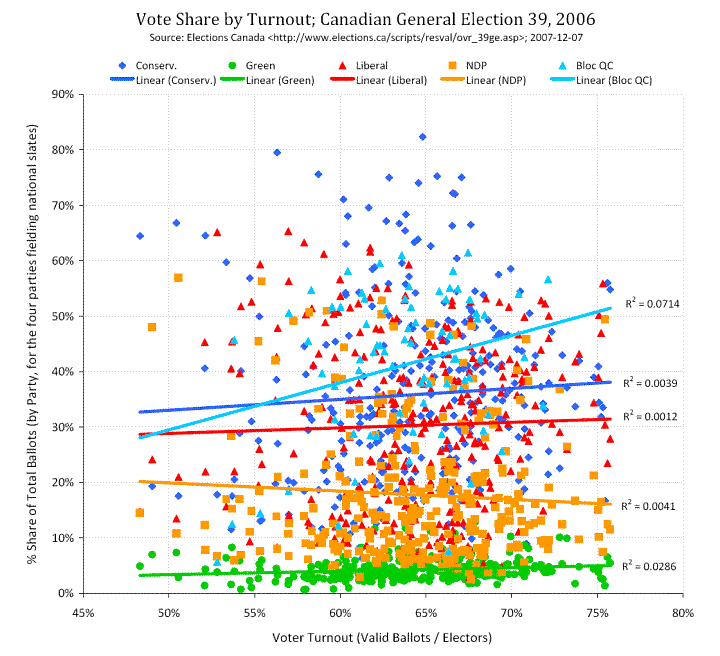
Macrovision continues moving into meta-data
Macrovision, which makes technology that protects videos and music against illegal copying, said on Friday it agreed to buy Gemstar-TV Guide in a cash-and-stock deal worth about $2.8 billion.
Macrovision is betting that a combination of its security software with Gemstar's interactive program guide, technology used by cable and satellite television companies, will allow protected TV shows, films, personal photos, or music to be available on numerous devices beyond the television.
Gemstar-TV Guide shareholders will get $6.35 per share in cash or 0.2548 of a share of common stock in a new holding company that will own both Gemstar-TV Guide and Macrovision.
Macrovision is trying to jump to a different S-curve. The industry transition to digital video formats makes their analog content security system obsolete. The gravy train they were riding all these years is about to run out of space.
They recently bought another meta-data supplier - AMG(?).
Tuesday, December 04, 2007
A new concept from Philips Design
http://www.design.philips.com/probes/projects/tattoo/index.page
The Electronics Tattoo film expresses the visual power of sensitive technology applied to the human body. The film subtly leads the viewer through the simultaneous emotional and aesthetic transformations between two lovers.
via http://centralasian.vox.com
This effect would look really cool in movies, stills, and live picture frames.
Predictions for 2008: A massive data meltdown
http://www.news.com/8301-10784_3-9828570-7.html?tag=nefd.top
"You'll see a massive failure in a year," Bapat said at a dinner with reporters on Monday. "We are going to see a data center failure of that scale."
"That scale" referred to the problems caused by the worm created by Cornell grad student Robert Morris Jr. in 1988. His worm infected about 5 percent of the Unix boxes on the Internet, freaked people out, and helped jump-start the security industry.
On a more cheery note, Bapat and other Sun executives said that the IT industry is also on the verge of a construction boom that, if it happens, will lead to big orders for equipment for makers of servers, storage systems, and other data center equipment.
The typical life span of a data center is only about 10 to 12 years, said the Sun executives. Thus, a lot of those data centers built at the beginning of the dot-com era need to be rebuilt. Other companies like Facebook are expanding rapidly as well. (Sun CTO Greg Papadopoulos mentioned Facebook several times, so it sounds like maybe Sun is working with, or trying to work with, them. Just a thought.)
National labs and universities are also looking at new centers. Next year, one of the national labs has plans to build a data center that will take up 500,000 square feet and consume 50 megawatts. (Big data centers now take up 400,000 square feet and chew up 40 megawatts, Sun executives said.)
Looks like a great opportunity to inject new technologies and/or capture market share from the existing players.
Another angle: solar power. Some of those data centers will be equipped with autonomous power units. http://money.cnn.com/2007/10/03/technology/solar_servers.biz2/
Tuesday, November 20, 2007
Will drones kill helicopters?
September 10, 2007 8:20 AM PDT
http://www.news.com/2300-11397_3-6207078-1.html
On September 7, NASA launched the Ikhana unmanned aerial vehicle (UAV) from Dryden Air Force Base to take a series of smoke-free images from the Lick wildfire near Gilroy, Calif. After sending images of the Lick fire, the drone was flown over Oregon and Washington to observe 10 other fires before returning after a 20-hour mission.
Ikhana, the Choctaw Nation word for "intelligent," is a Predator B unmanned aircraft system which has been refit with scientific instruments. It is being flown out of NASA's Dryden Flight Research Center, Edwards, Calif.
Drones have been extensively tested in various military applications. Now they are finding their way into multiple civilian usage scenarios. My prediction is that they will replace helicopters as high resolution air vehicles: from traffic monitoring to neighborhood policing to forest fired detection to geological research.
Sunday, November 04, 2007
Another sign that PC is losing its relevance:
Smart phones and gaming machines seem to be the next area of growth. The only constraint remaining is service providers desire to restrict access to third party software. Nevertheless, I think in 2008 we'll see major shifts in the industry.
Sunday November 4, 3:23 pm ET
By Hiroko Tabuchi, Associated Press Writer
TOKYO (AP) -- Masaya Igarashi wants $200 headphones for his new iPod Touch, and he's torn between Nintendo Co.'s Wii and Sony's PlayStation 3 game consoles. When he has saved up again, he plans to splurge on a digital camera or flat-screen TV.
There's one conspicuous omission from the college student's shopping list: a new computer.
The PC's role in Japanese homes is diminishing, as its once-awesome monopoly on processing power is encroached by gadgets such as smart phones that act like pocket-size computers, advanced Internet-connected game consoles, and digital video recorders with terabytes of memory.
"A new PC just isn't high on my priority list right now," said Igarashi, who was shopping at a Bic Camera electronics shop in central Tokyo and said his three-year-old desktop was "good for now."
Smart phones and gaming machines seem to be the next area of growth. The only constraint remaining is service providers desire to restrict access to third party software. Nevertheless, I think in 2008 we'll see major shifts in the industry.
Subscribe to:
Posts (Atom)